

Wayground
Ecosystems Review- 7th Grade - Printable ศาสตร์ Worksheets ระดับ 7 - Wayground

Ecosystems Review- 7th Grade

Brittney Christianson

สร้างโดย Brittney Christianson

20 คำถาม

7th ระดับชั้น

ศาสตร์

อัปเดตแล้ว เม.ย. 2569

แบบฝึกหัดวิทยาศาสตร์ชั้น ม.1 นี้ทบทวนการทำงานของระบบนิเวศผ่านความสัมพันธ์ระหว่างปัจจัยทางชีวภาพและปัจจัยทางกายภาพ นักเรียนจะได้ระบุว่าอะไรเป็นตัวกำหนดระบบนิเวศ ถิ่นที่อยู่ และชีวมณฑล แยกแยะปัจจัยทางกายภาพ เช่น อุณหภูมิ ดิน และน้ำ และพิจารณาว่าช่องว่างทางนิเวศวิทยา ส่งผลต่อการแข่งขัน การสูญพันธุ์ และปฏิสัมพันธ์ระหว่างสายพันธุ์อย่างไร แบบฝึกหัด 20 ข้อนี้ประกอบด้วยคำถามแบบเลือกตอบ 15 ข้อ และคำถามเติมคำในช่องว่างแบบถูกหรือผิด 5 ข้อ นอกจากนี้ยังให้นักเรียนจำแนกภาวะพึ่งพาอาศัยกัน ภาวะอิงอาศัย และภาวะปรสิต โดยใช้ตัวอย่างเช่น นกกระจอกเทศและม้าลาย และพยาธิปากขอและมนุษย์ พร้อมทั้งทบทวนการเติบโตของประชากรและปัจจัยต่างๆ เช่น อัตราการเกิดและอัตราการตาย แบบฝึกหัดนี้ออกแบบมาสำหรับการทบทวนวิทยาศาสตร์ชั้น ม.1 และมีเฉลยคำตอบครบถ้วนเพื่อตรวจสอบความเข้าใจและระบุแนวคิดที่ต้องสอนซ้ำ

การตั้งค่าแผ่นงาน

ขนาดตัวอักษร

S
M
L
XL
Waygroundแผ่นงาน

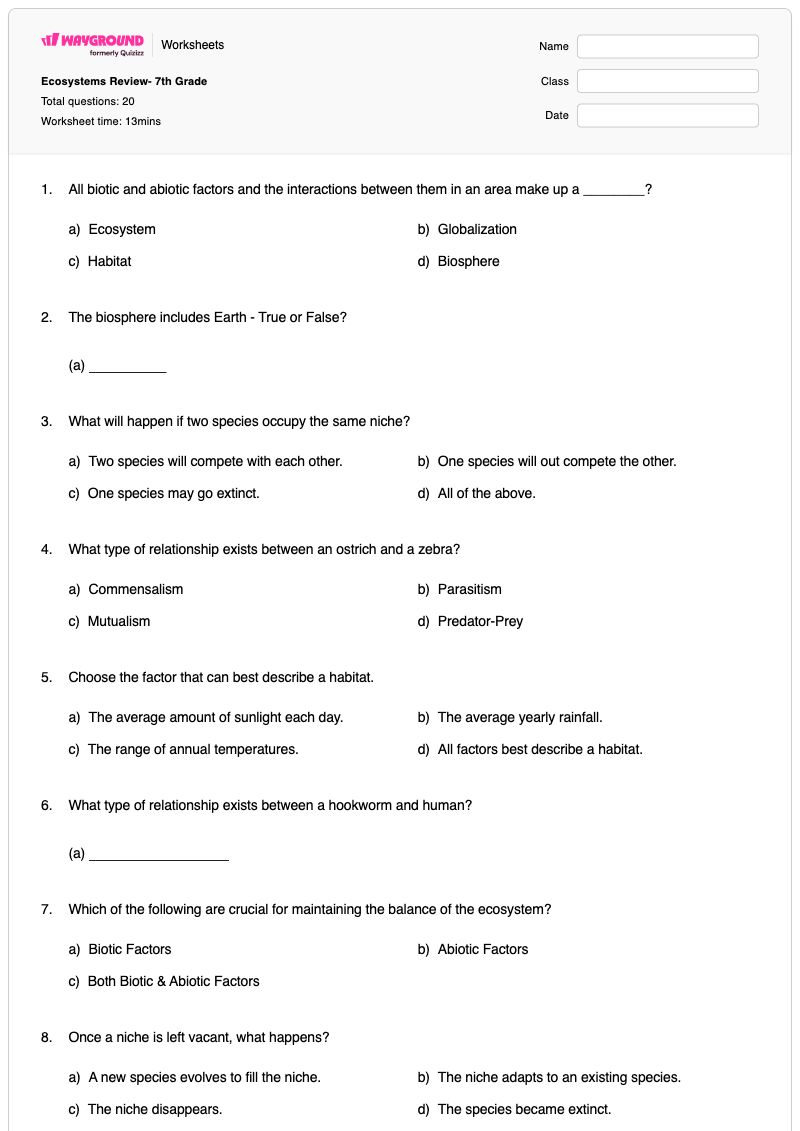
Ecosystems Review- 7th Grade

คำถามทั้งหมด: 20

ชื่อ
ระดับ
วันที่
1.

All biotic and abiotic factors and the interactions between them in an area make up a ​________?

a)

Ecosystem

b)

Globalization

c)

Habitat

d)

Biosphere

2.

The biosphere includes Earth - True or False?

(a)  

3.

What will happen if two species occupy the same niche?

a)

Two species will compete with each other.

b)

One species will out compete the other.

c)

One species may go extinct.

d)

All of the above.

4.

What type of relationship exists between an ostrich and a zebra?

a)

Commensalism

b)

Parasitism

c)

Mutualism

d)

Predator-Prey

5.

Choose the factor that can best describe a habitat.

a)

The average amount of sunlight each day.

b)

The average yearly rainfall.

c)

The range of annual temperatures.

d)

All factors best describe a habitat.

6.

What type of relationship exists between a hookworm and human?

(a)  

7.

Which of the following are crucial for maintaining the balance of the ecosystem?

a)

Biotic Factors

b)

Abiotic Factors

c)

Both Biotic & Abiotic Factors

8.

Once a niche is left vacant, what happens?

a)

A new species evolves to fill the niche.

b)

The niche adapts to an existing species.

c)

The niche disappears.

d)

The species became extinct.

9.

Choose the abiotic factors.

a)

Water, temperature, fungi

b)

Temperature, soil, water

c)

Soil, mold, and fungi

d)

Fungi, water, soil

10.

The human population shows exponential growth- true or false?

(a)  

11.

Which type of symbiotic relationship exists when one species benefits while the other species is not affected?

a)

Mutualism

b)

Commensalism

c)

Parasitism

12.

Parasitism is...

a)

When two organisms interact and one benefits while the other is harmed.

b)

When two organisms interact and one benefits with no harm to the other.

c)

When two organisms interact and it is beneficial for both.

13.

The human population has surpassed 7 Billion - true or false?

(a)  

14.

What type of relationship involves an organism using another for transportation or housing?

a)

Mutualism

b)

Commensalism

c)

Parasitism

d)

All answers are correct.

15.

Choose the factors that affect population growth.

a)

Death & Birth Rates

b)

Bird populations

c)

Housing

d)

Natural Disasters

16.

Symbiosis is...

a)

a type of commensalism

b)

a type of mutualism

c)

a type of parasitism

d)

a relationship between organisms

17.

Two species can fill the same niche - true or false

a)

True

b)

False

18.

Ecosystems can be studied on a small level or large levels. Which level is out of place: species, population, ecosystem, community

(a)  

19.

The flow of energy in an ecosystem refers to

a)

biogeochemical cycles

b)

water cycles

c)

the cycling of nutrients

d)

production and consumption of food

20.

What is a habitat?

a)

A group of animals

b)

Physical area where a species live

c)

Role a species plays in the ecosystem

d)

All of the answers are correct

Waygroundแป้นคำตอบ

Ecosystems Review- 7th Grade

คำถามทั้งหมด: 20

1.
a)

Ecosystem

2.
True, true
3.
d)

All of the above.

4.
c)

Mutualism

5.
d)

All factors best describe a habitat.

6.
parasitism, Parasitism
7.
c)

Both Biotic & Abiotic Factors

8.
a)

A new species evolves to fill the niche.

9.
b)

Temperature, soil, water

10.
true, True
11.
b)

Commensalism

12.
a)

When two organisms interact and one benefits while the other is harmed.

13.
true, True
14.
b)

Commensalism

15.
a)

Death & Birth Rates

16.
d)

a relationship between organisms

17.
b)

False

18.
ecosystem, Ecosystem
19.
d)

production and consumption of food

20.
b)

Physical area where a species live

คำถามที่พบบ่อย

แบบฝึกหัดเรื่องระบบนิเวศสำหรับนักเรียนชั้น ม.1 นี้ครอบคลุมเนื้อหาอะไรบ้าง?

แบบฝึกหัดนี้ประกอบด้วยคำถามแบบเลือกตอบ 15 ข้อ และคำถามเติมคำในช่องว่างแบบถูกหรือผิด 5 ข้อ เพื่อทบทวนโครงสร้างและปฏิสัมพันธ์ของระบบนิเวศ นักเรียนจะได้ระบุปัจจัยทางชีวภาพและปัจจัยทางกายภาพ อธิบายว่าช่องว่างทางนิเวศวิทยาที่ใช้ร่วมกันหรือว่างเปล่าส่งผลกระทบต่อสิ่งมีชีวิตอย่างไร จำแนกภาวะพึ่งพาอาศัยกัน ภาวะอิงอาศัย และภาวะปรสิต และทบทวนปัจจัยการเติบโตของประชากร การทำแบบฝึกหัดช่วยให้นักเรียนเชื่อมโยงคำศัพท์กับตัวอย่างระบบนิเวศที่เป็นรูปธรรม และแยกแยะแนวคิดทางนิเวศวิทยาที่เกี่ยวข้องได้

ฉันจะใช้แบบฝึกหัดนี้ในการสอนเรื่องระบบนิเวศและความสัมพันธ์ระหว่างสิ่งมีชีวิตได้อย่างไร?

เริ่มด้วยการให้นักเรียนจัดเรียงตัวอย่างออกเป็นปัจจัยทางชีวภาพ ปัจจัยทางกายภาพ และปฏิสัมพันธ์ จากนั้นอภิปรายว่าส่วนประกอบเหล่านั้นทำงานร่วมกันอย่างไรในระบบนิเวศ ก่อนที่นักเรียนจะตอบคำถามเกี่ยวกับความสัมพันธ์ ให้เปรียบเทียบสิ่งที่เกิดขึ้นกับแต่ละชนิดในภาวะพึ่งพาอาศัยกัน ภาวะอิงอาศัย และภาวะปรสิต โดยใช้ตัวอย่างนกกระจอกเทศ-ม้าลาย และพยาธิปากขอ-มนุษย์ จบด้วยการใช้คำถามเกี่ยวกับนิเวศวิทยาและการเติบโตของประชากรเป็นหัวข้อในการอภิปรายเกี่ยวกับการแข่งขัน นิเวศวิทยาที่ว่าง และอัตราการเกิดและการตาย

ฉันควรระวังข้อผิดพลาดอะไรบ้างเมื่อนักเรียนทำแบบประเมินระบบนิเวศนี้?

นักเรียนอาจสับสนระหว่างถิ่นที่อยู่กับระบบนิเวศ หรือเลือกเฉพาะปัจจัยสิ่งมีชีวิตเมื่อแบบฝึกหัดถามว่าอะไรที่ช่วยรักษาสมดุลของระบบนิเวศ จึงควรเตือนพวกเขาว่าทั้งปัจจัยทางชีวภาพและปัจจัยทางกายภาพมีส่วนเกี่ยวข้อง นอกจากนี้ พวกเขาอาจสับสนระหว่างความสัมพันธ์แบบพึ่งพาอาศัยกัน โดยเฉพาะอย่างยิ่งภาวะพึ่งพาฝ่ายเดียวและภาวะปรสิต ดังนั้นควรตรวจสอบว่าสิ่งมีชีวิตชนิดใดได้รับอันตราย ไม่ได้รับผลกระทบ หรือได้รับประโยชน์ ในส่วนของช่องว่างทางนิเวศวิทยา ควรสังเกตนักเรียนที่มองข้ามการแข่งขันเมื่อสิ่งมีชีวิตสองชนิดอาศัยอยู่ในช่องว่างทางนิเวศวิทยาเดียวกัน หรือเข้าใจผิดเกี่ยวกับสิ่งที่แบบฝึกหัดระบุว่าเกิดขึ้นเมื่อช่องว่างทางนิเวศวิทยาว่างเปล่า

ฉันจะมอบหมายและให้คะแนนแบบฝึกหัดเรื่องระบบนิเวศนี้ได้อย่างไร?

คุณสามารถมอบหมายแบบฝึกหัดทบทวนระบบนิเวศนี้ในรูปแบบไฟล์ PDF ที่พิมพ์ได้ หรือเป็นแบบทดสอบดิจิทัลบน Wayground แบบฝึกหัดนี้มีเฉลยคำตอบครบถ้วนสำหรับคำถามแบบเลือกตอบ 15 ข้อ และคำถามเติมคำในช่องว่าง 5 ข้อ สำหรับการส่งงานแบบพิมพ์ โปรดสแกนงานของนักเรียนด้วยแอป Wayground for Teachers เพื่อใช้ในการตรวจและให้คะแนน

ฉันจะปรับแบบฝึกหัดเรื่องระบบนิเวศนี้ให้เหมาะสมกับนักเรียนของฉันได้อย่างไร?

ใช้การตั้งค่าขั้นสูงของแบบฝึกหัดเพื่อปรับระยะห่างระหว่างตัวอักษรหรือเลือกขนาดตัวอักษรที่ใหญ่ขึ้น เพื่อให้คำศัพท์เกี่ยวกับระบบนิเวศ ตัวเลือกคำตอบ และคำถามแบบถูกหรือผิดอ่านง่ายขึ้น นอกจากนี้ คุณยังสามารถเปิดใช้งานแบบอักษรที่เหมาะสำหรับผู้ที่มีภาวะดิสเล็กเซีย หรือแปลแบบฝึกหัดเป็นภาษาอื่นเมื่อเหมาะสม ตัวเลือกเหล่านี้จะช่วยให้ข้อสอบแบบเลือกตอบเกี่ยวกับนิเวศวิทยาและความสัมพันธ์แบบพึ่งพาอาศัยกันเข้าถึงได้ง่ายขึ้นโดยไม่เปลี่ยนแปลงทักษะที่ประเมิน

ฉันจะหาแบบฝึกหัดแบบนี้เพิ่มเติมได้ที่ไหนบน Wayground?

Wayground มีแบบฝึกหัดและโจทย์ฝึกหัดมากมายให้ดาวน์โหลดฟรีในหลากหลายวิชา พร้อมไฟล์ PDF และเฉลยคำตอบ เพื่อช่วยให้นักเรียนพัฒนาทักษะและความเข้าใจในแนวคิดที่สำคัญ ดูแหล่งข้อมูลเพิ่มเติมได้ที่ https://wayground.com/en-us/worksheets