

Wayground
2.1 Osmosis Video - Printable ศาสตร์ Worksheets ระดับ 8 - Wayground

2.1 Osmosis Video

Celeste Hettinger

By Celeste Hettinger

19 คำถาม

8th - 8th ระดับชั้น

ศาสตร์

174 เล่น

อัปเดตแล้ว พ.ค. 2568

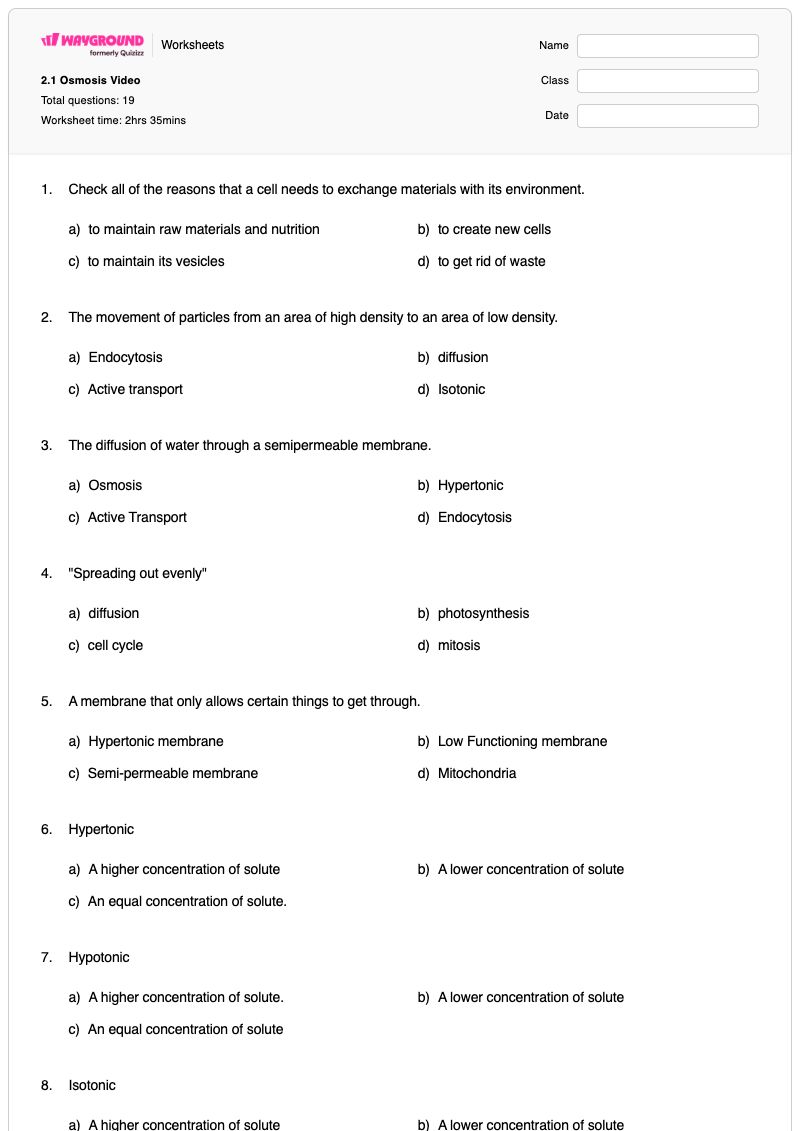
2.1 วิดีโอเรื่องออสโมซิส เป็นแบบฝึกหัดวิทยาศาสตร์สำหรับนักเรียนชั้น ม.2 ที่สามารถพิมพ์ได้ฟรี ซึ่งทบทวนกระบวนการแลกเปลี่ยนสารระหว่างเซลล์กับสิ่งแวดล้อม แบบฝึกหัดนี้มีทั้งหมด 19 ข้อ ประกอบด้วยคำถามแบบเลือกตอบ 4 ข้อ และคำถามแบบปรนัย 15 ข้อ ครอบคลุมหัวข้อต่างๆ เช่น เหตุใดเซลล์จึงแลกเปลี่ยนสาร การแพร่ ออสโมซิส เยื่อกั้นแบบกึ่งซึมผ่านได้ สภาวะไฮเปอร์โทนิก ไฮโปโทนิก และไอโซโทนิก การขนส่งแบบแอคทีฟและพาสซีฟ เอนโดไซโทซิส เอ็กโซไซโทซิส และความหมายของคำว่า endo, exo และ cyto นักเรียนจะได้ระบุคำจำกัดความและแยกแยะกระบวนการขนส่งภายในเซลล์ที่เกี่ยวข้อง รวมถึงว่าการเคลื่อนที่ต้องใช้พลังงานหรือไม่ และเซลล์นำสารเข้ามาหรือผลักสารออกไป แบบฝึกหัดนี้เหมาะสำหรับการแนะนำหรือเสริมสร้างคำศัพท์เกี่ยวกับการขนส่งภายในเซลล์ การตรวจสอบความเข้าใจของนักเรียนหลังการสอน หรือการทบทวนคำศัพท์สำคัญก่อนการประเมินผลที่ใหญ่กว่า แบบฝึกหัดนี้มีเฉลยคำตอบที่สมบูรณ์เพื่อการตรวจสอบและตรวจให้คะแนนอย่างมีประสิทธิภาพ

การตั้งค่าแผ่นงาน

ขนาดตัวอักษร

S
M
L
XL
Waygroundแผ่นงาน

2.1 Osmosis Video

คำถามทั้งหมด: 19

ชื่อ
ระดับ
วันที่
1.

Check all of the reasons that a cell needs to exchange materials with its environment.

a)

to maintain raw materials and nutrition

b)

to create new cells

c)

to maintain its vesicles

d)

to get rid of waste

2.

The movement of particles from an area of high density to an area of low density.

a)

Endocytosis

b)

diffusion

c)

Active transport

d)

Isotonic

3.

The diffusion of water through a semipermeable membrane.

a)

Osmosis

b)

Hypertonic

c)

Active Transport

d)

Endocytosis

4.

"Spreading out evenly"

a)

diffusion

b)

photosynthesis

c)

cell cycle

d)

mitosis

5.

A membrane that only allows certain things to get through.

a)

Hypertonic membrane

b)

Low Functioning membrane

c)

Semi-permeable membrane

d)

Mitochondria

6.

Hypertonic

a)

A higher concentration of solute

b)

A lower concentration of solute

c)

An equal concentration of solute.

7.

Hypotonic

a)

A higher concentration of solute.

b)

A lower concentration of solute

c)

An equal concentration of solute

8.

Isotonic

a)

A higher concentration of solute

b)

A lower concentration of solute

c)

An equal concentration of solute

9.

The material passes through the cell membrane and the cell uses energy.

a)

Active Transport

b)

Passive Transport

c)

Endocytosis

10.

The material passes through the cell membrane without using energy.

a)

Active Transport

b)

Passive Transport

c)

Endocytosis

11.

The cell surrounds and brings an item in.

a)

passive transport

b)

exocytosis

c)

Endocytosis

d)

active transport

12.

A cell pushes an item out.

a)

exocytosis

b)

endocytosis

c)

active transport

d)

passive transport

13.

Which means "in" or "inside"

a)

endo

b)

exo

c)

cyto

14.

Which means "out" or "outside"

a)

endo

b)

exo

c)

cyto

15.

Which means "cell"

a)

endo

b)

exo

c)

cyto

16.

Check all that apply to Endocytosis

a)

First the cell membrane wraps around the particle.

b)

Second the cell forms a vesicle around the particle.

c)

Third the cell brings the particle into itself.

d)

Fourth, the cell bakes a cake.

17.

Choose all of the steps of Exocytosis.

a)

Step #1 Waste is packed in a vesicle.

b)

Step #2 The vesicle moves to the cell membrane and fuses with it.

c)

Step #3 The cell membrane opens and releases the waste.

d)

Step #4. The cell trash truck comes and picks it up every Friday at 7 am.

18.

What is a channel in a cell membrane?

a)

A hole in the cell membrane made by a protein.

b)

A protein in the cell membrane made by a hole.

19.

What are the objectives for this section?

a)

Explain the process of diffusion.

b)

Describe how osmosis occurs.

c)

Comparing passive transport with active transport

d)

Explain how large particles get into and out of cells.

Waygroundแป้นคำตอบ

2.1 Osmosis Video

คำถามทั้งหมด: 19

1.
a)

to maintain raw materials and nutrition

, d)

to get rid of waste

2.
b)

diffusion

3.
a)

Osmosis

4.
a)

diffusion

5.
c)

Semi-permeable membrane

6.
a)

A higher concentration of solute

7.
b)

A lower concentration of solute

8.
c)

An equal concentration of solute

9.
a)

Active Transport

10.
b)

Passive Transport

11.
c)

Endocytosis

12.
a)

exocytosis

13.
a)

endo

14.
b)

exo

15.
c)

cyto

16.
a)

First the cell membrane wraps around the particle.

, b)

Second the cell forms a vesicle around the particle.

, c)

Third the cell brings the particle into itself.

17.
a)

Step #1 Waste is packed in a vesicle.

, b)

Step #2 The vesicle moves to the cell membrane and fuses with it.

, c)

Step #3 The cell membrane opens and releases the waste.

18.
a)

A hole in the cell membrane made by a protein.

19.
a)

Explain the process of diffusion.

, b)

Describe how osmosis occurs.

, c)

Comparing passive transport with active transport

, d)

Explain how large particles get into and out of cells.

คำถามที่พบบ่อย

แบบฝึกหัดวิดีโอเรื่องออสโมซิส หัวข้อ 2.1 ครอบคลุมเนื้อหาอะไรบ้าง?

แบบฝึกหัดวิทยาศาสตร์สำหรับนักเรียนชั้น ม.2 นี้ ช่วยเสริมสร้างความเข้าใจเกี่ยวกับวิธีการแลกเปลี่ยนสารภายในเซลล์ โดยใช้คำถามแบบเลือกตอบ 4 ข้อ และคำถามแบบปรนัย 15 ข้อ นักเรียนจะได้แยกแยะความแตกต่างระหว่างการแพร่และการออสโมซิส ระบุเยื่อกั้นแบบกึ่งซึมผ่านได้ และสภาวะไฮเปอร์โทนิก ไฮโปโทนิก และไอโซโทนิก จำแนกการขนส่งเป็นแบบแอคทีฟหรือแบบพาสซีฟ และแยกแยะความแตกต่างระหว่างเอนโดไซโทซิสและเอ็กโซไซโทซิส

ฉันจะใช้แบบฝึกหัดนี้ในการสอนเรื่องการลำเลียงสารภายในเซลล์ได้อย่างไร?

เริ่มแบบฝึกหัดโดยทบทวนว่าทำไมเซลล์จึงแลกเปลี่ยนสาร จากนั้นให้นักเรียนนิยามคำว่า การแพร่ การออสโมซิส และเยื่อกั้นแบบกึ่งซึมผ่านได้ ใช้คำถามเกี่ยวกับความเข้มข้นของสารละลายเพื่อเปรียบเทียบความเข้มข้นของสารละลายที่สูงกว่า ต่ำกว่า และเท่ากัน ก่อนที่นักเรียนจะนำความแตกต่างระหว่างการขนส่งแบบแอคทีฟและแบบพาสซีฟ รวมถึงเอนโดไซโทซิสและเอ็กโซไซโทซิสมาใช้ ถามนักเรียนว่าทำไมแต่ละคำที่เลือกจึงตรงกับนิยาม โดยเฉพาะอย่างยิ่งในข้อที่เลือกหลายข้อเกี่ยวกับความต้องการในการแลกเปลี่ยนสารของเซลล์

ฉันควรระวังข้อผิดพลาดอะไรบ้างเมื่อนักเรียนทำแบบฝึกหัดเรื่องออสโมซิสนี้?

นักเรียนอาจเลือกอธิบายการสร้างเซลล์ใหม่หรือการบำรุงรักษาเวสิเคิลแทนที่จะระบุว่าการได้รับวัตถุดิบและสารอาหารและการกำจัดของเสียเป็นเหตุผลที่เซลล์แลกเปลี่ยนสาร นอกจากนี้ พวกเขาอาจสับสนระหว่างการแพร่กับการออสโมซิส มองว่าการขนส่งผ่านเยื่อหุ้มเซลล์ทั้งหมดต้องใช้พลังงาน หรือสลับกันระหว่างเอนโดไซโทซิสและเอ็กโซไซโทซิส โปรดระวังความสับสนระหว่างสารละลายไฮเปอร์โทนิก ไฮโปโทนิก และไอโซโทนิก ซึ่งในแบบฝึกหัดได้แยกแยะความแตกต่างไว้แล้วโดยใช้ความเข้มข้นของสารละลายที่สูงกว่า ต่ำกว่า และเท่ากัน

ฉันจะมอบหมายและให้คะแนนแบบฝึกหัดการลำเลียงเซลล์นี้ได้อย่างไร?

แบบฝึกหัดนี้มีให้ดาวน์โหลดเป็นไฟล์ PDF สำหรับพิมพ์ และเป็นแบบทดสอบดิจิทัลบน Wayground โดยมีเฉลยคำตอบครบถ้วนสำหรับทั้ง 19 ข้อ สำหรับการส่งงานแบบพิมพ์ คุณสามารถสแกนงานของนักเรียนด้วยแอป Wayground for Teachers เพื่อใช้ในการตรวจให้คะแนนได้

ฉันจะปรับแบบฝึกหัดนี้ให้เหมาะสมกับนักเรียนของฉันได้อย่างไร?

ใช้การตั้งค่าขั้นสูงของแบบฝึกหัดเพื่อปรับระยะห่างระหว่างตัวอักษร หรือเลือกขนาดตัวอักษรที่ใหญ่ขึ้น เพื่อให้คำจำกัดความของการแพร่ การออสโมซิส และการขนส่งอ่านง่ายขึ้น นอกจากนี้ คุณยังสามารถใช้แบบอักษรที่เหมาะสำหรับผู้ที่มีภาวะดิสเล็กเซีย หรือแปลแบบฝึกหัดเป็นภาษาอื่นโดยยังคงรูปแบบคำถามแบบปรนัยและเลือกหลายข้อเอาไว้ได้

ฉันจะหาแบบฝึกหัดแบบนี้เพิ่มเติมได้ที่ไหนบน Wayground?

Wayground มีแบบฝึกหัดและโจทย์ฝึกหัดมากมายให้ดาวน์โหลดฟรีในหลากหลายวิชา พร้อมไฟล์ PDF และเฉลยคำตอบ เพื่อช่วยให้นักเรียนพัฒนาทักษะและความเข้าใจในแนวคิดสำคัญๆ ดูแหล่งข้อมูลเพิ่มเติมได้ที่ https://wayground.com/en-us/worksheets