

Wayground
Scramble for Africa - Printable สังคมศึกษา Worksheets 6th ระดับชั้น - Wayground

Scramble for Africa

R Sullivan

สร้างโดย R Sullivan

19 คำถาม

6th ระดับชั้น

สังคมศึกษา

อัปเดตแล้ว เม.ย. 2569

แบบฝึกหัดวิชาสังคมศึกษา ชั้นประถมศึกษาปีที่ 6 เรื่อง "การแย่งชิงแอฟริกา" ช่วยให้นักเรียนได้ศึกษาเกี่ยวกับลัทธิจักรวรรดินิยมและการแบ่งแยกแอฟริกาโดยชาวยุโรป นักเรียนจะได้ระบุเหตุการณ์ทางประวัติศาสตร์ที่แสดงในภาพการ์ตูนการเมือง นิยามลัทธิจักรวรรดินิยม ระบุช่วงเวลาที่ลัทธิจักรวรรดินิยมเกิดขึ้นหลังจากการล่าอาณานิคมในโลกใหม่ในช่วงปี 1800 และอธิบายว่าการตั้งถิ่นฐานของชาวยุโรป เทคโนโลยีทางการทหาร ความสนใจทางเศรษฐกิจในวัตถุดิบ การแข่งขันเพื่อแย่งชิงที่ดินและอำนาจ และทฤษฎีวิวัฒนาการทางสังคม (Social Darwinism) มีส่วนในการขยายอาณานิคมอย่างไร แบบฝึกหัดนี้ประกอบด้วยคำถาม 19 ข้อ: คำถามเติมคำในช่องว่าง 1 ข้อ และคำถามแบบเลือกตอบ 18 ข้อ นักเรียนจะได้ทบทวนการประชุมในปี 1884 ที่แบ่งแอฟริกาให้กับประเทศในยุโรป ตระหนักว่าประเทศในแอฟริกาไม่ได้รับเชิญ และไม่ได้พิจารณาเขตแดนของชนเผ่า และตีความแผนที่การแบ่งแยกดินแดนในช่วงปี 1914 โดยระบุสีของดินแดนอังกฤษและฝรั่งเศส และตัวเลขที่แสดงถึงดินแดนของเยอรมนี แบบฝึกหัดที่พิมพ์ได้ฟรีนี้มีเฉลยคำตอบครบถ้วนเพื่อการทบทวนและประเมินผลอย่างมีประสิทธิภาพ

การตั้งค่าแผ่นงาน

ขนาดตัวอักษร

S
M
L
XL
Waygroundแผ่นงาน

Scramble for Africa

คำถามทั้งหมด: 19

ชื่อ
ระดับ
วันที่
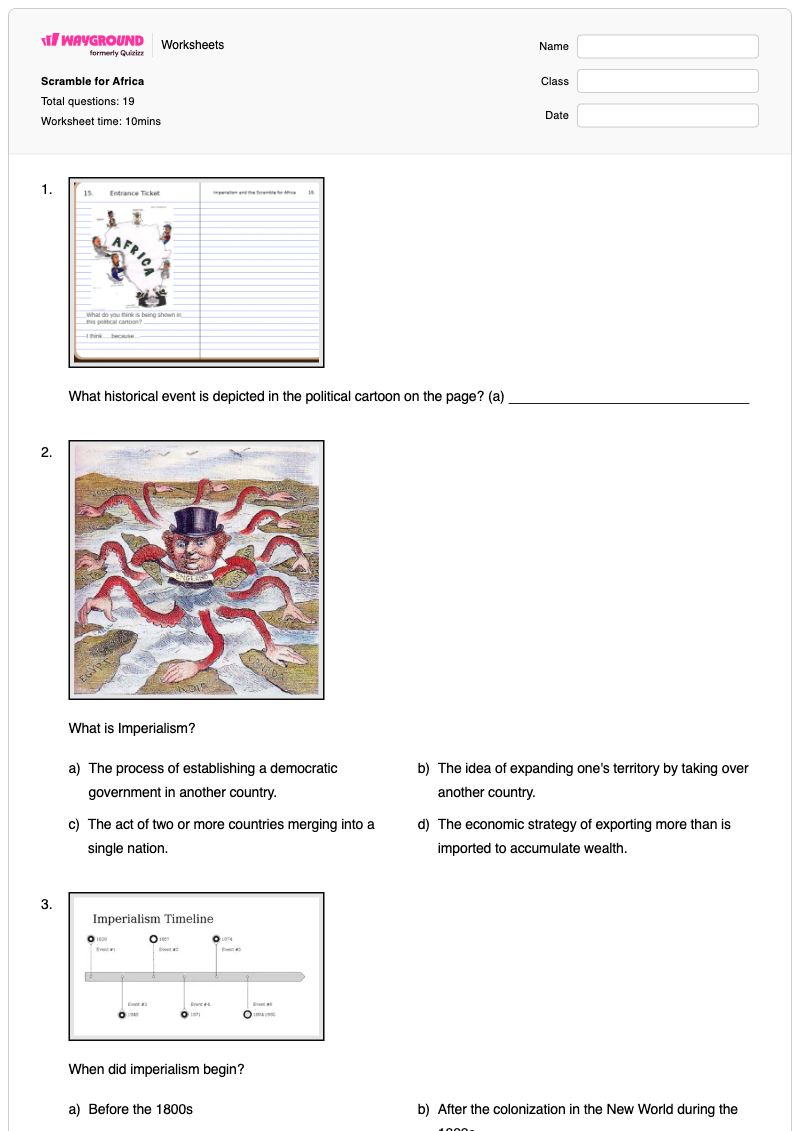
1.
What historical event is depicted in the political cartoon on the page?

What historical event is depicted in the political cartoon on the page? (a)  

2.
What is Imperialism?

What is Imperialism?

a)

The process of establishing a democratic government in another country.

b)

The idea of expanding one's territory by taking over another country.

c)

The act of two or more countries merging into a single nation.

d)

The economic strategy of exporting more than is imported to accumulate wealth.

3.
When did imperialism begin?

When did imperialism begin?

a)

Before the 1800s

b)

After the colonization in the New World during the 1800s

c)

During the 1600s

d)

In the 20th century

4.

What did European countries do after they began taking lands?

a)

Left the land as it was

b)

Only explored the land without settling

c)

Began to add settlements in the areas and to colonize

d)

Immediately sold the land to other countries

5.

For how long did Europeans and Africans trade with each other before Europeans began to take control?

a)

Several centuries

b)

50 years

c)

10 years

d)

1000 years

6.
What allowed Europeans to begin taking control in their trade with Africans?

What allowed Europeans to begin taking control in their trade with Africans?

a)

Cultural exchanges

b)

Advanced education

c)

Powerful weapons and ships

d)

Agricultural advances

7.
Why did Europeans want raw materials from other regions?

Why did Europeans want raw materials from other regions?

a)

To increase their military power

b)

To improve their cultural influence

c)

For their economy

d)

To improve their educational systems

8.

What was one of the reasons that made European countries very competitive during the colonial era?

a)

The belief in having more land for agriculture

b)

The belief that more land meant more power

c)

The desire to spread their language

d)

The need for new technology

9.

What was the European perspective of Africans according to the concept of Social Darwinism?

a)

Europeans considered Africans as equal trading partners.

b)

Europeans thought they were better than Africans.

c)

Europeans saw Africans as potential allies.

d)

Europeans believed Africans were more technologically advanced.

10.

When did the meeting to divide Africa among European countries take place?

a)

1884

b)

1901

c)

1865

d)

1914

11.

Were African Nations invited to the meeting where Africa was divided among European countries?

a)

Yes, all African Nations were invited

b)

Only some African Nations were invited

c)

No, African Nations were not invited

d)

The text does not specify

12.

Did the division of Africa take into account tribal boundaries?

a)

Yes, it was based on tribal boundaries

b)

No, it did not take into account tribal boundaries

c)

Tribal boundaries were partially considered

d)

The text does not specify

13.
What color represents the British territories on the map of the Partition of Africa around 1914?

What color represents the British territories on the map of the Partition of Africa around 1914?

a)

Red

b)

Blue

c)

Green

d)

Yellow

14.
What color is used to indicate French territories on the map of the Partition of Africa circa 1914?

What color is used to indicate French territories on the map of the Partition of Africa circa 1914?

a)

Pink

b)

Blue

c)

Green

d)

Yellow

15.
What number corresponds to the German territories on the map of the Partition of Africa around 1914?

What number corresponds to the German territories on the map of the Partition of Africa around 1914?

a)

4

b)

5

c)

7

d)

8

16.
On the map of the Partition of Africa around 1914, what color indicates the independent regions?

On the map of the Partition of Africa around 1914, what color indicates the independent regions?

a)

Grey

b)

Purple

c)

Light Blue

d)

Yellow

17.

What is one of the positive impacts mentioned?

a)

Improvements in agricultural techniques

b)

Better technology, transportation, and healthcare

c)

Increase in cultural diversity

d)

Improvement of global communication

18.

What was one of the negative impacts on native peoples?

a)

Improved economic stability

b)

Native peoples lost their culture, religion, and language

c)

Better access to education

d)

Increased employment opportunities

19.

What is one of the persistent problems in Africa mentioned in the material?

a)

Economic prosperity due to natural resources

b)

Persistent problems in Africa due to how boundaries were placed

c)

Rapid technological advancement

d)

Decrease in ethnic conflicts

Waygroundแป้นคำตอบ

Scramble for Africa

คำถามทั้งหมด: 19

1.
Scramble For Africa
2.
b)

The idea of expanding one's territory by taking over another country.

3.
b)

After the colonization in the New World during the 1800s

4.
c)

Began to add settlements in the areas and to colonize

5.
a)

Several centuries

6.
c)

Powerful weapons and ships

7.
c)

For their economy

8.
b)

The belief that more land meant more power

9.
b)

Europeans thought they were better than Africans.

10.
a)

1884

11.
c)

No, African Nations were not invited

12.
b)

No, it did not take into account tribal boundaries

13.
a)

Red

14.
b)

Blue

15.
d)

8

16.
a)

Grey

17.
b)

Better technology, transportation, and healthcare

18.
b)

Native peoples lost their culture, religion, and language

19.
b)

Persistent problems in Africa due to how boundaries were placed

คำถามที่พบบ่อย

แบบฝึกหัดเรื่องการแย่งชิงแอฟริกาครอบคลุมเนื้อหาอะไรบ้าง และช่วยให้นักเรียนเรียนรู้เกี่ยวกับลัทธิจักรวรรดินิยมได้อย่างไร?

แบบฝึกหัดวิชาสังคมศึกษา ชั้นประถมศึกษาปีที่ 6 นี้ ประกอบด้วยคำถามแบบเติมคำในช่องว่าง 1 ข้อ และคำถามแบบเลือกตอบ 18 ข้อ เพื่อสร้างความเข้าใจเกี่ยวกับจักรวรรดินิยมของยุโรปและการแบ่งแยกทวีปแอฟริกา นักเรียนจะได้เชื่อมโยงจักรวรรดินิยมกับการขยายดินแดน การตั้งถิ่นฐาน ผลประโยชน์ด้านวัตถุดิบ อาวุธและเรือรบที่มีประสิทธิภาพ การแข่งขันเพื่อแย่งชิงดินแดนและอำนาจ และทฤษฎีวิวัฒนาการทางสังคม จากนั้นจึงนำแนวคิดเหล่านั้นไปประยุกต์ใช้กับการแบ่งแยกทวีปแอฟริกาในปี 1884 และแผนที่ดินแดนอาณานิคมในช่วงประมาณปี 1914

ฉันจะใช้แบบฝึกหัดเรื่องการแย่งชิงแอฟริกา (Scramble for Africa) นี้ในการสอนเรื่องจักรวรรดินิยมและการแบ่งแยกแอฟริกาได้อย่างไร?

เริ่มแบบฝึกหัดโดยให้นักเรียนนิยามคำว่าจักรวรรดินิยมและระบุเหตุการณ์ที่แสดงในภาพการ์ตูนการเมืองก่อน จากนั้นจึงอภิปรายว่าทำไมประเทศในยุโรปจึงแสวงหาวัตถุดิบและดินแดนเพิ่มเติม ในขณะที่นักเรียนทำแบบฝึกหัดแบบเลือกตอบ ให้หยุดพักเพื่อเชื่อมโยงความได้เปรียบทางทหารของยุโรปและทฤษฎีวิวัฒนาการทางสังคมเข้ากับการแบ่งแยกแอฟริกาในปี 1884 จากนั้นใช้คำถามแผนที่สุดท้ายเพื่ออภิปรายว่าสีและหมายเลขกำกับแสดงถึงดินแดนอาณานิคมอย่างไร

ฉันควรสังเกตข้อผิดพลาดอะไรบ้างเมื่อนักเรียนทำแบบฝึกหัดเรื่องการแย่งชิงแอฟริกา?

นักเรียนอาจสับสนระหว่างลัทธิจักรวรรดินิยมกับระบอบประชาธิปไตย การสำรวจ หรือการรวมประเทศ ดังนั้นควรตรวจสอบให้แน่ใจว่าพวกเขาเข้าใจว่ามันคือการขยายอาณาเขตโดยการเข้ายึดครองประเทศอื่น นอกจากนี้ พวกเขาอาจเลือกวันที่ที่ช้ากว่าปี 1884 สมมติว่าประเทศในแอฟริกาได้รับเชิญเข้าร่วมการประชุมแบ่งแยกดินแดน หรือมองข้ามไปว่าไม่ได้พิจารณาเขตแดนของชนเผ่า ในระหว่างการเรียนรู้เรื่องแผนที่ ควรตรวจสอบว่านักเรียนแยกแยะสีแดงของอังกฤษ สีน้ำเงินของฝรั่งเศส และหมายเลข 8 สำหรับดินแดนของเยอรมนีได้หรือไม่

ฉันจะมอบหมายและตรวจงานแบบฝึกหัด "การแย่งชิงแอฟริกา" ได้อย่างไร?

คุณสามารถมอบหมายแบบฝึกหัดนี้เป็นไฟล์ PDF ที่พิมพ์ได้ หรือเป็นแบบทดสอบดิจิทัลบน Wayground แบบฝึกหัดนี้มีเฉลยคำตอบครบถ้วนสำหรับตรวจสอบคำตอบแบบเติมคำในช่องว่างและคำตอบแบบเลือกตอบ และสามารถตรวจงานส่งของนักเรียนได้โดยการสแกนงานของนักเรียนด้วยแอป Wayground for Teachers รูปแบบที่พิมพ์ได้ยังช่วยให้โรงเรียนมีทางเลือกในการลดเวลาการใช้หน้าจออีกด้วย

ฉันจะปรับแบบฝึกหัดเรื่องการแย่งชิงแอฟริกาให้เหมาะสมกับนักเรียนแต่ละคนได้อย่างไร?

ใช้การตั้งค่าขั้นสูงของแบบฝึกหัดเพื่อปรับระยะห่างระหว่างตัวอักษร หรือเลือกขนาดตัวอักษรที่ใหญ่ขึ้น เพื่อให้นักเรียนสามารถอ่านคำถามเกี่ยวกับประวัติศาสตร์และคำแนะนำในการระบุตำแหน่งบนแผนที่ได้อย่างสะดวกสบายยิ่งขึ้น นอกจากนี้ คุณยังสามารถเลือกแบบอักษรที่เหมาะสำหรับผู้ที่มีภาวะดิสเล็กเซีย หรือแปลแบบฝึกหัดเป็นภาษาอื่นได้ โดยยังคงเนื้อหาแบบเติมคำในช่องว่างและแบบเลือกตอบไว้เหมือนเดิม

ฉันจะหาแบบฝึกหัดแบบนี้เพิ่มเติมได้ที่ไหนบน Wayground?

Wayground นำเสนอชุดแบบฝึกหัดและโจทย์ฝึกหัดฟรีที่ครอบคลุมหลากหลายวิชา พร้อมไฟล์ PDF และเฉลยคำตอบ เพื่อสนับสนุนทักษะและแนวคิดที่สำคัญ ดูแหล่งข้อมูลเพิ่มเติมได้ที่ https://wayground.com/en-us/worksheets