
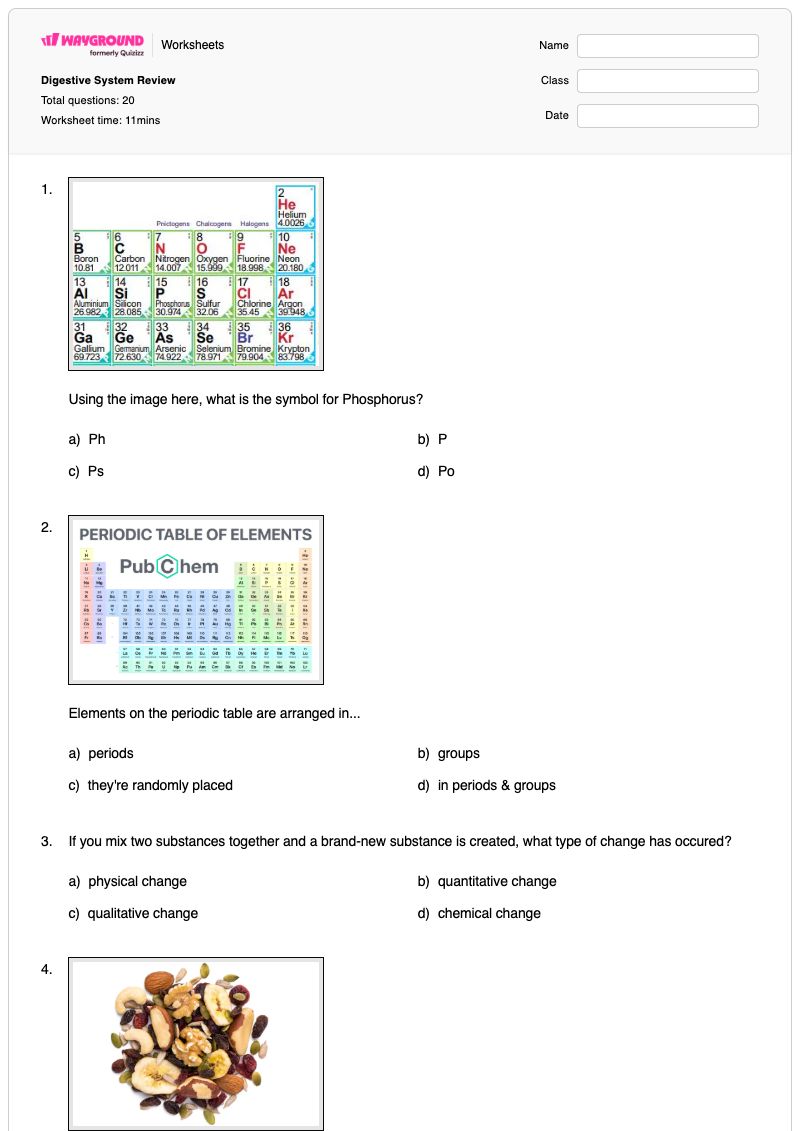

Using the image here, what is the symbol for Phosphorus?
a)
Ph
b)
P
c)
Ps
d)
Po
2.
Elements on the periodic table are arranged in...
a)
periods
b)
groups
c)
they're randomly placed
d)
in periods & groups
3.
If you mix two substances together and a brand-new substance is created, what type of change has occured?
a)
physical change
b)
quantitative change
c)
qualitative change
d)
chemical change
4.
If I combine many substances together, but could later easily seperate them, what have I made?
a)
mixture
b)
compound
c)
element
d)
atom
5.
True or False: Origami (paper folding) is an example of a physical change.
a)
True
b)
False
6.
True or False: Digestion is an example of physical change.
a)
True
b)
False
7.
Fill in the blank:
cell, tissue, organ, _________, organism
a)
stomach
b)
element
c)
compound
d)
organ system
8.
After food leaves the esophagus, it enters the stomach. From here, it will enter the _____ and then the _______. (Select two.)
a)
Liver
b)
Small intestine
c)
Gallbladder
d)
Large intestine
9.
The liver produces a digestive enzyme that breaks down fats in the small intestine. What is this enzyme called?
a)
mucus
b)
hydrochloric acid
c)
bile
d)
saliva
10.
What substance coats the inside of the stomach to protect it from its own acid?
a)
mucus
b)
hydrochloric acid
c)
bile
d)
saliva
11.
Where does digestion begin?
a)
mouth
b)
esophagus
c)
stomach
d)
small intesine
12.
Where does excess water get absorbed from undigested food?
a)
esophagus
b)
stomach
c)
small intestine
d)
large intestine
13.
The majority of digestion and absorption occurs here. Name this organ.
(a)
14.
Your teeth rip and tear your food into smaller pieces. This is an example of what type of digestion?
a)
physical digestion
b)
chemical digestion
15.
Bile from the liver breaks down fats in the food that you eat. Is this an example of physical or chemical digestion?
a)
physical digestion
b)
chemical digestion
16.
Amylase is an enzyme found in our saliva. Amylase changes starch into...
a)
glucose
b)
salt
c)
iron
d)
starch
17.
An _______ is a chemical that changes color when in the presence of a certain substance. (Example: Iodine changes to black when in the presence of starch.)
a)
acid
b)
base
c)
neutral
d)
indicator
18.
A substance has a pH level of 4. What is this substance?
a)
acid
b)
neutral
c)
base
19.
A substance has a pH of 12. What is this substance?
a)
acid
b)
neutral
c)
base
20.
A substance has a pH of 7. What is this substance?