
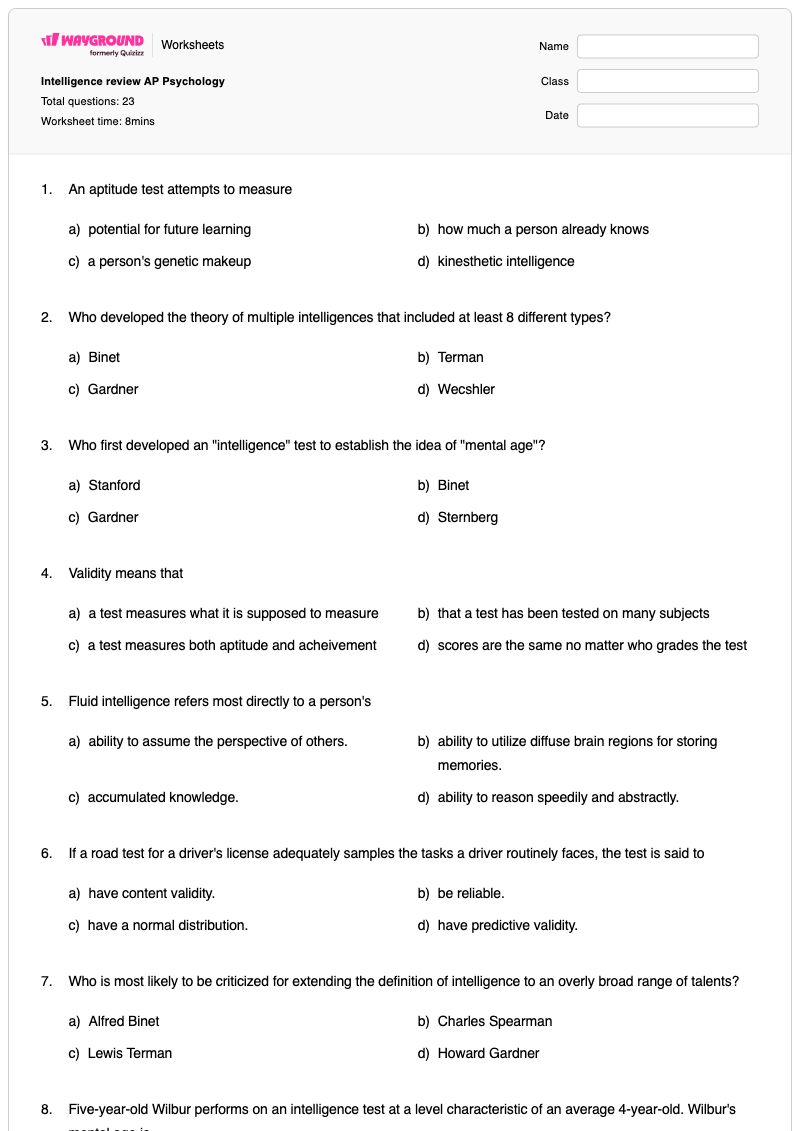

Who developed the theory of multiple intelligences that included at least 8 different types?
a)
Binet
b)
Terman
c)
Gardner
d)
Wecshler
3.
Who first developed an "intelligence" test to establish the idea of "mental age"?
a)
Stanford
b)
Binet
c)
Gardner
d)
Sternberg
4.
Validity means that
a)
a test measures what it is supposed to measure
b)
that a test has been tested on many subjects
c)
a test measures both aptitude and acheivement
d)
scores are the same no matter who grades the test
5.
Fluid intelligence refers most directly to a person's
a)
ability to assume the perspective of others.
b)
ability to utilize diffuse brain regions for storing memories.
c)
accumulated knowledge.
d)
ability to reason speedily and abstractly.
6.
If a road test for a driver's license adequately samples the tasks a driver routinely faces, the test is said to
a)
have content validity.
b)
be reliable.
c)
have a normal distribution.
d)
have predictive validity.
7.
Who is most likely to be criticized for extending the definition of intelligence to an overly broad range of talents?
a)
Alfred Binet
b)
Charles Spearman
c)
Lewis Terman
d)
Howard Gardner
8.
Five-year-old Wilbur performs on an intelligence test at a level characteristic of an average 4-year-old. Wilbur's mental age is
a)
4
b)
4.5
c)
5
d)
125
9.
If a test is standardized, this means that
a)
it accurately measures what it is intended to measure.
b)
most test scores will cluster near the average.
c)
the test will yield consistent results when administered on different occasions.
d)
a person's test performance can be compared with that of a representative pretested group.
10.
Factor analysis is a statistical procedure used to:
a)
derive IQ scores by comparing mental age with chronological age
b)
evaluate how accurately test items predict a criterion behavior.
c)
identify clusters of closely related test items.
d)
provide a quantitative estimate of heritability.
11.
Which of the following is NOT a part of Sternberg's intelligence theory?
a)
practical
b)
analytic
c)
interpersonal
d)
creative
12.
When a person's test performance can be compared with that of a representative and pretested sample of people, the test is said to be
a)
reliable
b)
standardized
c)
valid
d)
normally distributed
13.
The most commonly used individual intelligence test is
a)
ASVAB
b)
Stanford-Binet
c)
Jensen culture free assessment
d)
Wechsler Intelligence Scales
14.
Psychological tests must have two characteristics and they are:
a)
valid and reliable
b)
correlation and validity
c)
reliability and foundation
d)
reliability and correlation
15.
Although Nicole scored well above average on the SAT, she frequently loses her temper and needlessly antagonizes even her best friends. Her behavior best illustrates a low level of:
a)
convergent thinking
b)
validity
c)
mental age
d)
emotional intelligence
16.
Those who score above average on tests of mathematical aptitude are also likely to score above average on tests of verbal aptitude. According to Spearman, this best illustrates the importance of:
a)
predictive validity
b)
factor analysis
c)
the g factor
d)
reliability
17.
Which of the following is true of boys compared with girls?
a)
boys have a higher average IQ
b)
boys are better spellers than girls
c)
boys are better at detecting emotions
d)
boys are more likely to have extremely low IQ scores
18.
The fact that identical twins' IQ scores are so close together (highly correlated) even when they are raised apart suggests
a)
intelligence is strongly genetic
b)
intelligence has a strong environmental component
c)
Identical twins attend better schools than fraternal twins
d)
Adopted parents have a positive effect on intelligence.
19.
The characteristics of savant syndrome have been used to support
a)
Gardner's argument for multiple intelligences.
b)
Thurstone's notion of social intelligence.
c)
Binet's intelligence quotient formula.
d)
Spearman's belief in intelligence as one general ability, or g factor.
20.
Name Gardner's eight intelligences.
a)
Body, eyes, brain, speech, environment, music, self-aware, and other aware
b)
Moving, seeing, thinking, speaking, appreciating, singing, reflecting, and communicating
Physical, visual, intellectual, verbal, natural, musical, personal, and public
21.
According to Gardner, what is intrapersonal intelligence?
a)
The gift of environmental awareness.
b)
The gift of verbal or linguistic skills such as listening, reading, speaking, and writing.
c)
The gift of working with people and understanding the complexity of human relationships.
d)
The gift of inner thought, self-awareness, and self reflection as demonstrated in goal-setting, self assessing, and self regulating.
22.
According to Gardner, what is visual/spatial intelligence?
a)
The gift of being able to read maps.
b)
The gift of understanding what one sees and putting those sights into words.
c)
The gift of visually representing and appreciating concepts, ideas, and information, such as through drawing, building, and designing.
d)
None of the above.
23.
You just bought a used car. Your friend's dad gave you this advice, "Make sure you get a mechanic who doesn't mind getting his hands dirty, and likes to work alone." If you take his advice, what two kinds of intelligences would you like the mechanic to possess?
a)
Bodily/Kinesthetic and Intrapersonal
b)
Naturalist and Intrapersonal
c)
Visual/Spatial and Interpersonal
d)
Logical/Mathematical and Interpersonal
แป้นคำตอบ
Intelligence review AP Psychology
คำถามทั้งหมด: 23
1.
a) potential for future learning
2.
c) Gardner
3.
b) Binet
4.
a) a test measures what it is supposed to measure
5.
d)
ability to reason speedily and abstractly.
6.
a)
have content validity.
7.
d)
Howard Gardner
8.
a)
4
9.
d)
a person's test performance can be compared with that of a representative pretested group.
10.
c)
identify clusters of closely related test items.
11.
c) interpersonal
12.
b) standardized
13.
d) Wechsler Intelligence Scales
14.
a) valid and reliable
15.
d) emotional intelligence
16.
c) the g factor
17.
d) boys are more likely to have extremely low IQ scores
18.
a) intelligence is strongly genetic
19.
a)
Gardner's argument for multiple intelligences.
20.
c) Bodily/Kinesthetic, Visual/Spatial, Logical/Mathematical, Verbal/Linguistic, Naturalist, Musical/Rhythmical, Interpersonal, Intrapersonal
21.
d) The gift of inner thought, self-awareness, and self reflection as demonstrated in goal-setting, self assessing, and self regulating.
22.
c) The gift of visually representing and appreciating concepts, ideas, and information, such as through drawing, building, and designing.
23.
a) Bodily/Kinesthetic and Intrapersonal
140 %
Browse by subjects
เรียกดูตามระดับชั้น
เรียกดูตามรูปแบบ
คำถามที่พบบ่อย
แบบฝึกหัดทบทวนความฉลาดทางจิตวิทยา AP นี้ครอบคลุมหัวข้ออะไรบ้าง?