

Wayground
Argumentative Writing--Introduction Paragraph - Printable อีแอลเอ Worksheets ระดับ 11 - Wayground

Argumentative Writing--Introduction Paragraph

Reema Chawla

สร้างโดย Reema Chawla

17 คำถาม

9th - 12th ระดับชั้น

อีแอลเอ

อัปเดตแล้ว ส.ค. 2569

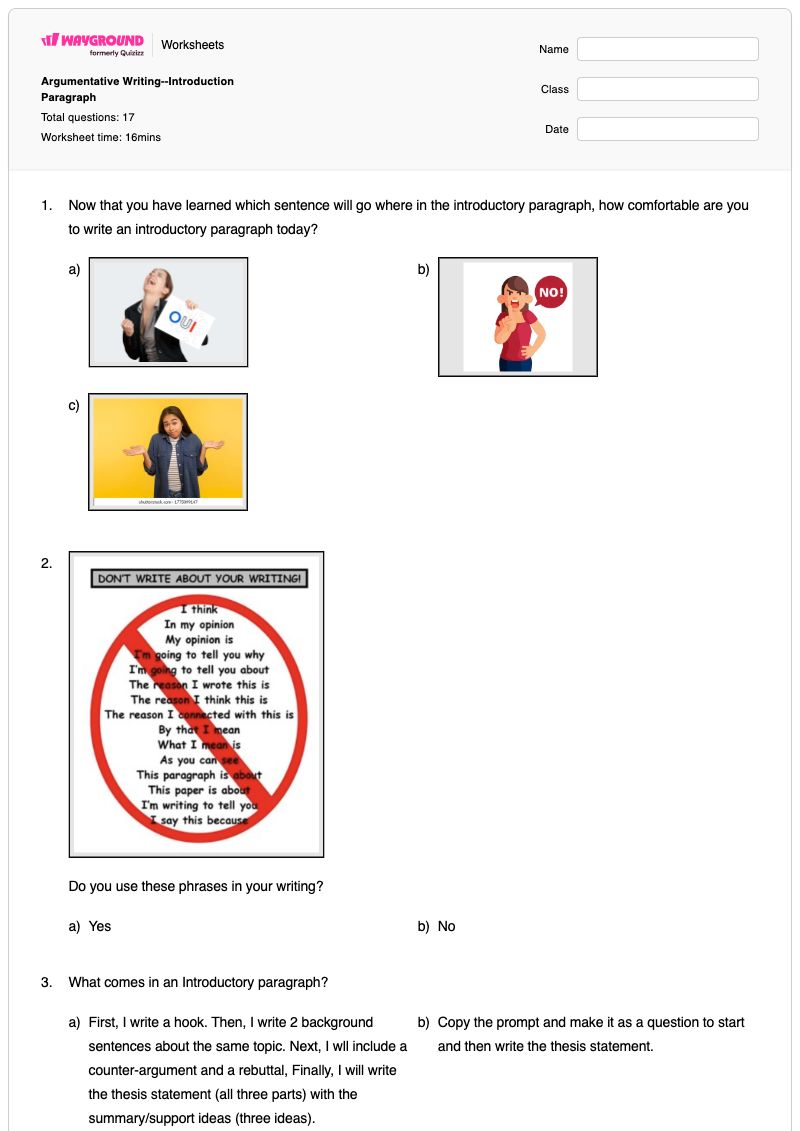
แบบฝึกหัดการเขียนเชิงโต้แย้ง—ย่อหน้าแรก เป็นแบบฝึกหัดภาษาอังกฤษสำหรับนักเรียนระดับชั้น ม.3-ม.6 ที่สามารถพิมพ์ได้ฟรี ช่วยให้นักเรียนสร้างย่อหน้าแรกของเรียงความเชิงโต้แย้งได้ แบบฝึกหัดนี้ประกอบด้วย 17 หัวข้อที่หลากหลาย—รวมถึงคำถามแบบเลือกตอบ เติมคำในช่องว่าง คำตอบปลายเปิด การสะท้อนความคิดด้วยภาพวาด และแบบฝึกหัดลากและวาง—ช่วยให้นักเรียนระบุส่วนดึงดูดความสนใจ (hook) ประโยคพื้นฐาน ข้อโต้แย้งและการหักล้าง ประโยคใจความหลัก และแนวคิดสนับสนุน นอกจากนี้ยังทบทวนประเภทของส่วนดึงดูดความสนใจ 6 แบบ และรู้จักการเชื่อมโยงที่เหมาะสมในข้อโต้แย้ง แบบฝึกหัดนี้เน้นการจัดระเบียบย่อหน้า ตลอดจนคำศัพท์และการจัดวางประโยค นักเรียนจะกำหนดว่าบทนำควรมีอย่างน้อย 5 ประโยค ระบุประโยคใจความหลักเป็นประโยคสุดท้าย อธิบายว่าประโยคใจความหลักคืออะไร และแยกแยะข้อโต้แย้งออกจากหลักฐานหรือความเห็นด้วยกับข้ออ้าง แบบฝึกหัดนี้เป็นแบบฝึกหัดที่สามารถพิมพ์ได้ฟรีพร้อมเฉลยครบถ้วน เหมาะสำหรับการสอนแบบมีผู้แนะนำ การฝึกฝนด้วยตนเอง หรือการตรวจสอบความพร้อมของนักเรียนในการเขียนบทนำเชิงโต้แย้งอย่างรวดเร็ว

การตั้งค่าแผ่นงาน

ขนาดตัวอักษร

S
M
L
XL
Waygroundแผ่นงาน

Argumentative Writing--Introduction Paragraph

คำถามทั้งหมด: 17

ชื่อ
ระดับ
วันที่
1.

Now that you have learned which sentence will go where in the introductory paragraph, how comfortable are you to write an introductory paragraph today?

a)
Now that you have learned which sentence will go where in the introductory paragraph, how comfortable are you to write an…
b)
Now that you have learned which sentence will go where in the introductory paragraph, how comfortable are you to write an…
c)
Now that you have learned which sentence will go where in the introductory paragraph, how comfortable are you to write an…
2.
Do you use these phrases in your writing?

Do you use these phrases in your writing?

a)

Yes

b)

No

3.

What comes in an Introductory paragraph?

a)

First, I write a hook. Then, I write 2 background sentences about the same topic. Next, I wll include a counter-argument and a rebuttal, Finally, I will write the thesis statement (all three parts) with the summary/support ideas (three ideas).

b)

Copy the prompt and make it as a question to start and then write the thesis statement.

4.

How many sentences you should write in an introductory paragraph?

a)

I should write 2 sentences only.

b)

I should write a minimum of 5 sentences.

5.
comes first in an introductory paragraph.

(a)   comes first in an introductory paragraph.

6.

Different types of hooks are (a)   (6 types).

7.

What comes at the end of an introductory paragraph, has three parts to it alongside supports/ideas and is also a sentence?

a)

thesis/claim/opinion/position

b)

counterargument

8.

A summary of three____/___ come in the introductory paragraph and it should be written in the last part of the ___ ___.

(a)  

9.
What is a thesis statement?

What is a thesis statement?

4 เส้น
10.

Where should a thesis statement come in an introductory paragraph?

a)

It is second sentence

b)

It is the last sentence

11.
What is counter argument and where it is written?

What is counter argument and where it is written?

a)

A counter argument is an argument that someone would make if they DISAGREED with your claim and it is written as one of the BACKGROUND sentences in the INTRODUCTORY PARAGRAPH.

b)

A counter argument is an argument that someone would make if they AGREED again with your own claim and it is written as an EVIDENCE in the BODY PARAGRAPH.

12.

WHERE TO WRITE COUNTERARGUMENTS?

Placing the _______ in your_______ is one effective way to make your argumentative essay stronger. This will show that you aren't one-sided or biased and that you are open to other ideas. This will allow the reader to trust you. Whereas, writing the counterargument in the introduction can be successful because it informs the reader why you are writing.

(a)  

13.
Where do you write background sentences?

Where do you write background sentences?

a)

In one of the body paragraphs

b)

In the introductory paragraph

c)

In the conclusion

14.

How are you feeling? Circle the emoji that describes your feelings.

How are you feeling? Circle the emoji that describes your feelings.
15.

What are some transitions or phrases for counter argument?

a)

Some people say...

It may be true that..

It's easy to think...

You may argue that...

b)

In conclusion..

Now you can see why...

It is clear that...

To wrap it up...

16.

What is a rebuttal?

a)

Restate your claim in a powerful way.

b)

What would you say to the person who disagreed with you to change their mind?

c)

What might someone say if they disagreed with you?

17.

What are some transitions or phrases for a rebuttal? (Two ​ (a)   options)​

เลือกจากคำด้านล่าง
However,the truth is.../You might argue that...
You might argue that...
This reveals,...
This expresses the idea...
This implies...
This suggests...
Waygroundแป้นคำตอบ

Argumentative Writing--Introduction Paragraph

คำถามทั้งหมด: 17

1.
ไม่มี
2.
b)

No

3.
a)

First, I write a hook. Then, I write 2 background sentences about the same topic. Next, I wll include a counter-argument and a rebuttal, Finally, I will write the thesis statement (all three parts) with the summary/support ideas (three ideas).

4.
b)

I should write a minimum of 5 sentences.

5.
Hook, attention grabber
6.
a question, fact, dialogue, setting, funny statement, or onomatopoeia.
7.
a)

thesis/claim/opinion/position

8.
ideas/supports thesis statement
9.
ไม่มี
10.
b)

It is the last sentence

11.
a)

A counter argument is an argument that someone would make if they DISAGREED with your claim and it is written as one of the BACKGROUND sentences in the INTRODUCTORY PARAGRAPH.

12.
counterargument, introduction
13.
b)

In the introductory paragraph

14.
ไม่มี
15.
a)

Some people say...

It may be true that..

It's easy to think...

You may argue that...

16.
b)

What would you say to the person who disagreed with you to change their mind?

17.
However,the truth is.../You might argue that...

คำถามที่พบบ่อย

แบบฝึกหัดการเขียนเชิงโต้แย้งนี้ครอบคลุมหัวข้ออะไรบ้าง?

แบบฝึกหัดนี้สอนให้นักเรียนเขียนย่อหน้าเกริ่นนำเชิงโต้แย้งโดยใช้ประโยคดึงดูดความสนใจ (hook) ประโยคอธิบายข้อมูลพื้นฐานสองประโยค ข้อโต้แย้งและคำชี้แจง และประโยคใจความหลัก (thesis statement) พร้อมด้วยแนวคิดสนับสนุน แบบฝึกหัด 17 ข้อนี้ประกอบด้วยแบบฝึกหัดแบบเลือกตอบ เติมคำในช่องว่าง คำถามปลายเปิด การวาดภาพ และการลากและวาง เพื่อให้นักเรียนได้ฝึกฝนทั้งการระบุส่วนประกอบและการอธิบายว่าส่วนประกอบเหล่านั้นเชื่อมโยงกันอย่างไร

ฉันจะใช้แบบฝึกหัดนี้สอนนักเรียนเขียนบทนำเชิงโต้แย้งได้อย่างไร?

แนะนำลำดับขั้นตอนห้าส่วนก่อนเริ่มให้นักเรียนได้เรียนรู้ ได้แก่ การเกริ่นนำ ข้อมูลพื้นฐาน ข้อโต้แย้งและการหักล้าง และประโยคใจความหลักพร้อมแนวคิดสนับสนุน ใช้คำถามเกริ่นนำและคำถามเชื่อมโยงเพื่ออธิบายว่าบทนำสามารถดึงดูดผู้อ่านและยอมรับมุมมองอื่นได้อย่างไร จากนั้นให้นักเรียนตอบคำถามใจความหลักแบบปลายเปิดก่อนที่จะเริ่มเขียนย่อหน้าด้วยตนเอง

ฉันควรระวังข้อผิดพลาดอะไรบ้างเมื่อนักเรียนทำแบบฝึกหัดการเขียนย่อหน้าแนะนำตัวนี้?

สังเกตนักเรียนที่วางประโยคใจความหลักไว้ใกล้กับตอนต้นแทนที่จะระบุว่าเป็นประโยคสุดท้าย หรือสับสนระหว่างใจความหลักกับข้อโต้แย้ง นักเรียนอาจเลือกใช้คำเชื่อมสรุปสำหรับข้อโต้แย้ง ละเว้นความคิดสนับสนุนจากใจความหลัก หรือถือว่าข้อโต้แย้งเป็นจุดที่เห็นด้วยกับข้ออ้างของตนเอง

ฉันจะมอบหมายและให้คะแนนแบบฝึกหัดการเขียนเชิงโต้แย้งนี้อย่างไร?

แบบฝึกหัดนี้มีให้ดาวน์โหลดบน Wayground ในรูปแบบไฟล์ PDF ที่สามารถพิมพ์ได้ และในรูปแบบแบบทดสอบดิจิทัล โดยมีเฉลยคำตอบครบถ้วนสำหรับคำถามแบบเลือกตอบและแบบเติมคำในช่องว่าง สำหรับการส่งงานแบบพิมพ์ ครูสามารถสแกนงานของนักเรียนด้วยแอป Wayground for Teachers ในขณะที่เวอร์ชันดิจิทัลรองรับการทำและตรวจงานออนไลน์ รูปแบบที่พิมพ์ได้ยังช่วยให้โรงเรียนลดเวลาการใช้หน้าจอเมื่อนักเรียนฝึกฝนการเรียบเรียงคำนำเชิงโต้แย้งได้อีกด้วย

แบบฝึกหัดนี้สอนให้นักเรียนรู้จักใช้ข้อโต้แย้งในบทนำได้อย่างไร?

นักเรียนจะระบุข้อโต้แย้งว่าเป็นจุดยืนที่บุคคลอาจยกขึ้นมาเมื่อไม่เห็นด้วยกับข้ออ้างของผู้เขียน และตรวจสอบว่าข้อโต้แย้งนั้นสามารถปรากฏได้ที่ใดในงานเขียนเชิงโต้แย้ง นอกจากนี้ พวกเขายังฝึกฝนการจดจำคำเชื่อม เช่น “บางคนกล่าวว่า” “อาจเป็นความจริงที่ว่า” และ “คุณอาจโต้แย้งว่า” ซึ่งบ่งบอกถึงมุมมองที่ตรงข้ามได้ชัดเจนกว่าวลีสรุป

ฉันจะหาแบบฝึกหัดแบบนี้เพิ่มเติมได้ที่ไหนบน Wayground?

Wayground นำเสนอชุดแบบฝึกหัดและโจทย์ฝึกหัดฟรีที่ครอบคลุมหลากหลายวิชา พร้อมไฟล์ PDF และเฉลยคำตอบ เพื่อช่วยให้นักเรียนเชี่ยวชาญทักษะและแนวคิดที่สำคัญ ดูแหล่งข้อมูลเพิ่มเติมได้ที่ https://wayground.com/en-us/worksheets