

Wayground
Unit 2 Week 5 - Wonders - The Inventor Thinks Up Helicopters - Printable อีแอลเอ Worksheets ระดับ 3 - Wayground

Unit 2 Week 5 - Wonders - The Inventor Thinks Up Helicopters

Lissette Azar

สร้างโดย Lissette Azar

16 คำถาม

ชั้นประถมศึกษาปีที่ 3

อีแอลเอ

อัปเดตแล้ว ม.ค. 2569

แบบฝึกหัดภาษาอังกฤษสำหรับชั้นประถมศึกษาปีที่ 3 นี้ ช่วยพัฒนาทักษะการอ่านอย่างละเอียดผ่านบทกวีสองบท ได้แก่ “นักประดิษฐ์คิดค้นเฮลิคอปเตอร์” และ “เครื่องบินปีกกระพือ” นักเรียนจะได้ระบุสัมผัสคล้องจอง การเปรียบเทียบ การใช้เสียงพยัญชนะซ้ำ และการซ้ำคำ ตีความว่าการเลือกใช้คำสร้างความเคลื่อนไหวและความเข้มข้นได้อย่างไร กำหนดรูปแบบของบทกวีแต่ละบท และวิเคราะห์ความคิดและมุมมองของกวี นอกจากนี้ นักเรียนยังต้องเลือกหลักฐานจากข้อความที่แสดงให้เห็นว่าแนวคิดเรื่องเฮลิคอปเตอร์เชื่อมโยงกับแมลงอย่างไร และเครื่องบินปีกกระพือถูกนำเสนอว่าเป็นสิ่งประดิษฐ์ที่แปลกประหลาดและน่าขบขันอย่างไร แบบฝึกหัดนี้ใช้คำถามแบบเลือกตอบและเลือกคำตอบหลายข้อผสมกัน ทำให้ผู้เรียนต้องรู้จักเทคนิคทางกวีนิพนธ์และนำไปใช้กับบทกวีที่ยกมา แทนที่จะเพียงแค่ท่องจำความหมาย แบบฝึกหัดนี้ออกแบบมาสำหรับการสอนภาษาอังกฤษชั้นประถมศึกษาปีที่ 3 การฝึกฝนด้วยตนเอง การทบทวนกลุ่มเล็ก หรือการตรวจสอบความเข้าใจหลังจากการอ่านบทกวี แบบฝึกหัดที่พิมพ์ได้ฟรีนี้มีเฉลยคำตอบครบถ้วน ทำให้ใช้งานได้จริงสำหรับการอ่านแบบมีผู้แนะนำ การประเมินในชั้นเรียน หรือการบ้าน

การตั้งค่าแผ่นงาน

ขนาดตัวอักษร

S
M
L
XL
Waygroundแผ่นงาน

Unit 2 Week 5 - Wonders - The Inventor Thinks Up Helicopters

คำถามทั้งหมด: 16

ชื่อ
ระดับ
วันที่
1.
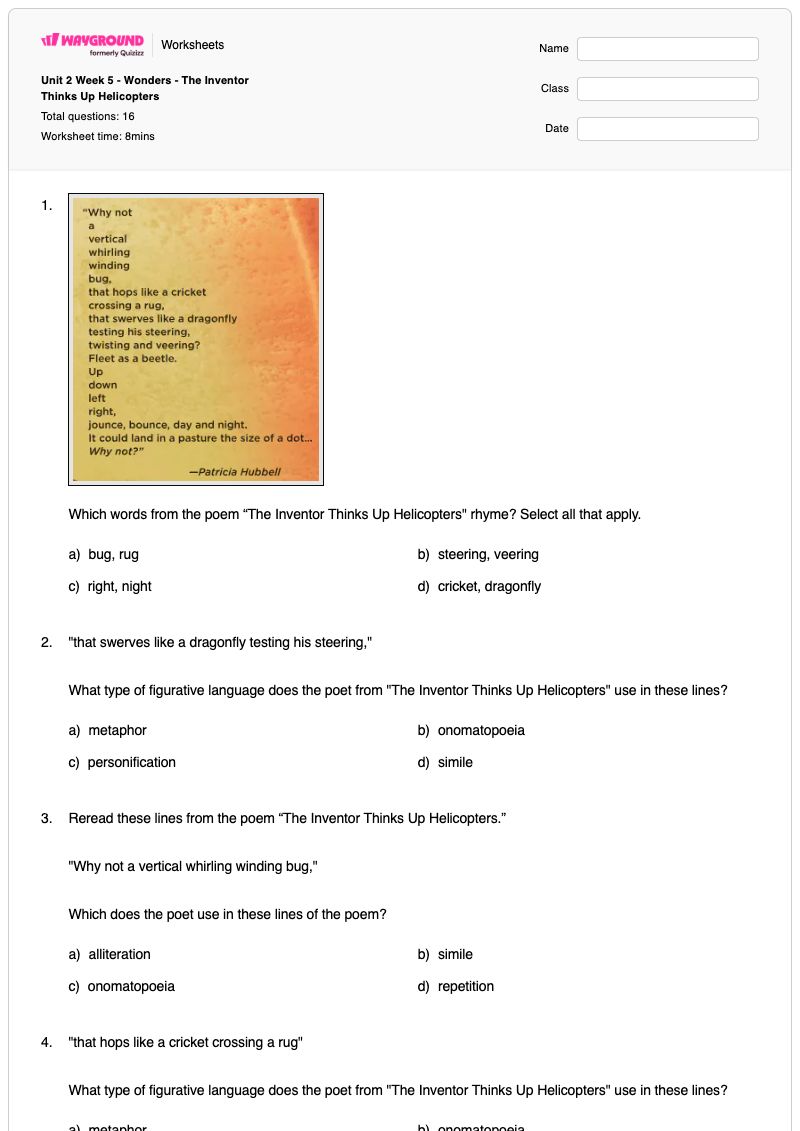
Which words from the poem “The Inventor Thinks Up Helicopters" rhyme? Select all that apply.

Which words from the poem “The Inventor Thinks Up Helicopters" rhyme? Select all that apply.

a)

bug, rug

b)

steering, veering

c)

right, night

d)

cricket, dragonfly

2.

"that swerves like a dragonfly testing his steering,"


What type of figurative language does the poet from "The Inventor Thinks Up Helicopters" use in these lines?

a)

metaphor

b)

onomatopoeia

c)

personification

d)

simile

3.

Reread these lines from the poem “The Inventor Thinks Up Helicopters.”


"Why not a vertical whirling winding bug,"


Which does the poet use in these lines of the poem?

a)

alliteration

b)

simile

c)

onomatopoeia

d)

repetition

4.

"that hops like a cricket crossing a rug"


What type of figurative language does the poet from "The Inventor Thinks Up Helicopters" use in these lines?

a)

metaphor

b)

onomatopoeia

c)

personification

d)

simile

5.

In "The Inventor Thinks Up Helicopters", what EFFECT does

"whirling and winding",

"up, down, left, right", and

"Jounce, bounce, day and night" create?

Select TWO answers.

a)

It focuses the reader on the motion of the helicopter

b)

It adds speed and intensity to the poem

c)

It makes the reader feel like the helicopter is still

d)

It adds a pause to the poem

6.
Reread the poem “The Inventor Thinks Up Helicopters.” To what is the poet comparing a helicopter?

Reread the poem “The Inventor Thinks Up Helicopters.”

To what is the poet comparing a helicopter?

a)

bugs

b)

pastures

c)

rugs

d)

spiders

7.
What text evidence (similes) supports that the inventor's ideas for the helicopter came from bugs? (Select THREE).

What text evidence (similes) supports that the inventor's ideas for the helicopter came from bugs? (Select THREE).

a)

"hops like a cricket"

b)

"swerves like a dragonfly"

c)

"fleet as a beetle"

d)

"crossing a rug"

8.

Why does the poet from "The Inventor Thinks Up Helicopters" end the poem with

"Why not?"

a)

to show that he does not like to do things that are different

b)

to show that he is an inventor because he takes risks

9.
What type of poem is “The Inventor Thinks Up Helicopters?”

What type of poem is “The Inventor Thinks

Up Helicopters?”

a)

acrostic

b)

free verse

c)

haiku

d)

limerick

10.
"Needs an engine as light as a feather." Which does the poet from "Ornithopter" use in these lines of the poem?

"Needs an engine as light as a feather."


Which does the poet from "Ornithopter" use in these lines of the poem?

a)

alliteration

b)

simile

c)

onomatopoeia

d)

repetition

11.
Which words from the poem “Ornithopter" in Stanza 1 rhyme? Select TWO that apply.

Which words from the poem “Ornithopter" in Stanza 1 rhyme? Select TWO that apply.

a)

clapping (line 1), snapping (line 2), flapping (line 5)

b)

place (line 3), chase (line 4)

c)

observers (line 1), pilot (line 2)

d)

wings (line 3), wild (line 4)

12.
Which words from the poem “Ornithopter" in Stanza 2 rhyme? Select TWO that apply.

Which words from the poem “Ornithopter" in Stanza 2 rhyme? Select TWO that apply.

a)

weather (line 1), together (line 2), feather (line 5)

b)

absurd (line 3), bird (line 4)

c)

wind (line 1), wings (line 2)

d)

plane (line 3), think (line 4)

13.
What type of poem is “Ornithopter?”

What type of poem is “Ornithopter?”

a)

acrostic

b)

free verse

c)

haiku

d)

limerick

14.

What is the poet's point of view about the ornithopter?

a)

it is a great invention

b)

it is a silly and unusual invention

15.
What lines in the stanza's support the author's point of view that the ornithopter is a silly, unusual invention? (Select…

What lines in the stanza's support the author's point of view that the ornithopter is a silly, unusual invention? (Select THREE)

a)

The pilot was happily snapping bird wings into place for a wild goose chase

b)

On a plane so absurd it thinks it's a bird

c)

The plane needs an engine as light as a feather

d)

But no matter the wind or the weather

16.

How are all the poems ALIKE?

a)

They are all about flying.

b)

They are all about flying machines.

c)

They all have similar rhyming patterns.

d)

They all include similes and metaphors.

Waygroundแป้นคำตอบ

Unit 2 Week 5 - Wonders - The Inventor Thinks Up Helicopters

คำถามทั้งหมด: 16

1.
a)

bug, rug

, b)

steering, veering

, c)

right, night

2.
d)

simile

3.
a)

alliteration

4.
d)

simile

5.
a)

It focuses the reader on the motion of the helicopter

, b)

It adds speed and intensity to the poem

6.
a)

bugs

7.
a)

"hops like a cricket"

, c)

"fleet as a beetle"

, b)

"swerves like a dragonfly"

8.
b)

to show that he is an inventor because he takes risks

9.
b)

free verse

10.
b)

simile

11.
a)

clapping (line 1), snapping (line 2), flapping (line 5)

, b)

place (line 3), chase (line 4)

12.
a)

weather (line 1), together (line 2), feather (line 5)

, b)

absurd (line 3), bird (line 4)

13.
d)

limerick

14.
b)

it is a silly and unusual invention

15.
a)

The pilot was happily snapping bird wings into place for a wild goose chase

, b)

On a plane so absurd it thinks it's a bird

, c)

The plane needs an engine as light as a feather

16.
b)

They are all about flying machines.

คำถามที่พบบ่อย

แบบฝึกหัดนี้ครอบคลุมเนื้อหาอะไรบ้างเกี่ยวกับ “นักประดิษฐ์คิดค้นเฮลิคอปเตอร์” และ “เครื่องบินปีกกระพือ”?

แบบฝึกหัดนี้ให้นักเรียนชั้นประถมศึกษาปีที่ 3 วิเคราะห์สัมผัสคล้องจอง การเปรียบเทียบ การใช้เสียงพยัญชนะซ้ำ การซ้ำคำ รูปแบบบทกวี มุมมอง และหลักฐานจากข้อความสนับสนุนในบทกวีสองบท นักเรียนตีความว่าวลีต่างๆ เช่น “หมุนวนและคดเคี้ยว” สร้างการเคลื่อนไหวได้อย่างไร ระบุว่า “นักประดิษฐ์คิดเฮลิคอปเตอร์” เป็นบทกวีไร้ฉันทลักษณ์ และ “เครื่องบินปีกกระพือ” เป็นบทกวีลิเมอริก และใช้ข้อความที่ยกมาเพื่อสนับสนุนแนวคิดของบทกวีแต่ละบท

ฉันจะใช้แบบฝึกหัดนี้สอนเรื่องกลวิธีการเขียนบทกวีและโครงสร้างของบทกวีได้อย่างไร?

ให้นักเรียนอ่านบทกวีทั้งสองบทอีกครั้ง แล้วจดบันทึกคำคล้องจองและตัวอย่างของภาษาเชิงเปรียบเทียบก่อนที่จะตอบคำถาม จากนั้นอภิปรายว่า “กระโดดเหมือนจิ้งหรีด” และ “เบาเหมือนขนนก” เป็นคำอุปมาอย่างไร ในขณะที่คำที่แสดงการเคลื่อนไหวซ้ำๆ ทำให้บทกวีมีความเร็วและความเข้มข้นมากขึ้น ปิดท้ายด้วยการขอให้นักเรียนอธิบายว่าโครงสร้างกลอนเปล่าและรูปแบบกลอนตลกมีส่วนทำให้บทกวีมีโทนเสียงที่แตกต่างกันอย่างไร

ฉันควรระวังข้อผิดพลาดอะไรบ้างเมื่อนักเรียนทำแบบฝึกหัดบทกวีนี้?

นักเรียนอาจเลือกคำคู่ที่ฟังดูเกี่ยวข้องกันทุกคำแทนที่จะตรวจสอบว่าคำเหล่านั้นคล้องจองกันจริงหรือไม่ โดยเฉพาะในข้อสอบแบบเลือกตอบหลายข้อ พวกเขาอาจสับสนระหว่างการเปรียบเปรยกับการใช้เสียงพยัญชนะซ้ำ เลือกวลี “crossing a rug” เป็นหลักฐานเกี่ยวกับแมลงทั้งๆ ที่ไม่ใช่การเปรียบเทียบแมลง หรือมองข้ามไปว่าคำถามนั้นต้องการคำตอบที่ถูกต้องหลายข้อ เตือนนักเรียนให้ใช้บรรทัดที่ยกมาและความหมายโดยรวมของบทกวีเมื่อระบุจุดยืนและหลักฐานจากข้อความ

ฉันจะมอบหมายและให้คะแนนแบบฝึกหัดนี้อย่างไร?

Wayground จัดเตรียมแบบฝึกหัดนี้ในรูปแบบไฟล์ PDF ที่สามารถพิมพ์ได้ และในรูปแบบแบบทดสอบดิจิทัล โดยมีเฉลยคำตอบครบถ้วนสำหรับคำถามแบบเลือกตอบและแบบเลือกคำตอบหลายข้อเกี่ยวกับบทกวีทั้งสองบท คุณสามารถตรวจสอบงานที่ส่งมาในรูปแบบไฟล์พิมพ์ได้โดยการสแกนงานของนักเรียนด้วยแอป Wayground for Teachers หรือมอบหมายงานในรูปแบบดิจิทัลเพื่อให้นักเรียนทำและตรวจให้คะแนนทางออนไลน์ได้

แบบฝึกหัดนี้ช่วยพัฒนาทักษะการวิเคราะห์ข้อความของนักเรียนได้อย่างไร?

คำถามแบบเลือกตอบหลายข้อต้องการให้นักเรียนเชื่อมโยงข้ออ้างกับบทกวีที่ยกมาอย่างแม่นยำ นักเรียนเลือกคำอุปมาที่แสดงให้เห็นว่าแนวคิดเรื่องเฮลิคอปเตอร์มาจากแมลง และระบุบทกวีที่สนับสนุนมุมมองที่ว่าเครื่องบินปีกกระพือเป็นสิ่งประดิษฐ์ที่ไร้สาระและแปลกประหลาด การฝึกฝนนี้ช่วยให้นักเรียนพัฒนาจากการระบุลักษณะเด่นของบทกวีไปสู่การอธิบายว่าหลักฐานที่ยกมาสนับสนุนการตีความอย่างไร

ฉันจะหาแบบฝึกหัดแบบนี้เพิ่มเติมได้ที่ไหนบน Wayground?

Wayground มีแบบฝึกหัดและโจทย์ฝึกหัดมากมายให้ดาวน์โหลดฟรีในหลากหลายวิชา พร้อมไฟล์ PDF และเฉลยคำตอบ เพื่อช่วยเสริมสร้างทักษะและความเข้าใจในเนื้อหาสำคัญ ดูแหล่งข้อมูลเพิ่มเติมได้ที่ https://wayground.com/en-us/worksheets