
while focusing a microscope on high power a student crushed the cover slip. The student probably
a)
closed the diaphragm
b)
turned up the light intensity
c)
rotated the eyepiece
d)
used the course adjustment knob
4.
A microscope has an ocular magnification of 10 and a high power objective magnification of 40. What is the highest total magnification of the microscope?
a)
500x
b)
400x
c)
50x
d)
40x
5.
What happens to your field of view as you increase magnification?
a)
it increases
b)
it decreases
c)
it stays the same
d)
it disappears
6.
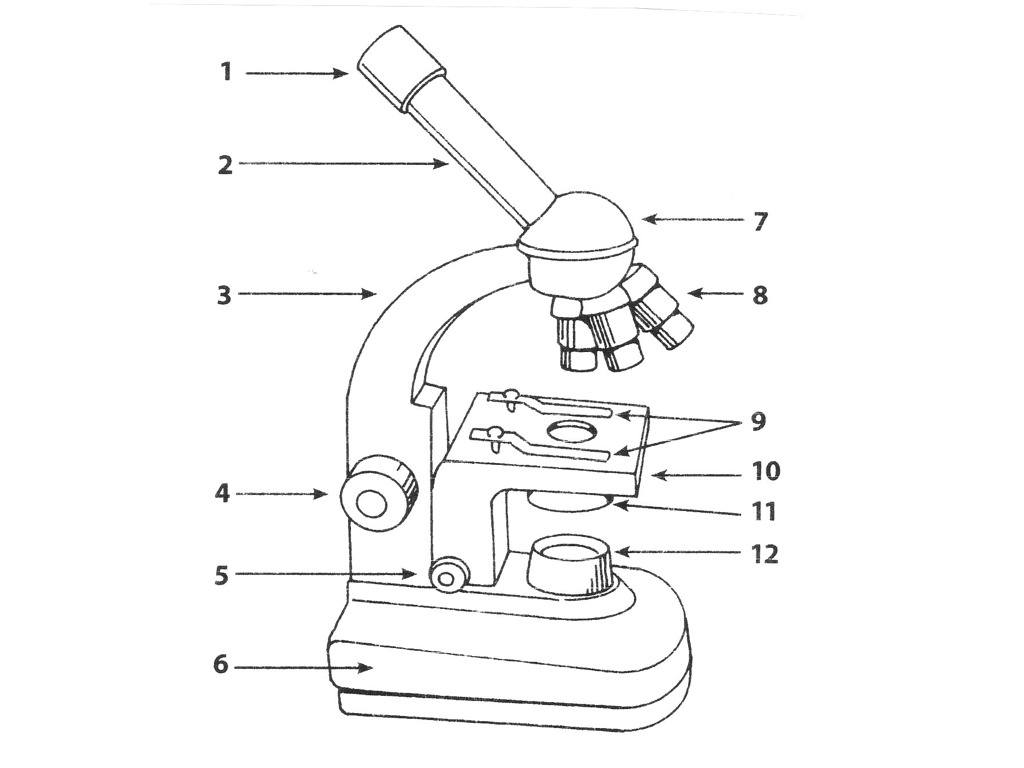
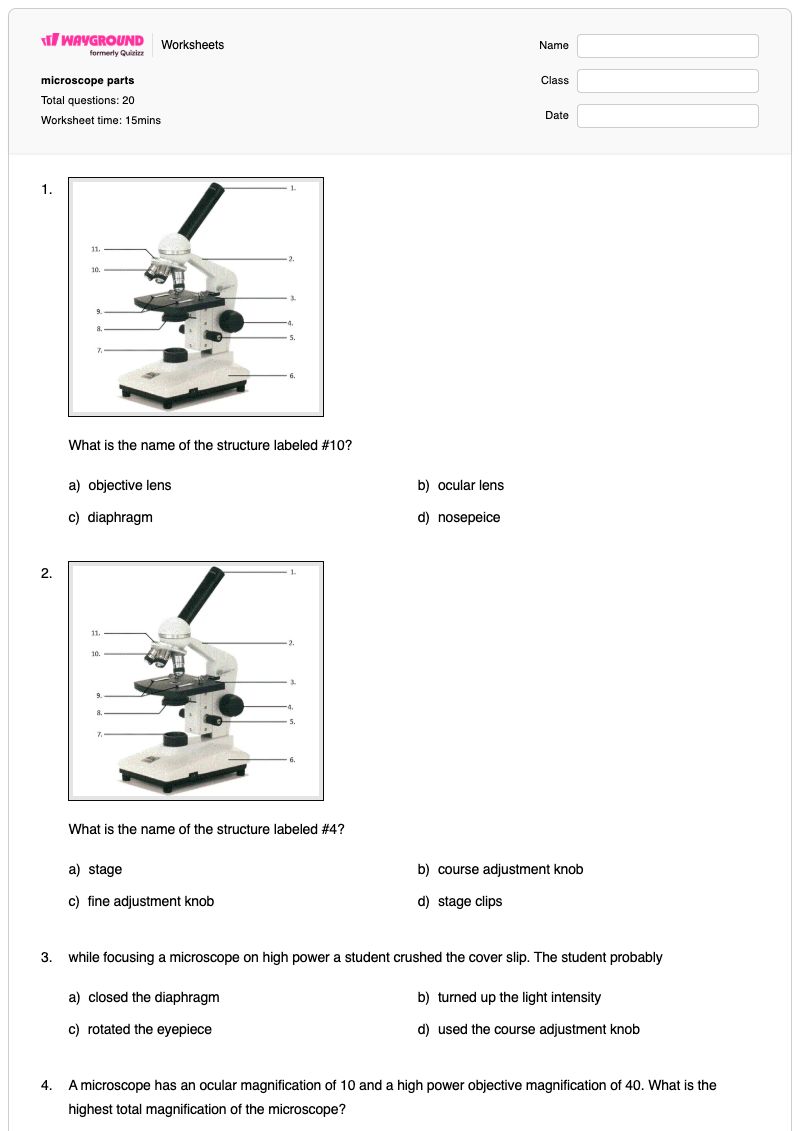
What is the function of the structure labeled #9?
a)
hold the slides in place on the stage
b)
shine light through the object being viewed
c)
bring the object being viewed into focus
d)
change the amount of shining through the object
7.
What piece supports the body tube and is also used to transport the microscope from one place to another, along with the base?
a)
Arm
b)
Stage
c)
Aperture
d)
Objective
8.
What piece is a larger knob usually found on either the body tube or the arm and it is used to focus the image under low power?
a)
Aperture
b)
Fine Adjustment Knob
c)
Diaphragm
d)
Course Adjustment Know
9.
What piece is the smaller knob, found near the course adjustment knob, and is used to focus the image under low and high power?
a)
Aperture
b)
Fine Adjustment Knob
c)
Diaphragm
d)
Course Adjustment Know
10.
Which picture below shows the safe way to hold a microscope when you are carrying it across the classroom?
a)
b)
c)
11.
Piece used in combination with the eyepiece. Provides a range of magnifications from 4x to 40x.
a)
Eyepiece
b)
Microscope
c)
Objective Lens
d)
Nosepiece
12.
A microscope is an instrument that.
a)
makes faraway objects look closer.
b)
makes small objects appear larger.
c)
decreases the size of small objects.
d)
increases the size of small objects.
13.
If you move the slide left while viewing, in which direction will it appear to move?
a)
right
b)
left
c)
up
d)
down
14.
The greater the ___________________, the smaller the field you are actually viewing.
a)
detail
b)
objective
c)
magnification
d)
body
15.
What will be the total magnification if ocular lens is 10X and objective lens is 4X?