

Wayground
Positive/Negative and Increasing/Decreasing Intervals - Printable Mathematics Worksheets - Wayground

Positive/Negative and Increasing/Decreasing Intervals

21 คำถาม

9th - 9th ระดับชั้น

Mathematics

แบบฝึกหัดคณิตศาสตร์ระดับชั้น ม.3 เรื่องช่วงบวก/ลบ และช่วงเพิ่มขึ้น/ลดลง ช่วยให้นักเรียนเข้าใจฟังก์ชันและระบุว่าช่วงนั้นเพิ่มขึ้น ลดลง เป็นบวก หรือเป็นลบ แบบฝึกหัดนี้มีคำถามแบบเลือกตอบ 21 ข้อ โดยนักเรียนจะต้องเลือกสัญลักษณ์ช่วงสำหรับช่วงเดี่ยว ช่วงหลายช่วงที่ไม่ซ้ำกัน และช่วงที่อธิบายโดยพฤติกรรมของฟังก์ชัน แบบฝึกหัดที่พิมพ์ได้ฟรีนี้มีประโยชน์สำหรับการฝึกฝนแบบมีผู้แนะนำ การทำงานอิสระ การทบทวน หรือการประเมินความสามารถของนักเรียนในการอ่านพฤติกรรมของฟังก์ชันและแยกแยะประเภทของช่วงอย่างรวดเร็ว คำถามประกอบด้วยการเปรียบเทียบระหว่างช่วงเพิ่มขึ้นและช่วงลดลง รวมถึงคำถามที่ถามนักเรียนว่าช่วงที่กำหนดเป็นบวก ลบ เพิ่มขึ้น หรือลดลง มีเฉลยคำตอบให้เพื่อความสะดวกในการตรวจสอบและให้ข้อเสนอแนะ

การตั้งค่าแผ่นงาน

ขนาดตัวอักษร

S
M
L
XL
แผ่นงาน

Positive/Negative and Increasing/Decreasing Intervals

คำถามทั้งหมด: 21

ชื่อ
ระดับ
วันที่
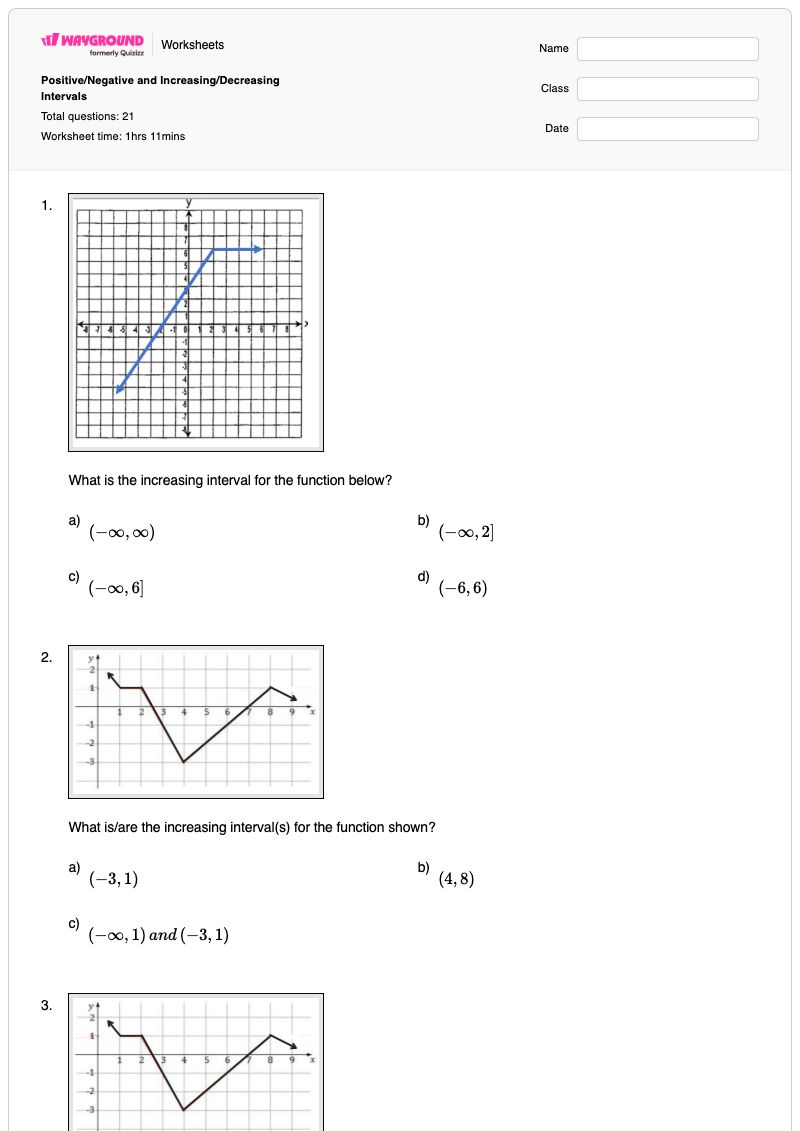
1.

What is the increasing interval for the function below?

a)

(−∞,∞)\left(-\infty,\infty\right)

b)

(−∞,2]\left(-\infty,2\right]

c)

(−∞,6]\left(-\infty,6\right]

d)

(−6,6)\left(-6,6\right)

2.

What is/are the increasing interval(s) for the function shown?

a)

(−3, 1)\left(-3,\ 1\right)

b)

(4, 8)\left(4,\ 8\right)

c)

(−∞,1) and (−3, 1)\left(-\infty,1\right)\ and\ \left(-3,\ 1\right)

3.

What is/are the increasing interval(s) for the function shown?

a)

(4, 8)\left(4,\ 8\right)

b)

(−3, 1)\left(-3,\ 1\right)

c)

(−∞,1) and (−3, 1)\left(-\infty,1\right)\ and\ \left(-3,\ 1\right)

d)

(−∞, 1) and (4, 8)\left(-\infty,\ 1\right)\ and\ \left(4,\ 8\right)

4.

What is/are the decreasing interval(s) for the function shown?

a)

 (2, 4) and (8, ∞)\left(2,\ 4\right)\ and\ \left(8,\ \infty\right) 

b)

 (−∞, 1) and (8, ∞)\left(-\infty,\ 1\right)\ and\ \left(8,\ \infty\right) 

c)

 (−∞,1), (−3, 1) and (8, ∞)\left(-\infty,1\right),\ \left(-3,\ 1\right)\ and\ \left(8,\ \infty\right) 

d)

 (−∞, 1), (2, 4) and (8, ∞)\left(-\infty,\ 1\right),\ \left(2,\ 4\right)\ and\ \left(8,\ \infty\right) 

5.

What is the decreasing interval(s) on the function shown?

a)

(−7, −6) and (−2, 4)\left(-7,\ -6\right)\ and\ \left(-2,\ 4\right)

b)

(−7, 0) and (−2, 4)\left(-7,\ 0\right)\ and\ \left(-2,\ 4\right)

c)

(−7, −6) and (−2, 0)\left(-7,\ -6\right)\ and\ \left(-2,\ 0\right)

d)

(−7, 0) and (4, 5)\left(-7,\ 0\right)\ and\ \left(4,\ 5\right)

6.

What is the increasing interval on the function shown?

a)

(−∞, 1)\left(-\infty,\ 1\right)

b)

(−∞, 2)\left(-\infty,\ 2\right)

c)

(2, ∞)\left(2,\ \infty\right)

d)

(1, ∞)\left(1,\ \infty\right)

7.

What is the decreasing interval on the function shown?

a)

(−∞, 1)\left(-\infty,\ 1\right)

b)

(−∞, 2)\left(-\infty,\ 2\right)

c)

(2, ∞)\left(2,\ \infty\right)

d)

(1, ∞)\left(1,\ \infty\right)

8.

What is the decreasing interval on the function shown?

a)

(−∞, −3)\left(-\infty,\ -3\right)

b)

(−∞, −4)\left(-\infty,\ -4\right)

c)

(−4, ∞)\left(-4,\ \infty\right)

d)

(−3, ∞)\left(-3,\ \infty\right)

9.

What is the increasing interval on the function shown?

a)

(−∞, −3)\left(-\infty,\ -3\right)

b)

(−∞, −4)\left(-\infty,\ -4\right)

c)

(−4, ∞)\left(-4,\ \infty\right)

d)

(−3, ∞)\left(-3,\ \infty\right)

10.

What is the increasing interval(s) on the function shown?

a)

(−∞, −15) and (9, −15)\left(-\infty,\ -15\right)\ and\ \left(9,\ -15\right)

b)

(−2, 9) and (2, ∞)\left(-2,\ 9\right)\ and\ \left(2,\ \infty\right)

c)

(−∞, −2) and (0, 2)\left(-\infty,\ -2\right)\ and\ \left(0,\ 2\right)

d)

(−2, 0) and (2, ∞)\left(-2,\ 0\right)\ and\ \left(2,\ \infty\right)

11.

What is the decreasing interval(s) on the function shown?

a)

(−∞, −15) and (9, −15)\left(-\infty,\ -15\right)\ and\ \left(9,\ -15\right)

b)

(−2, 9) and (2, ∞)\left(-2,\ 9\right)\ and\ \left(2,\ \infty\right)

c)

(−∞, −2) and (0, 2)\left(-\infty,\ -2\right)\ and\ \left(0,\ 2\right)

d)

(−2, 0) and (2, ∞)\left(-2,\ 0\right)\ and\ \left(2,\ \infty\right)

12.

What is the negative interval of the function?

a)

(−2,1)\left(-2,1\right)  

b)

[−2,1]\left[-2,1\right]  

c)

(0,−4)\left(0,-4\right)  

d)

(−1,0)\left(-1,0\right)  

e)

(−2,0)\left(-2,0\right)  

13.

Where does the function have a negative interval?

a)

(−2,0)∪(−1,0)∪(1,0)\left(-2,0\right)\cup\left(-1,0\right)\cup\left(1,0\right)  

b)

(−∞,−2)∪(−1,1)\left(-\infty,-2\right)\cup\left(-1,1\right)  

c)

(−2,−1)∪(1,∞)\left(-2,-1\right)\cup\left(1,\infty\right)  

d)

(−2,−1)∪(−∞,1)\left(-2,-1\right)\cup\left(-\infty,1\right)  

14.

The interval (-∞, 1) describes what interval?

a)

Negative Interval

b)

Increasing interval

c)

Positive Interval

d)

Decreasing Interval

15.

What is the negative interval for the function?

a)

(−∞,−2)\left(-\infty,-2\right)  

b)

(−∞,−3)\left(-\infty,-3\right)  

c)

(−2,∞)\left(-2,\infty\right)  

d)

(−3,∞)\left(-3,\infty\right)  

e)

(−∞,∞)\left(-\infty,\infty\right)  

16.

What is the positive interval of the function?

a)

(−9,−5)\left(-9,-5\right)  

b)

(−9,2)\left(-9,2\right)  

c)

(−5,2)\left(-5,2\right)  

d)

(3,0)\left(3,0\right)  

17.

What is the negative interval of the function?

a)

(1,0)\left(1,0\right)  

b)

(−1,0)\left(-1,0\right)  

c)

(1,∞)\left(1,\infty\right)  

d)

(−∞,∞)\left(-\infty,\infty\right)  

e)

(−∞,1)\left(-\infty,1\right)  

18.

What does the interval (-2,∞) represent on this function?

a)

Domain

b)

Range

c)

Positive Interval

d)

Negative Interval

19.

Which is the correct positive interval for the function?

a)

(−∞,0)\left(-\infty,0\right)  

b)

(0,2)\left(0,2\right)  

c)

(0,0)\left(0,0\right)  

d)

None

e)

(2,∞)\left(2,\infty\right)  

20.

Which of the following functions has a negative interval of (-2,1) 

a)
b)
c)
d)
21.

Which of the following functions has a positive interval of (-∞,-5)

a)
b)
c)
d)
แป้นคำตอบ

Positive/Negative and Increasing/Decreasing Intervals

คำถามทั้งหมด: 21

1.
b)

(−∞,2]\left(-\infty,2\right]

2.
b)

(4, 8)\left(4,\ 8\right)

3.
a)

(4, 8)\left(4,\ 8\right)

4.
d)

 (−∞, 1), (2, 4) and (8, ∞)\left(-\infty,\ 1\right),\ \left(2,\ 4\right)\ and\ \left(8,\ \infty\right) 

5.
c)

(−7, −6) and (−2, 0)\left(-7,\ -6\right)\ and\ \left(-2,\ 0\right)

6.
b)

(−∞, 2)\left(-\infty,\ 2\right)

7.
c)

(2, ∞)\left(2,\ \infty\right)

8.
a)

(−∞, −3)\left(-\infty,\ -3\right)

9.
d)

(−3, ∞)\left(-3,\ \infty\right)

10.
d)

(−2, 0) and (2, ∞)\left(-2,\ 0\right)\ and\ \left(2,\ \infty\right)

11.
c)

(−∞, −2) and (0, 2)\left(-\infty,\ -2\right)\ and\ \left(0,\ 2\right)

12.
a)

(−2,1)\left(-2,1\right)  

13.
c)

(−2,−1)∪(1,∞)\left(-2,-1\right)\cup\left(1,\infty\right)  

14.
a)

Negative Interval

15.
c)

(−2,∞)\left(-2,\infty\right)  

16.
a)

(−9,−5)\left(-9,-5\right)  

17.
e)

(−∞,1)\left(-\infty,1\right)  

18.
c)

Positive Interval

19.
b)

(0,2)\left(0,2\right)  

20.
c)
21.
a)

คำถามที่พบบ่อย

แบบฝึกหัดนี้ครอบคลุมหัวข้ออะไรบ้าง?

แบบฝึกหัดชั้น ม.3 นี้ครอบคลุมการระบุช่วงบวก ช่วงลบ ช่วงเพิ่มขึ้น และช่วงลดลงของฟังก์ชันโดยใช้สัญลักษณ์ช่วง แบบฝึกหัดนี้มีคำถามแบบเลือกตอบ 21 ข้อ ซึ่งนักเรียนจะต้องเลือกช่วงอย่างน้อยหนึ่งช่วง รวมถึงช่วงที่ไม่ซ้ำกัน และจำแนกช่วงตามพฤติกรรมของฟังก์ชันที่ช่วงนั้นแสดง

ฉันจะใช้แบบฝึกหัดนี้สอนเรื่องช่วงเพิ่มขึ้นและช่วงลดลงได้อย่างไร?

เริ่มต้นด้วยการทบทวนวิธีการติดตามพฤติกรรมของฟังก์ชันจากซ้ายไปขวา จากนั้นจำลองวิธีการที่การเปลี่ยนแปลงพฤติกรรมสร้างช่วงเวลาแยกต่างหาก ใช้คำถามเกี่ยวกับการเพิ่มขึ้นและลดลงที่จับคู่กันในแบบฝึกหัดเพื่อให้นักเรียนอธิบายว่าทำไมช่วงเวลาเช่น (−2, 0) จึงถูกเลือกในขณะที่ช่วงเวลาอื่น ๆ ถูกยกเว้น และตามด้วยรายการการจำแนกประเภทสำหรับพฤติกรรมที่เป็นบวก ลบ เพิ่มขึ้น และลดลง

ฉันควรสังเกตข้อผิดพลาดอะไรบ้างเมื่อนักเรียนทำแบบฝึกหัดนี้เสร็จ?

สังเกตนักเรียนที่สลับลำดับการเพิ่มขึ้นและการลดลง เลือกเพียงส่วนเดียวเมื่อคำตอบที่ถูกต้องมีหลายช่วง หรือใช้ค่าขอบเขตที่ไม่ถูกต้องจากการแสดงฟังก์ชัน นักเรียนอาจสับสนระหว่างช่วงบวกหรือลบกับช่วงที่เพิ่มขึ้นหรือลดลง ดังนั้นให้ขอให้นักเรียนระบุว่าแต่ละคำถามกำลังทดสอบพฤติกรรมประเภทใดก่อนที่จะเลือกคำตอบ

ฉันจะมอบหมายและตรวจงานใบงานนี้อย่างไร?

แบบฝึกหัดนี้มีให้ดาวน์โหลดในรูปแบบ PDF สำหรับพิมพ์ และเป็นแบบทดสอบดิจิทัลบน Wayground โดยมีเฉลยคำตอบครบถ้วน คุณสามารถตรวจงานที่ส่งในรูปแบบ PDF ได้โดยการสแกนงานของนักเรียนด้วยแอป Wayground for Teachers ในขณะที่เวอร์ชันดิจิทัลรองรับการทำและตรวจงานออนไลน์

ฉันจะปรับแบบฝึกหัดนี้ให้เหมาะสมกับนักเรียนของฉันได้อย่างไร?

เนื่องจากแบบฝึกหัดใช้สัญลักษณ์ช่วงและตัวเลือกคำตอบแบบปรนัย คุณสามารถปรับระยะห่างระหว่างตัวอักษรและขนาดตัวอักษรเพื่อให้ง่ายต่อการอ่าน นอกจากนี้ ในการตั้งค่าขั้นสูง คุณยังสามารถใช้แบบอักษรที่เหมาะสำหรับผู้ที่มีภาวะดิสเล็กเซีย หรือแปลแบบฝึกหัดเป็นภาษาอื่นได้ เมื่อตัวเลือกเหล่านั้นรองรับการเข้าถึงคำถามเกี่ยวกับฟังก์ชันและช่วง

ฉันจะหาแบบฝึกหัดแบบนี้เพิ่มเติมได้ที่ไหนบน Wayground?

Wayground มีแบบฝึกหัดและโจทย์ฝึกหัดมากมายให้ดาวน์โหลดฟรีในหลากหลายวิชา พร้อมไฟล์ PDF และเฉลยคำตอบ เพื่อช่วยเสริมสร้างทักษะและความเข้าใจในเนื้อหาสำคัญ ดูแหล่งข้อมูลเพิ่มเติมได้ที่ https://wayground.com/en-us/worksheets