

Wayground
Inductive and Deductive Reasoning - Printable Mathematics Worksheets ระดับ 8 - Wayground

Inductive and Deductive Reasoning

20 คำถาม

8th - 8th ระดับชั้น

Mathematics

แบบฝึกหัดคณิตศาสตร์ ม.2 นี้ ช่วยให้นักเรียนได้ฝึกฝนการใช้เหตุผลแบบอุปนัยและนิรนัยผ่านคำถามแบบเลือกตอบ 20 ข้อ นักเรียนจะได้ระบุว่าข้อสรุปมาจากข้อสังเกตหรือข้อเท็จจริงที่ระบุไว้ ขยายแบบแผนของตัวอักษรและตัวเลข และใช้แบบแผนเพื่อสร้างข้อสันนิษฐาน นอกจากนี้ พวกเขายังได้ทำงานกับประโยคเงื่อนไขโดยการระบุสมมติฐานและข้อสรุป การเชื่อมโยงประโยคที่เกี่ยวข้องกัน และการแยกแยะประโยคจากประโยคผกผัน ประโยคตรงข้าม หรือประโยคแย้ง แบบฝึกหัดนี้ยังแนะนำตัวอย่างค้านเพื่อแสดงว่าข้อความเงื่อนไขนั้นเป็นเท็จ รวมถึงการเลือกตัวเลขที่พิสูจน์ว่าข้อความหารลงตัวนั้นไม่จริง การผสมผสานนี้ช่วยให้นักเรียนเชื่อมโยงการจดจำแบบแผนกับการใช้เหตุผลเชิงตรรกะและภาษาคณิตศาสตร์ แบบฝึกหัดนี้เหมาะสำหรับใช้ในการสอนคณิตศาสตร์ ม.2 การฝึกฝนแบบมีผู้แนะนำ การทบทวนด้วยตนเอง หรือการประเมินทักษะการใช้เหตุผลพื้นฐาน สามารถดาวน์โหลดได้ฟรีพร้อมเฉลยคำตอบเพื่อการตรวจสอบที่มีประสิทธิภาพ

การตั้งค่าแผ่นงาน

ขนาดตัวอักษร

S
M
L
XL
Waygroundแผ่นงาน

Inductive and Deductive Reasoning

คำถามทั้งหมด: 20

ชื่อ
ระดับ
วันที่
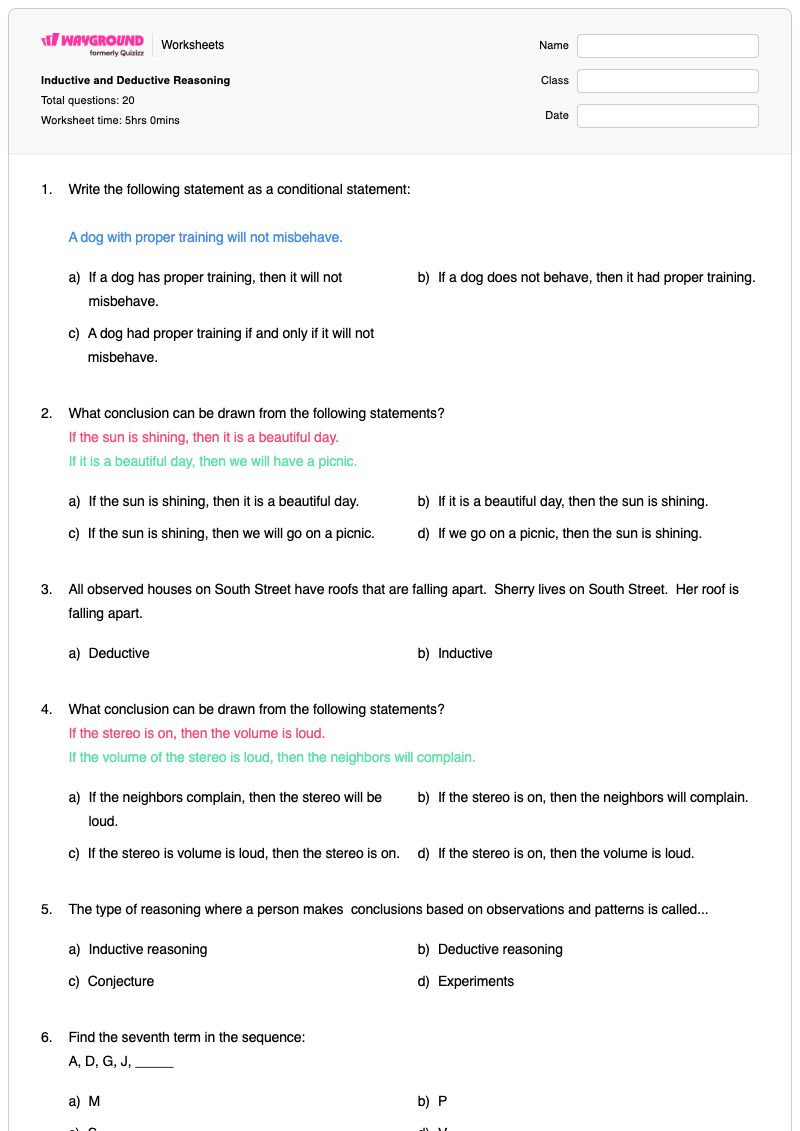
1.

Write the following statement as a conditional statement:


A dog with proper training will not misbehave.

a)

If a dog has proper training, then it will not misbehave.

b)

If a dog does not behave, then it had proper training.

c)

A dog had proper training if and only if it will not misbehave.

2.
What conclusion can be drawn from the following statements?
If the sun is shining, then it is a beautiful day.  
If it is a beautiful day, then we will have a picnic.
a)
If the sun is shining, then it is a beautiful day.
b)
If it is a beautiful day, then the sun is shining.
c)
If the sun is shining, then we will go on a picnic.
d)
If we go on a picnic, then the sun is shining.
3.
All observed houses on South Street have roofs that are falling apart.  Sherry lives on South Street.  Her roof is falling apart. 
a)
Deductive
b)
Inductive
4.
What conclusion can be drawn from the following statements?
If the stereo is on, then the volume is loud.  
If the volume of the stereo is loud, then the neighbors will complain.
a)
If the neighbors complain, then the stereo will be loud.
b)
If the stereo is on, then the neighbors will complain.
c)
If the stereo is volume is loud, then the stereo is on.
d)
If the stereo is on, then the volume is loud.
5.
The type of reasoning where a person makes  conclusions based on observations and patterns is called...
a)
Inductive reasoning
b)
Deductive reasoning
c)
Conjecture
d)
Experiments
6.

Find the seventh term in the sequence:

A, D, G, J, _____

a)

M

b)

P

c)

S

d)

V

7.
Where would the next red square be?
a)
bottom left
b)
top right
c)
top left
d)
bottom right
8.
What are the next two numbers in this pattern?
12, 17, 22, 27, ___, ___
a)
32, 37
b)
30, 37
c)
30, 33
d)
32, 35
9.

This is used to prove that a possible Conditional Statement is false.

a)

Counterexample

b)

Inductive Reasoning

c)

Concluding statement

d)

Negation

10.
Which number is a counterexample to the following statement? : 
All numbers that are divisible by 2 are divisible by 4
a)
0
b)
12
c)
28
d)
42
11.

Deductive reasoning means...

a)

Guessing without any information

b)

Sounding knowledgeable even when you are not

c)

Testing and observing patterns to make conjectures

d)

Drawing conclusions from situations based on facts and definitions

12.
Identify the hypothesis and conclusion of the conditional statement:
If you give me twenty dollars, then I will be your best friend.
a)
Hypothesis: I will be your best friend
Conclusion: you give me twenty dollars
b)
Hypothesis: you give me twenty dollars
Conclusion: I will be your best friend
c)
Hypothesis: if you have to pay for friends
Conclusion: then you probably should reevaluate your life
d)
Hypothesis: you will not have to pay twenty dollars
Conclusion: if you have lots of friends
13.
Given, "If angles are congruent, then the measures of the angles are equal." Identify the contrapositive.
a)
If the measures of the angles are equal, then the angles are congruent.
b)
If angles are not congruent, then the measures of the angles are not equal.
c)
If the measures of the angles are not equal, then the angles are not congruent.
d)
If the angles are not congruent, then the measure of the angles are equal.
14.
What is this mean?
What is this mean?
a)
Conditional Statement
b)
Converse
c)
Inverse
d)
Contrapositive
15.
Conditional: If Maria gets married, then the reception will be at the country club.
What is this statement: If the reception is at the country club, then Maria will be getting married.
a)
Converse
b)
Inverse
c)
Contrapositive
d)
Negation
16.
If it is a number, then it is either positive or negative. What is an appropriate counterexample?
a)
10
b)
-2
c)
0
d)
True. There is no counterexample.
17.

Which is a counterexample to the following statement?

If an angle is obtuse, then it is 125°125\degree .

a)

90°90\degree  

b)

57°57\degree  

c)

160°160\degree  

d)

180°180\degree  

18.

Which two statements make up the following biconditionals: "A polygon is a triangle if and only if it has exactly 3 sides."

a)

1. If a polygon is a triangle, then the polygon has exactly three sides. 2 If a polygon has exactly three sides then it is a triangle

b)

1. If a polygon is not a triangle, then the polygon does not have three side. 2. If a polygon does not have three sides,then it is not a triangle.

c)

1. A polygon is a triangle. 2. The polygon has three sides.

19.
When can a biconditional statement be written?
a)
When the inverse and the converse are both true
b)
When the original statement (conditional statement) & the contrapositive are both true.
c)
When the converse is true.
d)
When the original statement (conditional statement) and the converse are both true.
20.

"A bird is an animal that flies" is not a good definition because:

a)

It does not use clearly understood terms.

b)

It is not precise.

c)

It is not reversible.

d)

A bird is not an animal.

Waygroundแป้นคำตอบ

Inductive and Deductive Reasoning

คำถามทั้งหมด: 20

1.
a)

If a dog has proper training, then it will not misbehave.

2.
c) If the sun is shining, then we will go on a picnic.
3.
b) Inductive
4.
b) If the stereo is on, then the neighbors will complain.
5.
a) Inductive reasoning
6.
c)

S

7.
c) top left
8.
a) 32, 37
9.
a)

Counterexample

10.
d) 42
11.
d)

Drawing conclusions from situations based on facts and definitions

12.
b) Hypothesis: you give me twenty dollars
Conclusion: I will be your best friend
13.
c) If the measures of the angles are not equal, then the angles are not congruent.
14.
d) Contrapositive
15.
a) Converse
16.
c) 0
17.
c)

160°160\degree  

18.
a)

1. If a polygon is a triangle, then the polygon has exactly three sides. 2 If a polygon has exactly three sides then it is a triangle

19.
d) When the original statement (conditional statement) and the converse are both true.
20.
c)

It is not reversible.

คำถามที่พบบ่อย

แบบฝึกหัดการให้เหตุผลแบบอุปนัยและนิรนัยนี้ครอบคลุมหัวข้ออะไรบ้าง?

แบบฝึกหัดคณิตศาสตร์ระดับชั้น ม.2 นี้ประกอบด้วยคำถามแบบเลือกตอบ 20 ข้อ เพื่อฝึกฝนการแยกแยะการให้เหตุผลแบบอุปนัยและนิรนัย การขยายรูปแบบตัวอักษรและตัวเลข และการวิเคราะห์ประโยคเงื่อนไข นักเรียนจะได้ระบุสมมติฐานและข้อสรุป รู้จักประโยคผกผันและประโยคแย้ง เชื่อมโยงประโยคเงื่อนไข และเลือกตัวอย่างค้านที่หักล้างข้ออ้าง

ฉันจะใช้แบบฝึกหัดนี้ในการสอนการให้เหตุผลแบบอุปนัยและนิรนัยได้อย่างไร?

เริ่มแบบฝึกหัดโดยให้นักเรียนเปรียบเทียบข้อสรุปที่ได้จากรูปแบบ เช่น การขยายลำดับ กับข้อสรุปที่ได้จากข้อเท็จจริงที่ระบุไว้ จากนั้นสาธิตประโยคเงื่อนไขหนึ่งประโยคโดยระบุสมมติฐานและข้อสรุป ก่อนที่นักเรียนจะทำแบบฝึกหัดเกี่ยวกับประโยคผกผัน ประโยคแย้ง และข้อสรุปแบบลูกโซ่ ขอให้นักเรียนอธิบายว่าทำไมตัวเลขที่เลือกจึงเป็นตัวอย่างค้าน แทนที่จะเลือกคำตอบเพียงอย่างเดียว

ฉันควรสังเกตข้อผิดพลาดอะไรบ้างเมื่อนักเรียนทำแบบฝึกหัดนี้เสร็จ?

นักเรียนอาจกลับลำดับประโยคเงื่อนไขเมื่อระบุสมมติฐานและข้อสรุป หรือสับสนระหว่างประโยคผกผันกับประโยคแย้ง นอกจากนี้ พวกเขาอาจตีความการสังเกตตามรูปแบบว่าเป็นเหตุผลเชิงนิรนัย มองข้ามการเปลี่ยนแปลงคงที่ในลำดับ หรือเลือกเลขคู่ที่หารด้วย 4 ลงตัวแทนที่จะเลือกตัวอย่างค้านที่เป็นจริง สำหรับประโยคที่เชื่อมโยงกัน ให้ตรวจสอบว่านักเรียนปฏิบัติตามทิศทางที่กำหนดไว้ แทนที่จะอนุมานความหมายตรงกันข้าม

ฉันจะมอบหมายและให้คะแนนแบบฝึกหัดนี้อย่างไร?

Wayground จัดเตรียมแบบฝึกหัดนี้ในรูปแบบไฟล์ PDF ที่สามารถพิมพ์ได้ และในรูปแบบแบบทดสอบดิจิทัล โดยมีเฉลยคำตอบครบถ้วนสำหรับคำถามแบบเลือกตอบทั้ง 20 ข้อ คุณสามารถตรวจงานที่ส่งมาในรูปแบบไฟล์พิมพ์ได้โดยการสแกนงานของนักเรียนด้วยแอป Wayground for Teachers นอกจากนี้ เวอร์ชันที่สามารถพิมพ์ได้ยังสามารถใช้สนับสนุนการเรียนการสอนในสภาพแวดล้อมที่ลดเวลาการใช้หน้าจอได้อีกด้วย

ฉันจะปรับแบบฝึกหัดนี้ให้เหมาะสมกับนักเรียนของฉันได้อย่างไร?

ใช้การตั้งค่าขั้นสูงของแบบฝึกหัดเพื่อปรับระยะห่างระหว่างตัวอักษรหรือเพิ่มขนาดตัวอักษร เพื่อให้ข้อความเงื่อนไข ตัวเลือกคำตอบ และแบบฝึกหัดอ่านง่ายขึ้น นอกจากนี้ คุณยังสามารถใช้แบบอักษรที่เหมาะสำหรับผู้ที่มีภาวะดิสเล็กเซีย หรือแปลแบบฝึกหัดเป็นภาษาอื่นโดยคงรูปแบบคำถามแบบเลือกตอบไว้ได้

ฉันจะหาแบบฝึกหัดแบบนี้เพิ่มเติมได้ที่ไหนบน Wayground?

Wayground มีแบบฝึกหัดและโจทย์ฝึกหัดให้ดาวน์โหลดฟรีมากมายในทุกวิชา พร้อมไฟล์ PDF และเฉลยคำตอบ เพื่อสนับสนุนทักษะและแนวคิดที่สำคัญ ดูแหล่งข้อมูลเพิ่มเติมได้ที่ https://wayground.com/en-us/worksheets