

Wayground
7.1.2 Hinduism and Buddhism Review - Printable สังคมศึกษา Worksheets 7th ระดับชั้น - Wayground

7.1.2 Hinduism and Buddhism Review

Seth Baysinger

สร้างโดย Seth Baysinger

15 คำถาม

7th ระดับชั้น

สังคมศึกษา

อัปเดตแล้ว ม.ค. 2569

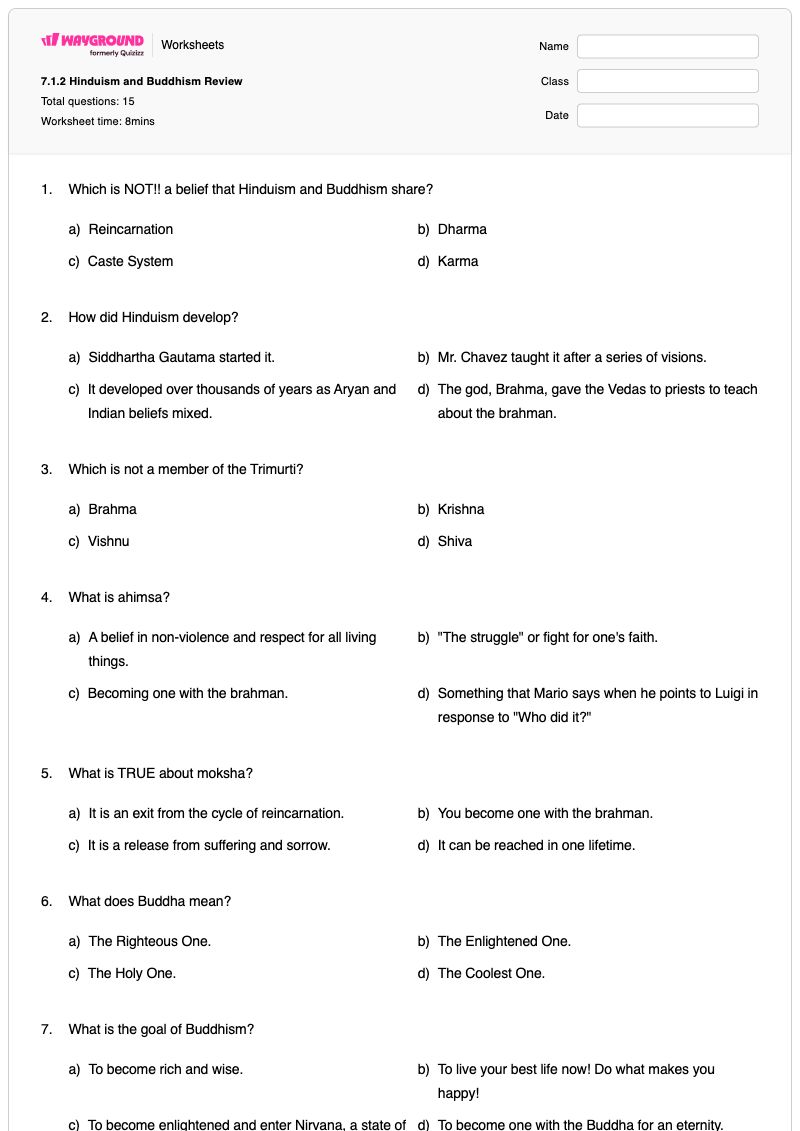
แบบฝึกหัดทบทวนวิชาสังคมศึกษา ชั้น ม.1 นี้ ช่วยให้นักเรียนเปรียบเทียบศาสนาฮินดูและพุทธศาสนาผ่านคำถาม 15 ข้อ: 12 ข้อเป็นแบบเลือกตอบ และ 3 ข้อเป็นแบบเลือกตอบหลายตัวเลือก นักเรียนจะได้ระบุความเชื่อที่เหมือนกันและแตกต่างกัน อธิบายแนวคิดต่างๆ เช่น ธรรมะ กรรม การเกิดใหม่ โมกษะ อหิงสา และนิพพาน รู้จักพระพุทธเจ้าศากยมุนีและตรีมูรติของศาสนาฮินดู และเชื่อมโยงแต่ละศาสนากับต้นกำเนิดและการแพร่กระจายทางภูมิศาสตร์ ใช้แบบฝึกหัดที่พิมพ์ได้ฟรีนี้เพื่อตรวจสอบว่านักเรียนสามารถแยกแยะคำสอนของศาสนาฮินดูและพุทธศาสนาได้หรือไม่ แทนที่จะใช้ความจำเพียงอย่างเดียว คำถามจะให้นักเรียนเลือกข้อความที่ถูกต้องทั้งหมดเกี่ยวกับโมกษะ ธรรมะของพุทธศาสนา และพระพุทธเจ้า ในขณะที่คำถามแบบเลือกตอบหลายตัวเลือกจะประเมินคำจำกัดความ เป้าหมาย การพัฒนาทางประวัติศาสตร์ และสถานที่ต่างๆ มีเฉลยคำตอบครบถ้วนสำหรับการทบทวนอย่างมีประสิทธิภาพ การฝึกฝนด้วยตนเอง หรือการประเมินผลท้ายหน่วย

การตั้งค่าแผ่นงาน

ขนาดตัวอักษร

S
M
L
XL
Waygroundแผ่นงาน

7.1.2 Hinduism and Buddhism Review

คำถามทั้งหมด: 15

ชื่อ
ระดับ
วันที่
1.

Which is NOT!! a belief that Hinduism and Buddhism share?

a)

Reincarnation

b)

Dharma

c)

Caste System

d)

Karma

2.

How did Hinduism develop?

a)

Siddhartha Gautama started it.

b)

Mr. Chavez taught it after a series of visions.

c)

It developed over thousands of years as Aryan and Indian beliefs mixed.

d)

The god, Brahma, gave the Vedas to priests to teach about the brahman.

3.

Which is not a member of the Trimurti?

a)

Brahma

b)

Krishna

c)

Vishnu

d)

Shiva

4.

What is ahimsa?

a)

A belief in non-violence and respect for all living things.

b)

"The struggle" or fight for one's faith.

c)

Becoming one with the brahman.

d)

Something that Mario says when he points to Luigi in response to "Who did it?"

5.

What is TRUE about moksha?

a)

It is an exit from the cycle of reincarnation.

b)

You become one with the brahman.

c)

It is a release from suffering and sorrow.

d)

It can be reached in one lifetime.

6.

What does Buddha mean?

a)

The Righteous One.

b)

The Enlightened One.

c)

The Holy One.

d)

The Coolest One.

7.

What is the goal of Buddhism?

a)

To become rich and wise.

b)

To live your best life now! Do what makes you happy!

c)

To become enlightened and enter Nirvana, a state of perfect peace.

d)

To become one with the Buddha for an eternity.

8.

What is the Buddhist dharma? Select all that apply.

a)

Relieve suffering of others in this world.

b)

Do what has been assigned to you by your caste.

c)

Become the best version of yourself on the road to enlightenment.

d)

Pretend that suffering and this world are fake, so that you're not unhappy.

9.

What is Hindu dharma?

a)

Do what makes you happy!

b)

Do the job assigned by your position in the caste system.

c)

Relieve suffering of others in this world.

d)

Find out what you're best at, and do it!

10.

Who was the Buddha? Check all that apply.

a)

A Hindu prince from Northern India/Nepal.

b)

The savior for all of mankind who died for sins.

c)

Siddhartha Gautama.

d)

Lao Tzu

11.

Where did Hinduism mostly spread to?

a)

Most of Southeast Asia and Europe.

b)

Mainly spread and stayed in India.

c)

China.

d)

Africa, specifically the areas along the Great Rift Valley.

12.

Where did Buddhism mainly spread?

a)

Mostly stayed in India, becoming the dominant religion there.

b)

Spread all over Eastern and Southeastern Asia, especially before the spread of communism.

c)

The Buddha carried his message to Europe before he died. Making it the popular religion there.

d)

Antarctica amongst the penguins.

13.

Where did Hinduism and Buddhism begin?

a)

America

b)

China

c)

Japan

d)

India

14.

How does Karma affect reincarnation?

a)

It doesn't.

b)

You can be born into a better/worse life depending on your karma.

c)

It mainly affects your present life, not future ones.

d)

It can make you forget your past life.

15.

What are gods in Hinduism thought to be representations of?

a)

Our deepest feelings and desires.

b)

Nothing. They're just fun.

c)

Different aspects of humanity.

d)

The universal spirit, the brahman.

Waygroundแป้นคำตอบ

7.1.2 Hinduism and Buddhism Review

คำถามทั้งหมด: 15

1.
c)

Caste System

2.
c)

It developed over thousands of years as Aryan and Indian beliefs mixed.

3.
b)

Krishna

4.
a)

A belief in non-violence and respect for all living things.

5.
a)

It is an exit from the cycle of reincarnation.

, b)

You become one with the brahman.

, c)

It is a release from suffering and sorrow.

6.
b)

The Enlightened One.

7.
c)

To become enlightened and enter Nirvana, a state of perfect peace.

8.
a)

Relieve suffering of others in this world.

, c)

Become the best version of yourself on the road to enlightenment.

9.
b)

Do the job assigned by your position in the caste system.

10.
a)

A Hindu prince from Northern India/Nepal.

, c)

Siddhartha Gautama.

11.
b)

Mainly spread and stayed in India.

12.
b)

Spread all over Eastern and Southeastern Asia, especially before the spread of communism.

13.
d)

India

14.
b)

You can be born into a better/worse life depending on your karma.

15.
d)

The universal spirit, the brahman.

คำถามที่พบบ่อย

แบบฝึกหัดทบทวนเรื่องศาสนาฮินดูและพุทธศาสนาครอบคลุมเนื้อหาอะไรบ้าง?

แบบฝึกหัด 15 ข้อนี้จะทบทวนความเหมือนและความแตกต่างระหว่างศาสนาฮินดูและพุทธศาสนา รวมถึงหลักธรรม กรรม การเกิดใหม่ โมกษะ อหิงสา นิพพาน สิทธัตถะ โคตมะ และตรีมูรติ แบบฝึกหัดนี้ประกอบด้วยคำถามแบบเลือกตอบ 12 ข้อ และคำถามแบบเลือกตอบหลายข้อ 3 ข้อ ซึ่งจะทดสอบความสามารถของนักเรียนในการระบุความหมาย แยกแยะคำสอนทางศาสนา รู้จักบุคคลสำคัญ และเชื่อมโยงแต่ละศาสนากับต้นกำเนิดทางประวัติศาสตร์และการแพร่กระจายทางภูมิศาสตร์

ฉันจะใช้แบบฝึกหัดนี้ในการสอนความแตกต่างระหว่างศาสนาฮินดูและศาสนาพุทธได้อย่างไร?

หลังจากที่นักเรียนได้เรียนรู้คำศัพท์สำคัญแล้ว ให้เริ่มทำแบบฝึกหัด จากนั้นให้พวกเขาจัดเรียงคำศัพท์ต่างๆ เช่น ธรรมะ กรรม โมกษะ และนิพพาน ตามศาสนา ก่อนที่จะตอบคำถาม หลังจากตอบคำถามแบบเลือกตอบหลายข้อแล้ว ให้หยุดถามนักเรียนว่าทำไมจึงมีคำตอบที่ถูกต้องมากกว่าหนึ่งข้อ โดยเฉพาะอย่างยิ่งสำหรับโมกษะ ธรรมะของพุทธศาสนา และอัตลักษณ์ของพระพุทธเจ้า วิธีนี้จะทำให้การเปรียบเทียบมีความรอบคอบมากกว่าการท่องจำแบบง่ายๆ

ฉันควรสังเกตข้อผิดพลาดอะไรบ้างเมื่อนักเรียนทำแบบฝึกหัดนี้เสร็จ?

นักเรียนอาจสับสนระหว่างธรรมะของศาสนาฮินดู ซึ่งในที่นี้อธิบายว่าเป็นหน้าที่ที่เชื่อมโยงกับวรรณะของบุคคล กับธรรมะของศาสนาพุทธ ซึ่งรวมถึงการบรรเทาความทุกข์ของผู้อื่นและการพัฒนาไปสู่การตรัสรู้ โปรดระวังนักเรียนที่เลือกคำตอบเพียงข้อเดียวในคำถามแบบเลือกตอบหลายข้อ มองว่าโมกษะเป็นความสำเร็จในชีวิตเดียว หรือสับสนความเชื่อร่วมกัน เช่น การเกิดใหม่และกรรม กับระบบวรรณะ ซึ่งบทวิจารณ์นี้ระบุว่าเป็นความเชื่อที่ศาสนาทั้งสองไม่ได้มีร่วมกัน

ฉันจะมอบหมายและให้คะแนนแบบฝึกหัดเรื่องศาสนาฮินดูและพุทธศาสนานี้อย่างไร?

แบบฝึกหัดนี้มีให้ดาวน์โหลดในรูปแบบ PDF ที่สามารถพิมพ์ได้ และเป็นแบบทดสอบดิจิทัลบน Wayground โดยมีเฉลยคำตอบครบถ้วนสำหรับคำถามแบบเลือกตอบ 12 ข้อ และคำถามแบบเลือกคำตอบหลายข้อ 3 ข้อ สำหรับการส่งงานแบบพิมพ์ คุณสามารถสแกนงานของนักเรียนด้วยแอป Wayground for Teachers เพื่อช่วยให้การตรวจงานรวดเร็วยิ่งขึ้น

ฉันจะปรับแบบฝึกหัดทบทวนศาสนาฮินดูและพุทธศาสนานี้ให้เหมาะสมกับนักเรียนของฉันได้อย่างไร?

ในส่วนการตั้งค่าขั้นสูงของแบบฝึกหัด ให้ปรับระยะห่างระหว่างตัวอักษรและขนาดตัวอักษรเพื่อให้ตัวเลือกคำตอบที่มีคำศัพท์จำนวนมากอ่านง่ายขึ้น นอกจากนี้ คุณยังสามารถเปิดใช้งานแบบอักษรที่เหมาะสำหรับผู้ที่มีภาวะดิสเล็กเซีย หรือแปลแบบฝึกหัดแบบเลือกตอบและเลือกหลายข้อเป็นภาษาอื่นได้

ฉันจะหาแบบฝึกหัดแบบนี้เพิ่มเติมได้ที่ไหนบน Wayground?

Wayground มีแบบฝึกหัดและโจทย์ฝึกหัดมากมายให้ดาวน์โหลดฟรีในหลากหลายวิชา พร้อมไฟล์ PDF และเฉลยคำตอบ เพื่อช่วยเสริมสร้างทักษะและความเข้าใจในเนื้อหาสำคัญ ดูแหล่งข้อมูลเพิ่มเติมได้ที่ https://wayground.com/en-us/worksheets