

Wayground
Understanding Electric Motors - Printable พลศึกษา Worksheets 10th ระดับชั้น - Wayground

Understanding Electric Motors

Austin Ebert

สร้างโดย Austin Ebert

15 คำถาม

10th ระดับชั้น

พลศึกษา

อัปเดตแล้ว ก.ย. 2569

แบบฝึกหัดฟิสิกส์ระดับชั้น ม.4 เรื่อง "การทำความเข้าใจมอเตอร์ไฟฟ้า" ประกอบด้วยคำถามแบบเลือกตอบ 15 ข้อ เพื่อสร้างความรู้พื้นฐานเกี่ยวกับวงจร แม่เหล็ก แม่เหล็กไฟฟ้า และการทำงานของมอเตอร์ไฟฟ้ากระแสตรง นักเรียนจะได้ระบุเงื่อนไขของวงจรที่สมบูรณ์ อธิบายว่าการกลับขั้วแบตเตอรี่เปลี่ยนแปลงกระแสไฟฟ้าและขั้วแม่เหล็กอย่างไร และแยกแยะบทบาทของสเตเตอร์ โรเตอร์ อาร์มาเจอร์ แปรงถ่าน และคอมมิวเทเตอร์ นอกจากนี้ คำถามยังเชื่อมโยงการออกแบบมอเตอร์กับประสิทธิภาพการทำงาน นักเรียนจะได้ระบุว่าการเพิ่มขดลวดอาร์มาเจอร์และการพันลวดช่วยเสริมความแข็งแรงของแม่เหล็กไฟฟ้าอย่างไร อธิบายว่าคอมมิวเทเตอร์ช่วยให้การหมุนไปในทิศทางเดียวอย่างต่อเนื่องได้อย่างไร และตระหนักถึงทางเลือกในการออกแบบที่เกี่ยวข้องกับแรงบิด แบบฝึกหัดที่พิมพ์ได้ฟรีนี้มีประโยชน์สำหรับการตรวจสอบความเข้าใจหลังการสอน การทบทวนส่วนประกอบของมอเตอร์ หรือเตรียมความพร้อมนักเรียนสำหรับการเรียนรู้รายละเอียดเพิ่มเติมเกี่ยวกับแรงแม่เหล็กไฟฟ้า แบบฝึกหัดนี้มีเฉลยคำตอบครบถ้วนเพื่อการตรวจและให้ข้อเสนอแนะที่มีประสิทธิภาพ

การตั้งค่าแผ่นงาน

ขนาดตัวอักษร

S
M
L
XL
Waygroundแผ่นงาน

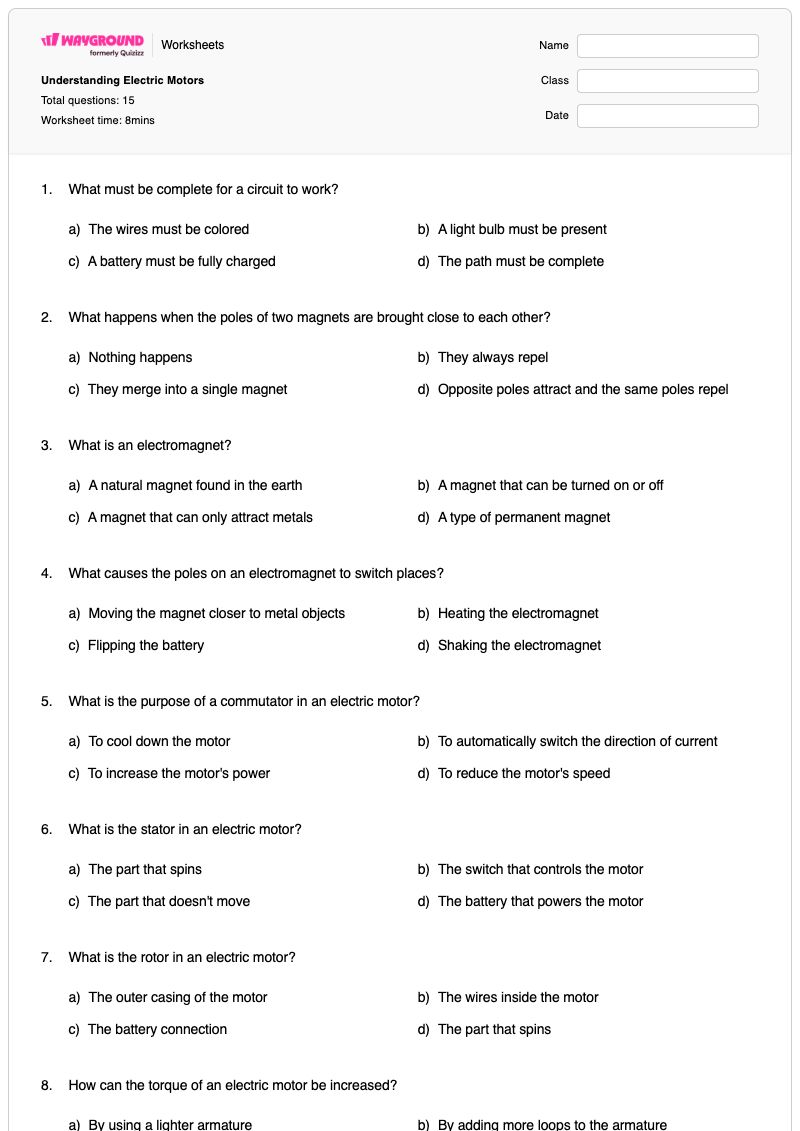
Understanding Electric Motors

คำถามทั้งหมด: 15

ชื่อ
ระดับ
วันที่
1.

What must be complete for a circuit to work?

a)

The wires must be colored

b)

A light bulb must be present

c)

A battery must be fully charged

d)

The path must be complete

2.

What happens when the poles of two magnets are brought close to each other?

a)

Nothing happens

b)

They always repel

c)

They merge into a single magnet

d)

Opposite poles attract and the same poles repel

3.

What is an electromagnet?

a)

A natural magnet found in the earth

b)

A magnet that can be turned on or off

c)

A magnet that can only attract metals

d)

A type of permanent magnet

4.

What causes the poles on an electromagnet to switch places?

a)

Moving the magnet closer to metal objects

b)

Heating the electromagnet

c)

Flipping the battery

d)

Shaking the electromagnet

5.

What is the purpose of a commutator in an electric motor?

a)

To cool down the motor

b)

To automatically switch the direction of current

c)

To increase the motor's power

d)

To reduce the motor's speed

6.

What is the stator in an electric motor?

a)

The part that spins

b)

The switch that controls the motor

c)

The part that doesn't move

d)

The battery that powers the motor

7.

What is the rotor in an electric motor?

a)

The outer casing of the motor

b)

The wires inside the motor

c)

The battery connection

d)

The part that spins

8.

How can the torque of an electric motor be increased?

a)

By using a lighter armature

b)

By adding more loops to the armature

c)

By using a smaller battery

d)

By using fewer wires

9.

What is the role of brushes in an electric motor?

a)

To clean the commutator

b)

To maintain electrical contact with the commutator

c)

To lubricate the motor

d)

To cool down the motor

10.

What type of motor was primarily discussed in the video?

a)

Servo motor

b)

AC motor

c)

Stepper motor

d)

DC motor

11.

What happens when you flip the battery in a circuit?

a)

The current flows the other way

b)

The device connected to the circuit turns off

c)

The current stops flowing

d)

The circuit breaks

12.

What is the effect of wrapping more wires around the armature loops?

a)

Has no effect on the motor

b)

Decreases the motor's efficiency

c)

Makes the electromagnets stronger

d)

Makes the electromagnets weaker

13.

What is the function of the armature in an electric motor?

a)

To spin and create motion

b)

To act as a permanent magnet

c)

To supply power to the motor

d)

To hold the motor together

14.

How does reversing the polarity of an electromagnet affect it?

a)

It loses its magnetic properties

b)

It becomes a permanent magnet

c)

North becomes south and vice versa

d)

It stops being a magnet

15.

What is the significance of the commutator's design in an electric motor?

a)

It makes the motor more energy-efficient

b)

It prevents the motor from overheating

c)

It switches the direction of current automatically

d)

It allows the motor to spin in one direction only

Waygroundแป้นคำตอบ

Understanding Electric Motors

คำถามทั้งหมด: 15

1.
d)

The path must be complete

2.
d)

Opposite poles attract and the same poles repel

3.
b)

A magnet that can be turned on or off

4.
c)

Flipping the battery

5.
b)

To automatically switch the direction of current

6.
c)

The part that doesn't move

7.
d)

The part that spins

8.
b)

By adding more loops to the armature

9.
b)

To maintain electrical contact with the commutator

10.
d)

DC motor

11.
a)

The current flows the other way

12.
c)

Makes the electromagnets stronger

13.
a)

To spin and create motion

14.
c)

North becomes south and vice versa

15.
c)

It switches the direction of current automatically

คำถามที่พบบ่อย

แบบฝึกหัดเรื่องความเข้าใจเกี่ยวกับมอเตอร์ไฟฟ้าครอบคลุมเนื้อหาอะไรบ้าง?

แบบฝึกหัดฟิสิกส์ระดับชั้น ม.4 นี้ประกอบด้วยคำถามแบบเลือกตอบ 15 ข้อ เพื่อประเมินการทำงานร่วมกันของวงจร แม่เหล็กไฟฟ้า และส่วนประกอบของมอเตอร์ไฟฟ้ากระแสตรง นักเรียนจะต้องระบุหน้าที่ของคอมมิวเทเตอร์ แปรงถ่าน สเตเตอร์ โรเตอร์ และอาร์มาเจอร์ และเชื่อมโยงการกลับขั้วแบตเตอรี่และการต่อวงจรเพิ่มเติมเข้ากับการเปลี่ยนแปลงทิศทางกระแสไฟฟ้า ขั้วแม่เหล็ก ความแรง และการเคลื่อนที่ของมอเตอร์

ฉันจะใช้แบบฝึกหัดนี้ในการสอนเรื่องมอเตอร์ไฟฟ้าได้อย่างไร?

เริ่มแบบฝึกหัดโดยทบทวนข้อกำหนดวงจรสมบูรณ์ และแรงดึงดูดและแรงผลักของขั้วแม่เหล็ก จากนั้นใช้คำถามตามลำดับเพื่อเชื่อมโยงการกลับขั้วแบตเตอรี่กับขั้วของแม่เหล็กไฟฟ้า และอธิบายว่าคอมมิวเทเตอร์ แปรงถ่าน สเตเตอร์ โรเตอร์ และอาร์มาเจอร์ ทำให้เกิดการเคลื่อนที่อย่างต่อเนื่องในมอเตอร์กระแสตรงได้อย่างไร ขอให้นักเรียนอธิบายเหตุผลของส่วนประกอบและหน้าที่ของมัน แทนที่จะเลือกคำตอบโดยการท่องจำ

ฉันควรระวังข้อผิดพลาดอะไรบ้างเมื่อนักเรียนทำแบบฝึกหัดเรื่องมอเตอร์ไฟฟ้าชุดนี้?

นักเรียนอาจสับสนระหว่างสเตเตอร์ซึ่งไม่เคลื่อนที่ กับโรเตอร์และอาร์มาเจอร์ซึ่งหมุนและสร้างการเคลื่อนที่ นอกจากนี้ พวกเขาอาจเข้าใจผิดว่าคอมมิวเทเตอร์เป็นชิ้นส่วนระบายความร้อนหรือควบคุมความเร็ว หรือมองข้ามไปว่าการกลับขั้วแบตเตอรี่จะทำให้กระแสไฟฟ้ากลับทิศทางและสลับขั้วแม่เหล็กไฟฟ้า ตรวจสอบให้แน่ใจว่านักเรียนสามารถแยกแยะความแตกต่างระหว่างแม่เหล็กไฟฟ้าที่แรงขึ้นและแรงบิดที่เพิ่มขึ้น กับการเปลี่ยนแปลงที่ไม่เกี่ยวข้อง เช่น การใช้สายไฟน้อยลงหรือแบตเตอรี่ขนาดเล็กกว่า

ฉันจะมอบหมายและตรวจงานเรื่องมอเตอร์ไฟฟ้าชิ้นนี้อย่างไร?

เอกสาร "ทำความเข้าใจเกี่ยวกับมอเตอร์ไฟฟ้า" มีให้เลือกทั้งในรูปแบบไฟล์ PDF ที่สามารถพิมพ์ได้ และแบบทดสอบดิจิทัลบน Wayground พร้อมเฉลยคำตอบครบถ้วนสำหรับคำถามแบบเลือกตอบทั้ง 15 ข้อ การส่งงานในรูปแบบไฟล์ PDF สามารถตรวจได้โดยการสแกนงานของนักเรียนด้วยแอป Wayground for Teachers ในขณะที่แบบทดสอบดิจิทัลสามารถมอบหมายผ่านแพลตฟอร์มเพื่อให้นักเรียนทำแบบทดสอบออนไลน์ได้

ฉันจะปรับแบบฝึกหัดเรื่องมอเตอร์ไฟฟ้าให้เหมาะสมกับนักเรียนของฉันได้อย่างไร?

ใช้การตั้งค่าขั้นสูงของแบบฝึกหัดเพื่อเพิ่มขนาดตัวอักษรหรือปรับระยะห่างระหว่างตัวอักษร เพื่อให้คำถามแบบเลือกตอบ 15 ข้อและคำศัพท์ต่างๆ อ่านง่ายขึ้น นอกจากนี้ คุณยังสามารถเปิดใช้งานแบบอักษรที่เหมาะสำหรับผู้ที่มีภาวะดิสเล็กเซีย หรือแปลแบบฝึกหัดเป็นภาษาอื่นเมื่อนักเรียนต้องการความช่วยเหลือด้านการอ่านเพิ่มเติม

ฉันจะหาแบบฝึกหัดแบบนี้เพิ่มเติมได้ที่ไหนบน Wayground?

Wayground มีแบบฝึกหัดและโจทย์ฝึกหัดมากมายให้ดาวน์โหลดฟรีในหลากหลายวิชา พร้อมไฟล์ PDF และเฉลยคำตอบ เพื่อช่วยเสริมสร้างทักษะและความเข้าใจในแนวคิดสำคัญ ดูแหล่งข้อมูลเพิ่มเติมได้ที่ https://wayground.com/en-us/worksheets