

Wayground
Gettysburg Address - Printable สังคมศึกษา Worksheets 11th ระดับชั้น - Wayground

Gettysburg Address

Leisha Masi

สร้างโดย Leisha Masi

15 คำถาม

11th ระดับชั้น

สังคมศึกษา

แบบฝึกหัดสุนทรพจน์เกตตีสเบิร์กนี้ ออกแบบมาสำหรับวิชาภาษาอังกฤษระดับชั้นมัธยมศึกษาปีที่ 4 (เกรด 11) ประกอบด้วยคำถามแบบเลือกตอบ 15 ข้อ เพื่อพัฒนาทักษะการอ่านอย่างละเอียดและการวิเคราะห์เชิงวาทศิลป์ นักเรียนจะได้ตีความความหมายของคำว่า “บิดา” วิเคราะห์การใช้สรรพนามรวมของลินคอล์น ระบุโทนเสียงที่แสดงความเคารพและความอ่อนน้อมถ่อมตนของสุนทรพจน์ และตรวจสอบว่าการเลือกใช้คำ อุปมาอุปไมย ภาพพจน์ โครงสร้างคู่ขนาน ปฏิปักษ์ และการซ้ำคำ มีส่วนในการสร้างความหมายอย่างไร นอกจากนี้ พวกเขายังต้องประเมินความสัมพันธ์ระหว่างส่วนต่างๆ ของสุนทรพจน์ จุดประสงค์โดยรวม และการโน้มน้าวใจในด้านจริยธรรม อารมณ์ และตรรกะ คำถามเหล่านี้ต้องการให้นักเรียนเชื่อมโยงบรรทัดและวลีเฉพาะกับแนวคิดที่กว้างขึ้น รวมถึงความสัมพันธ์ระหว่างการก่อตั้งประเทศและอนาคต การเสียสละและชีวิตของชาติ ความเสมอภาค หน้าที่ จิตวิญญาณ และการเริ่มต้นใหม่ แบบฝึกหัดที่พิมพ์ได้ฟรีนี้มีเฉลยคำตอบครบถ้วน ทำให้มีประโยชน์สำหรับการอ่านอย่างละเอียดแบบมีผู้แนะนำ การฝึกฝนด้วยตนเอง การเตรียมการอภิปราย หรือการประเมินความสามารถของนักเรียนในการอธิบายว่าการเลือกใช้เชิงวาทศิลป์สนับสนุนจุดประสงค์ของผู้เขียนอย่างไร

การตั้งค่าแผ่นงาน

ขนาดตัวอักษร

S
M
L
XL
Waygroundแผ่นงาน

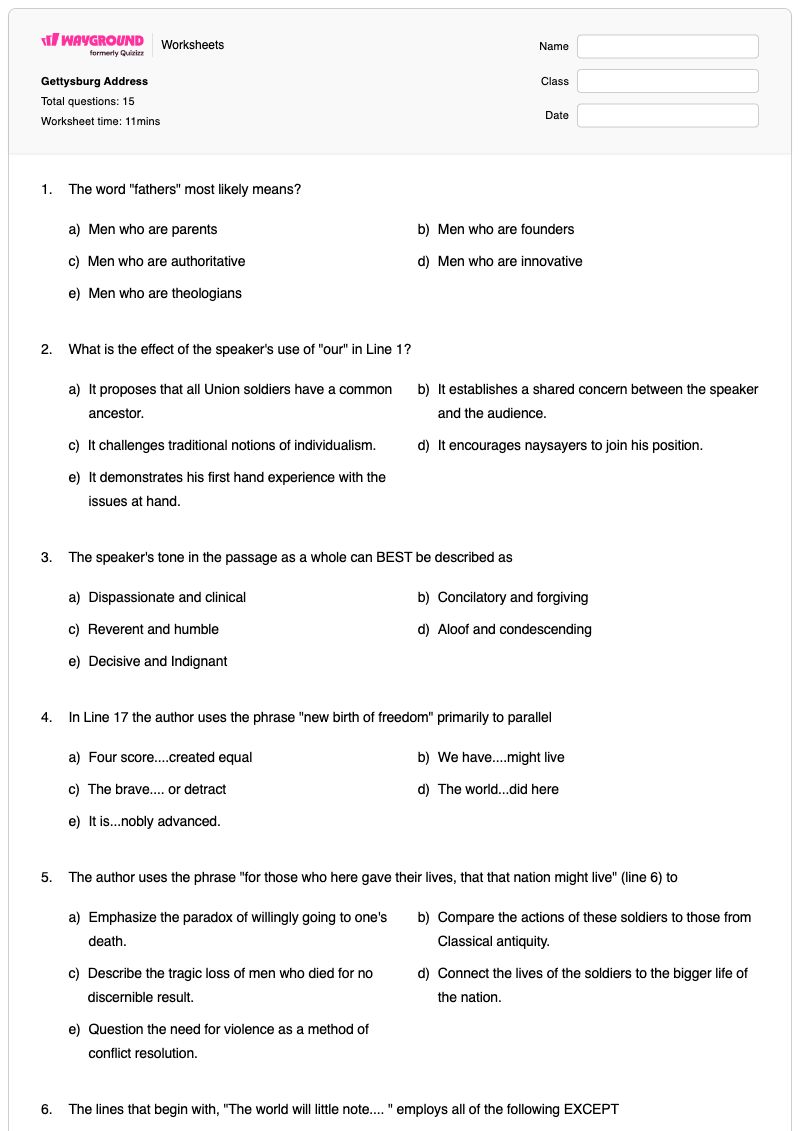
Gettysburg Address

คำถามทั้งหมด: 15

ชื่อ
ระดับ
วันที่
1.

The word "fathers" most likely means?

a)

Men who are parents

b)

Men who are founders

c)

Men who are authoritative

d)

Men who are innovative

e)

Men who are theologians

2.

What is the effect of the speaker's use of "our" in Line 1?

a)

It proposes that all Union soldiers have a common ancestor.

b)

It establishes a shared concern between the speaker and the audience.

c)

It challenges traditional notions of individualism.

d)

It encourages naysayers to join his position.

e)

It demonstrates his first hand experience with the issues at hand.

3.

The speaker's tone in the passage as a whole can BEST be described as

a)

Dispassionate and clinical

b)

Concilatory and forgiving

c)

Reverent and humble

d)

Aloof and condescending

e)

Decisive and Indignant

4.

In Line 17 the author uses the phrase "new birth of freedom" primarily to parallel

a)

Four score....created equal

b)

We have....might live

c)

The brave.... or detract

d)

The world...did here

e)

It is...nobly advanced.

5.

The author uses the phrase "for those who here gave their lives, that that nation might live" (line 6) to

a)

Emphasize the paradox of willingly going to one's death.

b)

Compare the actions of these soldiers to those from Classical antiquity.

c)

Describe the tragic loss of men who died for no discernible result.

d)

Connect the lives of the soldiers to the bigger life of the nation.

e)

Question the need for violence as a method of conflict resolution.

6.

The lines that begin with, "The world will little note.... " employs all of the following EXCEPT

a)

Parallel Structure

b)

Antithesis

c)

Anastrophe

d)

Formal Diction

e)

Juxtaposition

7.

Which of the following best describtes the purpose of the author's rhetorical choices in lines 12-18 (It is...the earth)?

a)

He develops an analogy between the virtues of the dead soldiers to the characteristics of a great Democracy.

b)

He employs a series of dashes to imply that the country will remain forever fragmented.

c)

He provides a list of problems that only can be solved through faith and devotion to God.

d)

He directly addresses the audience to suggest that a unfied country needs a strong and decisive leader.

e)

He emphasizes the amount of effort required to unify the country through the repetition of clauses beginning with "that".

8.

What is the relationship between lines 1-2 "Fourscore...equal" and lines 2-7 ("Now we are engaged...do this")?

a)

Lines 1-2 speak of the past in terms of spatial proximity and lines 2-7 speak of the present with a sense of spatial distance.

b)

Lines 1-2 rely on alliterative speech patterns, and lines 2-7 rely on cacophonic words and phrases.

c)

Lines 1-2 establish the speaker's credibility on the subject and lines 2-7 illustrate an emotional moment in the country's history.

d)

Lines 1-2 outline the challenges faced by the country's founders, and lines 2-7 detail how those challenges have changed over time.

e)

Lines 1-2 are solemn remembrance of fallen soldiers, and lines 2-7 are an accusation of those who have never had to sacrifice.

9.

The passage as a whole can BEST be described as

a)

A commemoration that gives way to criticism.

b)

A case for how the past can influence the future.

c)

An outline of causes that seem to be true of all human conflict.

d)

A lamentation of the perils of building a new nation.

e)

An illustration of interplay between memory and experience.

10.

What is the speaker's primary purpose in lines 1-4

a)

To introduce the idea of war.

b)

To remind the audienve that they are all part of the same nation.

c)

To give a sense of the passage of time and compare the birth of the nation with the present day.

d)

To give the audience a sense of urgency.

e)

To remind the audience who he is and why he has the authority to speak.

11.

The first sentence of this passage (lines 1-2) is unified by metaphorical references to

a)

The passage of time

b)

The founding fathers

c)

Childbirth

d)

The American Revolution

e)

The Fourth of July

12.

The diction of the piece supports imagery relating to which of the following?

I. Spirituality

II. New beginnings

III. Duty

a)

I only

b)

I and II only

c)

I and III only

d)

II and III only

e)

I, II, III

13.

In the address the speaker appeals to all of the following EXCEPT

a)

Equality

b)

Sacrifice

c)

Ambition

d)

Security

e)

Gratitude

14.

The address develops contrasts between each of the following except

a)

Black and white

b)

Words and Deeds

c)

Life and Death

d)

Past and Present

e)

Conflict and Rest

15.

In the second paragraph Lincoln appeal to which of the following

I. Ethos

II. Pathos

III. Logos

a)

I only

b)

III only

c)

I and II only

d)

II and III only

e)

I, II, III

Waygroundแป้นคำตอบ

Gettysburg Address

คำถามทั้งหมด: 15

1.
b)

Men who are founders

2.
b)

It establishes a shared concern between the speaker and the audience.

3.
c)

Reverent and humble

4.
a)

Four score....created equal

5.
d)

Connect the lives of the soldiers to the bigger life of the nation.

6.
c)

Anastrophe

7.
e)

He emphasizes the amount of effort required to unify the country through the repetition of clauses beginning with "that".

8.
a)

Lines 1-2 speak of the past in terms of spatial proximity and lines 2-7 speak of the present with a sense of spatial distance.

9.
b)

A case for how the past can influence the future.

10.
c)

To give a sense of the passage of time and compare the birth of the nation with the present day.

11.
c)

Childbirth

12.
e)

I, II, III

13.
c)

Ambition

14.
a)

Black and white

15.
a)

I only

คำถามที่พบบ่อย

แบบฝึกหัดสุนทรพจน์เกตตีสเบิร์กนี้ช่วยให้นักเรียนเรียนรู้อะไรบ้าง?

แบบฝึกหัดภาษาอังกฤษสำหรับนักเรียนชั้นมัธยมศึกษาปีที่ 4 (เกรด 11) นี้ มีคำถามแบบเลือกตอบ 15 ข้อ ที่เน้นการวิเคราะห์การเลือกใช้สำนวนโวหารของลินคอล์นในสุนทรพจน์เกตตีสเบิร์ก นักเรียนจะได้ตีความคำศัพท์และภาษาเชิงเปรียบเทียบ ติดตามความแตกต่างและความสัมพันธ์เชิงโครงสร้างระหว่างบรรทัด ระบุโทนเสียงและกลวิธีการโน้มน้าวใจ และเชื่อมโยงการเลือกใช้เหล่านั้นเข้ากับจุดประสงค์และแนวคิดหลักของสุนทรพจน์

ฉันจะใช้แบบฝึกหัดนี้ในการสอนการวิเคราะห์เชิงวาทศิลป์ของสุนทรพจน์เกตตีสเบิร์กได้อย่างไร?

หลังจากที่นักเรียนอ่านสุนทรพจน์อย่างละเอียดและทำเครื่องหมายวลีสำคัญ เช่น “ของเรา” “การกำเนิดใหม่แห่งเสรีภาพ” และ “เพื่อให้ประเทศชาติดำรงอยู่” แล้ว ให้ใช้แบบฝึกหัดนี้ ให้นักเรียนตอบคำถามแบบเลือกตอบทีละคน จากนั้นให้พวกเขาอ้างอิงบรรทัดหรือวลีที่เกี่ยวข้องเมื่ออธิบายเหตุผลเกี่ยวกับน้ำเสียง โครงสร้าง ภาพพจน์ และกลวิธีการโน้มน้าวใจ การอภิปรายต่อยอดสามารถเปรียบเทียบว่าคำกล่าวเปิดเชื่อมโยงการก่อตั้งประเทศกับปัจจุบันและอนาคตอย่างไร

ฉันควรสังเกตข้อผิดพลาดอะไรบ้างเมื่อนักเรียนทำแบบฝึกหัดนี้เสร็จ?

นักเรียนอาจเลือกความหมายตรงตัวของคำว่า “บิดา” แทนที่จะตระหนักถึงความหมายที่อ้างถึงผู้ก่อตั้งประเทศ หรืออาจตีความคำว่า “ของเรา” ว่าเป็นเพียงการแสดงความเป็นเจ้าของ แทนที่จะเป็นการแสดงถึงความห่วงใยร่วมกัน นอกจากนี้ พวกเขาอาจสับสนระหว่างน้ำเสียงกับจุดประสงค์ มองข้ามว่าวลี “ว่า” ที่ซ้ำกันช่วยสนับสนุนความหมายของข้อความ หรือระบุการใช้กลวิธีการโน้มน้าวใจโดยไม่พิจารณาถึงภาษาเฉพาะที่ใช้สร้างมันขึ้นมา ขอให้นักเรียนกลับไปอ่านข้อความที่ยกมาอีกครั้งก่อนที่จะเลือกคำตอบเกี่ยวกับโครงสร้าง การเลือกใช้คำ หรือผลทางวาทศิลป์

ฉันจะมอบหมายและให้คะแนนแบบฝึกหัดสุนทรพจน์เกตตีสเบิร์กนี้ได้อย่างไร?

Wayground จัดเตรียมแบบฝึกหัดนี้ในรูปแบบไฟล์ PDF ที่สามารถพิมพ์ได้ และในรูปแบบแบบทดสอบดิจิทัล โดยมีเฉลยคำตอบครบถ้วนสำหรับคำถามแบบเลือกตอบทั้ง 15 ข้อ คุณสามารถมอบหมายงานในรูปแบบดิจิทัลผ่าน Wayground หรือพิมพ์ไฟล์ PDF เพื่อฝึกการอ่านอย่างละเอียดด้วยลายมือ การส่งงานในรูปแบบพิมพ์สามารถตรวจได้โดยการสแกนงานของนักเรียนด้วยแอป Wayground for Teachers

ฉันจะปรับแบบฝึกหัดสุนทรพจน์เกตตีสเบิร์กนี้ให้เหมาะสมกับนักเรียนของฉันได้อย่างไร?

ใช้การตั้งค่าขั้นสูงของแบบฝึกหัดเพื่อปรับระยะห่างระหว่างตัวอักษรและขนาดตัวอักษร เพื่อให้คำถามแบบเลือกตอบ 15 ข้อและวลีที่ยกมานั้นอ่านง่ายขึ้น นอกจากนี้ คุณยังสามารถเปิดใช้งานแบบอักษรที่เหมาะสำหรับผู้ที่มีภาวะดิสเล็กเซีย หรือแปลแบบฝึกหัดเป็นภาษาอื่นได้ โดยที่งานวิเคราะห์เชิงวาทศิลป์และเฉลยคำตอบยังคงเหมือนเดิม

ฉันจะหาแบบฝึกหัดแบบนี้เพิ่มเติมได้ที่ไหนบน Wayground?

Wayground นำเสนอชุดแบบฝึกหัดและโจทย์ฝึกหัดฟรีที่ครอบคลุมหลากหลายวิชา พร้อมไฟล์ PDF และเฉลยคำตอบ เพื่อช่วยให้นักเรียนเชี่ยวชาญทักษะและแนวคิดที่สำคัญ ดูแหล่งข้อมูลเพิ่มเติมได้ที่ https://wayground.com/en-us/worksheets