

Wayground
Personal Hygiene/ Sleep - Printable พลศึกษา Worksheets ระดับ 8 - Wayground

Personal Hygiene/ Sleep

Kayleen Keefer

สร้างโดย Kayleen Keefer

21 คำถาม

6th - 8th ระดับชั้น

พลศึกษา

อัปเดตแล้ว ส.ค. 2569

แบบฝึกหัดพลศึกษาสำหรับนักเรียนชั้น ป.6-ม.2 นี้ ช่วยเสริมสร้างความรู้เกี่ยวกับสุขอนามัยส่วนบุคคลและสุขภาพการนอนหลับ ผ่านข้อสอบแบบเลือกตอบ 21 ข้อ ประกอบด้วยคำถามแบบเลือกตอบ 20 ข้อ และคำถามแบบเลือกคำตอบ 1 ข้อ นักเรียนจะได้ระบุคำศัพท์และแนวคิดที่เกี่ยวข้องกับผิวหนัง เส้นผม เล็บ การดูแลช่องปาก การป้องกันดวงตาและการได้ยิน การนอนหลับที่เหมาะสม ผู้ที่นอนหลับน้อย จังหวะการนอนหลับ ความฝัน และภาวะนอนหลับผิดปกติ นอกจากนี้ยังมีข้อสอบหลายข้อที่ให้นักเรียนรู้จักการดูแลสุขภาพที่ดี และระบุข้อยกเว้นของข้อความที่ถูกต้อง แบบฝึกหัดนี้ออกแบบมาสำหรับใช้ในการสอน การทบทวน หรือการประเมินผลระหว่างเรียนในวิชาสุขศึกษาสำหรับนักเรียนระดับมัธยมต้น คำถามที่หลากหลายจะช่วยให้นักเรียนแยกแยะคำศัพท์ที่เกี่ยวข้องกันอย่างใกล้ชิด เช่น รูขุมขน คราบจุลินทรีย์ เคราติน และเหงือกอักเสบ เชื่อมโยงสุขอนามัยกับการป้องกัน และจดจำแนวคิดสำคัญเกี่ยวกับการนอนหลับ แบบฝึกหัดที่พิมพ์ได้ฟรีนี้มีเฉลยคำตอบครบถ้วน ทำให้ใช้งานได้จริงสำหรับการฝึกฝนด้วยตนเอง งานในชั้นเรียน การบ้าน หรือการทบทวนก่อนการประเมิน

การตั้งค่าแผ่นงาน

ขนาดตัวอักษร

S
M
L
XL
Waygroundแผ่นงาน

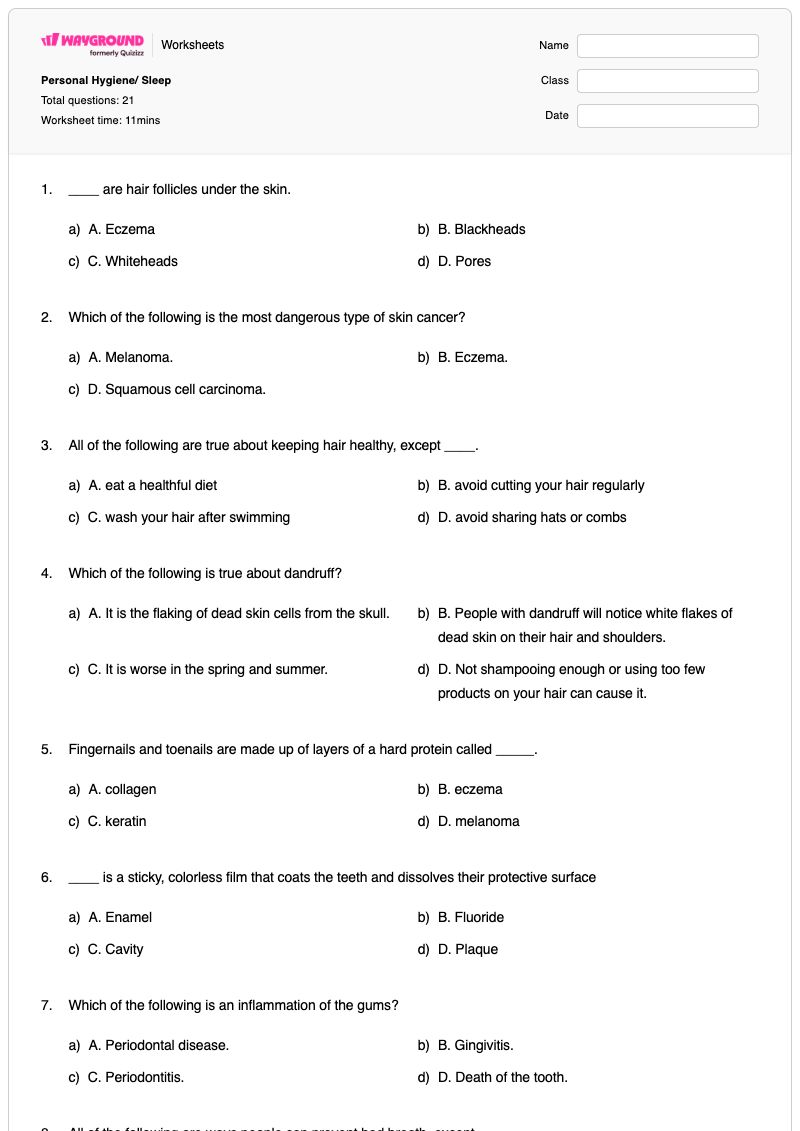
Personal Hygiene/ Sleep

คำถามทั้งหมด: 21

ชื่อ
ระดับ
วันที่
1.

____ are hair follicles under the skin.

a)

A. Eczema

b)

B. Blackheads

c)

C. Whiteheads

d)

D. Pores

2.

Which of the following is the most dangerous type of skin cancer?

a)

A. Melanoma.

b)

B. Eczema.

c)

D. Squamous cell carcinoma.

3.

All of the following are true about keeping hair healthy, except ____.

a)

A. eat a healthful diet

b)

B. avoid cutting your hair regularly

c)

C. wash your hair after swimming

d)

D. avoid sharing hats or combs

4.

Which of the following is true about dandruff?

a)

A. It is the flaking of dead skin cells from the skull.

b)

B. People with dandruff will notice white flakes of dead skin on their hair and shoulders.

c)

C. It is worse in the spring and summer.

d)

D. Not shampooing enough or using too few products on your hair can cause it.

5.

Fingernails and toenails are made up of layers of a hard protein called _____.

a)

A. collagen

b)

B. eczema

c)

C. keratin

d)

D. melanoma

6.

____ is a sticky, colorless film that coats the teeth and dissolves their protective surface

a)

A. Enamel

b)

B. Fluoride

c)

C. Cavity

d)

D. Plaque

7.

Which of the following is an inflammation of the gums?

a)

A. Periodontal disease.

b)

B. Gingivitis.

c)

C. Periodontitis.

d)

D. Death of the tooth.

8.

All of the following are ways people can prevent bad breath, except ____.

a)

A. seeing the dentist once every two years for checkups

b)

B. brushing your teeth twice a day

c)

C. using an antiseptic mouth-rinse

d)

D. flossing your teeth to remove food particles

9.

Which of the following is a way to protect your eyes from damage?

a)

A. Wearing protective eyewear when doing something that could create flying debris that could hit the eyes.

b)

B. Only sharing makeup and eye care products with people who you know have good hygiene habits.

c)

C. Flushing your eyes if something gets into them with soapy water.

d)

D. Wearing sunglasses to prevent eye strain when indoors.

10.

All of the following are early signs of hearing damage, except ____.

a)

A. having difficulty hearing relatively soft sounds

b)

B. having difficulty understanding speech during phone conversations

c)

C. experiencing tinnitus after exposure to excessively loud sounds

d)

D. losing the ability to hear suddenly

11.

The average amount of sleep school-age children should get every night is ____ hours.

a)

A. 12–16

b)

B. 10–13

c)

C. 9–12

d)

D. 7–9

12.

A short sleeper is someone who ____.

a)

A. can function well on less sleep

b)

B. needs to sleep less often than others

c)

C. does not experience a sleep deficit

d)

D. goes to sleep early and wakes up early

13.

All of the following are part of the circadian rhythms controlled by the body’s master biological “clock,” except ____.

a)

A. sleep-wake cycle

b)

B. dream cycles

c)

C. hormone (melatonin)levels

d)

D. brain wave activity

14.

Which of the following do researchers believe dreams help people do?

a)

A. Regulate their moods.

b)

B. Forget information.

c)

C. Cause conflicts.

15.

____ is a disorder that results in a person being unable to fall asleep until very late at night and naturally not waking up until much later in the morning. Teens are commonly experiencing this.

a)

A. Delayed sleep phase syndrome

b)

B. Insomnia

c)

C. Parasomnia

d)

D. Sleep apnea

16.

All of the following are common parasomnia disorders, except ____.

a)

A. sleepwalking

b)

B. restless leg syndrome

c)

C. sleep apnea

d)

D. teeth grinding

17.

The stage of sleep where you are falling asleep.

a)

A. Stage 2

b)

B. Stage 3

c)

D. Stage 1

d)

C. Stage 4

18.

All of the following are snacks that contain tryptophan, which can help you fall asleep at night, except ____.

a)

A. turkey sandwich

b)

B. banana

c)

C. chocolate

d)

D. kiwi

19.

Which of the following is a technique you should use to create a comfortable environment for sleeping?

a)

A. Create a small space on your bed where you cannot toss or turn.

b)

B. Reduce the room’s temperature so it isn't too warm.

c)

C. Listen to loud music to drown out other noise.

d)

D. Keep a light on to mimic the moon.

20.

All of the following are examples of how to control exposure to light in order to regulate your sleep schedule, EXCEPT ____.

a)

A. using a night-light in the bathroom to avoid turning on a light in the middle of the night

b)

B. keeping the curtains and blinds closed during the day to reduce the amount of light

c)

C. eating lunch outside or going for a walk in the late afternoon

d)

D. minimizing the time you spend in front of the television or computer screen at the end of the day

21.

What is a way that you can care for your ears?

a)

Ear drops

b)

Wear ear protection (ear plugs)

c)

Wear sunscreen

d)

Be careful around hazard zones.

Waygroundแป้นคำตอบ

Personal Hygiene/ Sleep

คำถามทั้งหมด: 21

1.
d)

D. Pores

2.
a)

A. Melanoma.

3.
b)

B. avoid cutting your hair regularly

4.
b)

B. People with dandruff will notice white flakes of dead skin on their hair and shoulders.

5.
c)

C. keratin

6.
d)

D. Plaque

7.
b)

B. Gingivitis.

8.
a)

A. seeing the dentist once every two years for checkups

9.
a)

A. Wearing protective eyewear when doing something that could create flying debris that could hit the eyes.

10.
d)

D. losing the ability to hear suddenly

11.
c)

C. 9–12

12.
a)

A. can function well on less sleep

13.
b)

B. dream cycles

14.
a)

A. Regulate their moods.

15.
a)

A. Delayed sleep phase syndrome

16.
c)

C. sleep apnea

17.
c)

D. Stage 1

18.
c)

C. chocolate

19.
b)

B. Reduce the room’s temperature so it isn't too warm.

20.
b)

B. keeping the curtains and blinds closed during the day to reduce the amount of light

21.
b)

Wear ear protection (ear plugs)

คำถามที่พบบ่อย

แบบฝึกหัดเกี่ยวกับสุขอนามัยส่วนบุคคลและการนอนหลับนี้ครอบคลุมเรื่องอะไรบ้าง?

แบบฝึกหัดพลศึกษาสำหรับนักเรียนชั้นประถมศึกษาปีที่ 6-8 นี้ ประกอบด้วยคำถามแบบเลือกตอบ 20 ข้อ และคำถามแบบเลือกคำตอบหลายข้ออีก 1 ข้อ เพื่อประเมินความรู้ด้านสุขอนามัยส่วนบุคคล การปกป้องประสาทสัมผัส และสุขภาพการนอนหลับ นักเรียนจะได้แยกแยะคำศัพท์ต่างๆ เช่น รูขุมขน มะเร็งผิวหนัง เคราติน คราบจุลินทรีย์ และโรคเหงือกอักเสบ รู้จักวิธีการปกป้องดวงตาและการได้ยิน และระบุแนวคิดเกี่ยวกับการนอนหลับ รวมถึงชั่วโมงการนอนหลับที่แนะนำ จังหวะชีวิตประจำวัน ผู้ที่นอนหลับน้อย และภาวะนอนหลับผิดปกติ

ฉันจะใช้แบบฝึกหัดนี้ในการสอนเรื่องสุขอนามัยส่วนบุคคลและสุขภาพการนอนหลับได้อย่างไร?

เริ่มแนะนำแบบฝึกหัดโดยแบ่งคำถามออกเป็นกลุ่มการดูแลร่างกาย การปกป้องประสาทสัมผัส และสุขภาพการนอนหลับ หลังจากที่นักเรียนทำแบบฝึกหัดแต่ละกลุ่มเสร็จแล้ว ให้พวกเขาอธิบายว่าเหตุใดสุขอนามัยหรือการป้องกันจึงถูกต้อง และให้นิยามคำศัพท์ต่างๆ เช่น คราบจุลินทรีย์ โรคเหงือกอักเสบ เคราติน และจังหวะชีวิตประจำวัน ใช้คำถามเกี่ยวกับข้อยกเว้นและข้อคำถามเกี่ยวกับรังแคแบบเลือกตอบหลายข้อเพื่อกระตุ้นให้นักเรียนอธิบายเหตุผลของแต่ละตัวเลือก แทนที่จะพึ่งพาการจำคำศัพท์เพียงอย่างเดียว

ฉันควรสังเกตข้อผิดพลาดอะไรบ้างเมื่อนักเรียนทำแบบฝึกหัดนี้เสร็จ?

นักเรียนอาจสับสนคำศัพท์ด้านสุขภาพที่เกี่ยวข้องกัน เช่น คราบพลัคกับเคลือบฟัน โรคเหงือกอักเสบกับโรคปริทันต์ หรือรูขุมขนกับโรคผิวหนัง นอกจากนี้ พวกเขาอาจมองข้ามคำว่า “ยกเว้น” ในคำถามเกี่ยวกับการดูแลเส้นผม การป้องกันกลิ่นปาก และสัญญาณของความเสียหายทางการได้ยิน ในข้อสอบแบบเลือกตอบหลายข้อเกี่ยวกับรังแค ให้ตรวจสอบว่านักเรียนประเมินทุกตัวเลือกแทนที่จะเลือกคำตอบที่คุ้นเคยโดยอัตโนมัติ และระวังความสับสนระหว่างจังหวะชีวิตประจำวันกับวงจรการฝัน

ฉันจะมอบหมายและให้คะแนนแบบฝึกหัดเรื่องสุขอนามัยส่วนบุคคลและการนอนหลับนี้อย่างไร?

แบบฝึกหัดนี้มีให้ดาวน์โหลดในรูปแบบไฟล์ PDF สำหรับพิมพ์ และเป็นแบบทดสอบดิจิทัลบน Wayground แบบฝึกหัดนี้มีเฉลยคำตอบครบถ้วนสำหรับคำถามแบบเลือกตอบ 20 ข้อ และคำถามแบบเลือกตอบหลายข้ออีก 1 ข้อ และสามารถตรวจให้คะแนนได้โดยการสแกนงานของนักเรียนด้วยแอป Wayground for Teachers นอกจากนี้ รูปแบบไฟล์ PDF ยังช่วยสนับสนุนโรงเรียนที่ต้องการลดเวลาการใช้หน้าจออีกด้วย

ฉันจะปรับแบบฝึกหัดเรื่องสุขอนามัยส่วนบุคคลและการนอนหลับนี้ให้เหมาะสมกับนักเรียนของฉันได้อย่างไร?

ในส่วนการตั้งค่าขั้นสูงของแบบฝึกหัด ให้ปรับระยะห่างระหว่างตัวอักษรและขนาดตัวอักษรเพื่อให้คำศัพท์ด้านสุขภาพและตัวเลือกคำตอบอ่านง่ายขึ้น นอกจากนี้ คุณยังสามารถเปิดใช้งานแบบอักษรที่เหมาะสำหรับนักเรียนที่มีภาวะดิสเล็กเซีย หรือแปลแบบฝึกหัดเป็นภาษาอื่นโดยคงรูปแบบคำถามแบบปรนัยและเลือกหลายข้อไว้ได้

ฉันจะหาแบบฝึกหัดแบบนี้เพิ่มเติมได้ที่ไหนบน Wayground?

Wayground นำเสนอชุดแบบฝึกหัดและโจทย์ฝึกหัดฟรีที่ครอบคลุมทุกวิชา พร้อมไฟล์ PDF และเฉลยคำตอบ เพื่อสนับสนุนทักษะและแนวคิดที่สำคัญ ดูแหล่งข้อมูลเพิ่มเติมได้ที่ https://wayground.com/en-us/worksheets