

Wayground
A.O.C., Preamble, Rule of Law and Fed/Anti-Fed. Debate - Printable สังคมศึกษา Worksheets ระดับ 7 - Wayground

A.O.C., Preamble, Rule of Law and Fed/Anti-Fed. Debate

Civics Goddess

สร้างโดย Civics Goddess

19 คำถาม

7th ระดับชั้น

สังคมศึกษา

อัปเดตแล้ว ต.ค. 2569

แบบฝึกหัดวิชาสังคมศึกษา ชั้น ม.1 นี้จะสำรวจว่าบทบัญญัติแห่งสมาพันธรัฐ รัฐธรรมนูญสหรัฐฯ คำนำ หลักนิติธรรม และการถกเถียงระหว่างกลุ่มเฟเดอราลิสต์และกลุ่มแอนตี้เฟเดอราลิสต์ มีส่วนในการกำหนดรูปแบบการปกครองของอเมริกาอย่างไร แบบฝึกหัดประกอบด้วย 19 ข้อ—คำถามแบบเลือกตอบ 18 ข้อ และกิจกรรมจับคู่ 1 ข้อ—นักเรียนจะได้เชื่อมโยงจุดอ่อนของบทบัญญัติแห่งสมาพันธรัฐ เช่น อำนาจการเก็บภาษีที่จำกัด และความยากลำบากในการออกกฎหมาย กับโครงสร้างสหพันธรัฐที่แข็งแกร่งกว่าของรัฐธรรมนูญ นอกจากนี้ นักเรียนยังจะได้ระบุวัตถุประสงค์ของคำนำ อธิบายว่าทำไม “เราประชาชน” จึงมีความสำคัญ ตระหนักถึงการคุ้มครองที่ได้รับจากหลักนิติธรรม และตีความข้อกังวลของกลุ่มแอนตี้เฟเดอราลิสต์เกี่ยวกับสิทธิส่วนบุคคล คำถามเหล่านี้ช่วยเสริมสร้างทักษะการคิดเชิงพลเมืองและประวัติศาสตร์ โดยขอให้นักเรียนเชื่อมโยงสาเหตุ ปัญหา ผลลัพธ์ และหลักการทางรัฐธรรมนูญ แทนที่จะศึกษาคำศัพท์แบบแยกส่วน กิจกรรมจับคู่ช่วยเสริมความเข้าใจในคำศัพท์สำคัญ เช่น สมาพันธรัฐ การให้สัตยาบัน รัฐธรรมนูญ หนี้สิน และบัญญัติสิทธิ ในขณะที่คำถามแบบเลือกตอบจะตรวจสอบความเข้าใจเกี่ยวกับการถกเถียงที่นำไปสู่การร่างบัญญัติสิทธิ แบบฝึกหัดที่พิมพ์ได้ฟรีนี้มีเฉลยคำตอบครบถ้วน เพื่อใช้ในการทบทวนอย่างมีประสิทธิภาพ การฝึกฝนด้วยตนเอง หรือการประเมินผลในชั้นเรียน

การตั้งค่าแผ่นงาน

ขนาดตัวอักษร

S
M
L
XL
Waygroundแผ่นงาน

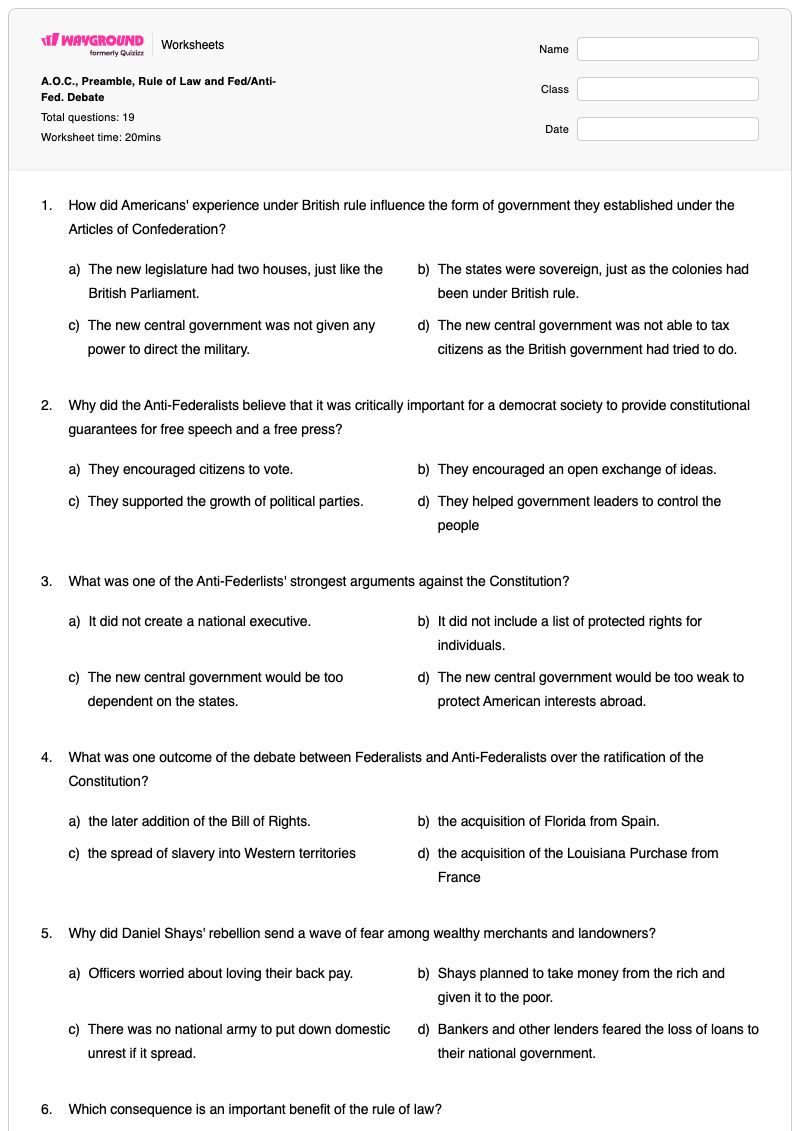
A.O.C., Preamble, Rule of Law and Fed/Anti-Fed. Debate

คำถามทั้งหมด: 19

ชื่อ
ระดับ
วันที่
1.

How did Americans' experience under British rule influence the form of government they established under the Articles of Confederation?

a)

The new legislature had two houses, just like the British Parliament.

b)

The states were sovereign, just as the colonies had been under British rule.

c)

The new central government was not given any power to direct the military.

d)

The new central government was not able to tax citizens as the British government had tried to do.

2.

Why did the Anti-Federalists believe that it was critically important for a democrat society to provide constitutional guarantees for free speech and a free press?

a)

They encouraged citizens to vote.

b)

They encouraged an open exchange of ideas.

c)

They supported the growth of political parties.

d)

They helped government leaders to control the people

3.

What was one of the Anti-Federlists' strongest arguments against the Constitution?

a)

It did not create a national executive.

b)

It did not include a list of protected rights for individuals.

c)

The new central government would be too dependent on the states.

d)

The new central government would be too weak to protect American interests abroad.

4.

What was one outcome of the debate between Federalists and Anti-Federalists over the ratification of the Constitution?

a)

the later addition of the Bill of Rights.

b)

the acquisition of Florida from Spain.

c)

the spread of slavery into Western territories

d)

the acquisition of the Louisiana Purchase from France

5.

Why did Daniel Shays' rebellion send a wave of fear among wealthy merchants and landowners?

a)

Officers worried about loving their back pay.

b)

Shays planned to take money from the rich and given it to the poor.

c)

There was no national army to put down domestic unrest if it spread.

d)

Bankers and other lenders feared the loss of loans to their national government.

6.

Which consequence is an important benefit of the rule of law?

a)

Bureaucratic government procedures are reduced

b)

Government decisions are based on the will of the majority

c)

Government officials can act on their own instincts in emergencies

d)

Citizens are protected from arbitrary and oppressive uses of government power

7.

Which action reflects a fundamental principle of the rule of law?

a)

Decisions by the government are based on the law.

b)

Government leaders can change the law without notice.

c)

People accused of crimes against the state are tried in secret.

d)

Different social classes enjoy different legal rights and privileges.

8.

 Why did the Preamble to the Constitution begin with the phrase, “We the People”?

a)

To indicate that the national government had limited powers.

b)

To indicate that the states had been associated in a confederation

c)

To indicate that federal power was separated among three branches

d)

To indicate that the American people were the ultimate source of its authority

9.

Which identifies one of the goals of government listed in the Preamble?

a)

To guarantee employment to all citizens

b)

To expand the nation’s frontiers westward

c)

To establish independence from Great Britain

d)

To promote the general welfare

10.

Which part of the U.S. Constitution states the six purposes of government?

a)

Bill of Rights

b)

Article IV

c)

preamble

d)

Article I

11.

Match the following

Confederation

A loose association of states

Debt

Something, typically money,that is owed or due

Bill of Rights

The first 10 amendments to the U.S. Constitution.

Ratification

Approval by a formal vote

Constitution

A written plan of government

12.

How did the U.S. Constitution solve a problem created by the Articles of Confederation?

a)

It avoided the issue of states’ rights

b)

It allowed the states to elect representatives

c)

It prevented the amendment of federal laws

d)

It enabled the federal government to collect taxes

13.

 What is the most likely reason it was difficult to pass laws under the Articles of Confederation?

a)

Passage required a unanimous vote of the 13 states

b)

Passage required the votes of 9 of the 13 states

c)

The government did not have a legislative branch

d)

Americans were content to follow British laws

14.

Which of the following might have caused people to oppose the Articles of Confederation?

a)

Congress had the power to collect taxes

b)

Congress could not pay soldiers who fought in the Revolutionary War

c)

Congress controlled trade between the states

d)

Congress granted too much power to the executive branch

15.

What sort of government was established by the Articles of Confederation?

a)

A federal arrangement with a strong central government

b)

A firm union of states

c)

A union in which some states had more power than others

d)

A loose association of states

16.

Because this branch was missing under the Articles of Confederation the government had no power to enforce its laws.

a)

Legislative

b)

Congress

c)

Judicial

d)

Executive

17.

Which of the following was NOT a weakness of the Articles of Confederation?

a)

There was only one branch

b)

There was no national judicial branch.

c)

There was no way to enforce laws

d)

There was no way to make laws

18.

Why did the Founding Fathers separate the power to make, enforce, and interpret laws between different branches of government?

a)

to ensure that Congress would act according to the will of the people

b)

to increase the power of the presidency

c)

to make the national government more efficient

d)

to prevent one branch of government from becoming too powerful

19.

Under the Articles most of the power resided with?

a)

The people

b)

The national government

c)

The central government

d)

The states

Waygroundแป้นคำตอบ

A.O.C., Preamble, Rule of Law and Fed/Anti-Fed. Debate

คำถามทั้งหมด: 19

1.
d)

The new central government was not able to tax citizens as the British government had tried to do.

2.
b)

They encouraged an open exchange of ideas.

3.
b)

It did not include a list of protected rights for individuals.

4.
a)

the later addition of the Bill of Rights.

5.
c)

There was no national army to put down domestic unrest if it spread.

6.
d)

Citizens are protected from arbitrary and oppressive uses of government power

7.
a)

Decisions by the government are based on the law.

8.
d)

To indicate that the American people were the ultimate source of its authority

9.
d)

To promote the general welfare

10.
c)

preamble

11.

Confederation

 - 

A loose association of states

, 

Debt

 - 

Something, typically money,that is owed or due

, 

Bill of Rights

 - 

The first 10 amendments to the U.S. Constitution.

, 

Ratification

 - 

Approval by a formal vote

, 

Constitution

 - 

A written plan of government

12.
d)

It enabled the federal government to collect taxes

13.
b)

Passage required the votes of 9 of the 13 states

14.
b)

Congress could not pay soldiers who fought in the Revolutionary War

15.
d)

A loose association of states

16.
d)

Executive

17.
d)

There was no way to make laws

18.
d)

to prevent one branch of government from becoming too powerful

19.
d)

The states

คำถามที่พบบ่อย

แบบฝึกหัดนี้ครอบคลุมเนื้อหาอะไรบ้าง และช่วยให้นักเรียนชั้น ม.1 เข้าใจการปกครองของสหรัฐอเมริกาในยุคแรกได้อย่างไร?

แบบฝึกหัดนี้ประกอบด้วยคำถามแบบเลือกตอบ 18 ข้อ และกิจกรรมจับคู่ 1 กิจกรรม เพื่อศึกษาเกี่ยวกับบทบัญญัติแห่งสมาพันธรัฐ รัฐธรรมนูญ คำนำ หลักนิติธรรม และการถกเถียงระหว่างฝ่ายเฟเดอราลิสต์และฝ่ายแอนตี้เฟเดอราลิสต์ นักเรียนจะต้องเชื่อมโยงจุดอ่อนเฉพาะของบทบัญญัติแห่งสมาพันธรัฐ เช่น อำนาจการเก็บภาษีที่จำกัด และความยากลำบากในการออกกฎหมาย กับการเปลี่ยนแปลงในรัฐธรรมนูญ ระบุเป้าหมายของคำนำ และอธิบายว่าเหตุใดฝ่ายแอนตี้เฟเดอราลิสต์จึงผลักดันให้มีการคุ้มครองสิทธิส่วนบุคคล

ฉันจะใช้แบบฝึกหัดนี้ในการสอนเรื่องบทบัญญัติแห่งสมาพันธรัฐและการถกเถียงระหว่างฝ่ายเฟเดอราลิสต์และฝ่ายแอนตี้เฟเดอราลิสต์ได้อย่างไร?

หลังจากที่นักเรียนทบทวนโครงสร้างและข้อจำกัดของบทบัญญัติแล้ว ให้เริ่มด้วยแบบฝึกหัด จากนั้นหยุดพักที่คำถามเกี่ยวกับการเก็บภาษี อำนาจทางทหาร และข้อกำหนดการลงคะแนนเสียงของเก้ารัฐ เพื่ออภิปรายถึงสาเหตุและผลกระทบ ต่อด้วยคำนำและหัวข้อเกี่ยวกับหลักนิติธรรม โดยถามนักเรียนว่ารัฐบาลกลางที่เข้มแข็งกว่าแก้ไขปัญหาในอดีตได้อย่างไร ในขณะที่กลุ่มเฟเดอราลิสต์และกลุ่มแอนตี้เฟเดอราลิสต์ยังคงถกเถียงกันเรื่องสิทธิส่วนบุคคล ใช้กิจกรรมจับคู่เพื่อรวบรวมคำศัพท์ต่างๆ เช่น การให้สัตยาบัน สมาพันธรัฐ และบัญญัติสิทธิ

ฉันควรสังเกตข้อผิดพลาดอะไรบ้างเมื่อนักเรียนทำแบบฝึกหัดนี้เสร็จ?

นักเรียนอาจสับสนระหว่างข้อตกลงสมาพันธรัฐที่กล่าวถึงการรวมตัวกันอย่างหลวมๆ ของรัฐต่างๆ กับการจัดระเบียบแบบสหพันธรัฐที่แข็งแกร่งกว่าซึ่งบัญญัติไว้ในรัฐธรรมนูญ นอกจากนี้ พวกเขาอาจเลือกคำอธิบายทั่วไปของประชาธิปไตยแทนที่จะเลือกหลักนิติธรรมที่เฉพาะเจาะจงซึ่งระบุว่าการตัดสินใจของรัฐบาลนั้นอยู่บนพื้นฐานของกฎหมาย หรืออาจสับสนระหว่างจุดประสงค์ของคำนำกับบทบัญญัติที่พบในบัญญัติสิทธิหรือมาตราเฉพาะของรัฐธรรมนูญ ในแบบฝึกหัดจับคู่ ให้ตรวจสอบว่านักเรียนแยกแยะความแตกต่างระหว่างการให้สัตยาบันกับรัฐธรรมนูญเองและกับสมาพันธรัฐได้หรือไม่

ฉันจะมอบหมายและตรวจงานใบงานนี้อย่างไร?

แบบฝึกหัดนี้มีให้ดาวน์โหลดในรูปแบบไฟล์ PDF และแบบทดสอบดิจิทัลบน Wayground พร้อมเฉลยคำตอบครบถ้วนสำหรับทั้ง 19 ข้อ ใช้ไฟล์ PDF สำหรับฝึกเขียนเกี่ยวกับบทความ รัฐธรรมนูญ และการถกเถียงระหว่างกลุ่มเฟเดอราลิสต์และกลุ่มแอนตี้เฟเดอราลิสต์ หรือใช้แบบทดสอบดิจิทัลสำหรับการตอบคำถามออนไลน์ การส่งงานในรูปแบบไฟล์ PDF สามารถตรวจได้โดยการสแกนงานของนักเรียนด้วยแอป Wayground for Teachers

ฉันจะปรับแบบฝึกหัดนี้ให้เหมาะสมกับนักเรียนของฉันได้อย่างไร?

สำหรับคำถามแบบเลือกตอบและกิจกรรมจับคู่คำศัพท์ ให้ใช้การตั้งค่าขั้นสูงของแบบฝึกหัดเพื่อปรับระยะห่างระหว่างตัวอักษรและขนาดตัวอักษรเพื่อให้ง่ายต่อการอ่าน นอกจากนี้ คุณยังสามารถเปิดใช้งานแบบอักษรที่เหมาะสำหรับผู้ที่มีภาวะดิสเล็กเซีย หรือแปลแบบฝึกหัดเป็นภาษาอื่นได้ตามความเหมาะสม ตัวเลือกเหล่านี้จะคงคำถามไว้ในขณะที่เปลี่ยนรูปแบบการนำเสนอของไฟล์แบบฝึกหัด

ฉันจะหาแบบฝึกหัดแบบนี้เพิ่มเติมได้ที่ไหนบน Wayground?

Wayground มีแบบฝึกหัดและโจทย์ฝึกหัดมากมายให้ดาวน์โหลดฟรีในหลากหลายวิชา พร้อมไฟล์ PDF และเฉลยคำตอบ เพื่อช่วยเสริมสร้างทักษะและความเข้าใจในแนวคิดสำคัญ ดูแหล่งข้อมูลเพิ่มเติมได้ที่ https://wayground.com/en-us/worksheets