

Wayground
Introduction to Life Science - Printable ศาสตร์ Worksheets ระดับ 7 - Wayground

Introduction to Life Science

Christine Fuller

สร้างโดย Christine Fuller

32 คำถาม

7th ระดับชั้น

ศาสตร์

อัปเดตแล้ว ก.ย. 2568

แบบฝึกหัดวิทยาศาสตร์เบื้องต้นสำหรับนักเรียนชั้น ม.1 (เกรด 7) นี้ ช่วยสร้างทักษะการสืบค้นทางวิทยาศาสตร์ขั้นพื้นฐาน นักเรียนจะได้เรียนรู้การแยกแยะความแตกต่างระหว่างการสังเกต การอนุมาน และการคาดการณ์ การระบุข้อมูล การจัดประเภทข้อมูล การสื่อสารผลการค้นพบ และการรู้จักขั้นตอนต่างๆ เช่น การตั้งคำถาม การค้นคว้า การทดสอบสมมติฐาน การวิเคราะห์ข้อมูล และการสรุปผล แบบฝึกหัดนี้มีทั้งหมด 32 ข้อ ประกอบด้วยคำถามแบบเลือกตอบ 29 ข้อ คำถามแบบเลือกคำตอบหลายข้อ 1 ข้อ และช่องให้กรอกชื่อและนามสกุล คำถามใช้ตัวอย่างในชีวิตประจำวัน เช่น การตีความพฤติกรรมของสุนัข หรือการพยากรณ์อากาศในวันพรุ่งนี้ เพื่อช่วยให้นักเรียนเชื่อมโยงคำศัพท์ทางวิทยาศาสตร์กับสถานการณ์จริง แบบฝึกหัดที่พิมพ์ได้ฟรีนี้มีเฉลยคำตอบครบถ้วน และสามารถใช้ประกอบการเรียนการสอนเบื้องต้น การฝึกฝนแบบมีผู้แนะนำ การทบทวนด้วยตนเอง หรือการตรวจสอบความเข้าใจสำหรับนักเรียนชั้น ม.1 (เกรด 7)

การตั้งค่าแผ่นงาน

ขนาดตัวอักษร

S
M
L
XL
Waygroundแผ่นงาน

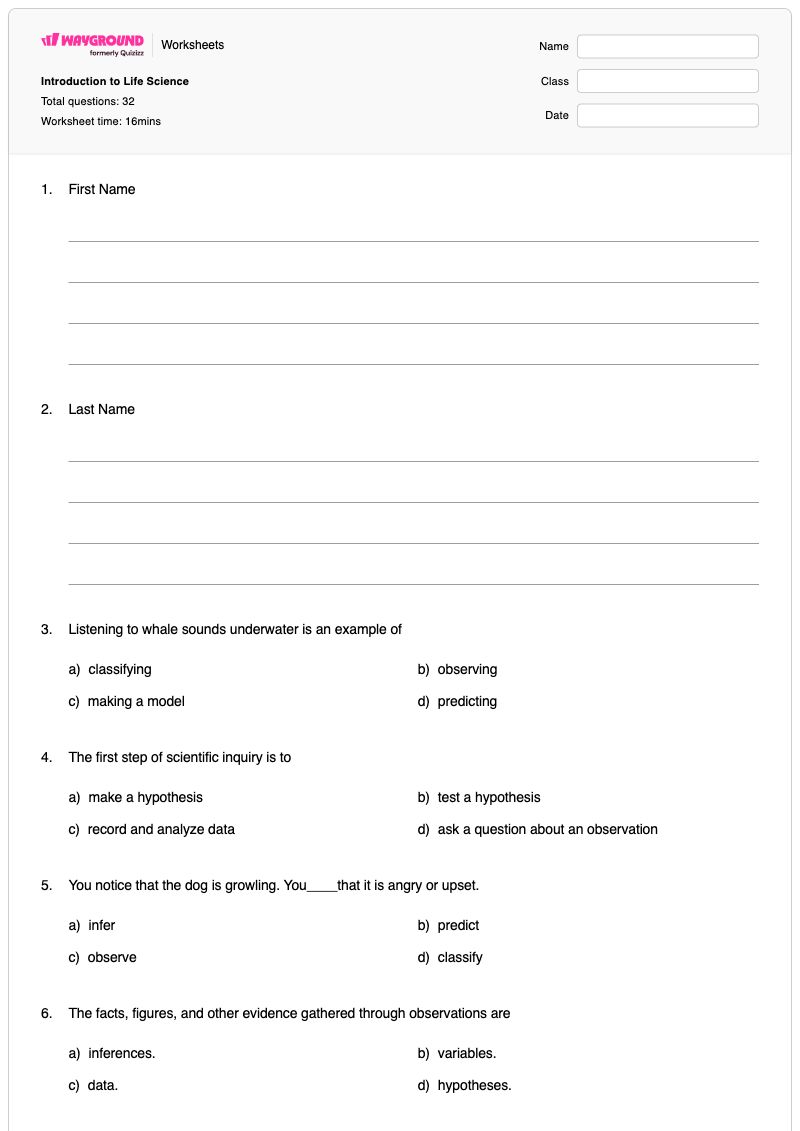
Introduction to Life Science

คำถามทั้งหมด: 32

ชื่อ
ระดับ
วันที่
1.
First Name
4 เส้น
2.
Last Name
4 เส้น
3.
Listening to whale sounds underwater is an example of
a)
classifying
b)
observing
c)
making a model
d)
predicting
4.
The first step of scientific inquiry is to
a)
make a hypothesis
b)
test a hypothesis
c)
record and analyze data
d)
ask a question about an observation
5.
You notice that the dog is growling. You____that it is angry or upset.
a)
infer
b)
predict
c)
observe
d)
classify
6.
The facts, figures, and other evidence gathered through observations are
a)
inferences.
b)
variables.
c)
data.
d)
hypotheses.
7.
Which science skill uses your senses to gather information?
a)
classifying
b)
observing
c)
making models
d)
predicting
8.
If someone said, "It will be sunny tomorrow," they are making a(n)____________________.
a)
inference
b)
observation
c)
model
d)
prediction
9.
Which science skill is a good way to keep things organized?
a)
classifying
b)
observing
c)
making a model
d)
predicting
10.
A(n) _____________is a forecast of future events.
a)
inference.
b)
observation
c)
model
d)
prediction
11.
An attempt to interpret or explain an observation or to explain what IS or HAS happened in the past is a(n)
a)
inference
b)
observation
c)
conclusion
d)
prediction
12.
The sharing of ideas and experimental findings through writing and speaking is called
a)
observing
b)
communicating
c)
classifying
d)
predicting
13.
In which step of scientific inquiry would you test your hypothesis?
a)
State the problem.
b)
Perform an experiment.
c)
Make an educated guess.
d)
State the conclusion.
14.
Which step of scientific inquiry is a summary of the whole experiment?
a)
Make a hypothesis.
b)
Test the hypothesis.
c)
State the problem.
d)
State a conclusion.
15.
In which step of the scientific method would you use the internet to find information?
a)
Make a hypothesis.
b)
Test the hypothesis.
c)
Record and analyze data.
d)
Research.
16.
The one variable that is purposely changed to test a hypothesis is the
a)
manipulated (independent) variable
b)
responding (dependent) variable
c)
controlled variable
d)
data
17.
The one variable that may change in response to the manipulated variable is the
a)
independent variable.
b)
responding (dependent) variable.
c)
contolled variable.
d)
data.
18.
A possible explanation for a set of observations or an answer to a scientific question that is written in an "if/then" format is a
a)
observation
b)
inquiry
c)
hypothesis
d)
variable
19.
A statement of whether the hypothesis was correct or incorrect is called a(n)
a)
observation
b)
inference
c)
prediction
d)
conclusion
20.
Skepticism involves
a)
being inventive when designing experiments.
b)
having an attitude of doubt.
c)
being open minded to new ideas.
d)
reporting your data truthfully.
21.
Life Science is also known as
a)
botany
b)
biology
c)
geology
d)
micrology
22.
The goal of TECHNOLOGY is to improve the way people live.
a)
True
b)
False
23.
A leaf is an example of technology.
a)
True
b)
False
24.
A spoon is an example of technology.
a)
True
b)
False
25.
An observation that deals with a number or an amount is
a)
a quantitative observation
b)
a qualitative observation
c)
direct observation
d)
indirect observation
26.
An observation that cannot be expressed in numbers is
a)
a quantitative observation
b)
a qualitative observation
c)
direct observation
d)
indirect observation
27.
Why is it important to change only one variable at a time when performing an experiment?
a)
so you know which variable caused the change
b)
changing more than one variable at a time will take too long
c)
Your data table will be too big.
d)
None of the above
e)
28.

Michael is conducting an experiment to see how different factors affect plant growth. What is the manipulated (independent) variable?

a)

A. amount of sunlight

b)

B. 10 identical plants

c)

C. amount of water

d)

D. both A and B

29.

Anika is conducting an experiment to determine the effect of different amounts of sunlight on plant growth. What is the responding (dependent) variable?

a)

amount of sunlight

b)

plant growth

c)

amount of water

d)

none of the above

30.

Nora is conducting an experiment to determine the effect of different tire treads on braking distance. What is the manipulated variable?

a)

car type

b)

braking distance

c)

tire treads

d)

pavement surface

31.

Charlotte is conducting an experiment to see how different factors affect the stopping distance of a car. What is the responding variable?

a)

car speed

b)

braking distance

c)

tire treads

d)

pavement surface

32.

Lily is conducting an experiment to understand the factors affecting braking distance. Select any variable that should be controlled.

a)

car speed

b)

braking distance

c)

tire treads

d)

pavement surface

Waygroundแป้นคำตอบ

Introduction to Life Science

คำถามทั้งหมด: 32

1.
ไม่มี
2.
ไม่มี
3.
b) observing
4.
d) ask a question about an observation
5.
a) infer
6.
c) data.
7.
b) observing
8.
d) prediction
9.
a) classifying
10.
d) prediction
11.
a) inference
12.
b) communicating
13.
b) Perform an experiment.
14.
d) State a conclusion.
15.
d) Research.
16.
a) manipulated (independent) variable
17.
b) responding (dependent) variable.
18.
c) hypothesis
19.
d) conclusion
20.
b) having an attitude of doubt.
21.
b) biology
22.
a) True
23.
b) False
24.
a) True
25.
a) a quantitative observation
26.
b) a qualitative observation
27.
a) so you know which variable caused the change
28.
c)

C. amount of water

29.
b)

plant growth

30.
c)

tire treads

31.
b)

braking distance

32.
a)

car speed

, d)

pavement surface

คำถามที่พบบ่อย

แบบฝึกหัดเรื่องความรู้เบื้องต้นเกี่ยวกับวิทยาศาสตร์ชีวภาพนี้ครอบคลุมเนื้อหาอะไรบ้าง?

แบบฝึกหัดวิทยาศาสตร์สำหรับนักเรียนชั้น ม.1 นี้ ส่วนใหญ่ประกอบด้วยคำถามแบบเลือกตอบหลายตัวเลือก และมีคำถามแบบเลือกตอบหลายข้ออีกหนึ่งข้อ เพื่อประเมินทักษะการสืบค้นทางวิทยาศาสตร์ขั้นพื้นฐาน นักเรียนจะได้ระบุการสังเกต การอนุมาน การคาดการณ์ ข้อมูล การจำแนกประเภท การสื่อสาร และลำดับขั้นตอนการสืบค้น ตั้งแต่การตั้งคำถาม การค้นคว้า ไปจนถึงการทดสอบสมมติฐานและการสรุปผล

ฉันจะใช้แบบฝึกหัดนี้ในการสอนทักษะการสืบค้นทางวิทยาศาสตร์ได้อย่างไร?

เริ่มแนะนำแบบฝึกหัดโดยยกตัวอย่างในชีวิตประจำวัน เช่น การแยกแยะสิ่งที่สังเกตได้โดยตรงจากสิ่งที่อนุมานได้จากพฤติกรรมของสุนัข จากนั้นแนะนำนักเรียนตามลำดับขั้นตอนการสืบค้น ได้แก่ การตั้งคำถาม การค้นคว้า การตั้งสมมติฐาน การทดลอง การวิเคราะห์ข้อมูล และการสรุปผล โดยขอให้นักเรียนอธิบายว่าทำไมแต่ละขั้นตอนจึงอยู่ในลำดับนั้น ก่อนที่จะทำข้อสอบแบบเลือกตอบด้วยตนเอง

ฉันควรระวังข้อผิดพลาดอะไรบ้างเมื่อนักเรียนทำแบบฝึกหัดการสืบค้นทางวิทยาศาสตร์นี้?

นักเรียนอาจสับสนระหว่างการสังเกตกับการอนุมาน เช่น การอธิบายพฤติกรรมของสุนัขว่าเป็นสิ่งที่รับรู้ได้โดยตรง พวกเขายังอาจสับสนระหว่างการคาดการณ์กับการอนุมาน ระบุข้อมูลว่าเป็นสมมติฐาน หรือวางการทดสอบสมมติฐานและการสรุปผลไว้ในขั้นตอนการสืบค้นที่ไม่ถูกต้อง โปรดสังเกตข้อสอบแบบเลือกหลายตัวเลือกอย่างระมัดระวังด้วย เนื่องจากนักเรียนต้องเลือกคำตอบที่ถูกต้องทุกข้อ แทนที่จะหยุดหลังจากพบคำตอบที่ถูกต้องเพียงข้อเดียว

ฉันจะมอบหมายและให้คะแนนแบบฝึกหัดความรู้เบื้องต้นเกี่ยวกับวิทยาศาสตร์ชีวภาพนี้ได้อย่างไร?

คุณสามารถมอบหมายงานในรูปแบบไฟล์ PDF ที่พิมพ์ได้ หรือเป็นแบบทดสอบดิจิทัลบน Wayground แบบฝึกหัดนี้มีเฉลยคำตอบครบถ้วน และสามารถตรวจงานส่งในรูปแบบไฟล์พิมพ์ได้โดยการสแกนงานของนักเรียนด้วยแอป Wayground for Teachers รูปแบบไฟล์พิมพ์ยังช่วยให้โรงเรียนมีทางเลือกในการลดเวลาการใช้หน้าจออีกด้วย

ฉันจะปรับเปลี่ยนแบบฝึกหัดการสืบค้นทางวิทยาศาสตร์นี้ให้เหมาะสมกับนักเรียนของฉันได้อย่างไร?

ใช้การตั้งค่าขั้นสูงของแบบฝึกหัดเพื่อปรับระยะห่างระหว่างตัวอักษรหรือเพิ่มขนาดตัวอักษร เพื่อให้คำถามการสืบค้นทางวิทยาศาสตร์และตัวเลือกคำตอบติดตามได้ง่ายขึ้น นอกจากนี้ คุณยังสามารถเลือกแบบอักษรที่เหมาะสำหรับผู้ที่มีภาวะดิสเล็กเซีย หรือแปลแบบฝึกหัดเป็นภาษาอื่นได้ หากตัวเลือกเหล่านั้นช่วยให้เข้าถึงคำศัพท์ต่างๆ เช่น การสังเกต การอนุมาน การคาดการณ์ และสมมติฐานได้ดีกว่า

ฉันจะหาแบบฝึกหัดแบบนี้เพิ่มเติมได้ที่ไหนบน Wayground?

Wayground มีแบบฝึกหัดและโจทย์ฝึกหัดมากมายให้ดาวน์โหลดฟรีในหลากหลายวิชา พร้อมไฟล์ PDF และเฉลยคำตอบ เพื่อช่วยเสริมสร้างทักษะและความเข้าใจในแนวคิดสำคัญ ดูแหล่งข้อมูลเพิ่มเติมได้ที่ https://wayground.com/en-us/worksheets