


Wayground
7.SP.1 - Population vs. Sample & Biased vs. Unbiased - Printable คณิตศาสตร์ Worksheets ระดับ 7 - Wayground

7.SP.1 - Population vs. Sample & Biased vs. Unbiased

Kenneth Golden

สร้างโดย Kenneth Golden

10 คำถาม

7th ระดับชั้น

คณิตศาสตร์

อัปเดตแล้ว ก.ย. 2569

แบบฝึกหัดคณิตศาสตร์ชั้น ม.1 นี้ช่วยเสริมสร้างความเข้าใจเกี่ยวกับประชากร ตัวอย่าง และการสุ่มตัวอย่างแบบมีอคติและไม่มีอคติ แบบฝึกหัดประกอบด้วยคำถามแบบเลือกตอบ 9 ข้อ และคำถามแบบเลือกคำตอบ 1 ข้อ นักเรียนจะได้จำแนกสถานการณ์การสุ่มตัวอย่าง แยกแยะความแตกต่างระหว่างตัวอย่างกับประชากร ระบุตัวอย่างที่เป็นตัวแทน และรู้จักวิธีการเลือกแบบสุ่ม นักเรียนจะได้นำแนวคิดไปประยุกต์ใช้กับสถานการณ์สำรวจที่สมจริง เช่น ประชากรในโรงเรียน ชุมชน ความชอบด้านอาหาร การขนส่ง กีฬา และภาวะผู้นำของนักเรียน ตัวอย่างเหล่านี้จะให้นักเรียนตัดสินใจว่าทุกคนมีโอกาสถูกเลือกเท่าเทียมกันหรือไม่ และตัวอย่างนั้นเป็นตัวแทนของประชากรที่กำลังศึกษาอยู่หรือไม่ แบบฝึกหัดที่พิมพ์ได้ฟรีนี้มีเฉลยคำตอบครบถ้วน ทำให้มีประโยชน์สำหรับการฝึกฝนด้วยตนเอง การเรียนในชั้นเรียน การทบทวน หรือการประเมินความสามารถด้านสถิติของนักเรียนชั้น ม.1 อย่างรวดเร็ว

การตั้งค่าแผ่นงาน

ขนาดตัวอักษร

S
M
L
XL
Waygroundแผ่นงาน

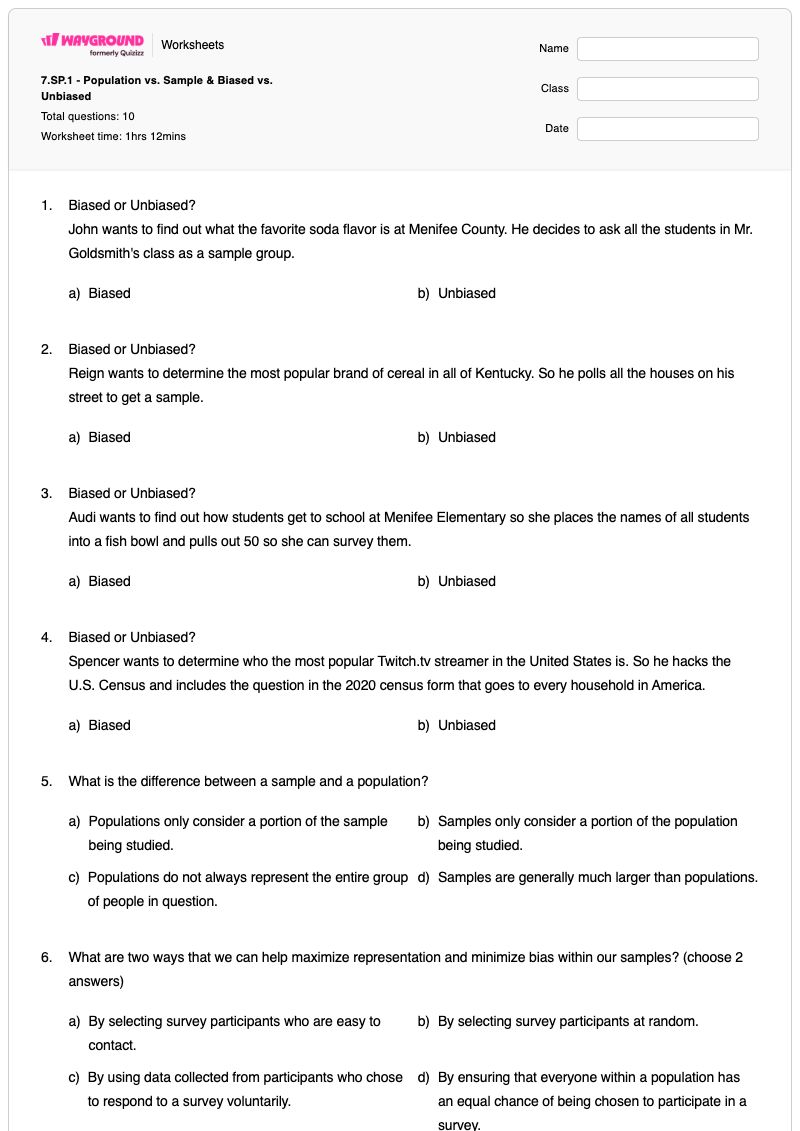
7.SP.1 - Population vs. Sample & Biased vs. Unbiased

คำถามทั้งหมด: 10

ชื่อ
ระดับ
วันที่
1.

Biased or Unbiased?

John wants to find out what the favorite soda flavor is at Menifee County. He decides to ask all the students in Mr. Goldsmith's class as a sample group.

a)

Biased

b)

Unbiased

2.

Biased or Unbiased?

Reign wants to determine the most popular brand of cereal in all of Kentucky. So he polls all the houses on his street to get a sample.

a)

Biased

b)

Unbiased

3.

Biased or Unbiased?

Audi wants to find out how students get to school at Menifee Elementary so she places the names of all students into a fish bowl and pulls out 50 so she can survey them.

a)

Biased

b)

Unbiased

4.

Biased or Unbiased?

Spencer wants to determine who the most popular Twitch.tv streamer in the United States is. So he hacks the U.S. Census and includes the question in the 2020 census form that goes to every household in America.

a)

Biased

b)

Unbiased

5.

What is the difference between a sample and a population?

a)

Populations only consider a portion of the sample being studied.

b)

Samples only consider a portion of the population being studied.

c)

Populations do not always represent the entire group of people in question.

d)

Samples are generally much larger than populations.

6.

What are two ways that we can help maximize representation and minimize bias within our samples? (choose 2 answers)

a)

By selecting survey participants who are easy to contact.

b)

By selecting survey participants at random.

c)

By using data collected from participants who chose to respond to a survey voluntarily.

d)

By ensuring that everyone within a population has an equal chance of being chosen to participate in a survey.

7.

A survey was distributed to determine food preferences for Middle School students. Which sample is most the representative for this survey?

a)

A group of High School students during a PE class.

b)

A group of parents of local Middle School students.

c)

10 Elementary School students from each of the 5 local Elementary Schools.

d)

20 randomly selected students from 6th, 7th, and 8th grade from each local Middle School.

8.
Your school newspaper is conducting a survey to find out which school sports team is most popular.  How would it most likely get a random sample from the student population?
a)
By asking every fifth person entering the basketball game
b)
By asking 10 students from every homeroom
c)
By asking the parents
d)
By asking the students on the pep club
9.
Which population would provide the most random sample to determine who the students will select for student body president?
a)
students from band
b)
Students on the athletic team
c)
Five students from every class in the sixth grade
d)
five students from every class in sixth, seventh, and eighth grade
10.
Your teacher needs 5 students to help set up for the dance.  Which would represent a random method for her to choose students.  
a)
Select the 5 students with the highest GPA
b)
Place the names of the students on the BETA club in a hat and draw out 5 names
c)
ask the teachers to vote
d)
Place the names of all students in the school in a hat and draw out 5 names
Waygroundแป้นคำตอบ

7.SP.1 - Population vs. Sample & Biased vs. Unbiased

คำถามทั้งหมด: 10

1.
a)

Biased

2.
a)

Biased

3.
b)

Unbiased

4.
b)

Unbiased

5.
b)

Samples only consider a portion of the population being studied.

6.
b)

By selecting survey participants at random.

, d)

By ensuring that everyone within a population has an equal chance of being chosen to participate in a survey.

7.
d)

20 randomly selected students from 6th, 7th, and 8th grade from each local Middle School.

8.
b) By asking 10 students from every homeroom
9.
d) five students from every class in sixth, seventh, and eighth grade
10.
d) Place the names of all students in the school in a hat and draw out 5 names

คำถามที่พบบ่อย

แบบฝึกหัดนี้ครอบคลุมเนื้อหาอะไรบ้างเกี่ยวกับประชากร กลุ่มตัวอย่าง และอคติในการสุ่มตัวอย่าง?

แบบฝึกหัดสำหรับนักเรียนชั้น ม.1 นี้ ประกอบด้วยคำถามแบบเลือกตอบ 9 ข้อ และคำถามแบบเลือกคำตอบ 1 ข้อ เพื่อประเมินว่านักเรียนสามารถแยกแยะความแตกต่างระหว่างประชากรกับกลุ่มตัวอย่าง และระบุวิธีการสุ่มตัวอย่างที่มีอคติหรือไม่มีอคติได้หรือไม่ นักเรียนจะต้องประเมินสถานการณ์การสำรวจ เลือกกลุ่มตัวอย่างที่เป็นตัวแทน และเลือกวิธีการที่ใช้การสุ่มเลือกและให้โอกาสสมาชิกทุกคนในประชากรได้มีส่วนร่วมอย่างเท่าเทียมกัน

ฉันจะใช้แบบฝึกหัดนี้ในการสอนเรื่องการสุ่มตัวอย่างแบบมีอคติและแบบไม่มีอคติได้อย่างไร?

เริ่มต้นด้วยการกำหนดประชากรเป้าหมายของการสำรวจ และกลุ่มตัวอย่างขนาดเล็กที่เลือกมาจากประชากรนั้น จากนั้นให้นักเรียนอธิบายว่าเหตุใดการสำรวจชั้นเรียนเดียว ถนนเดียว หรือกลุ่มที่มีความสนใจเฉพาะกลุ่ม อาจไม่สามารถเป็นตัวแทนของประชากรกลุ่มใหญ่ได้ ก่อนที่จะใช้สถานการณ์จำลองการสำรวจในโรงเรียนจากแบบฝึกหัดเพื่อเปรียบเทียบการเลือกแบบสุ่มกับการเลือกแบบสะดวกหรือแบบจำกัด ขอให้นักเรียนอธิบายเหตุผลของแต่ละทางเลือกโดยระบุว่าใครบ้างที่สามารถหรือไม่อาจถูกเลือกได้

ฉันควรระวังข้อผิดพลาดอะไรบ้างเมื่อนักเรียนทำแบบฝึกหัดการสุ่มตัวอย่างนี้?

นักเรียนอาจระบุว่ากลุ่มตัวอย่างนั้นเป็นกลางเพียงเพราะมีจำนวนคนมาก โดยไม่ได้ตรวจสอบว่าการเลือกนั้นเป็นการสุ่มหรือเป็นตัวแทนของประชากรทั้งหมดหรือไม่ ระวังความสับสนระหว่างประชากรและกลุ่มตัวอย่าง และตัวเลือกที่สำรวจเฉพาะอาสาสมัคร สมาชิกชมรม นักเรียนในระดับชั้นเดียว หรือกลุ่มย่อยเดียว ในขณะที่คำถามเกี่ยวข้องกับนักเรียนทุกคน ในข้อสอบแบบเลือกหลายตัวเลือก นักเรียนต้องเลือกทั้งการสุ่มและการเลือกอย่างเท่าเทียมกัน ไม่ใช่เลือกเพียงอย่างใดอย่างหนึ่ง

ฉันจะมอบหมายและให้คะแนนแบบฝึกหัดนี้อย่างไร?

แบบฝึกหัดนี้มีให้ดาวน์โหลดในรูปแบบ PDF สำหรับพิมพ์ และเป็นแบบทดสอบดิจิทัลบน Wayground พร้อมเฉลยคำตอบครบถ้วนสำหรับคำถามแบบเลือกตอบ 9 ข้อ และคำถามแบบเลือกคำตอบเดียว 1 ข้อ สามารถตรวจงานของนักเรียนได้โดยการสแกนงานของนักเรียนด้วยแอป Wayground for Teachers

ฉันจะแยกความแตกต่างระหว่างแบบฝึกหัดเรื่องประชากรและกลุ่มตัวอย่างได้อย่างไร?

ในส่วนการตั้งค่าขั้นสูงของแบบฝึกหัด ให้ปรับระยะห่างระหว่างตัวอักษรหรือเลือกขนาดตัวอักษรที่ใหญ่ขึ้นเพื่อให้สถานการณ์การสุ่มตัวอย่างและตัวเลือกคำตอบอ่านง่ายขึ้น นอกจากนี้ คุณยังสามารถใช้แบบอักษรที่เหมาะสำหรับผู้ที่มีภาวะดิสเล็กเซีย หรือแปลแบบฝึกหัดเป็นภาษาอื่นโดยคงคำถามเกี่ยวกับประชากร กลุ่มตัวอย่าง และอคติไว้เหมือนเดิม

ฉันจะหาแบบฝึกหัดฟรีแบบนี้เพิ่มเติมได้ที่ไหนบน Wayground?

Wayground นำเสนอชุดแบบฝึกหัดและโจทย์ฝึกหัดที่สามารถพิมพ์ได้ฟรีอย่างครอบคลุมในทุกวิชา รวมถึงไฟล์ PDF ที่ดาวน์โหลดได้และเฉลยคำตอบ เพื่อสนับสนุนทักษะและแนวคิดที่สำคัญ ดูแหล่งข้อมูลเพิ่มเติมได้ที่ https://wayground.com/en-us/worksheets