
Wayground
History of the atomic model - Printable ศาสตร์ Worksheets ระดับ 6 - Wayground

History of the atomic model

C. Hawkins

สร้างโดย C. Hawkins

20 คำถาม

6th ระดับชั้น

ศาสตร์

อัปเดตแล้ว ก.ย. 2569

แบบฝึกหัดวิทยาศาสตร์สำหรับนักเรียนชั้นประถมศึกษาปีที่ 6 นี้ ช่วยให้นักเรียนติดตามประวัติความเป็นมาของแบบจำลองอะตอมผ่านคำถามแบบเลือกตอบ 20 ข้อ นักเรียนระบุชื่อนักวิทยาศาสตร์ที่เกี่ยวข้องกับแนวคิดสำคัญเกี่ยวกับอะตอม ได้แก่ ข้อเสนอเรื่องอะตอมของเดโมคริตุส แบบจำลองทรงกลมตันของดาลตัน แบบจำลองพุดดิ้งลูกพลัมของทอมสัน นิวเคลียสและพื้นที่ว่างส่วนใหญ่ของรัทเทอร์ฟอร์ด วงโคจรของอิเล็กตรอนของโบห์ร และแบบจำลองกลศาสตร์ควอนตัม นอกจากนี้ พวกเขายังจับคู่ลักษณะของแบบจำลองกับนักวิทยาศาสตร์ที่เหมาะสม และเรียงลำดับแบบจำลองที่เลือกตามลำดับเวลา คำถามใช้ชื่อนักวิทยาศาสตร์ ชื่อแบบจำลอง คำอธิบาย และคำศัพท์ เช่น อิเล็กตรอน สสารบวก นิวเคลียส และเส้นทางพลังงานที่กำหนด เพื่อตรวจสอบความเข้าใจของนักเรียน ใช้แบบฝึกหัดที่พิมพ์ได้ฟรีนี้เป็นแบบฝึกหัดอิสระ กิจกรรมทบทวน หรือการประเมินผลระหว่างเรียนหลังจากการสอนเกี่ยวกับวิธีที่แบบจำลองอะตอมเปลี่ยนแปลงไปตามกาลเวลา แบบฝึกหัดนี้มีเฉลยคำตอบที่สมบูรณ์เพื่อการตรวจสอบและอภิปรายเหตุผลของนักเรียนอย่างมีประสิทธิภาพ

การตั้งค่าแผ่นงาน

ขนาดตัวอักษร

S
M
L
XL
Waygroundแผ่นงาน

History of the atomic model

คำถามทั้งหมด: 20

ชื่อ
ระดับ
วันที่
1.
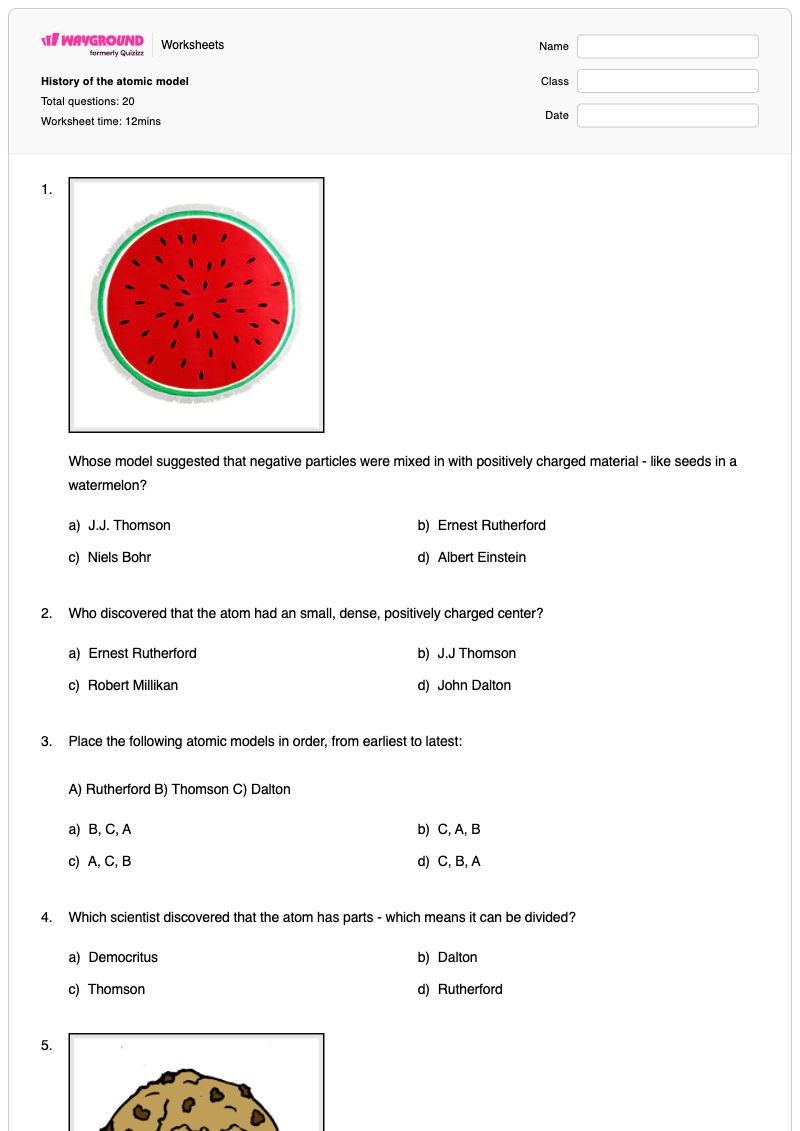
Whose model suggested that negative particles were mixed in with positively charged material - like seeds in a watermelon?

Whose model suggested that negative particles were mixed in with positively charged material - like seeds in a watermelon?

a)

J.J. Thomson

b)

Ernest Rutherford

c)

Niels Bohr

d)

Albert Einstein

2.

Who discovered that the atom had an small, dense, positively charged center?

a)

Ernest Rutherford

b)

J.J Thomson

c)

Robert Millikan

d)

John Dalton

3.

Place the following atomic models in order, from earliest to latest:


A) Rutherford B) Thomson C) Dalton

a)

B, C, A

b)

C, A, B

c)

A, C, B

d)

C, B, A

4.

Which scientist discovered that the atom has parts - which means it can be divided?

a)

Democritus

b)

Dalton

c)

Thomson

d)

Rutherford

5.
In the atomic model nicknamed the "plum pudding" model, what do the plums represent?

In the atomic model nicknamed the "plum pudding" model, what do the plums represent?

a)

the nucleus

b)

the atom

c)

the electrons

d)

the positive material

6.

Who discovered that atoms are mostly empty space?

a)

Dalton

b)

Thomson

c)

Rutherford

d)

Bohr

7.

Who proposed that electrons move around the nucleus in circular orbits?

a)

Dalton

b)

Thomson

c)

Rutherford

d)

Bohr

8.
Which scientist was the first person responsible for proposing the idea of atoms?

Which scientist was the first person responsible for proposing the idea of atoms?

a)

Democritus

b)

John Dalton

c)

Ernest Rutherford

d)

J.J. Thomson

e)

Niels Bohr

9.
Which scientist was the first person responsible for proposing the discovery of the electron?

Which scientist was the first person responsible for proposing the discovery of the electron?

a)

Democritus

b)

John Dalton

c)

Ernest Rutherford

d)

J.J. Thomson

e)

Niels Bohr

10.
Which scientist was the first person responsible for proposing the discovery of the nucleus?

Which scientist was the first person responsible for proposing the discovery of the nucleus?

a)

Democritus

b)

John Dalton

c)

Ernest Rutherford

d)

J.J. Thomson

e)

Niels Bohr

11.
Which scientist claimed that the atom was a small, dense, solid sphere?

Which scientist claimed that the atom was a small, dense, solid sphere?

a)

Democritus

b)

John Dalton

c)

Ernest Rutherford

d)

J.J. Thomson

e)

Niels Bohr

12.
Which scientist's model is referred to as the Plum Pudding Model?

Which scientist's model is referred to as the Plum Pudding Model?

a)

Democritus

b)

John Dalton

c)

Ernest Rutherford

d)

J.J. Thomson

e)

Niels Bohr

13.
Which scientist proposed the idea that the electrons orbited the nucleus on fixed paths with designated energies?

Which scientist proposed the idea that the electrons orbited the nucleus on fixed paths with designated energies?

a)

Democritus

b)

John Dalton

c)

Ernest Rutherford

d)

J.J. Thomson

e)

Niels Bohr

14.
Which model of the atom is the most up to date model?

Which model of the atom is the most up to date model?

a)

The Billiard Ball Model

b)

The Plum Pudding Model

c)

The Planetary Model

d)

The Quantum Mechanical Model

e)

The Nuclear Model

15.
Which scientist saw the atom as a solid sphere?
a)
Dalton
b)
Thomson
c)
Rutherford
d)
Bohr
16.

Discovered the neutron

a)

Democritus

b)

John Dalton

c)

JJ Thomson

d)

Robert Millikan

e)

James Chadwick

17.
Which number represents the atomic number of this element?
a)
12.011
b)
6
c)
3
d)
12
18.
Elements in the same group have the same number of ____________.

Elements in the same group have the same number of ____________.

a)

Valence Electrons

b)

Energy Levels

c)

Protons

d)

Charges

19.
Elements in the same group have similar __________.

Elements in the same group have similar __________.

a)

Shapes

b)

Properties

c)

Colors

d)

Energy levels

20.

Who developed the Periodic Table of Elements?

a)

Dmitri Mendeleev

b)

Dmitri Mendeleev and Scientists

c)

Dmitri Mendeleev and Julius Lothar Meyer

d)

Dmitri Mendeleev, Julius Lothar Meyer and other Scientists

Waygroundแป้นคำตอบ

History of the atomic model

คำถามทั้งหมด: 20

1.
a)

J.J. Thomson

2.
a)

Ernest Rutherford

3.
d)

C, B, A

4.
c)

Thomson

5.
c)

the electrons

6.
c)

Rutherford

7.
d)

Bohr

8.
a)

Democritus

9.
b)

John Dalton

10.
c)

Ernest Rutherford

11.
b)

John Dalton

12.
d)

J.J. Thomson

13.
e)

Niels Bohr

14.
d)

The Quantum Mechanical Model

15.
a) Dalton
16.
e)

James Chadwick

17.
b) 6
18.
a)

Valence Electrons

19.
b)

Properties

20.
d)

Dmitri Mendeleev, Julius Lothar Meyer and other Scientists

คำถามที่พบบ่อย

แบบฝึกหัดประวัติความเป็นมาของแบบจำลองอะตอมนี้ครอบคลุมหัวข้ออะไรบ้าง?

แบบฝึกหัดวิทยาศาสตร์สำหรับนักเรียนชั้นประถมศึกษาปีที่ 6 นี้ ประกอบด้วยคำถามแบบเลือกตอบ 20 ข้อ เพื่อประเมินความสามารถของนักเรียนในการเชื่อมโยงนักวิทยาศาสตร์กับแบบจำลองอะตอมและคุณลักษณะของแบบจำลอง นักเรียนจะต้องระบุแบบจำลองพลัมพุดดิ้ง แบบจำลองนิวเคลียสและพื้นที่ว่างส่วนใหญ่ของรัทเทอร์ฟอร์ด แบบจำลองวงโคจรของอิเล็กตรอนของโบร์ และแบบจำลองกลศาสตร์ควอนตัม พร้อมทั้งเรียงลำดับแบบจำลองของดาลตัน ทอมสัน และรัทเทอร์ฟอร์ด

ฉันจะใช้แบบฝึกหัดนี้ในการสอนประวัติศาสตร์ของแบบจำลองอะตอมได้อย่างไร?

เริ่มบทเรียนด้วยแผนภูมิเวลาหรือชุดการ์ดนักวิทยาศาสตร์และแบบจำลอง จากนั้นให้นักเรียนอภิปรายว่าแบบจำลองแต่ละแบบเพิ่มหรือเปลี่ยนแปลงอะไรบ้าง ก่อนที่จะให้ตอบคำถามแบบเลือกตอบ ใช้คำถามกระตุ้นความคิด เช่น “แบบจำลองพุดดิ้งลูกพลัมแสดงถึงอะไร?” และ “แบบจำลองของโบห์รแตกต่างจากแบบจำลองของรัทเทอร์ฟอร์ดอย่างไร?” เพื่อเชื่อมโยงคำศัพท์ในแบบฝึกหัดกับคุณลักษณะของแบบจำลอง

ฉันควรสังเกตข้อผิดพลาดอะไรบ้างเมื่อนักเรียนทำแบบฝึกหัดนี้เสร็จ?

นักเรียนอาจสับสนระหว่างนักวิทยาศาสตร์กับแบบจำลองหรือการค้นพบที่เกี่ยวข้องกับบุคคลนั้น เช่น เลือกรัทเทอร์ฟอร์ดสำหรับแบบจำลองพุดดิ้งลูกพลัม หรือทอมสันสำหรับนิวเคลียส พวกเขาอาจสลับลำดับของดาลตัน-ทอมสัน-รัทเทอร์ฟอร์ด สับสนระหว่างอิเล็กตรอนกับวัสดุบวกในแบบจำลองของทอมสัน หรือสับสนระหว่างคำอธิบายของรัทเทอร์ฟอร์ดที่ส่วนใหญ่เป็นพื้นที่ว่างเปล่ากับเส้นทางอิเล็กตรอนที่กำหนดโดยโบร์

ฉันจะมอบหมายและให้คะแนนแบบฝึกหัดเรื่องแบบจำลองอะตอมนี้ได้อย่างไร?

แบบฝึกหัดนี้มีให้ดาวน์โหลดในรูปแบบไฟล์ PDF สำหรับพิมพ์ และในรูปแบบแบบทดสอบดิจิทัลบน Wayground โดยมีเฉลยคำตอบครบถ้วน คุณสามารถตรวจงานที่พิมพ์ออกมาได้โดยการสแกนงานของนักเรียนด้วยแอป Wayground for Teachers หรือตรวจสอบคำตอบจากแบบทดสอบดิจิทัลก็ได้

คำถามเกี่ยวกับการเรียงลำดับช่วยเสริมสร้างการเรียนรู้เกี่ยวกับแบบจำลองอะตอมได้อย่างไร?

แบบฝึกหัดเรื่องลำดับเหตุการณ์กำหนดให้นักเรียนเรียงลำดับแบบจำลองของดาลตัน ทอมสัน และรัทเทอร์ฟอร์ดจากเก่าที่สุดไปใหม่ที่สุด แทนที่จะระบุชื่อนักวิทยาศาสตร์แต่ละคนแยกกัน วิธีนี้ช่วยให้นักเรียนจัดลำดับความสัมพันธ์ระหว่างนักวิทยาศาสตร์และแบบจำลองในแบบฝึกหัด และตระหนักว่าแบบจำลองอะตอมมีการเปลี่ยนแปลงไปตามแนวคิดใหม่ๆ เกี่ยวกับโครงสร้างอะตอมที่เกิดขึ้น

ฉันจะหาแบบฝึกหัดแบบนี้เพิ่มเติมได้ที่ไหนบน Wayground?

Wayground มีแบบฝึกหัดและโจทย์ฝึกหัดมากมายให้ดาวน์โหลดฟรีในหลากหลายวิชา พร้อมไฟล์ PDF และเฉลยคำตอบ เพื่อช่วยเสริมสร้างทักษะและความเข้าใจในแนวคิดสำคัญ ดูแหล่งข้อมูลเพิ่มเติมได้ที่ https://wayground.com/en-us/worksheets