

Wayground
Understanding FHA and VA Loans - Printable สังคมศึกษา Worksheets ระดับ 11 - Wayground

Understanding FHA and VA Loans

Christina Velazquez

สร้างโดย Christina Velazquez

17 คำถาม

11th ระดับชั้น

สังคมศึกษา

แบบฝึกหัดวิชาสังคมศึกษา ชั้นมัธยมศึกษาปีที่ 4 เรื่อง "การทำความเข้าใจสินเชื่อ FHA และ VA" เป็นแบบฝึกหัดที่สามารถพิมพ์ได้ฟรี ช่วยเสริมสร้างความสามารถของนักเรียนในการเปรียบเทียบโครงการสินเชื่อบ้านที่ได้รับการสนับสนุนจากรัฐบาลสองโครงการ แบบฝึกหัดนี้ประกอบด้วยคำถามแบบเลือกตอบ 17 ข้อ นักเรียนจะได้ศึกษาเกี่ยวกับข้อกำหนดการวางเงินดาวน์ เกณฑ์เครดิตที่ยืดหยุ่น เบี้ยประกันสินเชื่อบ้านของ FHA ค่าธรรมเนียมการจัดหาเงินทุนของ VA วงเงินสินเชื่อ และการไม่มีประกันสินเชื่อบ้านส่วนบุคคลสำหรับสินเชื่อ VA แบบฝึกหัดนี้ยังถามนักเรียนเกี่ยวกับการระบุผู้ที่มีสิทธิ์ได้รับสินเชื่อ VA อธิบายวัตถุประสงค์ของใบรับรองคุณสมบัติ แยกแยะบทบาทของผู้ให้กู้เอกชนและกระทรวงกิจการทหารผ่านศึกของสหรัฐอเมริกา และประเมินว่าการวางเงินดาวน์ส่งผลต่อต้นทุนการกู้ยืมอย่างไร คำถามเหล่านี้ช่วยให้นักเรียนเชื่อมโยงคุณสมบัติของสินเชื่อกับคุณสมบัติของผู้กู้และค่าใช้จ่ายระยะยาว แทนที่จะท่องจำคำศัพท์ที่แยกจากกัน แบบฝึกหัดนี้ออกแบบมาสำหรับการเรียนการสอนในห้องเรียน การฝึกฝนด้วยตนเอง หรือการทบทวนในชั้นมัธยมศึกษาปีที่ 4 และมีเฉลยคำตอบครบถ้วนเพื่อการตรวจสอบที่มีประสิทธิภาพ

การตั้งค่าแผ่นงาน

ขนาดตัวอักษร

S
M
L
XL
Waygroundแผ่นงาน

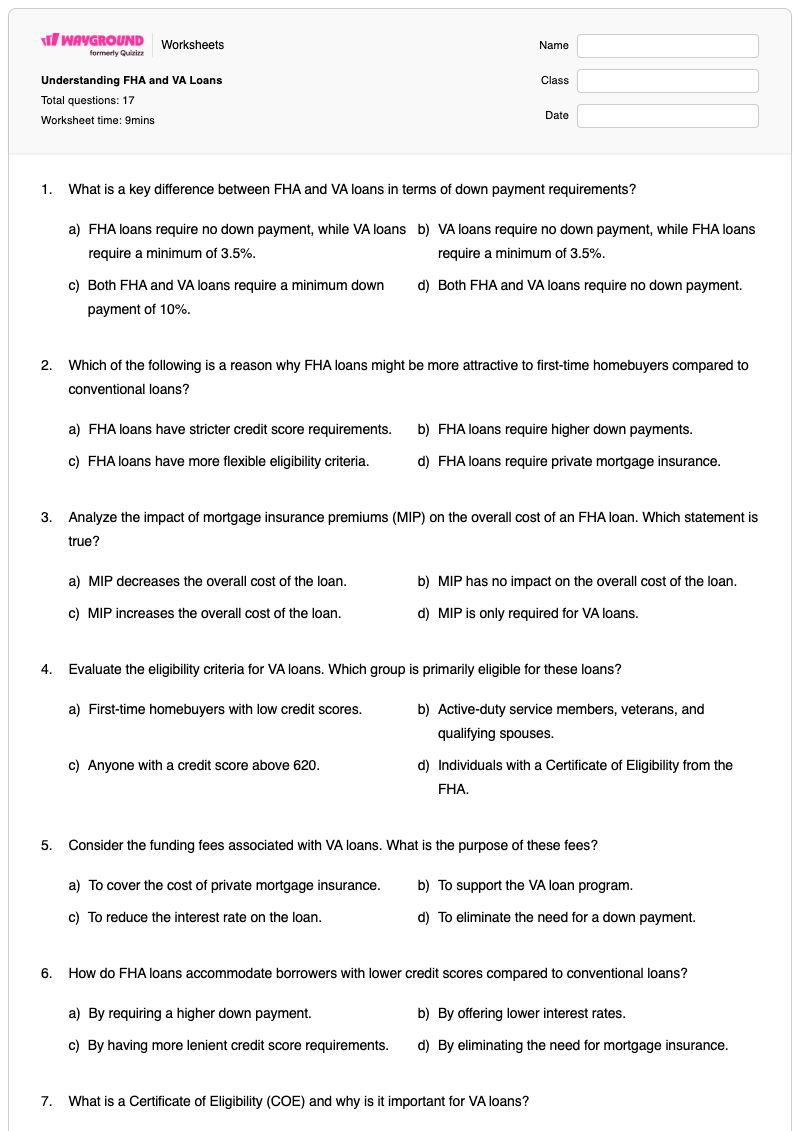
Understanding FHA and VA Loans

คำถามทั้งหมด: 17

ชื่อ
ระดับ
วันที่
1.

What is a key difference between FHA and VA loans in terms of down payment requirements?

a)

FHA loans require no down payment, while VA loans require a minimum of 3.5%.

b)

VA loans require no down payment, while FHA loans require a minimum of 3.5%.

c)

Both FHA and VA loans require a minimum down payment of 10%.

d)

Both FHA and VA loans require no down payment.

2.

Which of the following is a reason why FHA loans might be more attractive to first-time homebuyers compared to conventional loans?

a)

FHA loans have stricter credit score requirements.

b)

FHA loans require higher down payments.

c)

FHA loans have more flexible eligibility criteria.

d)

FHA loans require private mortgage insurance.

3.

Analyze the impact of mortgage insurance premiums (MIP) on the overall cost of an FHA loan. Which statement is true?

a)

MIP decreases the overall cost of the loan.

b)

MIP has no impact on the overall cost of the loan.

c)

MIP increases the overall cost of the loan.

d)

MIP is only required for VA loans.

4.

Evaluate the eligibility criteria for VA loans. Which group is primarily eligible for these loans?

a)

First-time homebuyers with low credit scores.

b)

Active-duty service members, veterans, and qualifying spouses.

c)

Anyone with a credit score above 620.

d)

Individuals with a Certificate of Eligibility from the FHA.

5.

Consider the funding fees associated with VA loans. What is the purpose of these fees?

a)

To cover the cost of private mortgage insurance.

b)

To support the VA loan program.

c)

To reduce the interest rate on the loan.

d)

To eliminate the need for a down payment.

6.

How do FHA loans accommodate borrowers with lower credit scores compared to conventional loans?

a)

By requiring a higher down payment.

b)

By offering lower interest rates.

c)

By having more lenient credit score requirements.

d)

By eliminating the need for mortgage insurance.

7.

What is a Certificate of Eligibility (COE) and why is it important for VA loans?

a)

It is a document that verifies the borrower's income.

b)

It confirms the borrower's eligibility for a VA loan.

c)

It is required to apply for an FHA loan.

d)

It guarantees a lower interest rate.

8.

Analyze the role of private lenders in the context of FHA and VA loans. What is their primary function?

a)

To set the eligibility criteria for these loans.

b)

To provide the actual financing for the loans.

c)

To insure the loans against default.

d)

To determine the interest rates for these loans.

9.

What is the impact of a larger down payment on an FHA or VA loan?

a)

It increases the monthly payment.

b)

It reduces the principal balance and monthly payment.

c)

It has no impact on the loan terms.

d)

It increases the funding fees.

10.

Evaluate the statement: "VA loans require private mortgage insurance (PMI)." Is this true or false, and why?

a)

True, because all government-backed loans require PMI.

b)

False, because VA loans do not require PMI.

c)

True, because PMI is necessary for loans with no down payment.

d)

False, because PMI is only required for FHA loans.

11.

What is the significance of the loan limits set by the FHA for borrowers?

a)

They determine the interest rate of the loan.

b)

They cap the maximum amount that can be borrowed.

c)

They eliminate the need for a down payment.

d)

They guarantee loan approval.

12.

How does the requirement of mortgage insurance premiums (MIP) affect the long-term costs of an FHA loan?

a)

It reduces the long-term costs by lowering interest rates.

b)

It increases the long-term costs by adding additional fees.

c)

It has no effect on the long-term costs.

d)

It eliminates the need for a down payment.

13.

What is the primary advantage of VA loans over FHA loans for eligible borrowers?

a)

Lower interest rates and no requirement for mortgage insurance.

b)

Higher loan limits and stricter credit requirements.

c)

No funding fees and higher down payment requirements.

d)

More flexible eligibility criteria and higher interest rates.

14.

In what way do FHA loans provide an advantage to borrowers with limited savings?

a)

By requiring no down payment.

b)

By offering lower interest rates than VA loans.

c)

By allowing a down payment as low as 3.5%.

d)

By eliminating the need for mortgage insurance.

15.

What is the role of the U.S. Department of Veterans Affairs in the context of VA loans?

a)

To provide the actual financing for the loans.

b)

To insure the loans against default.

c)

To set the interest rates for the loans.

d)

To determine the eligibility criteria for the loans.

16.

Which of the following types of loan is suitable for homeowners who plan to move and sell their home before their fixed-rate period is up?

a)

Bridge loan

b)

USDA loan

c)

Adjustable-rate loan

d)

VA loan

17.

When purchasing a home, it is recommended to put at least ___ % as a down payment.

a)

0

b)

10

c)

20

d)

40

Waygroundแป้นคำตอบ

Understanding FHA and VA Loans

คำถามทั้งหมด: 17

1.
b)

VA loans require no down payment, while FHA loans require a minimum of 3.5%.

2.
c)

FHA loans have more flexible eligibility criteria.

3.
c)

MIP increases the overall cost of the loan.

4.
b)

Active-duty service members, veterans, and qualifying spouses.

5.
b)

To support the VA loan program.

6.
c)

By having more lenient credit score requirements.

7.
b)

It confirms the borrower's eligibility for a VA loan.

8.
b)

To provide the actual financing for the loans.

9.
b)

It reduces the principal balance and monthly payment.

10.
b)

False, because VA loans do not require PMI.

11.
b)

They cap the maximum amount that can be borrowed.

12.
b)

It increases the long-term costs by adding additional fees.

13.
a)

Lower interest rates and no requirement for mortgage insurance.

14.
c)

By allowing a down payment as low as 3.5%.

15.
d)

To determine the eligibility criteria for the loans.

16.
c)

Adjustable-rate loan

17.
c)

20

คำถามที่พบบ่อย

เอกสาร "ทำความเข้าใจสินเชื่อ FHA และ VA" ครอบคลุมเนื้อหาอะไรบ้าง?

แบบฝึกหัดสำหรับนักเรียนชั้นมัธยมศึกษาปีที่ 4 นี้ ประกอบด้วยคำถามแบบเลือกตอบ 17 ข้อ เพื่อเปรียบเทียบข้อกำหนดสินเชื่อ FHA และ VA คุณสมบัติของผู้กู้ ค่าธรรมเนียม ประกันภัย วงเงินสินเชื่อ และบทบาทของผู้ให้กู้ นักเรียนจะได้นำความแตกต่างต่างๆ มาใช้ เช่น เงินดาวน์ขั้นต่ำ 3.5% ของ FHA คุณสมบัติไม่ต้องวางเงินดาวน์ของ VA เบี้ยประกันสินเชื่อที่อยู่อาศัยของ FHA ค่าธรรมเนียมการจัดหาเงินทุนของ VA และข้อกำหนดใบรับรองคุณสมบัติ

ฉันจะใช้แบบฝึกหัดนี้สอนนักเรียนเกี่ยวกับสินเชื่อ FHA และ VA ได้อย่างไร?

เริ่มการเปรียบเทียบโดยให้นักเรียนสร้างสองคอลัมน์สำหรับคุณสมบัติของ FHA และ VA จากนั้นใช้คำถามแบบเลือกตอบเพื่อเพิ่มรายละเอียดเกี่ยวกับเงินดาวน์ ข้อกำหนดด้านเครดิต ค่าธรรมเนียม ประกันภัย และคุณสมบัติของผู้ขอสินเชื่อ หยุดพักหลังจากถามคำถามเกี่ยวกับ MIP ค่าธรรมเนียมการจัดหาเงินทุน และ PMI เพื่อถามนักเรียนว่าค่าใช้จ่ายหรือข้อกำหนดแต่ละอย่างเปลี่ยนแปลงความน่าสนใจของสินเชื่อสำหรับผู้กู้แต่ละรายอย่างไร จบด้วยการให้นักเรียนอธิบายว่าเหตุใดสินเชื่อ VA จึงมีให้เฉพาะสมาชิกกองทัพที่มีสิทธิ์ ทหารผ่านศึก และคู่สมรสที่มีคุณสมบัติเท่านั้น

นักเรียนควรระวังข้อผิดพลาดอะไรบ้างเมื่อกรอกแบบฟอร์มคำนวณสินเชื่อ FHA และ VA นี้?

นักเรียนอาจเข้าใจผิดเกี่ยวกับการเปรียบเทียบเงินดาวน์ โดยมองว่าสินเชื่อ FHA เป็นตัวเลือกที่ไม่ต้องวางเงินดาวน์ แทนที่จะเป็นสินเชื่อ VA นอกจากนี้ พวกเขาอาจสับสนระหว่างเบี้ยประกันสินเชื่อ FHA กับค่าธรรมเนียมการจัดหาเงินทุนของ VA เข้าใจผิดว่าสินเชื่อที่ได้รับการสนับสนุนจากรัฐบาลทั้งหมดต้องมี PMI หรือเข้าใจผิดว่าใบรับรองคุณสมบัติเป็นเอกสารของ FHA โปรดระวังความสับสนระหว่างบทบาทของหน่วยงานภาครัฐและบทบาทของผู้ให้กู้เอกชน: เอกสารประกอบจะแยกความแตกต่างระหว่างคุณสมบัติและการสนับสนุนโครงการกับการให้เงินทุนจริง

ฉันจะมอบหมายและให้คะแนนแบบฝึกหัดสินเชื่อ FHA และ VA นี้ได้อย่างไร?

คุณสามารถส่งแบบฝึกหัดนี้เป็นไฟล์ PDF ที่พิมพ์ได้ หรือเป็นแบบทดสอบดิจิทัลบน Wayground ก็ได้ และแบบฝึกหัดนี้มีเฉลยคำตอบครบถ้วนสำหรับคำถามแบบเลือกตอบทั้ง 17 ข้อ สำหรับการส่งแบบพิมพ์ ให้สแกนงานของนักเรียนด้วยแอป Wayground for Teachers เพื่อตรวจให้คะแนนได้อย่างมีประสิทธิภาพ รูปแบบที่พิมพ์ได้ยังสามารถสนับสนุนการเรียนการสอนในห้องเรียนที่ลดเวลาการใช้หน้าจอได้อีกด้วย

ฉันจะอธิบายความแตกต่างระหว่างแบบฟอร์มสินเชื่อ FHA และ VA นี้ให้นักเรียนเข้าใจได้อย่างไร?

ใช้การตั้งค่าขั้นสูงของแบบฝึกหัดเพื่อปรับระยะห่างระหว่างตัวอักษรและขนาดตัวอักษร เพื่อให้ข้อสอบแบบเลือกตอบ 17 ข้ออ่านและทำเครื่องหมายได้ง่ายขึ้น นอกจากนี้ คุณยังสามารถเปิดใช้งานแบบอักษรที่เหมาะสำหรับผู้ที่มีภาวะดิสเล็กเซีย หรือแปลแบบฝึกหัดเป็นภาษาอื่น เพื่อช่วยให้นักเรียนเข้าถึงคำศัพท์ของ FHA และ VA ได้โดยไม่ต้องเปลี่ยนคำถามหรือตัวเลือกคำตอบ

ฉันจะหาแบบฝึกหัดฟรีแบบนี้เพิ่มเติมได้ที่ไหนบน Wayground?

Wayground นำเสนอชุดแบบฝึกหัดและโจทย์ฝึกหัดฟรีที่ครอบคลุมหลากหลายวิชา พร้อมไฟล์ PDF และเฉลยคำตอบ เพื่อช่วยให้นักเรียนเชี่ยวชาญทักษะและแนวคิดที่สำคัญ ดูแหล่งข้อมูลเพิ่มเติมได้ที่ https://wayground.com/en-us/worksheets