

Wayground
Rates of chemical reactions - Printable ศาสตร์ Worksheets ระดับ 8 - Wayground

Rates of chemical reactions

Reese Woytek

สร้างโดย Reese Woytek

11 คำถาม

8th ระดับชั้น

ศาสตร์

อัปเดตแล้ว ก.ค. 2569

แบบฝึกหัดวิทยาศาสตร์สำหรับนักเรียนชั้น ม.2 นี้ ช่วยให้นักเรียนอธิบายปัจจัยที่ส่งผลต่ออัตราการเกิดปฏิกิริยาเคมี ประกอบด้วยคำถาม 11 ข้อ—แบบเลือกตอบ 9 ข้อ และแบบเลือกคำตอบ 2 ข้อ—นักเรียนจะได้ระบุว่าพื้นที่ผิว ความเข้มข้นของสารตั้งต้น และอุณหภูมิ มีอิทธิพลต่อการชนกันของอนุภาคและความเร็วของปฏิกิริยาอย่างไร พวกเขายังเชื่อมโยงปัจจัยเหล่านี้กับตัวอย่างต่างๆ เช่น เม็ดโซดาผง แมกนีเซียมทำปฏิกิริยากับกรดไฮโดรคลอริก และการเกิดผลิตภัณฑ์เร็วขึ้นเมื่อความเข้มข้นเพิ่มขึ้น แบบฝึกหัดนี้ขยายความเข้าใจนี้ไปสู่สถานการณ์ประยุกต์ที่เกี่ยวข้องกับตะเกียงน้ำมันก๊าดและกองไฟ นักเรียนจะวิเคราะห์ว่าการไหลของอากาศ ปริมาณเชื้อเพลิง และสภาวะการเผาไหม้ส่งผลต่อระยะเวลาที่ตะเกียงให้แสงสว่าง ความสว่างของไฟ และความเร็วในการเผาไหม้เชื้อเพลิงอย่างไร แบบฝึกหัดที่พิมพ์ได้ฟรีนี้ออกแบบมาสำหรับการเรียนการสอนวิทยาศาสตร์ชั้น ม.2 การฝึกฝนด้วยตนเอง การทบทวน หรือการประเมินผล และมีเฉลยคำตอบครบถ้วนเพื่อการตรวจสอบที่มีประสิทธิภาพ

การตั้งค่าแผ่นงาน

ขนาดตัวอักษร

S
M
L
XL
Waygroundแผ่นงาน

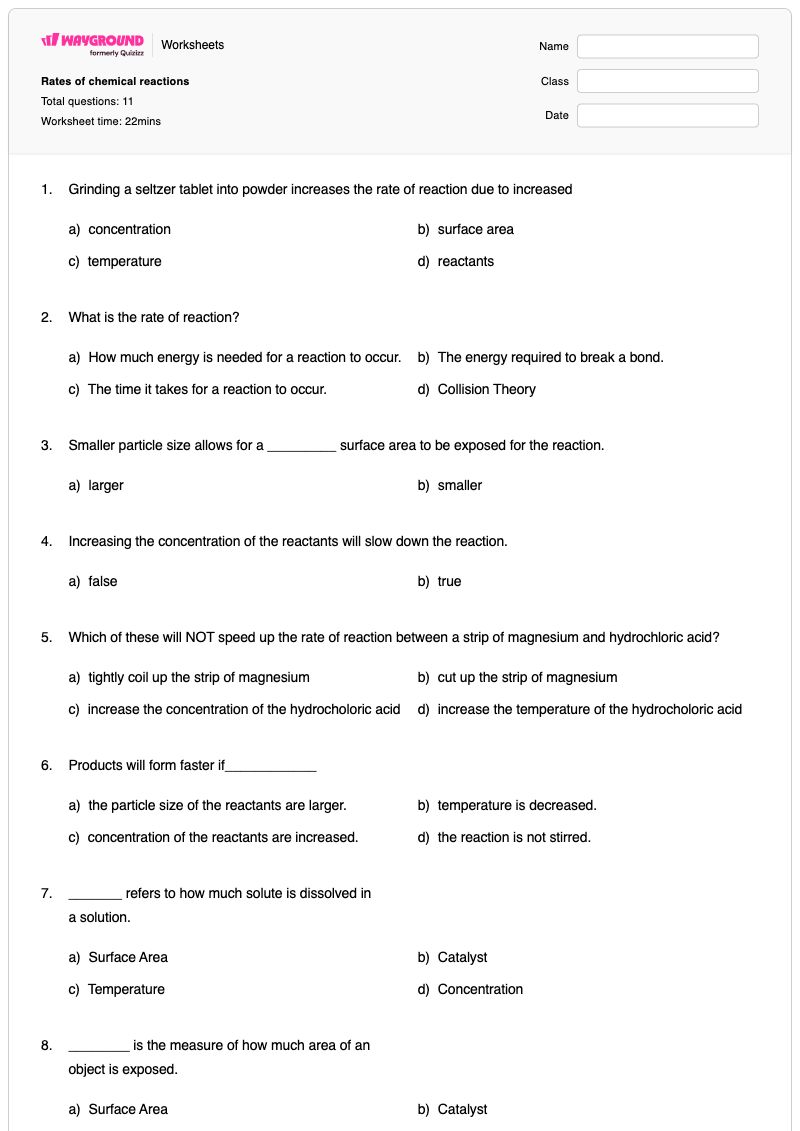
Rates of chemical reactions

คำถามทั้งหมด: 11

ชื่อ
ระดับ
วันที่
1.
Grinding a seltzer tablet into powder increases the rate of reaction due to increased
a)

concentration

b)

surface area

c)

temperature

d)

reactants

2.

What is the rate of reaction?

a)

How much energy is needed for a reaction to occur.

b)

The energy required to break a bond.

c)

The time it takes for a reaction to occur.

d)

Collision Theory

3.
Smaller particle size allows for a _________ surface area to be exposed for the reaction.
a)
larger
b)
smaller
4.
Increasing the concentration of the reactants will slow down the reaction.
a)
false 
b)
true
5.
Which of these will NOT speed up the rate of reaction between a strip of magnesium and hydrochloric acid?
a)
tightly coil up the strip of magnesium
b)
cut up the strip of magnesium
c)
increase the concentration of the hydrocholoric acid
d)
increase the temperature of the hydrocholoric acid
6.
Products will form faster if____________
a)
the particle size of the reactants are larger.
b)
temperature is decreased.
c)
concentration of the reactants are increased.
d)
the reaction is not stirred.
7.

_______ refers to how much solute is dissolved in

a solution.

a)

Surface Area

b)

Catalyst

c)

Temperature

d)

Concentration

8.

________ is the measure of how much area of an

object is exposed.

a)

Surface Area

b)

Catalyst

c)

Concentration

9.

Increasing the ____ causes the particles (atoms

or molecules) of the reactants to move more quickly so that

they collide with each other more frequently and with more

energy.

a)

Catalyst

b)

Surface Area

c)

Temperature

d)

Concentration

10.
The diagram shows a kerosene lantern. A kerosene lantern is a lighting device. It uses a petroleum product called kerosene…

The diagram shows a kerosene lantern.

A kerosene lantern is a lighting device. It uses a petroleum product called kerosene as fuel. The kerosene is held in the base of the lantern, and a cloth wick soaks up the kerosene. Air can flow into the lantern through holes in the device. When the wick is lit, the kerosene in the wick undergoes a chemical reaction with oxygen in the air to release energy in the form of light.

Which change to the device would increase the amount of time the lantern provides light? (Choose two correct)

a)

Increase the size of the base to hold more kerosene

b)

Change the shape of the flame to give off more light.

c)

Decrease the size of the air holes to allow less air flow.

d)

Change the material of the wick to soak up more kerosene.

e)

Add an extra wick so two flames can burn at the same time.

11.
Billows are often used to pump more air into a fire. Which statements would be true about the results (two correct)?

Billows are often used to pump more air into a fire. Which statements would be true about the results (two correct)?

a)

The fire would burn hotter and brighter

b)

There would be no change in the brightness.

c)

The wood fuel source would be used up sooner.

d)

Less smoke would be produced

e)

The total energy released would be greater than without billows

Waygroundแป้นคำตอบ

Rates of chemical reactions

คำถามทั้งหมด: 11

1.
b)

surface area

2.
c)

The time it takes for a reaction to occur.

3.
a) larger
4.
a) false 
5.
a) tightly coil up the strip of magnesium
6.
c) concentration of the reactants are increased.
7.
d)

Concentration

8.
a)

Surface Area

9.
c)

Temperature

10.
a)

Increase the size of the base to hold more kerosene

, c)

Decrease the size of the air holes to allow less air flow.

11.
a)

The fire would burn hotter and brighter

, c)

The wood fuel source would be used up sooner.

คำถามที่พบบ่อย

แบบฝึกหัดเรื่องอัตราการเกิดปฏิกิริยาเคมีครอบคลุมหัวข้ออะไรบ้าง?

แบบฝึกหัดวิทยาศาสตร์สำหรับนักเรียนชั้น ม.2 นี้ครอบคลุมถึงวิธีการที่พื้นที่ผิว ความเข้มข้น และอุณหภูมิส่งผลต่ออัตราการเกิดปฏิกิริยาเคมี แบบฝึกหัดนี้มีคำถามแบบเลือกตอบ 9 ข้อ และคำถามแบบเลือกคำตอบ 2 ข้อ โดยให้นักเรียนนำแนวคิดเหล่านี้ไปประยุกต์ใช้กับผงโซดา แมกนีเซียมและกรดไฮโดรคลอริก ตะเกียงน้ำมันก๊าด และไฟ เพื่อสร้างทักษะในการเชื่อมโยงการชนกันของอนุภาคและสภาวะการเกิดปฏิกิริยาเข้ากับผลลัพธ์ที่สังเกตได้

ฉันจะใช้แบบฝึกหัดนี้ในการสอนเกี่ยวกับปัจจัยที่มีผลต่ออัตราการเกิดปฏิกิริยาได้อย่างไร?

เริ่มแบบฝึกหัดโดยให้นักเรียนคาดเดาว่าจะเกิดอะไรขึ้นเมื่อผงโซดาถูกบดเป็นผง เมื่อความเข้มข้นของสารตั้งต้นเพิ่มขึ้น หรือเมื่ออุณหภูมิสูงขึ้น จากนั้นใช้แมกนีเซียมและกรดไฮโดรคลอริกเพื่ออธิบายพื้นที่ผิวและความเข้มข้น ก่อนที่จะขอให้นักเรียนอธิบายเหตุผลของตัวเลือกสองข้อในสถานการณ์ตะเกียงและเปลวไฟ หลังจากนั้นให้ทบทวนเฉลยเพื่ออธิบายว่าเหตุใดแต่ละสภาวะจึงเปลี่ยนแปลงความเร็วของปฏิกิริยา การใช้เชื้อเพลิง หรือปริมาณแสง

ฉันควรระวังข้อผิดพลาดอะไรบ้างเมื่อนักเรียนทำแบบฝึกหัดเรื่องอัตราการเกิดปฏิกิริยานี้?

นักเรียนอาจสับสนระหว่างพื้นที่ผิวกับความเข้มข้น โดยเฉพาะอย่างยิ่งเมื่อตัดสินใจว่าเหตุใดการบดเม็ดโซดาหรือการหั่นแมกนีเซียมจึงช่วยเร่งปฏิกิริยา พวกเขาอาจเลือกการเปลี่ยนแปลงที่เพิ่มความสว่างแทนที่จะเลือกการเปลี่ยนแปลงที่ช่วยยืดเวลาการใช้งานของตะเกียง หรือมองข้ามไปว่าข้อคำถามแบบเลือกหลายข้อต้องการคำตอบเพียงสองข้อเท่านั้น ในสถานการณ์เกี่ยวกับเปลวไฟที่พวยพุ่ง ให้ตรวจสอบว่านักเรียนสามารถแยกแยะความแตกต่างระหว่างไฟที่ร้อนและสว่างกว่ากับการที่ไม้ถูกใช้หมดเร็วกว่าได้หรือไม่

ฉันจะมอบหมายและให้คะแนนแบบฝึกหัดปฏิกิริยาเคมีนี้อย่างไร?

คุณสามารถมอบหมายแบบฝึกหัดเรื่องอัตราการเกิดปฏิกิริยาเคมีในรูปแบบไฟล์ PDF ที่พิมพ์ได้ หรือเป็นแบบทดสอบดิจิทัลบน Wayground แบบฝึกหัดนี้มีเฉลยคำตอบครบถ้วนสำหรับคำถามแบบเลือกตอบ 9 ข้อ และคำถามแบบเลือกตอบหลายข้อ 2 ข้อ และสามารถตรวจงานของนักเรียนได้โดยการสแกนงานของนักเรียนด้วยแอป Wayground for Teachers รูปแบบที่พิมพ์ได้ยังช่วยให้โรงเรียนสามารถลดเวลาการใช้หน้าจอได้อีกด้วย

ฉันจะปรับแบบฝึกหัดนี้ให้เหมาะสมกับนักเรียนของฉันได้อย่างไร?

ใช้การตั้งค่าขั้นสูงของแบบฝึกหัดเพื่อปรับระยะห่างระหว่างตัวอักษรหรือเลือกขนาดตัวอักษรที่ใหญ่ขึ้น เพื่อให้คำถามเกี่ยวกับอัตราการตอบสนองและสถานการณ์จำลองเกี่ยวกับตะเกียงและไฟอ่านง่ายขึ้น นอกจากนี้ คุณยังสามารถเปิดใช้งานแบบอักษรที่เหมาะสำหรับผู้ที่มีภาวะดิสเล็กเซีย หรือแปลแบบฝึกหัดเป็นภาษาอื่นได้ตามความเหมาะสม ตัวเลือกเหล่านี้จะแก้ไขไฟล์แบบฝึกหัด แต่ยังคงรักษารูปแบบคำถามแบบปรนัยและเลือกหลายข้อไว้

ฉันจะหาแบบฝึกหัดฟรีแบบนี้เพิ่มเติมได้ที่ไหนบน Wayground?

Wayground มีแบบฝึกหัดและโจทย์ฝึกหัดมากมายให้ดาวน์โหลดฟรีในหลากหลายวิชา พร้อมไฟล์ PDF และเฉลยคำตอบ เพื่อช่วยให้นักเรียนพัฒนาทักษะและความเข้าใจในแนวคิดสำคัญๆ ดูแหล่งข้อมูลเพิ่มเติมได้ที่ https://wayground.com/en-us/worksheets