

Wayground
Ocean Productivity  - Printable ศาสตร์ Worksheets ระดับ 9 - Wayground

Ocean Productivity

Margaret Cooper

สร้างโดย Margaret Cooper

17 คำถาม

9th ระดับชั้น

ศาสตร์

อัปเดตแล้ว พ.ย. 2568

แบบฝึกหัดวิทยาศาสตร์สำหรับนักเรียนชั้น ม.3 เรื่อง "ผลิตภาพของมหาสมุทร" เป็นแบบฝึกหัดฟรีพร้อมเฉลยคำตอบ ที่ช่วยให้นักเรียนเชื่อมโยงการไหลเวียนของกระแสน้ำในมหาสมุทร ความพร้อมของสารอาหาร การสังเคราะห์แสง และห่วงโซ่อาหารในทะเล แบบฝึกหัดประกอบด้วย 17 ข้อ—15 ​​ข้อเป็นแบบเลือกตอบ และ 2 ข้อเป็นแบบเลือกตอบหลายตัวเลือก—นักเรียนจะได้เรียนรู้เกี่ยวกับปรากฏการณ์น้ำผุด อธิบายว่าลมพัดพาน้ำอุ่นบนผิวน้ำได้อย่างไร และแยกแยะความแตกต่างระหว่างกระแสน้ำผิวน้ำที่เกิดจากลมกับกระแสน้ำลึกที่เกิดจากความหนาแน่น นอกจากนี้ นักเรียนยังใช้แนวคิดพื้นฐานทางชีววิทยาและนิเวศวิทยาเพื่ออธิบายว่าเหตุใดสารอาหารและแสงจึงส่งผลต่อผลิตภาพของมหาสมุทร แบบฝึกหัดนี้ถามให้นักเรียนตระหนักว่าน้ำเย็นมีความหนาแน่นมากกว่าน้ำอุ่น ระบุแพลงก์ตอนพืชว่าเป็นพื้นฐานของห่วงโซ่อาหารในทะเล ตีความการไหลของพลังงานในห่วงโซ่อาหาร ระบุผลิตภัณฑ์และความต้องการของการสังเคราะห์แสง และพิจารณาว่าช่วงเวลาใดที่ผลิตภาพอาจต่ำที่สุด แบบฝึกหัดนี้เหมาะสำหรับการทบทวน การประเมินผลระหว่างเรียน หรือการฝึกฝนด้วยตนเองหลังจากการเรียนการสอนเกี่ยวกับระบบมหาสมุทรและผลิตภาพของมหาสมุทร

การตั้งค่าแผ่นงาน

ขนาดตัวอักษร

S
M
L
XL
Waygroundแผ่นงาน

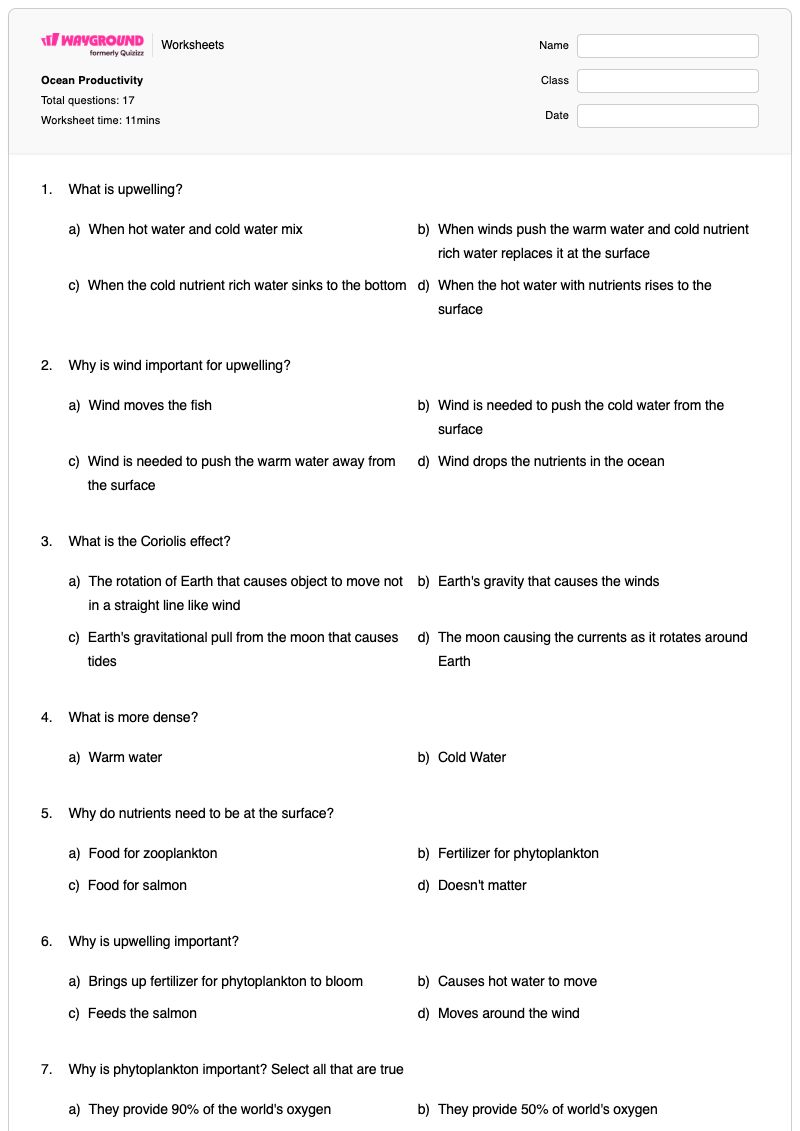
Ocean Productivity

คำถามทั้งหมด: 17

ชื่อ
ระดับ
วันที่
1.

What is upwelling?

a)

When hot water and cold water mix

b)

When winds push the warm water and cold nutrient rich water replaces it at the surface

c)

When the cold nutrient rich water sinks to the bottom

d)

When the hot water with nutrients rises to the surface

2.

Why is wind important for upwelling?

a)

Wind moves the fish

b)

Wind is needed to push the cold water from the surface

c)

Wind is needed to push the warm water away from the surface

d)

Wind drops the nutrients in the ocean

3.

What is the Coriolis effect?

a)

The rotation of Earth that causes object to move not in a straight line like wind

b)

Earth's gravity that causes the winds

c)

Earth's gravitational pull from the moon that causes tides

d)

The moon causing the currents as it rotates around Earth

4.

What is more dense?

a)

Warm water

b)

Cold Water

5.

Why do nutrients need to be at the surface?

a)

Food for zooplankton

b)

Fertilizer for phytoplankton

c)

Food for salmon

d)

Doesn't matter

6.

Why is upwelling important?

a)

Brings up fertilizer for phytoplankton to bloom

b)

Causes hot water to move

c)

Feeds the salmon

d)

Moves around the wind

7.

Why is phytoplankton important? Select all that are true

a)

They provide 90% of the world's oxygen

b)

They provide 50% of world's oxygen

c)

They eat orca whales

d)

They are the basis of the marine food chain

8.

What does the food chain show?

a)

Flow of energy in an ecosystem

b)

Flow of forces in an ecosystem

c)

Flow of matter in an ecosystem

d)

Life cycles

9.
Deep ocean currents are caused by

Deep ocean currents are caused by

a)

Wind

b)

Differences in densities

c)

Differences in temperature

d)

Cold and warm air currents

10.

Surface currents in the ocean are caused by

a)

Hot and cold temperatures

b)

Differences in Density

c)

Wind

d)

Hurricanes

11.

What is produced during photosynthesis?

a)

Carbon dioxide, water and Oxygen

b)

Glucose, water and Oxygen

c)

Caron dioxide, water and Glucose

d)

Carbon dioxide, water and light

12.

What are the two most significant factors affecting photosynthesis in the ocean

a)

Temperature

b)

Carbon Dioxide

c)

Nutrients

d)

Light

13.

Which time of the year would have the potential for the lowest productivity?

a)

Winter

b)

Spring

c)

Summer

d)

Fall

14.
What factors are likely to limit the growth and productivity of plants and algae if there is not enough available?

What factors are likely to limit the growth and productivity of plants and algae if there is not enough available?

a)

bacteria and viruses

b)

light and nutrients

c)

hydrogen ions

d)

epiphytes

15.
Producers like plants and algae require these for photosynthesis to occur:

Producers like plants and algae require these for photosynthesis to occur:

a)

carbon dioxide and water

b)

glucose and oxygen

c)

oxygen and water

d)

carbon dioxide and oxygen

16.
This color of light is absorbed closest to the surface and cannot be seen in deeper water.

This color of light is absorbed closest to the surface and cannot be seen in deeper water.

a)

blue

b)

red

c)

green

d)

yellow

17.
A secondary consumer only gains ____ of the energy of the total available energy of the primary consumer that it eats.

A secondary consumer only gains ____ of the energy of the total available energy of the primary consumer that it eats.

a)

30%

b)

50%

c)

90%

d)

10%

Waygroundแป้นคำตอบ

Ocean Productivity

คำถามทั้งหมด: 17

1.
b)

When winds push the warm water and cold nutrient rich water replaces it at the surface

2.
c)

Wind is needed to push the warm water away from the surface

3.
a)

The rotation of Earth that causes object to move not in a straight line like wind

4.
b)

Cold Water

5.
b)

Fertilizer for phytoplankton

6.
a)

Brings up fertilizer for phytoplankton to bloom

7.
b)

They provide 50% of world's oxygen

, d)

They are the basis of the marine food chain

8.
a)

Flow of energy in an ecosystem

9.
b)

Differences in densities

10.
c)

Wind

11.
b)

Glucose, water and Oxygen

12.
c)

Nutrients

, d)

Light

13.
a)

Winter

14.
b)

light and nutrients

15.
a)

carbon dioxide and water

16.
b)

red

17.
d)

10%

คำถามที่พบบ่อย

แบบฝึกหัดเรื่องผลิตภาพของมหาสมุทรครอบคลุมเนื้อหาอะไรบ้าง และช่วยให้นักเรียนเรียนรู้แนวคิดนี้ได้อย่างไร?

แบบฝึกหัดวิทยาศาสตร์สำหรับนักเรียนชั้น ม.3 นี้ ประกอบด้วยคำถามแบบเลือกตอบ 15 ข้อ และคำถามแบบเลือกคำตอบหลายข้อ 2 ข้อ เพื่อเชื่อมโยงปรากฏการณ์น้ำผุดขึ้นสู่ผิวน้ำกับผลผลิตในมหาสมุทร นักเรียนจะได้ระบุว่าลมพัดพาน้ำอุ่นบนผิวน้ำอย่างไร ทำให้น้ำเย็นที่มีสารอาหารสูงลอยขึ้นมา แยกแยะความแตกต่างระหว่างกระแสน้ำผิวน้ำที่เกิดจากลมกับกระแสน้ำลึกที่เกิดจากความหนาแน่น และอธิบายว่าสารอาหารและแสงช่วยสนับสนุนการเจริญเติบโตของแพลงก์ตอนพืชได้อย่างไร คำถามเกี่ยวกับการสังเคราะห์แสง การไหลของพลังงานในห่วงโซ่อาหาร และผลผลิตตามฤดูกาล ช่วยให้นักเรียนเชื่อมโยงกระบวนการทางกายภาพในมหาสมุทรเข้ากับระบบนิเวศทางทะเล

ฉันจะใช้แบบฝึกหัดนี้ในการสอนเรื่องการเพิ่มผลผลิตทางทะเลได้อย่างไร?

เริ่มแนะนำแบบฝึกหัดโดยให้นักเรียนติดตามลำดับขั้นตอนตั้งแต่การไหลขึ้นของน้ำที่เกิดจากลมไปจนถึงความพร้อมของสารอาหาร การเจริญเติบโตของแพลงก์ตอนพืช และการสนับสนุนห่วงโซ่อาหารในทะเล ก่อนมอบหมายแบบฝึกหัด ให้พูดคุยกันว่าทำไมน้ำเย็นจึงมีความหนาแน่นมากกว่าน้ำอุ่น และเปรียบเทียบกระแสน้ำผิวน้ำที่เกิดจากลมกับกระแสน้ำลึกที่เกิดจากความหนาแน่น ใช้คำถามแบบเลือกตอบหลายข้อเป็นหัวข้อในการอภิปราย: ขอให้นักเรียนอธิบายเหตุผลของทั้งสองปัจจัยที่มีผลต่อการสังเคราะห์แสงในมหาสมุทรและทั้งสองบทบาทของแพลงก์ตอนพืช แทนที่จะเลือกเพียงคำตอบเดียว

ฉันควรระวังข้อผิดพลาดอะไรบ้างเมื่อนักเรียนทำแบบฝึกหัดเรื่องผลิตภาพของมหาสมุทร?

นักเรียนอาจเข้าใจทิศทางการไหลขึ้นของน้ำผิด โดยเลือกที่จะคิดว่าน้ำเย็นที่มีสารอาหารสูงจมลงแทนที่จะตระหนักว่ามันเข้ามาแทนที่น้ำอุ่นบนผิวน้ำ นอกจากนี้ พวกเขาอาจสับสนระหว่างกระแสน้ำผิวน้ำที่เกิดจากลมกับกระแสน้ำลึกที่เกิดจากความหนาแน่น หรือเข้าใจผิดว่าอุณหภูมิเป็นปัจจัยหลักสองประการของการสังเคราะห์แสงในมหาสมุทรที่ระบุไว้ในแบบฝึกหัด ได้แก่ สารอาหารและแสง สำหรับข้อคำถามแบบเลือกหลายข้อ ให้ตรวจสอบว่านักเรียนเลือกบทบาททั้งหมดของแพลงก์ตอนพืชและปัจจัยการผลิตที่เกี่ยวข้องทั้งสองอย่าง ไม่ใช่แค่ตัวเลือกเดียว

ฉันจะมอบหมายและให้คะแนนแบบฝึกหัดเรื่องผลิตภาพของมหาสมุทรได้อย่างไร?

แบบฝึกหัดนี้มีให้ดาวน์โหลดในรูปแบบไฟล์ PDF ที่สามารถพิมพ์ได้ และเป็นแบบทดสอบดิจิทัลบน Wayground โดยมีเฉลยคำตอบครบถ้วนสำหรับทั้ง 17 ข้อ การส่งงานในรูปแบบไฟล์พิมพ์สามารถตรวจได้โดยการสแกนงานของนักเรียนด้วยแอป Wayground for Teachers นอกจากนี้ ตัวเลือกไฟล์ PDF ยังช่วยสนับสนุนโรงเรียนที่ต้องการลดเวลาการใช้หน้าจอขณะที่นักเรียนทบทวนแนวคิดเกี่ยวกับการเพิ่มผลผลิตในมหาสมุทร

ฉันจะปรับแบบฝึกหัดเรื่องผลิตภาพของมหาสมุทรให้เหมาะสมกับนักเรียนแต่ละคนได้อย่างไร?

ใช้การตั้งค่าขั้นสูงของแบบฝึกหัดเพื่อปรับระยะห่างระหว่างตัวอักษรและขนาดตัวอักษรเมื่อคำศัพท์ทางวิทยาศาสตร์หรือตัวเลือกคำตอบต้องการพื้นที่ในการมองเห็นมากขึ้น นอกจากนี้ คุณยังสามารถใช้แบบอักษรที่เหมาะสำหรับผู้ที่มีภาวะดิสเล็กเซียกับคำถามเกี่ยวกับการไหลขึ้นของน้ำ กระแสน้ำ การสังเคราะห์แสง และแพลงก์ตอนพืช หรือแปลแบบฝึกหัดเป็นภาษาอื่นเพื่อช่วยให้เข้าใจคำศัพท์ทางวิทยาศาสตร์เกี่ยวกับมหาสมุทรได้ดียิ่งขึ้น

ฉันจะหาแบบฝึกหัดแบบนี้เพิ่มเติมได้ที่ไหนบน Wayground?

Wayground นำเสนอชุดแบบฝึกหัดและโจทย์ฝึกหัดฟรีที่ครอบคลุมทุกวิชา พร้อมไฟล์ PDF และเฉลยคำตอบ เพื่อช่วยให้นักเรียนเชี่ยวชาญทักษะและแนวคิดที่สำคัญ ดูแบบฝึกหัดเพิ่มเติมได้ที่ https://wayground.com/en-us/worksheets