

Wayground
Genes to Proteins to Traits - Printable ศาสตร์ Worksheets 7th ระดับชั้น - Wayground

Genes to Proteins to Traits

Iris Kim

สร้างโดย Iris Kim

17 คำถาม

7th ระดับชั้น

ศาสตร์

อัปเดตแล้ว ก.พ. 2569

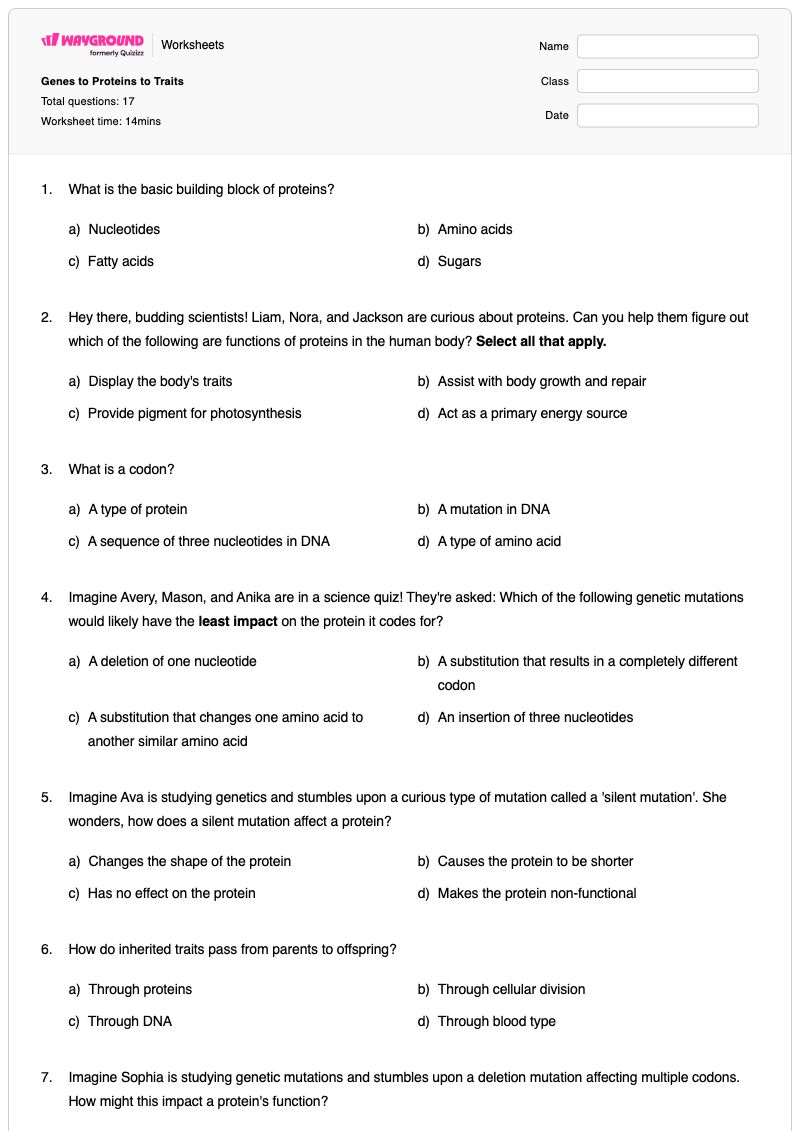
แบบฝึกหัดวิทยาศาสตร์สำหรับนักเรียนชั้น ม.1 เรื่อง "ยีนสู่โปรตีนสู่ลักษณะทางพันธุกรรม" ช่วยให้นักเรียนเชื่อมโยงคำสั่งในดีเอ็นเอเข้ากับโคดอน กรดอะมิโน โปรตีน และลักษณะทางพันธุกรรม แบบฝึกหัดประกอบด้วยคำถามแบบผสมผสาน 17 ข้อ ทั้งแบบเลือกตอบ เลือกหลายข้อ จับคู่ จัดประเภท ลากและวาง และคำถามที่ใช้รูปภาพ นักเรียนจะได้ระบุส่วนประกอบและหน้าที่ของโปรตีน อธิบายว่าลำดับโคดอนกำหนดกรดอะมิโนได้อย่างไร และหาจำนวนโคดอนที่จำเป็นสำหรับกรดอะมิโนจำนวนหนึ่ง แบบฝึกหัดนี้ยังให้นักเรียนแยกแยะประเภทของการกลายพันธุ์และคาดการณ์ว่าการเปลี่ยนแปลงในดีเอ็นเออาจส่งผลต่อโครงสร้างหรือหน้าที่ของโปรตีนอย่างไร นักเรียนจะจัดประเภทตัวอย่างที่เกี่ยวข้องกับลำดับนิวคลีโอไทด์ กรดอะมิโน โปรตีน และลักษณะทางพันธุกรรม พร้อมทั้งประยุกต์ใช้ความเข้าใจเกี่ยวกับการกลายพันธุ์แบบเงียบ ลักษณะทางพันธุกรรม การแสดงออกของยีน และผลลัพธ์ของโปรตีน แบบฝึกหัดที่พิมพ์ได้ฟรีนี้มีเฉลยคำตอบครบถ้วน และออกแบบมาสำหรับการสอน การทบทวน หรือการประเมินผลวิทยาศาสตร์ชั้น ม.1

การตั้งค่าแผ่นงาน

ขนาดตัวอักษร

S
M
L
XL
Waygroundแผ่นงาน

Genes to Proteins to Traits

คำถามทั้งหมด: 17

ชื่อ
ระดับ
วันที่
1.

What is the basic building block of proteins?

a)

Nucleotides

b)

Amino acids

c)

Fatty acids

d)

Sugars

2.

Hey there, budding scientists! Liam, Nora, and Jackson are curious about proteins. Can you help them figure out which of the following are functions of proteins in the human body? Select all that apply.

a)

Display the body's traits

b)

Assist with body growth and repair

c)

Provide pigment for photosynthesis

d)

Act as a primary energy source

3.

What is a codon?

a)

A type of protein

b)

A mutation in DNA

c)

A sequence of three nucleotides in DNA

d)

A type of amino acid

4.

Imagine Avery, Mason, and Anika are in a science quiz! They're asked: Which of the following genetic mutations would likely have the least impact on the protein it codes for?

a)

A deletion of one nucleotide

b)

A substitution that results in a completely different codon

c)

A substitution that changes one amino acid to another similar amino acid

d)

An insertion of three nucleotides

5.

Imagine Ava is studying genetics and stumbles upon a curious type of mutation called a 'silent mutation'. She wonders, how does a silent mutation affect a protein?

a)

Changes the shape of the protein

b)

Causes the protein to be shorter

c)

Has no effect on the protein

d)

Makes the protein non-functional

6.

How do inherited traits pass from parents to offspring?

a)

Through proteins

b)

Through cellular division

c)

Through DNA

d)

Through blood type

7.

Imagine Sophia is studying genetic mutations and stumbles upon a deletion mutation affecting multiple codons. How might this impact a protein's function?

a)

No impact since other codons will compensate

b)

The protein may become non-functional or gain a new function

c)

The protein will be produced more quickly

d)

The mutation will be reversed naturally

8.

Samuel is studying genetics and is curious about how the sequence of nucleotides in DNA determines the sequence of amino acids in a protein. Explain this process to him.

a)

By matching one nucleotide with 3 corresponding amino acids

b)

Through the formation of peptide bonds between nucleotides

c)

By determining the order of codons, which specify amino acids

d)

By directly synthesizing amino acids from DNA segments

9.

James, a genetic researcher, is tasked to develop a model to show how mutations in the DNA sequence of a gene could lead to changes in the structure and function of a protein in a specific disease context.

a)

Illustrate different DNA mutations and their protein outcomes in the disease

b)

Create a chart showing DNA, RNA, and protein before and after mutation in the disease context

c)

Write a computer program to simulate mutations in the disease's genetic framework

d)

All of the above

10.

Imagine you're part of a groundbreaking study led by Evelyn, Michael, and Benjamin. Your mission? To uncover how different environments influence gene expression over decades. How would you design this long-term research project?

a)

Join Evelyn and her team in monitoring gene expression in individuals across various environments for the next 20 years.

b)

Assist Michael in conducting a one-time survey of gene expression across multiple environments.

c)

Work with Benjamin to analyze gene expression within strictly controlled laboratory settings.

d)

Explore non-genetic factors that influence traits, diverging from gene expression studies.

11.

How many amino acids are coded for by this sequence of nucleotides:
ATG GGA ACT CCA

a)

4

b)

2

c)

6

d)

12

12.

Harper is studying genetics and needs to know how many codons are required to specify for five amino acids in a DNA sequence. How many codons does she need?

a)

3

b)

5

c)

15

d)

30

13.

Imagine you're a scientist like Benjamin, and you're exploring the blueprint of life! DNA holds the code for making what?

a)

lipids

b)

carbohydrates

c)

proteins

d)

sugars

14.

What does this picture represent?

15.

Organize these options into the right categories

จัดหมวดหมู่ดังต่อไปนี้

ACG

GTA
TGC
CTA
AGT
Methionine
Leucine
Lysine
Phenylalanine
Valine
Hemoglobin
Insulin
Collagen
Keratin
Myosin
Blue eyes
Curly hair
Double-jointed
Freckles
Tongue rolling ability
Codon
Amino Acid
Protein
Trait
16.

Match the following:

Codon

3 nucleotides

Amino Acid

Building Block of Proteins

Protein

Chain of Amino Acids

Trait

Characteristic Feature

Nitrogen Bases

Adenine, Thymine, Cytosine, Guanine

17.

​ (a)   are segments of ​ (b)   that code for a ​ (c)   and therefore determine a ​ (d)   . This is called ​ (e)   .

เลือกจากคำด้านล่าง
Genes
DNA
protein
trait
gene expression
Waygroundแป้นคำตอบ

Genes to Proteins to Traits

คำถามทั้งหมด: 17

1.
b)

Amino acids

2.
a)

Display the body's traits

, b)

Assist with body growth and repair

, d)

Act as a primary energy source

3.
c)

A sequence of three nucleotides in DNA

4.
c)

A substitution that changes one amino acid to another similar amino acid

5.
c)

Has no effect on the protein

6.
c)

Through DNA

7.
b)

The protein may become non-functional or gain a new function

8.
c)

By determining the order of codons, which specify amino acids

9.
d)

All of the above

10.
a)

Join Evelyn and her team in monitoring gene expression in individuals across various environments for the next 20 years.

11.
a)

4

12.
b)

5

13.
c)

proteins

14.
15.
Codon

ACG

GTA
TGC
CTA
AGT
Amino Acid
Methionine
Leucine
Lysine
Phenylalanine
Valine
Protein
Hemoglobin
Insulin
Collagen
Keratin
Myosin
Trait
Blue eyes
Curly hair
Double-jointed
Freckles
Tongue rolling ability
16.

Codon

 - 

3 nucleotides

, 

Amino Acid

 - 

Building Block of Proteins

, 

Protein

 - 

Chain of Amino Acids

, 

Trait

 - 

Characteristic Feature

, 

Nitrogen Bases

 - 

Adenine, Thymine, Cytosine, Guanine

17.
Genes, DNA, protein, trait, gene expression

คำถามที่พบบ่อย

แบบฝึกหัด "ยีนสู่โปรตีนสู่ลักษณะทางพันธุกรรม" ครอบคลุมเนื้อหาอะไรบ้าง?

แบบฝึกหัดวิทยาศาสตร์สำหรับนักเรียนชั้น ม.1 นี้ครอบคลุมถึงวิธีการจัดเรียงลำดับดีเอ็นเอเป็นโคดอนซึ่งกำหนดกรดอะมิโน ซึ่งเป็นส่วนประกอบของโปรตีนที่มีผลต่อลักษณะต่างๆ แบบฝึกหัดนี้มีคำถามแบบผสมผสาน 17 ข้อ ที่จะให้นักเรียนระบุหน้าที่ของโปรตีน นับโคดอนและกรดอะมิโน จำแนกประเภทของตัวอย่าง ตีความแผนภาพ และทำนายว่าการกลายพันธุ์ เช่น การแทนที่ การลบ และการกลายพันธุ์แบบเงียบ อาจส่งผลต่อโปรตีนอย่างไร

ฉันจะใช้แบบฝึกหัดนี้สอนเรื่องความสัมพันธ์ระหว่างยีน โปรตีน และลักษณะทางพันธุกรรมได้อย่างไร?

แนะนำลำดับ DNA → โคดอน → กรดอะมิโน → โปรตีน → ลักษณะเฉพาะ จากนั้นให้นักเรียนใช้แบบฝึกหัดเพื่อประยุกต์ใช้แต่ละส่วน ถามนักเรียนว่าทำไมลำดับเช่น “ATG GGA ACT CCA” จึงแทนโคดอนสี่ตัว และการเปลี่ยนโคดอนจะเปลี่ยนแปลงโปรตีนได้อย่างไร ใช้หัวข้อการกลายพันธุ์และการจำแนกประเภทเพื่ออภิปรายหลังจากที่นักเรียนตอบคำถามหลักเสร็จแล้ว

ฉันควรระวังข้อผิดพลาดอะไรบ้างเมื่อนักเรียนทำแบบฝึกหัดพันธุศาสตร์นี้?

นักเรียนอาจสับสนระหว่างโคดอนกับกรดอะมิโน นับนิวคลีโอไทด์ทีละตัวแทนที่จะนับเป็นกลุ่มสามตัว หรือเข้าใจผิดว่าการกลายพันธุ์ทุกครั้งจะเปลี่ยนหน้าที่ของโปรตีน ตรวจสอบให้แน่ใจว่านักเรียนเข้าใจว่าการกลายพันธุ์แบบเงียบไม่มีผลต่อโปรตีนในแบบฝึกหัดนี้ และแยกแยะความแตกต่างระหว่างลำดับดีเอ็นเอ กรดอะมิโน โปรตีน และลักษณะเฉพาะต่างๆ เมื่อทำแบบฝึกหัดการจำแนกประเภทและการลากและวาง

ฉันจะมอบหมายและให้คะแนนแบบฝึกหัด "ยีนสู่โปรตีนสู่ลักษณะ" นี้ได้อย่างไร?

คุณสามารถมอบหมายงานผ่าน Wayground ในรูปแบบไฟล์ PDF ที่พิมพ์ได้ หรือเป็นแบบทดสอบดิจิทัล โดยมีเฉลยคำตอบครบถ้วนสำหรับตรวจสอบคำตอบแบบเลือกตอบหลายตัวเลือก เลือกคำตอบที่ถูกต้องหลายข้อ จัดประเภท จับคู่ และลากและวาง สำหรับการส่งงานแบบพิมพ์ได้ ให้สแกนงานของนักเรียนด้วยแอป Wayground for Teachers เพื่อให้การตรวจงานง่ายขึ้น

ฉันจะปรับแบบฝึกหัดพันธุศาสตร์นี้ให้เหมาะสมกับนักเรียนของฉันได้อย่างไร?

ใช้การตั้งค่าขั้นสูงของแบบฝึกหัดเพื่อปรับระยะห่างระหว่างตัวอักษรหรือเพิ่มขนาดตัวอักษรเมื่อนักเรียนต้องการพื้นที่มากขึ้นในการอ่านข้อมูลเกี่ยวกับโคดอน การกลายพันธุ์ และการจำแนกประเภท นอกจากนี้ คุณยังสามารถเปิดใช้งานแบบอักษรที่เหมาะสำหรับผู้ที่มีภาวะดิสเล็กเซีย หรือแปลแบบฝึกหัดเป็นภาษาอื่นเพื่อให้คำถามทางพันธุศาสตร์ในรูปแบบผสมเข้าถึงได้ง่ายขึ้น

ฉันจะหาแบบฝึกหัดแบบนี้เพิ่มเติมได้ที่ไหนบน Wayground?

Wayground นำเสนอชุดแบบฝึกหัดและโจทย์ฝึกหัดฟรีที่ครอบคลุมหลากหลายวิชา พร้อมไฟล์ PDF และเฉลยคำตอบ เพื่อช่วยเสริมสร้างทักษะและความเข้าใจในแนวคิดสำคัญ ดูแหล่งข้อมูลเพิ่มเติมได้ที่ https://wayground.com/en-us/worksheets