

 แผ่นงาน
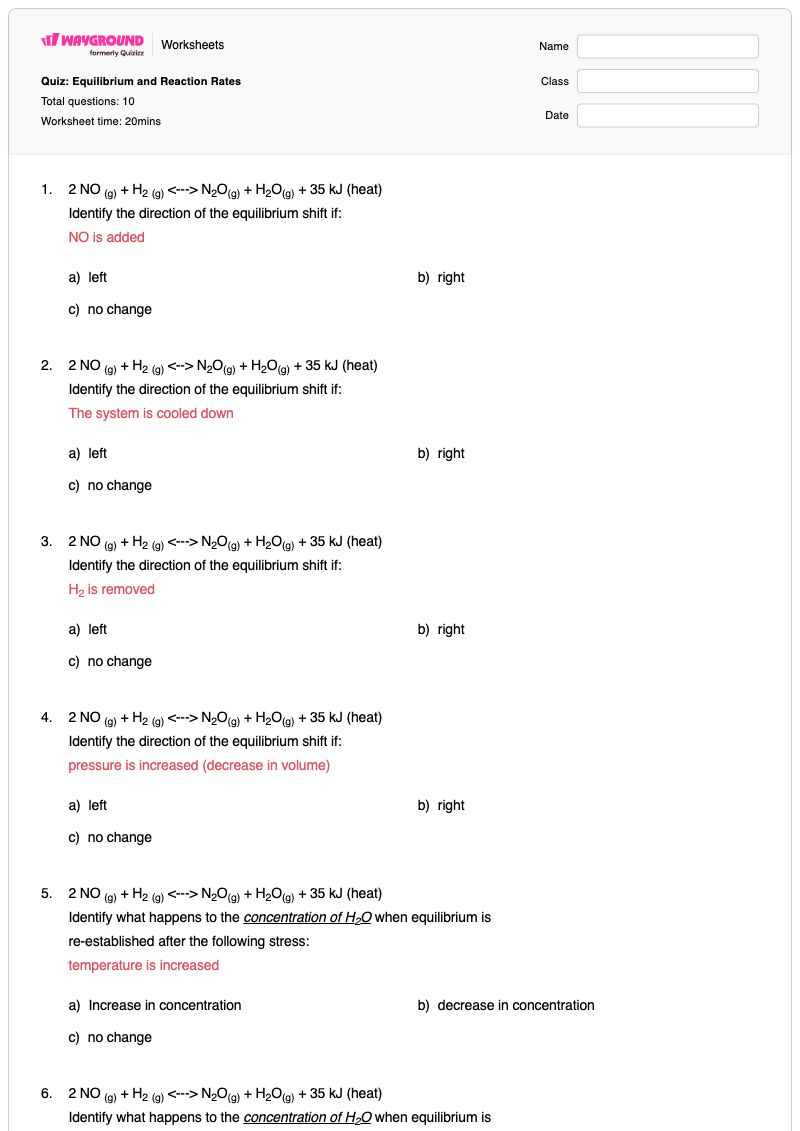
Quiz: Equilibrium and Reaction Rates
คำถามทั้งหมด: 10
2 NO (g) + H2 (g) <---> N2O(g) + H2O(g) + 35 kJ (heat)
Identify the direction of the equilibrium shift if:
NO is added
left
right
no change
2 NO (g) + H2 (g) <--> N2O(g) + H2O(g) + 35 kJ (heat)
Identify the direction of the equilibrium shift if:
The system is cooled down
left
right
no change
2 NO (g) + H2 (g) <---> N2O(g) + H2O(g) + 35 kJ (heat)
Identify the direction of the equilibrium shift if:
H2 is removed
left
right
no change
2 NO (g) + H2 (g) <---> N2O(g) + H2O(g) + 35 kJ (heat)
Identify the direction of the equilibrium shift if:
pressure is increased (decrease in volume)
left
right
no change
2 NO (g) + H2 (g) <---> N2O(g) + H2O(g) + 35 kJ (heat)
Identify what happens to the concentration of H2O when equilibrium is
re-established after the following stress:
temperature is increased
Increase in concentration
decrease in concentration
no change
2 NO (g) + H2 (g) <---> N2O(g) + H2O(g) + 35 kJ (heat)
Identify what happens to the concentration of H2O when equilibrium is
re-established after the following stress:
a catalyst is added
Increase in concentration
decrease in concentration
no change
Identify which of the following factors would most likely cause the rate of a chemical reaction to slow.
Increase in concentration of reactants
Increase in surface area of reactants
Increase in temperature of reactants
Increase in volume of reactants
A catalyst is used to increase the rate of a reaction, briefly explain how this occurs.
It decreases the amount of energy required for the reaction to occur
It offers an alternative path for reactants to take.
It helps increase the likelihood that reactants will collide with enough energy and proper position.
All of the above

The following diagram represent...
Endothermic reaction
Exothermic reaction
A catalyzed reaction
A fast reaction
Identify who has more potential energy.
Reactants
Products
Transition State molecules
None of the above
แป้นคำตอบQuiz: Equilibrium and Reaction Rates
คำถามทั้งหมด: 10
right
right
left
right
decrease in concentration
no change
Increase in volume of reactants
All of the above
Exothermic reaction
Transition State molecules