
Wayground
Abiotic vs. Biotic Factors (S7L4a)  - Printable ศาสตร์ Worksheets 7th ระดับชั้น - Wayground

Abiotic vs. Biotic Factors (S7L4a)

Belser

สร้างโดย Belser

25 คำถาม

7th ระดับชั้น

ศาสตร์

อัปเดตแล้ว เม.ย. 2569

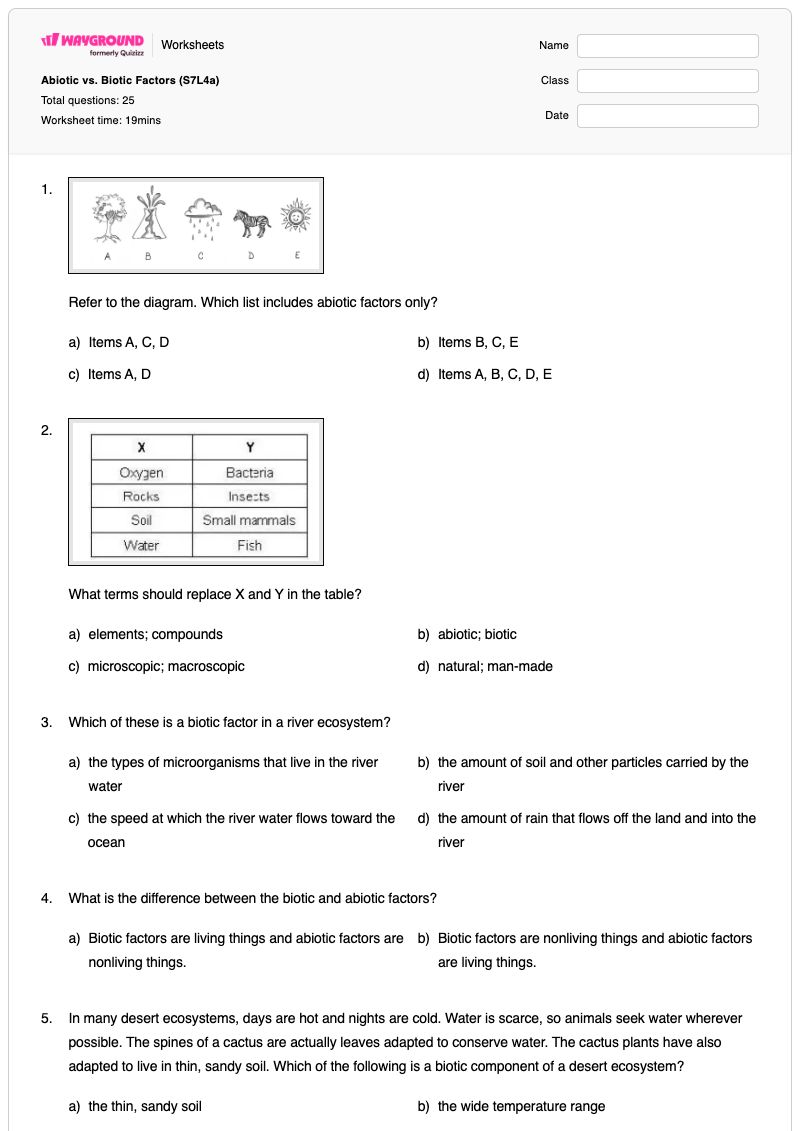
ปัจจัยทางชีวภาพและปัจจัยทางกายภาพ (S7L4a) เป็นแบบฝึกหัดชีววิทยาสำหรับนักเรียนชั้น ม.1 ที่ช่วยให้นักเรียนแยกแยะองค์ประกอบที่มีชีวิตและองค์ประกอบที่ไม่มีชีวิตในระบบนิเวศ แบบฝึกหัดนี้ประกอบด้วยคำถามแบบเลือกตอบ 25 ข้อ โดยนักเรียนจะต้องจำแนกตัวอย่างต่างๆ เช่น จุลินทรีย์ ปลา ใบกระบองเพชร ปลวก แสงแดด น้ำ อากาศ อุณหภูมิ ดิน ปริมาณน้ำฝน และสภาพแวดล้อมอื่นๆ ว่าเป็นปัจจัยทางชีวภาพหรือปัจจัยทางกายภาพ แบบฝึกหัดนี้ยังเน้นทักษะการจำแนกประเภทในบริบทของแม่น้ำ ทะเลทราย มหาสมุทร และระบบนิเวศที่กว้างขึ้น โดยให้นักเรียนระบุปัจจัยจากแผนภาพ ตาราง คำจำกัดความ และสถานการณ์สั้นๆ รูปแบบนี้ช่วยให้นักเรียนได้ฝึกฝนการประยุกต์ใช้ความแตกต่างระหว่างปัจจัยทางชีวภาพและปัจจัยทางกายภาพกับตัวอย่างจริงซ้ำๆ แทนที่จะท่องจำคำจำกัดความเพียงอย่างเดียว แบบฝึกหัดที่พิมพ์ได้ฟรีนี้มีเฉลยคำตอบครบถ้วน ทำให้มีประโยชน์สำหรับการสอนชีววิทยาในชั้น ม.1 การฝึกฝนด้วยตนเอง การทบทวน หรือการตรวจสอบความเข้าใจอย่างรวดเร็ว

การตั้งค่าแผ่นงาน

ขนาดตัวอักษร

S
M
L
XL
Waygroundแผ่นงาน

Abiotic vs. Biotic Factors (S7L4a)

คำถามทั้งหมด: 25

ชื่อ
ระดับ
วันที่
1.
Refer to the diagram. Which list includes abiotic factors only?

Refer to the diagram. Which list includes abiotic factors only?

a)

Items A, C, D

b)

Items B, C, E

c)

Items A, D

d)

Items A, B, C, D, E

2.
What terms should replace X and Y in the table?

What terms should replace X and Y in the table?

a)

elements; compounds

b)

abiotic; biotic

c)

microscopic; macroscopic

d)

natural; man-made

3.

Which of these is a biotic factor in a river ecosystem?

a)

the types of microorganisms that live in the river water

b)

the amount of soil and other particles carried by the river

c)

the speed at which the river water flows toward the ocean

d)

the amount of rain that flows off the land and into the river

4.

What is the difference between the biotic and abiotic factors?

a)

Biotic factors are living things and abiotic factors are nonliving things.

b)

Biotic factors are nonliving things and abiotic factors are living things.

5.

In many desert ecosystems, days are hot and nights are cold. Water is scarce, so animals seek water wherever possible. The spines of a cactus are actually leaves adapted to conserve water. The cactus plants have also adapted to live in thin, sandy soil. Which of the following is a biotic component of a desert ecosystem?

a)

the thin, sandy soil

b)

the wide temperature range

c)

the scarcity of water

d)

the spiny cactus leaves

6.

Which of the following is a biotic factor in an ocean ecosystem?

a)

the salt content of the water

b)

the temperature of the water

c)

the fish in the water

d)

the oxygen in the water

7.

Drought, erosion, flood, and prolonged heat spells are examples of —

a)

communities

b)

biotic factors within an ecosystem which affect abiotic components

c)

populations

d)

abiotic changes within an ecosystem which can affect biotic factors

8.

An abiotic component of an ecosystem is represented by the —

a)

bats under a bridge in Austin, Texas

b)

population of deer on a deer lease in Central Texas

c)

attack on a wheat field by fungus

d)

monthly average rainfall in Texas

9.

Which statement below refers only to biotic components in an ecosystem?

a)

Evaporation, transpiration, and precipitation are complex processes that cycle water between the atmosphere and the Earth's surface.

b)

Photosynthesis and respiration are not considered atmospheric processes.

c)

Vegetation is an indicator of several environmental factors, including precipitation, temperature, soil, geology, and wind.

d)

In Yellowstone Park, shrubs have expanded their range into large areas formerly populated by short grasses, due to overgrazing and trampling by livestock.

10.
The Sun is the source of all energy within an ecosystem. Plants depend on light from the sun in order to perform the process…

The Sun is the source of all energy within an ecosystem. Plants depend on light from the sun in order to perform the process of photosynthesis. Sunlight is an example of what type of factor?

a)

Biotic

b)

Abiotic

11.
Termites are tiny insects that can cause severe damage to homes and other structures that consist of wood. Termites are an…

Termites are tiny insects that can cause severe damage to homes and other structures that consist of wood. Termites are an example of what type of factor.

a)

Biotic

b)

Abiotic

12.
Water is a compound that consists of 2 hydrogen atoms and 1 oxygen atom. Up to 60% of an adult human is made up of water.…

Water is a compound that consists of 2 hydrogen atoms and 1 oxygen atom. Up to 60% of an adult human is made up of water. Water is an example of what type of factor?

a)

Biotic

b)

Abiotic

13.
Air is a mixture of colorless gases. The air that makes up the Earth's atmosphere consists primarily of nitrogen and oxygen.…

Air is a mixture of colorless gases. The air that makes up the Earth's atmosphere consists primarily of nitrogen and oxygen. Air is an example of which type of factor?

a)

Biotic

b)

Abiotic

14.
An arctic blast pushed its way through several of the Northern state in the United State. The temperatures dropped below…

An arctic blast pushed its way through several of the Northern state in the United State. The temperatures dropped below freezing for several days. Temperature is an example of which type of factor?

a)

Biotic

b)

Abiotic

15.
An angler fish has a fleshy growth on its head that gives off light. This part acts as a lure to help the angler fish catch…

An angler fish has a fleshy growth on its head that gives off light. This part acts as a lure to help the angler fish catch its prey. An anglerfish is an example of which type of factor?

a)

Biotic

b)

Abiotic

16.
All living things or organisms in an ecosystem are

All living things or organisms in an ecosystem are

a)

None

b)

biotic factors

c)

abiotic factors

17.
Is a deer an abiotic or biotic factor?

Is a deer an abiotic or biotic factor?

a)

abiotic

b)

biotic

18.
Is a rose an abiotic or biotic factor?

Is a rose an abiotic or biotic factor?

a)

abiotic

b)

biotic

19.
Is a rock considered abiotic or biotic?

Is a rock considered abiotic or biotic?

a)

Abiotic

b)

biotic

c)

neither

20.

Which of the following shows an abiotic factor interacting with a biotic factor in the environment?

a)

Lamprey eels survive by attaching themselves to trout.

b)

Water temperature affects its oxygen level.

c)

Low light intensity affects the growth of forest pine trees.

d)

Gypsy moth caterpillars eat the leaves of apple tree.

21.

Which is an example of a seasonal change to a biotic factor?

a)

Temperatures get cooler in the fall.

b)

Hours of sunlight increase the summer.

c)

Birds fly south for the winter.

d)

Rainfall increases in the spring.

22.

A hollow, sealed glass sphere contains sand, water, air, algae, and tiny brine shrimp. The sphere is a model ecosystem. Which of these is a biotic factor of this ecosystem?

a)

air

b)

algae

c)

sand

d)

water

23.
How does a decrease an abiotic resource (like water) impact the population of an ecosystem?

How does a decrease an abiotic resource (like water) impact the population of an ecosystem?

a)

The population size will increase.

b)

The population size will decrease.

c)

The population size will not change.

24.
Which of the following is an example of two organisms competing for an abiotic factor?

Which of the following is an example of two organisms competing for an abiotic factor?

a)

Two different species of insects competing for leaves from trees.

b)

Two different species of mammals competing for small rodents to eat.

c)

Two different species of birds competing for berries to eat.

d)

Two different species of mammals competing for the same water source.

25.
Which abiotic factor(s) do plants compete for in order to make their own food?

Which abiotic factor(s) do plants compete for in order to make their own food?

a)

Water

b)

Sunlight

c)

Wind

d)

Water and sunlight

Waygroundแป้นคำตอบ

Abiotic vs. Biotic Factors (S7L4a)

คำถามทั้งหมด: 25

1.
b)

Items B, C, E

2.
b)

abiotic; biotic

3.
a)

the types of microorganisms that live in the river water

4.
a)

Biotic factors are living things and abiotic factors are nonliving things.

5.
d)

the spiny cactus leaves

6.
c)

the fish in the water

7.
d)

abiotic changes within an ecosystem which can affect biotic factors

8.
d)

monthly average rainfall in Texas

9.
d)

In Yellowstone Park, shrubs have expanded their range into large areas formerly populated by short grasses, due to overgrazing and trampling by livestock.

10.
b)

Abiotic

11.
a)

Biotic

12.
b)

Abiotic

13.
b)

Abiotic

14.
b)

Abiotic

15.
a)

Biotic

16.
b)

biotic factors

17.
b)

biotic

18.
b)

biotic

19.
a)

Abiotic

20.
c)

Low light intensity affects the growth of forest pine trees.

21.
c)

Birds fly south for the winter.

22.
b)

algae

23.
b)

The population size will decrease.

24.
d)

Two different species of mammals competing for the same water source.

25.
d)

Water and sunlight

คำถามที่พบบ่อย

แบบฝึกหัดเรื่องปัจจัยทางชีวภาพและปัจจัยทางกายภาพครอบคลุมหัวข้ออะไรบ้าง?

แบบฝึกหัดชีววิทยาสำหรับนักเรียนชั้น ม.1 นี้ ประกอบด้วยคำถามแบบเลือกตอบ 25 ข้อ เพื่อเสริมสร้างความสามารถของนักเรียนในการจำแนกองค์ประกอบของระบบนิเวศออกเป็นสิ่งมีชีวิต (biotic) และสิ่งไม่มีชีวิต (abiotic) นักเรียนจะได้นำความแตกต่างนี้ไปใช้กับตัวอย่างจากระบบนิเวศของแม่น้ำ ทะเลทราย และมหาสมุทร รวมถึงปัจจัยต่างๆ เช่น แสงแดด น้ำ อากาศ อุณหภูมิ ดิน จุลินทรีย์ ปลา และพืช

ฉันจะใช้แบบฝึกหัดนี้สอนนักเรียนเกี่ยวกับปัจจัยทางชีวภาพและปัจจัยทางกายภาพได้อย่างไร?

เริ่มแบบฝึกหัดโดยให้นักเรียนนิยามปัจจัยทางชีวภาพและปัจจัยทางกายภาพ จากนั้นสาธิตการจำแนกตัวอย่างสิ่งมีชีวิตหนึ่งอย่างและสภาวะแวดล้อมหนึ่งอย่าง เมื่อนักเรียนทำแบบฝึกหัดแบบเลือกตอบ ให้ถามพวกเขาว่าหลักฐานใดที่ทำให้ตัวเลือกนั้นเป็นสิ่งมีชีวิตหรือสิ่งไม่มีชีวิต โดยเฉพาะอย่างยิ่งเมื่อเปรียบเทียบตัวอย่างระบบนิเวศที่ใกล้เคียงกัน เช่น ปลาเทียบกับน้ำ หรือใบกระบองเพชรเทียบกับดินทราย

ฉันควรสังเกตข้อผิดพลาดอะไรบ้างเมื่อนักเรียนทำแบบฝึกหัดนี้เสร็จ?

นักเรียนอาจสับสนระหว่างถิ่นที่อยู่หรือสภาพแวดล้อมของสิ่งมีชีวิตกับตัวสิ่งมีชีวิตเอง เช่น เลือกน้ำในแม่น้ำแทนที่จะเป็นจุลินทรีย์ในแม่น้ำ หรือเลือกดินแทนที่จะเป็นใบกระบองเพชร นอกจากนี้ พวกเขาอาจจัดประเภทปัจจัยที่มีประโยชน์หรือจำเป็น เช่น แสงแดด อากาศ และน้ำ ว่าเป็นสิ่งมีชีวิต ควรเตือนพวกเขาว่า ความสำคัญต่อสิ่งมีชีวิตไม่ได้ทำให้ปัจจัยนั้นเป็นสิ่งมีชีวิตเสมอไป

ฉันจะมอบหมายและให้คะแนนแบบฝึกหัดเรื่องปัจจัยทางชีวภาพและปัจจัยทางกายภาพได้อย่างไร?

Wayground จัดเตรียมแบบฝึกหัดนี้ในรูปแบบไฟล์ PDF ที่สามารถพิมพ์ได้ และแบบทดสอบดิจิทัล โดยมีเฉลยคำตอบครบถ้วนสำหรับคำถามแบบเลือกตอบ 25 ข้อ คุณสามารถตรวจงานส่งในรูปแบบไฟล์พิมพ์ได้โดยการสแกนงานของนักเรียนด้วยแอป Wayground for Teachers หรือมอบหมายแบบทดสอบดิจิทัลผ่าน Wayground เพื่อให้นักเรียนทำและตรวจงานทางออนไลน์ได้

ฉันจะปรับแบบฝึกหัดนี้ให้เหมาะสมกับนักเรียนของฉันได้อย่างไร?

ใช้การตั้งค่าขั้นสูงของแบบฝึกหัดเพื่อปรับระยะห่างระหว่างตัวอักษรและขนาดตัวอักษร เพื่อให้ตัวเลือกแบบปรนัยและสถานการณ์ระบบนิเวศอ่านง่ายขึ้น นอกจากนี้ คุณยังสามารถเปิดใช้งานแบบอักษรที่เหมาะสำหรับผู้ที่มีภาวะดิสเล็กเซีย หรือแปลแบบฝึกหัดเป็นภาษาอื่นได้ เมื่อตัวเลือกเหล่านั้นสนับสนุนการเข้าถึงงานจำแนกประเภทสิ่งมีชีวิตและสิ่งไม่มีชีวิต

ฉันจะหาแบบฝึกหัดแบบนี้เพิ่มเติมได้ที่ไหนบน Wayground?

Wayground นำเสนอชุดแบบฝึกหัดและโจทย์ฝึกหัดฟรีที่ครอบคลุมหลากหลายวิชา พร้อมไฟล์ PDF และเฉลยคำตอบ เพื่อสนับสนุนทักษะและแนวคิดที่สำคัญ ดูแหล่งข้อมูลเพิ่มเติมได้ที่ https://wayground.com/en-us/worksheets