

Wayground
Scale factor with Perimeter and Area - Printable คณิตศาสตร์ Worksheets 6th - 8th ระดับชั้น - Wayground

Scale factor with Perimeter and Area

Suzanne Cariddi

สร้างโดย Suzanne Cariddi

20 คำถาม

6th - 8th ระดับชั้น

คณิตศาสตร์

อัปเดตแล้ว ก.ย. 2569

แบบฝึกหัดคณิตศาสตร์สำหรับนักเรียนชั้น ป.6-ม.2 นี้ ช่วยให้นักเรียนได้ฝึกฝนอย่างเจาะจงเกี่ยวกับวิธีที่อัตราส่วนการขยาย/ลดขนาดเปลี่ยนแปลงขนาด เส้นรอบรูป และพื้นที่ของรูปทรง แบบฝึกหัดประกอบด้วยคำถามแบบเลือกตอบ 20 ข้อ นักเรียนจะได้ระบุการขยายและการย่อขนาด กำหนดการเปลี่ยนแปลงของเส้นรอบรูปโดยใช้อัตราส่วนการขยาย/ลดขนาดเดียวกัน คำนวณการเปลี่ยนแปลงของพื้นที่โดยใช้อัตราส่วนการขยาย/ลดขนาดกำลังสอง และหาค่าอัตราส่วนการขยาย/ลดขนาดที่ไม่ทราบค่าจากเส้นรอบรูปเดิมและเส้นรอบรูปใหม่ ตัวอย่างประกอบด้วยอัตราส่วนการขยาย/ลดขนาดที่เป็นจำนวนเต็มและเศษส่วน เช่น 4 และ 1/4 กับรูปสี่เหลี่ยมผืนผ้าและรูปสี่เหลี่ยมจัตุรัส แบบฝึกหัดนี้มีประโยชน์สำหรับการแนะนำหรือทบทวนการให้เหตุผลเชิงสัดส่วนและการแยกแยะความแตกต่างระหว่างการเปลี่ยนแปลงเชิงเส้นและการเปลี่ยนแปลงพื้นที่ นักเรียนจะนำกฎไปใช้กับทั้งคำถามเชิงแนวคิดและการคำนวณเชิงตัวเลข ช่วยให้ครูระบุได้ว่านักเรียนเข้าใจหรือไม่ว่าเมื่อใดควรคูณด้วยอัตราส่วนการขยาย/ลดขนาด และเมื่อใดควรยกกำลังสอง แบบฝึกหัดที่พิมพ์ได้ฟรีนี้มีเฉลยคำตอบครบถ้วนเพื่อการตรวจสอบและให้ข้อเสนอแนะอย่างมีประสิทธิภาพ

การตั้งค่าแผ่นงาน

ขนาดตัวอักษร

S
M
L
XL
Waygroundแผ่นงาน

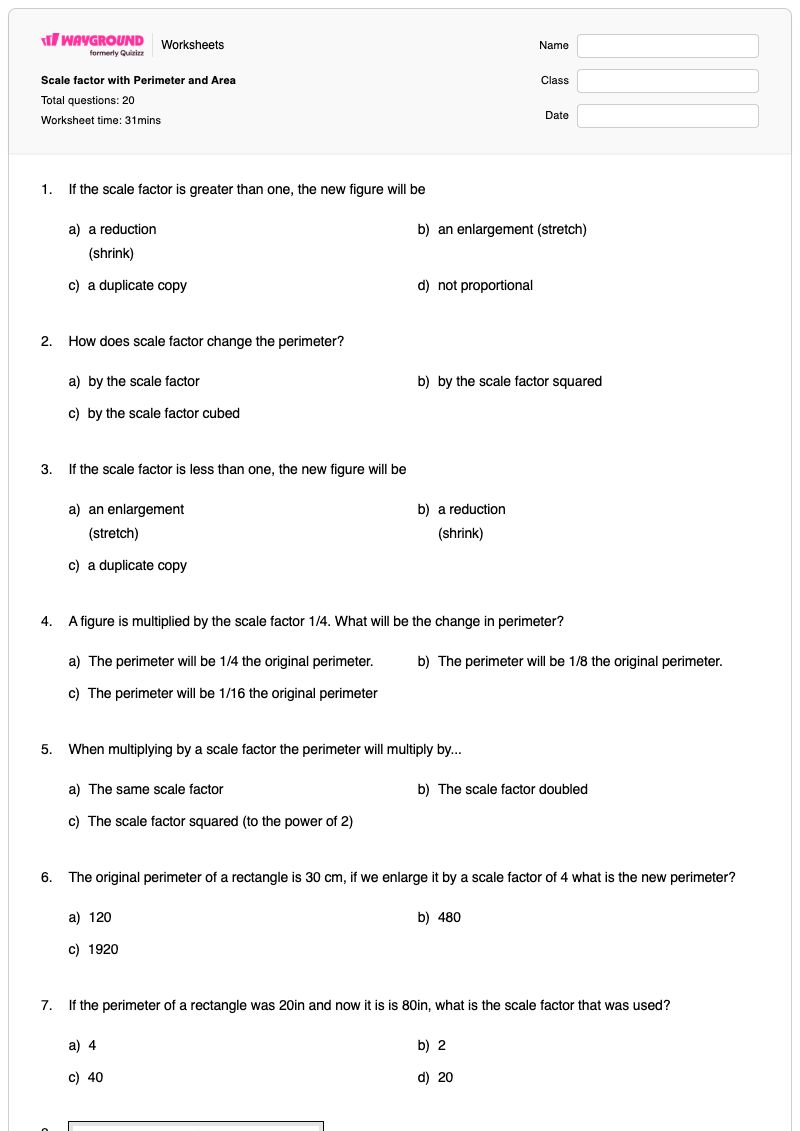
Scale factor with Perimeter and Area

คำถามทั้งหมด: 20

ชื่อ
ระดับ
วันที่
1.
If the scale factor is greater than one, the new figure will be
a)

a reduction

(shrink)

b)

an enlargement (stretch)

c)

a duplicate copy

d)

not proportional

2.

How does scale factor change the perimeter?

a)

by the scale factor

b)

by the scale factor squared

c)

by the scale factor cubed

3.
If the scale factor is less than one, the new figure will be
a)

an enlargement

(stretch)

b)

a reduction

(shrink)

c)

a duplicate copy

4.
A figure is multiplied by the scale factor 1/4. What will be the change in perimeter?
a)
The perimeter will be 1/4 the original perimeter.
b)
The perimeter will be 1/8 the original perimeter.
c)
The perimeter will be 1/16 the original perimeter
5.
When multiplying by a scale factor the perimeter will multiply by...
a)
The same scale factor
b)
The scale factor doubled
c)
The scale factor squared (to the power of 2)
6.

The original perimeter of a rectangle is 30 cm, if we enlarge it by a scale factor of 4 what is the new perimeter?

a)

120

b)

480

c)

1920

7.

If the perimeter of a rectangle was 20in and now it is is 80in, what is the scale factor that was used?

a)

4

b)

2

c)

40

d)

20

8.
Both the side lengths and perimeter are 3 times larger in the bigger rectangle.

Both the side lengths and perimeter are 3 times larger in the bigger rectangle.

a)

True

b)

False

9.
ภาพคำถาม
a)

The new perimeter will be 2 times the old perimeter.

b)

The new perimeter will be 1/2 of the old perimeter.

c)

The new perimeter will be 3 times the old perimeter.

d)

The new perimeter will be 4 times the old perimeter.

10.
ภาพคำถาม
a)
The perimeter of the new rectangle will be the same as the perimeter of the original rectangle.
b)
The perimeter of the new rectangle will be 2.5 times as large as the perimeter of the original rectangle.
c)
The perimeter of the new rectangle will be 5 times as large as the perimeter of the original rectangle.
11.
A rectangle has a perimeter of 15 inches. An image is created with a scale factor of 2. What is the new perimeter?
a)
17
b)
60
c)
30
d)
15
12.

A scale factor of 2 is used to enlarge the dimensions of a square. What is the effect of this change on the area of the square?

a)

The area will be half as big.

b)

The area will be twice as large.

c)

The area will be 4 times larger.

d)

The area will be 8 times larger.

e)

The area will not change.

13.
What is one way to determine how much the area would increase using a scale factor of 3?

What is one way to determine how much the area would increase using a scale factor of 3?

a)

take the scale factor and square it to get 3x3=9

b)

add all of the sides together then multiply by 3

c)

multiply the area of the smaller rectangle by 3

14.
When multiplying by a scale factor the area will multiply by...
a)

The same scale factor

b)

The scale factor doubled

c)

The scale factor squared (to the power of 2)

(scale factor x scale factor)

15.
If the scale factor is 5, how times larger will the area of the big square be compared to the smaller square?

If the scale factor is 5, how times larger will the area of the big square be compared to the smaller square?

a)

5

b)

20

c)

25

16.
A figure is multiplied by the scale factor 1/4. What will be the change in area?
a)
The area will be 1/4 the original area.
b)
The area will be 1/8 the original area.
c)
The area will be 1/16 the original area.
17.
A scale factor greater than one creates ....
a)
a reduction
b)
an enlargement
c)
an exact copy
d)
none of these
18.

If the perimeter is 8 times bigger, what scale factor was used?

a)

64

b)

8

c)

16

d)

4

19.
The area of this rectangle is 90 km 2 . If a scaled copy of this rectangle is made using a scale factor of 5, then what is…

The area of this rectangle is 90 km2. If a scaled copy of this rectangle is made using a scale factor of 5, then what is the area of the copy?

a)

210 km2

b)

450 km2

c)

4500 km2

d)

2,250 km2

20.
The area of this rectangle is 90 km 2 . If a scaled copy of this rectangle is made using a scale factor of 3, then what is…

The area of this rectangle is 90 km2. If a scaled copy of this rectangle is made using a scale factor of 3, then what is the area of the copy?

a)

270 km2

b)

810 km2

c)

30 km2

d)

156 km2

Waygroundแป้นคำตอบ

Scale factor with Perimeter and Area

คำถามทั้งหมด: 20

1.
b)

an enlargement (stretch)

2.
a)

by the scale factor

3.
b)

a reduction

(shrink)

4.
a) The perimeter will be 1/4 the original perimeter.
5.
a) The same scale factor
6.
a)

120

7.
a)

4

8.
a)

True

9.
c)

The new perimeter will be 3 times the old perimeter.

10.
b) The perimeter of the new rectangle will be 2.5 times as large as the perimeter of the original rectangle.
11.
c) 30
12.
c)

The area will be 4 times larger.

13.
a)

take the scale factor and square it to get 3x3=9

14.
c)

The scale factor squared (to the power of 2)

(scale factor x scale factor)

15.
c)

25

16.
c) The area will be 1/16 the original area.
17.
b) an enlargement
18.
b)

8

19.
d)

2,250 km2

20.
b)

810 km2

คำถามที่พบบ่อย

แบบฝึกหัดเรื่อง "อัตราส่วนมาตราส่วนกับเส้นรอบวงและพื้นที่" ครอบคลุมเนื้อหาอะไรบ้าง?

แบบฝึกหัดนี้มีคำถามแบบเลือกตอบ 20 ข้อ เพื่อสร้างความเข้าใจเกี่ยวกับวิธีการที่อัตราส่วนการขยาย/ลดขนาดเปลี่ยนแปลงเส้นรอบรูปและพื้นที่ของรูปทรง นักเรียนจะได้ระบุการขยายและการย่อขนาด คำนวณเส้นรอบรูปใหม่โดยการคูณด้วยอัตราส่วนการขยาย/ลดขนาด คำนวณพื้นที่ใหม่โดยการคูณด้วยอัตราส่วนการขยาย/ลดขนาดกำลังสอง และคำนวณย้อนกลับจากเส้นรอบรูปเพื่อหาอัตราส่วนการขยาย/ลดขนาดที่ไม่ทราบค่า

ฉันจะใช้แบบฝึกหัดนี้สอนเรื่องการเปลี่ยนแปลงอัตราส่วนมาตราส่วนในเส้นรอบวงและพื้นที่ได้อย่างไร?

เริ่มแบบฝึกหัดโดยให้นักเรียนเปรียบเทียบว่าความยาวด้านเปลี่ยนแปลงอย่างไรเมื่ออัตราส่วนการขยายมากกว่าหรือน้อยกว่า 1 จากนั้นใช้คำถามเกี่ยวกับเส้นรอบวงเพื่อแสดงให้เห็นว่าเส้นรอบวงเปลี่ยนแปลงไปตามอัตราส่วนเดียวกัน ก่อนที่จะเปรียบเทียบกับคำถามเกี่ยวกับพื้นที่ ซึ่งอัตราส่วนการขยายเป็นกำลังสอง หยุดพักหลังจากยกตัวอย่างเช่น อัตราส่วนการขยาย 1/4 หรือ 4 แล้วถามนักเรียนว่าทำไมเส้นรอบวงและพื้นที่จึงให้ผลลัพธ์ที่แตกต่างกัน

ฉันควรระวังข้อผิดพลาดอะไรบ้างเมื่อนักเรียนทำแบบฝึกหัดเรื่องตัวประกอบมาตราส่วนนี้?

ระวังนักเรียนที่คูณพื้นที่ด้วยตัวคูณมาตราส่วนเพียงครั้งเดียว แทนที่จะยกกำลังสอง เช่น เลือก 5 แทนที่จะเป็น 25 สำหรับตัวคูณมาตราส่วนเท่ากับ 5 นักเรียนอาจยกกำลังสองตัวคูณสำหรับเส้นรอบรูปอย่างไม่ถูกต้อง กลับลำดับการขยายและการย่อเมื่อตัวคูณน้อยกว่า 1 หรือเลือกเส้นรอบรูปเดิมแทนที่จะหารเส้นรอบรูปใหม่ด้วยเส้นรอบรูปเดิมเพื่อหาตัวคูณมาตราส่วน

ฉันจะมอบหมายและให้คะแนนแบบฝึกหัดเรื่องตัวประกอบมาตราส่วนนี้ได้อย่างไร?

คุณสามารถมอบหมายแบบฝึกหัดนี้เป็นไฟล์ PDF ที่พิมพ์ได้ หรือเป็นแบบทดสอบดิจิทัลบน Wayground ก็ได้ และแบบฝึกหัดนี้มีเฉลยคำตอบครบถ้วนสำหรับตรวจสอบคำถามแบบเลือกตอบ 20 ข้อ สำหรับการส่งงานแบบพิมพ์ได้ ให้สแกนงานของนักเรียนด้วยแอป Wayground for Teachers เพื่อช่วยตรวจคำตอบได้อย่างมีประสิทธิภาพ

ฉันจะปรับแบบฝึกหัดนี้ให้เหมาะสมกับนักเรียนของฉันได้อย่างไร?

ใช้การตั้งค่าขั้นสูงของแบบฝึกหัดเพื่อปรับระยะห่างระหว่างตัวอักษรหรือขนาดตัวอักษร เพื่อให้ข้อสอบแบบเลือกตอบเกี่ยวกับเส้นรอบวงและพื้นที่อ่านและใช้งานง่ายขึ้น นอกจากนี้ คุณยังสามารถใช้แบบอักษรที่เหมาะสำหรับผู้ที่มีภาวะดิสเล็กเซีย หรือแปลแบบฝึกหัดเป็นภาษาอื่นได้ เมื่อตัวเลือกเหล่านั้นรองรับการเข้าถึงคำถามเกี่ยวกับปัจจัยมาตราส่วน

ฉันจะหาแบบฝึกหัดแบบนี้เพิ่มเติมได้ที่ไหนบน Wayground?

Wayground นำเสนอชุดแบบฝึกหัดและโจทย์ฝึกหัดฟรีที่ครอบคลุมหลากหลายวิชา พร้อมไฟล์ PDF และเฉลยคำตอบ เพื่อช่วยให้นักเรียนเชี่ยวชาญทักษะและแนวคิดที่สำคัญ ดูแหล่งข้อมูลเพิ่มเติมได้ที่ https://wayground.com/en-us/worksheets