

Wayground
Chemical Bonds Practice - Printable ศาสตร์ Worksheets ระดับ 8 - Wayground

Chemical Bonds Practice

Christiane Henderson

สร้างโดย Christiane Henderson

23 คำถาม

8th ระดับชั้น

ศาสตร์

อัปเดตแล้ว ต.ค. 2569

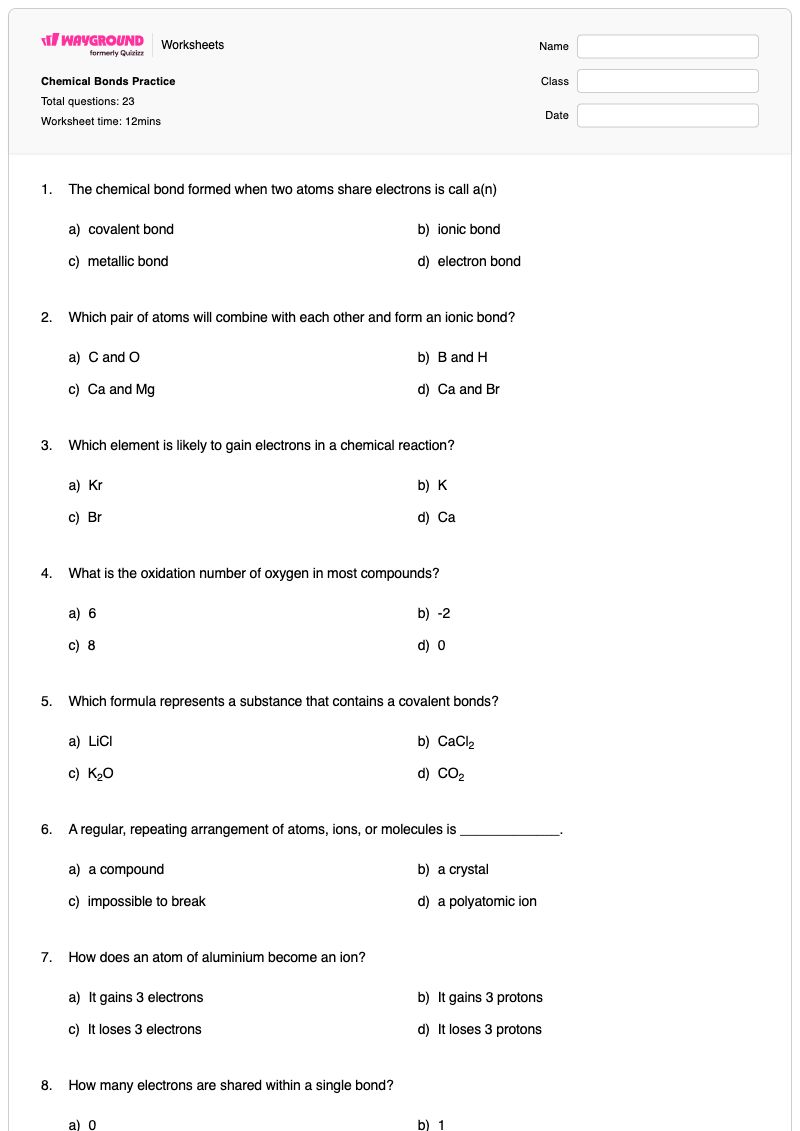
แบบฝึกหัดเรื่องพันธะเคมี เป็นแบบฝึกหัดวิทยาศาสตร์สำหรับนักเรียนชั้น ม.2 (เกรด 8) ที่พิมพ์ได้ฟรี ประกอบด้วยคำถามแบบเลือกตอบ 23 ข้อ พร้อมเฉลยคำตอบครบถ้วน แบบฝึกหัดนี้มุ่งเน้นแนวคิดหลักเกี่ยวกับพันธะเคมี รวมถึงการแยกแยะพันธะไอออนิกและพันธะโคเวเลนต์ การระบุอิเล็กตรอนวาเลนซ์ การพิจารณาว่าอะตอมได้รับหรือสูญเสียอิเล็กตรอน การรู้จักเลขออกซิเดชัน และการตีความสูตรเคมี เช่น CO₂, NaF และ CaCl₂ นักเรียนยังได้ประยุกต์ใช้ความเข้าใจเกี่ยวกับระดับพลังงานภายนอกที่เสถียร การแบ่งปันอิเล็กตรอนในพันธะเดี่ยว โครงสร้างผลึก แรงดึงดูดของไอออน คุณสมบัติของสารประกอบ และการตั้งชื่อสารประกอบ เช่น แมกนีเซียมซัลไฟด์ รูปแบบคำถามและตัวเลือกที่เน้นเฉพาะเจาะจง ช่วยให้ครูตรวจสอบได้อย่างรวดเร็วว่านักเรียนสามารถเชื่อมโยงพฤติกรรมของอะตอมกับประเภทของพันธะ ระบุตัวอย่างจากสูตรเคมี และใช้คำศัพท์พื้นฐานเกี่ยวกับพันธะได้อย่างถูกต้องหรือไม่

การตั้งค่าแผ่นงาน

ขนาดตัวอักษร

S
M
L
XL
Waygroundแผ่นงาน

Chemical Bonds Practice

คำถามทั้งหมด: 23

ชื่อ
ระดับ
วันที่
1.

The chemical bond formed when two atoms share electrons is call a(n)

a)

covalent bond

b)

ionic bond

c)

metallic bond

d)

electron bond

2.

Which pair of atoms will combine with each other and form an ionic bond?

a)

C and O

b)

B and H

c)

Ca and Mg

d)

Ca and Br

3.

Which element is likely to gain electrons in a chemical reaction?

a)

Kr

b)

K

c)

Br

d)

Ca

4.

What is the oxidation number of oxygen in most compounds?

a)

6

b)

-2

c)

8

d)

0

5.

Which formula represents a substance that contains a covalent bonds?

a)

LiCl

b)

CaCl2

c)

K2O

d)

CO2

6.

A regular, repeating arrangement of atoms, ions, or molecules is _____________.

a)

a compound

b)

a crystal

c)

impossible to break

d)

a polyatomic ion

7.

How does an atom of aluminium become an ion?

a)

It gains 3 electrons

b)

It gains 3 protons

c)

It loses 3 electrons

d)

It loses 3 protons

8.

How many electrons are shared within a single bond?

a)

0

b)

1

c)

2

d)

4

9.

Which atoms are most likely to form covalent bonds?

a)

metal atoms that share electrons

b)

metal atoms that share protons

c)

nonmetal atoms that share electrons

d)

nonmetal atoms that share protons

10.

The electrons that are lost, gained, or shared in chemical bonds are called ________________.

a)

valence electrons

b)

chemical electrons

c)

Lewis electrons

d)

none of the above

11.

Which of the following is NOT an example of covalent bonding?

a)

H2O

b)

NaF

c)

NH3

d)

O2

12.

How many electrons are needed in the outer energy levels of most atoms for the atom to be chemically stable?

a)

2

b)

4

c)

6

d)

8

13.

The properties of a compound are _________ the properties of the elements that form it.

a)

similar to

b)

different from

c)

identical to

d)

derived from

14.

Which of the following is the reason why atoms of sodium and chlorine attract each other in a salt crystal?

a)

Sodium has a positive charge and chlorine has a negative charge

b)

Sodium has a negative charge and chlorine has a positive charge

c)

Both have a positive charge

d)

Both have a negative charge

15.

Which of the following is the correct name for a compound between Magnesium and Sulfur?

a)

Magnesium Sulfur

b)

Magnesium sulfide

c)

Magnesium (I) sulfide

d)

Dimagnesium Disulfide

16.

Which of the following is the correct name for a compound between Phosphorous and Chlorine?

a)

Phosphorous chlorine

b)

Phosphorous chloride

c)

Phosphorous (III) chloride

d)

Phosphorous trichloride

17.

Which of the following is a similarity between ionic and covalent bonds?

a)

Both include the gaining and losing of electrons

b)

Both include the sharing of electrons

c)

Both make the elements more stable

d)

Both are typically found as solids at room temperature

18.

Cations are ions with _________ charge.

a)

positive

b)

negative

c)

gains

d)

loses

19.

Cations are formed when an atom __________ electrons.

a)

positive

b)

negative

c)

gains

d)

loses

20.

Anions are ions with a ___________ charge.

a)

positive

b)

negative

c)

gains

d)

loses

21.

Anions are formed when an atom __________ electrons.

a)

positive

b)

negative

c)

gains

d)

loses

22.

______________ compounds are usually the strongest.

a)

Ionic

b)

Covalent

c)

Molecule

d)

solid

23.

____________ compounds are usually solid at room temperature and form a crystal structure.

a)

Ionic

b)

Covalent

c)

Molecule

d)

Solid

Waygroundแป้นคำตอบ

Chemical Bonds Practice

คำถามทั้งหมด: 23

1.
a)

covalent bond

2.
d)

Ca and Br

3.
c)

Br

4.
b)

-2

5.
d)

CO2

6.
b)

a crystal

7.
c)

It loses 3 electrons

8.
c)

2

9.
c)

nonmetal atoms that share electrons

10.
a)

valence electrons

11.
b)

NaF

12.
d)

8

13.
b)

different from

14.
a)

Sodium has a positive charge and chlorine has a negative charge

15.
b)

Magnesium sulfide

16.
d)

Phosphorous trichloride

17.
c)

Both make the elements more stable

18.
a)

positive

19.
d)

loses

20.
b)

negative

21.
c)

gains

22.
a)

Ionic

23.
a)

Ionic

คำถามที่พบบ่อย

แบบฝึกหัดเรื่องพันธะเคมีครอบคลุมเนื้อหาอะไรบ้าง?

แบบฝึกหัดวิทยาศาสตร์สำหรับนักเรียนชั้น ม.2 นี้ ประกอบด้วยคำถามแบบเลือกตอบ 23 ข้อ เพื่อประเมินความเข้าใจเกี่ยวกับพันธะไอออนิกและพันธะโคเวเลนต์ อิเล็กตรอนวาเลนซ์ การรับและการสูญเสียอิเล็กตรอน เลขออกซิเดชัน ระดับพลังงานภายนอกที่เสถียร โครงสร้างผลึก และการตั้งชื่อสารประกอบ นักเรียนจะใช้ตัวอย่างเช่น CaBr₂, CO₂, NaF และแมกนีเซียมซัลไฟด์ เพื่อเชื่อมโยงพฤติกรรมของอะตอมและสูตรเคมีกับประเภทและคุณสมบัติของสารประกอบ

ฉันจะใช้แบบฝึกหัดนี้ในการสอนเรื่องพันธะไอออนิกและพันธะโคเวเลนต์ได้อย่างไร?

เริ่มแบบฝึกหัดโดยทบทวนบทบาทของอิเล็กตรอนวาเลนซ์และเปรียบเทียบการถ่ายโอนอิเล็กตรอนในพันธะไอออนิกกับการแบ่งปันอิเล็กตรอนในพันธะโคเวเลนต์ จากนั้นให้นักเรียนอธิบายว่าทำไมคู่ของธาตุเช่นแคลเซียมและโบรมีนจึงเกิดพันธะไอออนิก และทำไมอะตอมของอโลหะเช่นใน CO₂ จึงเกิดพันธะโคเวเลนต์ ใช้ข้อสอบแบบเลือกตอบเป็นหัวข้อในการอภิปราย โดยขอให้นักเรียนตัดตัวเลือกที่เกี่ยวข้องกับโปรตอนหรือรูปแบบประจุที่ไม่ถูกต้องออก

ฉันควรระวังข้อผิดพลาดอะไรบ้างเมื่อนักเรียนทำแบบฝึกหัดเรื่องพันธะเคมีนี้?

นักเรียนอาจสับสนระหว่างการแบ่งปันอิเล็กตรอนกับการถ่ายโอนอิเล็กตรอน จัดประเภท NaF เป็นสารประกอบโคเวเลนต์เพราะมีธาตุสองชนิด หรือเลือกคู่โลหะ เช่น แคลเซียมและแมกนีเซียม เมื่อระบุอะตอมที่สร้างพันธะไอออนิก ระวังความสับสนระหว่างอิเล็กตรอนวาเลนซ์และโปรตอน โดยเฉพาะในคำถามเกี่ยวกับอะลูมิเนียมที่สูญเสียอิเล็กตรอนสามตัวและเลขออกซิเดชันปกติของออกซิเจนคือ -2 นักเรียนอาจสลับประจุของโซเดียมและคลอรีน หรือใช้ชื่อสารประกอบที่ไม่ถูกต้อง เช่น “แมกนีเซียมซัลเฟอร์”

ฉันจะมอบหมายและตรวจงานแบบฝึกหัดเรื่องพันธะเคมีได้อย่างไร?

คุณสามารถมอบหมายแบบฝึกหัดนี้เป็นไฟล์ PDF ที่พิมพ์ได้ หรือเป็นแบบทดสอบดิจิทัลบน Wayground ก็ได้ และแบบฝึกหัดนี้มีเฉลยคำตอบครบถ้วนสำหรับคำถามแบบเลือกตอบทั้ง 23 ข้อ การส่งงานแบบพิมพ์ได้สามารถตรวจได้โดยการสแกนงานของนักเรียนด้วยแอป Wayground for Teachers รูปแบบที่พิมพ์ได้ยังช่วยให้โรงเรียนมีตัวเลือกในการลดเวลาการใช้หน้าจอขณะประเมินความรู้เรื่องพันธะเคมีอีกด้วย

ฉันจะปรับแบบฝึกหัดเรื่องพันธะเคมีนี้ให้เหมาะสมกับนักเรียนของฉันได้อย่างไร?

เนื่องจากแบบฝึกหัดนี้มีคำถามแบบเลือกตอบ 23 ข้อ พร้อมคำศัพท์และสูตรทางเคมี คุณสามารถปรับระยะห่างระหว่างตัวอักษรและขนาดตัวอักษรเพื่อให้ง่ายต่อการอ่านได้ นอกจากนี้ ในการตั้งค่าขั้นสูง คุณยังสามารถเลือกใช้แบบอักษรที่เหมาะสำหรับผู้ที่มีภาวะดิสเล็กเซีย หรือแปลแบบฝึกหัดเป็นภาษาอื่นสำหรับนักเรียนที่ได้รับประโยชน์จากตัวเลือกในระดับไฟล์เหล่านั้นได้

ฉันจะหาแบบฝึกหัดแบบนี้เพิ่มเติมได้ที่ไหนบน Wayground?

Wayground นำเสนอชุดแบบฝึกหัดและโจทย์ฝึกหัดฟรีที่ครอบคลุมหลากหลายวิชา รวมถึงไฟล์ PDF และเฉลยคำตอบ เพื่อช่วยให้นักเรียนเชี่ยวชาญทักษะและแนวคิดที่สำคัญ ดูแหล่งข้อมูลเพิ่มเติมได้ที่ https://wayground.com/en-us/worksheets