

 แผ่นงาน
Understanding the Great Depression
คำถามทั้งหมด: 2
1-10.
ตอบคำถามด้านล่างหลังจากชมวิดีโอแล้ว
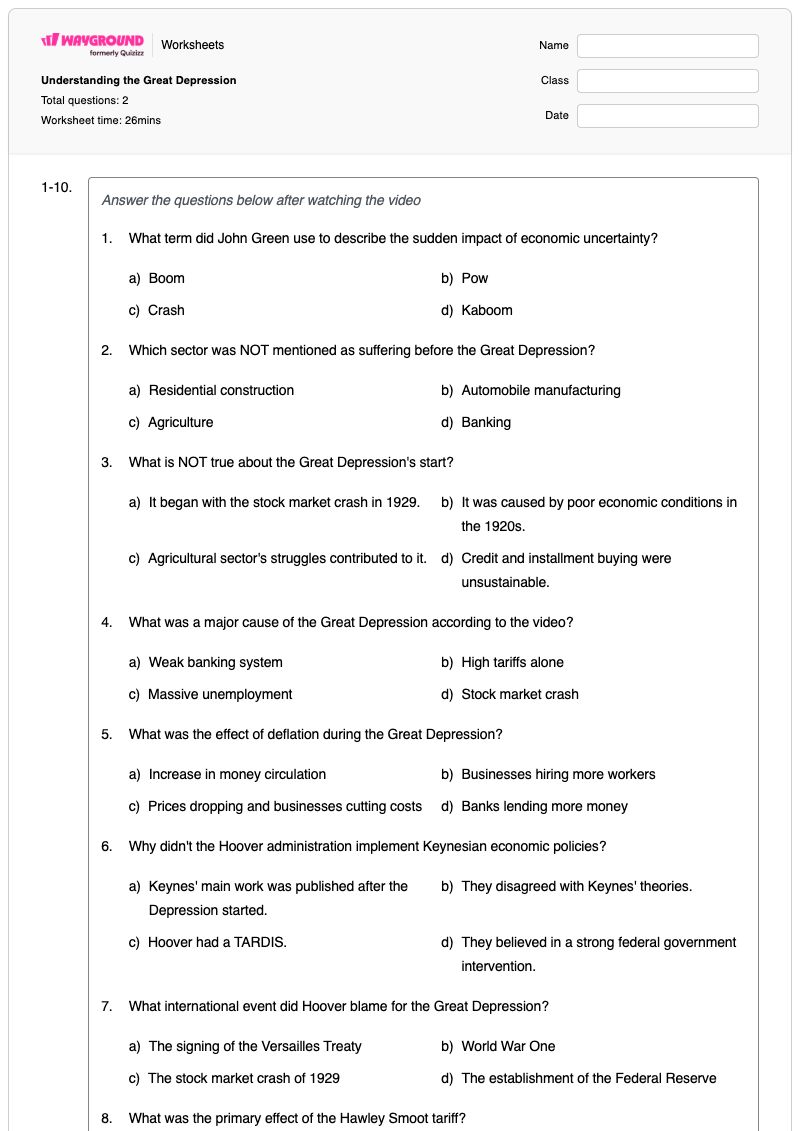
What term did John Green use to describe the sudden impact of economic uncertainty?
Boom
Pow
Crash
Kaboom
Which sector was NOT mentioned as suffering before the Great Depression?
Residential construction
Automobile manufacturing
Agriculture
Banking
What is NOT true about the Great Depression's start?
It began with the stock market crash in 1929.
It was caused by poor economic conditions in the 1920s.
Agricultural sector's struggles contributed to it.
Credit and installment buying were unsustainable.
What was a major cause of the Great Depression according to the video?
Weak banking system
High tariffs alone
Massive unemployment
Stock market crash
What was the effect of deflation during the Great Depression?
Increase in money circulation
Businesses hiring more workers
Prices dropping and businesses cutting costs
Banks lending more money
Why didn't the Hoover administration implement Keynesian economic policies?
Keynes' main work was published after the Depression started.
They disagreed with Keynes' theories.
Hoover had a TARDIS.
They believed in a strong federal government intervention.
What international event did Hoover blame for the Great Depression?
The signing of the Versailles Treaty
World War One
The stock market crash of 1929
The establishment of the Federal Reserve
What was the primary effect of the Hawley Smoot tariff?
Increased international trade
Lowered prices for consumer goods
Reduced buyers for American goods
Stabilized the banking system
What was Hoover's major action to combat the Great Depression?
Implementing Keynesian economics
Creating the Reconstruction Finance Corporation
Lowering taxes
Creating the New Deal
What percentage of the labor force was unemployed by early 1932?
10%
20%
30%
40%
The Dust Bowl and the Great Depression
In order to understand the extent of the damage caused by the Dust Bowl, it is imperative to contextualize this disaster in the broader context of the Great Depression, which created an atmosphere of crisis. With World War I occurring from 1914-1918, feeding troops overseas required substantial quantities of wheat leading to the overplowing of land (Dust Bowl, Britannica). Since Russia cut its wheat supply off, the United States government paid farmers a premium of $2 a bushel to convert more and more grassland into wheat farms.
The Roaring Twenties were a time of overspeculation, overstimulation, and overuse, which added to the non-natural causes of the Dust Bowl. The Great Gatsby stereotypically, but accurately, portrays the speculative, gambling, risk-taking culture of the wealthy elite, both on Wall Street and in their over-the-top country homes. Those who hosted gatherings with contraband alcohol risked being caught by authorities during the Prohibition Era, yet they took the risk anyway for personal enjoyment and gain. This underground, bootlegging, fun-loving, and money-making atmosphere introduced and ignored the consequences of overleveraging oneself, one’s country, and one’s environment. To supply copious amounts of gin and whiskey, bootleggers demanded large amounts of grain. Again, farmers, gracious for the opportunity to increase profits, produced more grain and barley.
The Dust Bowl, a period of severe dust storms that greatly damaged the ecology and agriculture of the American and Canadian prairies during the 1930s, was one of the major factors that led to the Great Depression. The causes of the Dust Bowl are attributed to a combination of poor farming practices, prolonged drought, and economic factors that exacerbated the situation.
One of the primary causes of the Dust Bowl was the extensive plowing and deforestation of the prairies, which left the soil exposed and vulnerable to erosion. The lack of crop rotation and sustainable farming methods further depleted the soil's nutrients, making it more susceptible to wind erosion. The severe drought that hit the region in the early 1930s exacerbated the situation, turning the once fertile land into barren dust bowls.
The environmental devastation caused by the Dust Bowl had far-reaching consequences, including widespread crop failures, economic hardship, and mass migration of people from the affected areas. The combination of the Dust Bowl and the Great Depression created a perfect storm of economic and environmental crises that had a lasting impact on the United States and its people.
What were some of the enviromental factors that led to the Great Depression?
Poor farming practices
Polar ice caps melting
food scarcity
agricultural revolution
What were the primary causes of the Dust Bowl?
Overgrazing and industrialization
Urbanization and pollution
Extensive plowing and deforestation
Crop rotation and heavy rainfall
What do you feel was the main causes of the dust bowl and the impact it had on the great depression(use details from the passage)
แป้นคำตอบUnderstanding the Great Depression
คำถามทั้งหมด: 2
Pow
Banking
It began with the stock market crash in 1929.
Weak banking system
Prices dropping and businesses cutting costs
Keynes' main work was published after the Depression started.
World War One
Reduced buyers for American goods
Creating the Reconstruction Finance Corporation
20%
Poor farming practices
Extensive plowing and deforestation