
 แผ่นงาน
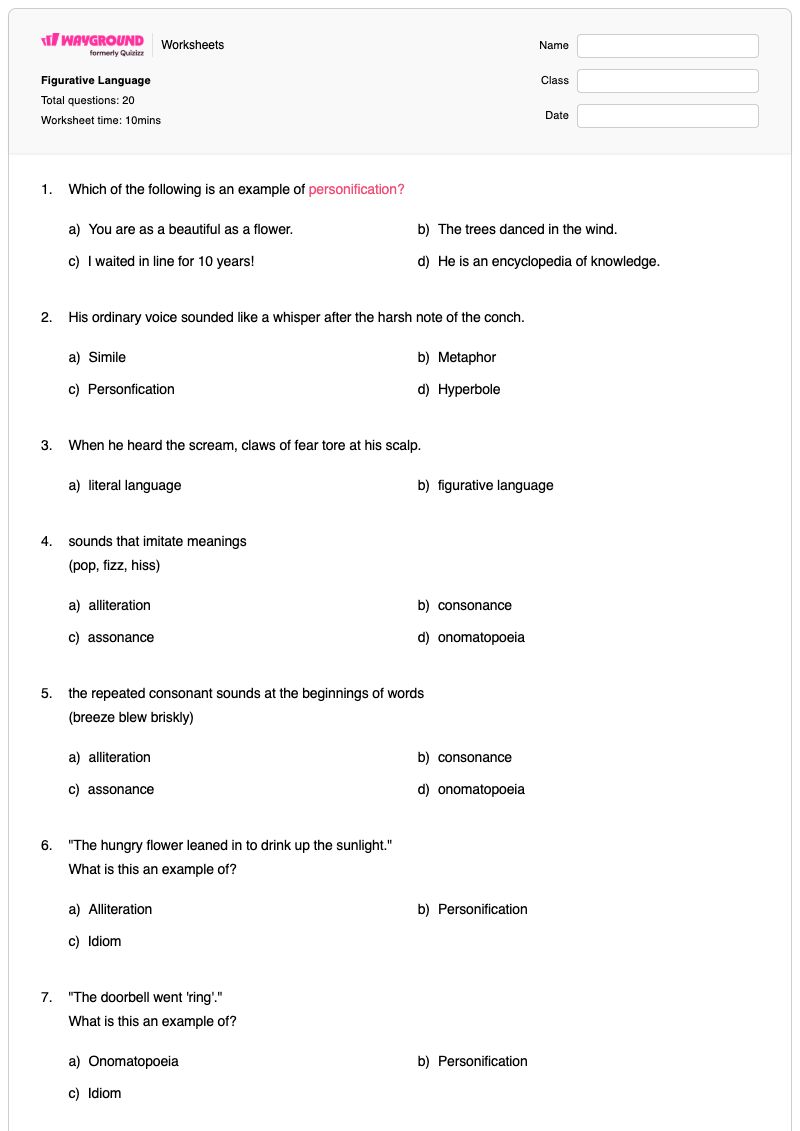
Figurative Language
คำถามทั้งหมด: 20
(pop, fizz, hiss)
(breeze blew briskly)
"The hungry flower leaned in to drink up the sunlight."
What is this an example of?
Alliteration
Personification
Idiom
"The doorbell went 'ring'."
What is this an example of?
Onomatopoeia
Personification
Idiom
The repetition of vowel sounds in words that are adjacent or close together in text.
Hyperbole
Alliteration
Assonance
"The white rice was eaten by the mice."
What is this an example of?
Alliteration
Assonance
Hyperbole
"The unicorn was as pink and fluffy as cotton candy. "
What is this an example of?
Metaphor
Simile
"The pitcher threw the ball as fast as lightning."
What is this an example of?
Simile
Metaphor

(1)The breeze felt like a refreshing drink of lemonade. (2)The night air was fuel for my work, and it was a beautiful night. (3)If I was going to finish writing this test, then it was going to be the longest night of my life. (4)Then like booming thunder, a light bulb went off in my head. (5) I searched for the perfect program where I could peruse several small suggestions swiftly. (6) Sadly, my time on Herculean efforts on Google reminded me of a crazy Spongebob Squarepants episode. (7) Even though I knew what I was searching for, it didn’t go well. (8) It seems that I will be working like a dog for tonight. (9) One good thing did happen, though: I finally discovered what one calls a super articulate dinosaur... a Thesaurus..., and next time a dinosaur drops by for lunch, I'll know how to properly invite him. "Tea, Rex?"
The underlined sentence in blue font is an example of
visual imagery (sense of sight)
simile
No figurative language is used here.
metaphor

(1) This week had been a shipwreck! (2) Monday greeted with a slap on the face as my alarm clock screamed at me to get up. (3) I woke up feeling as ragged as a old pair of holey shoes. (4) I got on my bus feeling like I'd stepped through Platform 9 3/4 into a Hogwarts experience. (5) First of all, math landed an uppercut with a Job-sized problem that had no solution. (6) My mathematician teacher assured me that if I just used my head as something besides a hat rack, I'd find the answer. (7) Then I trudged to English feeling like something the cat dragged, and my friend Paige (8) accidentally gave me a glue stick instead of chapstick. I'm still not talking to her. (9) Although it took forever and a day to get here, Friday finally showed up with her famously fat smile on her face.
metaphor
allusion
simile
alliteration
Read the sentence from paragraph 4.
But Charles remembered Daresbury Parsonage as a happy spot, an “island farm, ’midst seas of corn.”
How does the author use rhetoric to support his views about Dodgson?
The author uses personification to express Dodgson’s preference for solitude.
The author uses metaphor to illustrate Dodgson’s nostalgia for his family home.
The author uses irony to emphasize Dodgson’s ability to see the ordinary as exciting.
The author uses hyperbole to show Dodgson’s connection to nature.
1 Fats.
2 They’re the black-hatted bad guys of nutrition, the most demonized of all nutrients.…
3 But is fat really all that bad? Does it deserve to be so maligned?
4 This may come as a surprise to you, but fats are mostly good guys in nutrition. You need them to survive. In fact, there are a slew of “good” fats with astonishing powers to outwit disease and keep you healthy for a lifetime. Sure, there are some health-risky fats, but even some of those are needed in small amounts for good health. When you’re dealing with fats, the key is to control not only the amount you eat but also the kind of fat you eat.
5 To get a handle on how fats affect your heath, it helps to learn some basic facts about this most misunderstood of all nutrients.
How does the author use rhetoric in paragraphs 1-5 to establish the purpose of the passage?
The author uses formal scientific language to present information about fats.
The author uses irony to encourage increased consumption of fats.
The author uses satire to ridicule people who refuse to consume fats.
The author uses figurative language to clarify the misconceptions about fats.
All Nature seems at work. Slugs leave their lair—
The bees are stirring—birds are on the wing—
And Winter slumbering in the open air,
Wears on his smiling face a dream of Spring!
5 And I, the while, the sole unbusy thing, Nor honey make, nor pair, nor build, nor sing.
What is the purpose of the personification of Winter in lines 3-4?
to illustrate the positive effect of having a goal
to provide visual imagery of the speaker’s surroundings
to reinforce the overall whimsical tone of the poem
to relay a natural phenomenon using a poetic device
Read this sentence from paragraph 3.
All that day he stood at his lard machine, rocking unsteadily, his eyes closing in spite of him ; and he all but lost his place even so, for the foreman booted him twice to waken him.
What does the phrase his eyes closing in spite of him mean?
It implies that he is ill.
It describes that he is bored at work.
It shows his efforts to fight exhaustion.
It illustrates how he is pushed at work.
Mrs. Hernandez' daughter calls herself "Child Hercules."
Why would someone say, do this?
To allude to Hercules from Greek mythology, emphasizing the strength of the person.
To allude to Hercules from Greek mythology, emphasizing the wisdom of the person.
To allude to Hercules from Greek mythology, emphasizing the weakness of the person.
Which is an metaphor .?
Her long hair was Flowing golden river .
Her long hair is flowing like an golden river .
Why would an author use extended metaphor .?
To provide a warning of something yet to come .
To help the audience visualize the idea or story .
To both create a stronger 'visual' experience and a stronger comparison .
To create a stronger comparison between the two subjects .
แป้นคำตอบFigurative Language
คำถามทั้งหมด: 20
Personification
Onomatopoeia
Assonance
Assonance
Simile
Simile
metaphor
allusion
The author uses metaphor to illustrate Dodgson’s nostalgia for his family home.
The author uses figurative language to clarify the misconceptions about fats.
to provide visual imagery of the speaker’s surroundings
It shows his efforts to fight exhaustion.
To allude to Hercules from Greek mythology, emphasizing the strength of the person.
Her long hair was Flowing golden river .
To both create a stronger 'visual' experience and a stronger comparison .