
 แผ่นงาน
Character perspective, theme, summarize, author's purpose
คำถามทั้งหมด: 20
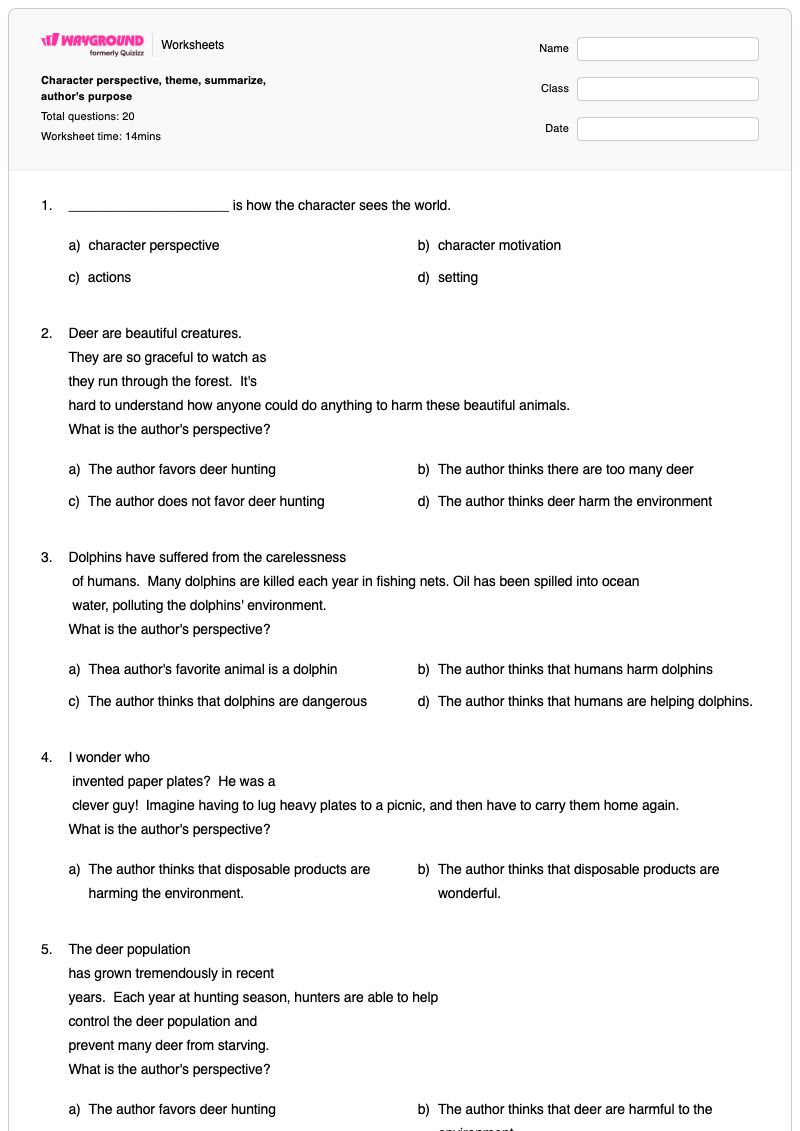
_____________________ is how the character sees the world.
character perspective
character motivation
actions
setting
They are so graceful to watch as
they run through the forest. It's
hard to understand how anyone could do anything to harm these beautiful animals.
What is the author's perspective?
of humans. Many dolphins are killed each year in fishing nets. Oil has been spilled into ocean
water, polluting the dolphins' environment.
What is the author's perspective?
invented paper plates? He was a
clever guy! Imagine having to lug heavy plates to a picnic, and then have to carry them home again.
What is the author's perspective?
has grown tremendously in recent
years. Each year at hunting season, hunters are able to help
control the deer population and
prevent many deer from starving.
What is the author's perspective?

When Curtis transferred to our high school from some fancy private school, I was assigned the job of showing him around our building. First, I showed him our trophy case. Our school has done put together some quality teams and programs over the years, so our trophy case was pretty full. Curtis was not impressed. He claimed that the trophy case at his old school was at least twice as big as ours and much more crowded. Next I showed him our swimming pool. Not every high school has a swimming pool, so we were proud of ours, but Curtis couldn't care less. "The swimming pool at my old school is bigger and more modern. This one looks kind of dirty," he said with disdain. I continued to guide Curtis around the school, showing him our cafeteria, gymnasium, and even our garden, but Curtis seemed disappointed with everything that he saw. He'd quickly compare it to his old school, which in his words was superior to ours in every way. The last thing I showed Curtis was the front door. I told him that he would like this one best because he could walk through it and go back to his old school.
What is the theme of the story?
Do not criticize things that are dear to others.
A thing worth doing is worth doing correctly; cutting corners comes at a cost; better to do a thing once the right way then many times the wrong way.
Give credit where credit is due; a good relationship has to have some give and take.
Treat others as you wish to be treated; what goes around, comes around.
Alan had very few responsibilities, but one of them was to clean his room. It did not take long, but Alan still didn't like doing it. One day Alan thought of a way to save some time. Rather than putting everything neatly back in its place, he decided to just throw all the stuff on the floor into his closet. His mom would think that he had cleaned his room, and it would only take a fraction of the time. Alan was pleased with himself for thinking of this brilliant idea. He figured that this would save a lot of time and energy. The next time his room got messy, he piled everything up in the closet and the pile grew. It grew and grew. Then Alan's friend Steve called. "Alan, everyone is playing baseball at the park. Do you want to play too?" Alan loved baseball. "That sounds great, Steve. I'll be right there." Alan went to grab his baseball mitt when he realized that it wasn't in its usual place. Alan thought to himself, I guess it's in the closet. When he opened up the closet door, he was faced with a huge, unnavigable mess, some of which poured out as he opened the door. Alan began digging through the pile in a frantic attempt to find his mitt. He dug and dug, and as he dug his room got messier and messier. Soon his room was the messiest that it had ever been, and he still hadn't found his mitt. Alan sighed in despair. By the time he found his mitt, the boys had long concluded their game and Alan had hours of cleaning ahead of him before he'd be allowed to leave.
What is the theme of the story?
Treat others as you wish to be treated; what goes around, comes around.
A thing worth doing, is worth doing correctly; cutting corners comes at a cost; it is better to do a thing once the right way than many times the wrong way.
Give credit where credit is due; a good relationship has to have some give and take.
Do not criticize things that are dear to others, particularly if they are not seeking your criticism
There are five teams of students in the fifth grade. The blue team has math first period, and the red team has science. The yellow team gets to go outside early in the morning, while the green team goes to music. Only students on the orange team get to play games first period. Each student wears a nametag with his or her color, so that the teachers and students all know where a student should be.
The Elk River flows from the far northern part of the state all the way to the southern tip. All kinds of animals rely on it for drinking water, people eat the fish they catch in it, and farmers in the state depend on it for irrigating their crops. Since there is very little rain in this state, the Elk River gives animals and humans the water they need to stay alive. Even though the river is not nearly the biggest in the nation, it is very important to the people and animals that live near it.
As soon as she arrived at grandmother's house, Jessica ran into her bedroom to look at the blue quilt. It covered her grandmother's bed and was Jessica's favorite. It had patches of dark blue, medium blue, and light blue, with pictures of birds and flowers on every other patch. Jessica liked to take naps with the quilt wrapped around her. She loved the way it felt so soft and warm against her skin. Whenever she was visiting grandma, just looking at the quilt made Jessica happy.
What is the author's purpose:
A book containing knock-knock jokes?
persuade
inform
entertain
What is the author's purpose:
A book about how dogs are better than cats.
persuade
inform
entertain
What is the author's purpose:
A book containing information about the history of the United States of America.
persuade
inform
entertain
What is the author's purpose:
A book about why New York is the best city to live in.
persuade
inform
entertain
Thirsty? Don't reach for fruit juice or energy drinks, which are often high in sugar. Reach for water, the healthier choice.
What is the author's purpose
To persuade
To inform
To entertain
The first step in setting up a lemonade stand is making the lemonade. You'll also need to create a sign that shows the price for a cup. After that, you can set up a table and start your business!
What is the author's purpose
To persuade
To inform
To entertain
Kate picked cherries with her grandma. "I love summer," she said and kissed her grandma's cheek.
What is the author's purpose
To persuade
To inform
To entertain
แป้นคำตอบCharacter perspective, theme, summarize, author's purpose
คำถามทั้งหมด: 20
character perspective
Do not criticize things that are dear to others.
A thing worth doing, is worth doing correctly; cutting corners comes at a cost; it is better to do a thing once the right way than many times the wrong way.
entertain
persuade
inform
persuade
To persuade
To inform
To entertain