

Wayground
Author's Point of View and Purpose - Printable English Worksheets - Wayground

Author's Point of View and Purpose

14 คำถาม

8th - 8th ระดับชั้น

English

แบบฝึกหัดภาษาอังกฤษสำหรับนักเรียนชั้น ม.2 เรื่อง มุมมองและจุดประสงค์ของผู้เขียน เป็นแบบฝึกหัดที่พิมพ์ได้ฟรี มีคำถามแบบเลือกตอบ 14 ข้อ ช่วยให้นักเรียนแยกแยะมุมมองของผู้เขียน—ความคิดเห็นหรือทัศนคติของผู้เขียนต่อเรื่องใดเรื่องหนึ่ง—ออกจากจุดประสงค์ของผู้เขียน หรือเหตุผลและความตั้งใจเบื้องหลังการเขียน คำถามจะกล่าวถึงว่าจุดประสงค์ส่งผลต่อข้อความ กลุ่มเป้าหมาย ความน่าเชื่อถือ และอคติของงานเขียนอย่างไร รวมถึงน้ำเสียง การเลือกใช้คำ ภาษาที่แสดงอารมณ์ เรื่องเล่าส่วนตัว และข้อโต้แย้ง แสดงให้เห็นถึงสิ่งที่ผู้เขียนพยายามจะบรรลุอย่างไร แบบฝึกหัดนี้ยังตรวจสอบความเข้าใจของนักเรียนเกี่ยวกับมุมมองทางวรรณกรรม นักเรียนระบุการเล่าเรื่องแบบบุคคลที่หนึ่งผ่านคำสรรพนาม เช่น “ฉัน” “ของฉัน” การเล่าเรื่องแบบบุคคลที่สองผ่าน “คุณ” และ “ของคุณ” การเล่าเรื่องแบบบุคคลที่สามแบบจำกัดผ่านการเข้าถึงความคิดและความรู้สึกของตัวละครตัวใดตัวหนึ่ง และการเล่าเรื่องแบบบุคคลที่สามแบบรอบรู้ผ่านความรู้เกี่ยวกับความคิดและความรู้สึกของตัวละครทุกตัว เหมาะสำหรับการสอนโดยตรง การทบทวน หรือการตรวจสอบความเข้าใจด้วยตนเอง และมีเฉลยคำตอบครบถ้วนเพื่อการตรวจให้คะแนนที่มีประสิทธิภาพ

การตั้งค่าแผ่นงาน

ขนาดตัวอักษร

S
M
L
XL
แผ่นงาน

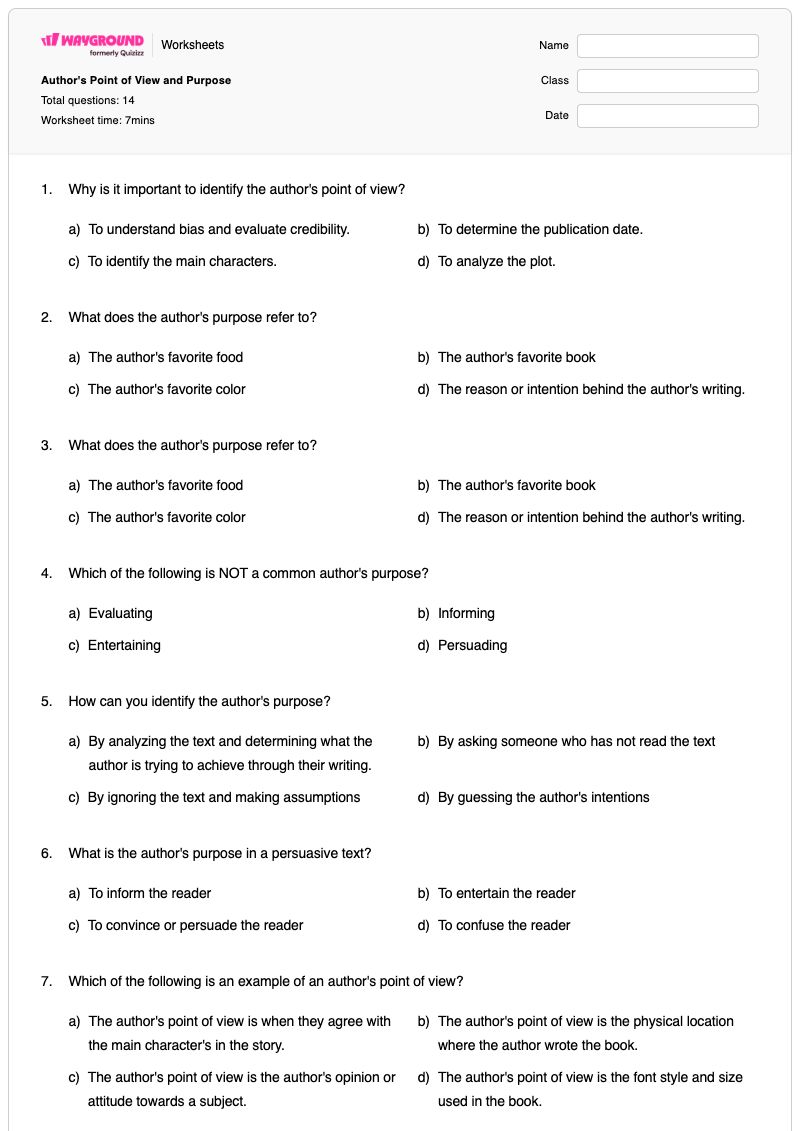
Author's Point of View and Purpose

คำถามทั้งหมด: 14

ชื่อ
ระดับ
วันที่
1.

Why is it important to identify the author's point of view?

a)

To understand bias and evaluate credibility.

b)

To determine the publication date.

c)

To identify the main characters.

d)

To analyze the plot.

2.

What does the author's purpose refer to?

a)

The author's favorite food

b)

The author's favorite book

c)

The author's favorite color

d)

The reason or intention behind the author's writing.

3.

What does the author's purpose refer to?

a)

The author's favorite food

b)

The author's favorite book

c)

The author's favorite color

d)

The reason or intention behind the author's writing.

4.

Which of the following is NOT a common author's purpose?

a)

Evaluating

b)

Informing

c)

Entertaining

d)

Persuading

5.

How can you identify the author's purpose?

a)

By analyzing the text and determining what the author is trying to achieve through their writing.

b)

By asking someone who has not read the text

c)

By ignoring the text and making assumptions

d)

By guessing the author's intentions

6.

What is the author's purpose in a persuasive text?

a)

To inform the reader

b)

To entertain the reader

c)

To convince or persuade the reader

d)

To confuse the reader

7.

Which of the following is an example of an author's point of view?

a)

The author's point of view is when they agree with the main character's in the story.

b)

The author's point of view is the physical location where the author wrote the book.

c)

The author's point of view is the author's opinion or attitude towards a subject.

d)

The author's point of view is the font style and size used in the book.

8.

What can you infer about the author's purpose if a text is filled with emotional language and personal anecdotes?

a)

The author's purpose is to educate the reader with scientific evidence.

b)

The author's purpose is to entertain the reader with fictional stories.

c)

The author's purpose is to evoke emotions and connect with the reader on a personal level.

d)

The author's purpose is to provide objective information and facts.

9.

Why is it important to analyze the author's purpose?

a)

To learn about the author's favorite color

b)

To understand the message, intended audience, credibility, and bias of the author's perspective.

c)

To determine the author's shoe size

d)

To find out the author's favorite food

10.

What should you consider when analyzing the author's purpose?

a)

Length of the text

b)

Grammar, punctuation, and spelling

c)

Publication date and location

d)

Tone, choice of words, intended audience, and message or argument.

11.

In literature, which point of view is characterized by the use of pronouns like "I," "me," and "my," providing direct access to the thoughts and feelings of the narrator?

a)

econd person

b)

Third person limited

c)

First person

d)

Omniscient point of view

12.

Which point of view in literature directly addresses the reader, using pronouns like "you" and "your," creating a sense of immediacy and involvement?

a)

First person

b)

Third person limited

c)

Second person

d)

Omniscient point of view

13.

In a narrative employing a third person limited point of view, the narrator has access to the thoughts and feelings of:

a)

All characters in the story

b)

Only one specific character

c)

The narrator themselves

d)

None of the characters

14.

In a story with a third-person omniscient point of view, the narrator possesses knowledge of:

a)

Only the main character's thoughts and feelings

b)

Limited information about all characters

c)

All characters' thoughts and feelings

d)

Only the events happening in the present moment

แป้นคำตอบ

Author's Point of View and Purpose

คำถามทั้งหมด: 14

1.
a)

To understand bias and evaluate credibility.

2.
d)

The reason or intention behind the author's writing.

3.
d)

The reason or intention behind the author's writing.

4.
a)

Evaluating

5.
a)

By analyzing the text and determining what the author is trying to achieve through their writing.

6.
c)

To convince or persuade the reader

7.
c)

The author's point of view is the author's opinion or attitude towards a subject.

8.
c)

The author's purpose is to evoke emotions and connect with the reader on a personal level.

9.
b)

To understand the message, intended audience, credibility, and bias of the author's perspective.

10.
d)

Tone, choice of words, intended audience, and message or argument.

11.
c)

First person

12.
c)

Second person

13.
b)

Only one specific character

14.
c)

All characters' thoughts and feelings

คำถามที่พบบ่อย

แบบฝึกหัด "มุมมองและจุดประสงค์ของผู้เขียน" ครอบคลุมเนื้อหาอะไรบ้าง?

แบบฝึกหัดภาษาอังกฤษสำหรับนักเรียนชั้น ม.2 นี้ ประกอบด้วยคำถามแบบเลือกตอบ 14 ข้อ เพื่อประเมินว่านักเรียนสามารถระบุความคิดเห็นหรือทัศนคติของผู้เขียน กำหนดเหตุผลเบื้องหลังงานเขียน และวิเคราะห์เบาะแสต่างๆ เช่น น้ำเสียง การเลือกใช้คำ กลุ่มเป้าหมาย ภาษาที่แสดงอารมณ์ และเรื่องราวส่วนตัว ได้อย่างไร นอกจากนี้ยังแยกแยะมุมมองการเล่าเรื่องแบบบุคคลที่หนึ่ง บุคคลที่สอง บุคคลที่สามแบบจำกัด และบุคคลที่สามแบบรอบรู้ โดยพิจารณาจากสรรพนามของผู้เล่าเรื่องและการเข้าถึงความคิดและความรู้สึกของตัวละคร

ฉันจะใช้แบบฝึกหัดนี้สอนเรื่องมุมมองและจุดประสงค์ของผู้เขียนได้อย่างไร?

แนะนำมุมมองและจุดประสงค์แยกกัน จากนั้นสาธิตวิธีการที่ผู้อ่านใช้โทนเสียง การเลือกใช้คำ กลุ่มเป้าหมาย และสารของข้อความเพื่ออนุมานเจตนาของผู้เขียน ก่อนที่นักเรียนจะทำแบบทดสอบแบบเลือกตอบ ให้พวกเขาอธิบายว่าข้อความโน้มน้าวใจแตกต่างจากข้อความที่ใช้ภาษาเชิงอารมณ์และเรื่องเล่าส่วนตัวอย่างไร และให้พวกเขาระบุว่ามุมมองของผู้เล่าเรื่องแบบใดที่ตรงกับสรรพนาม เช่น “ฉัน” “คุณ” หรือ “พวกเขา” ใช้ตัวเลือกของนักเรียนเพื่ออภิปรายหลักฐานที่อยู่เบื้องหลังคำตอบแต่ละข้อ แทนที่จะใช้แบบฝึกหัดนี้เป็นเพียงแบบทดสอบคำศัพท์

ฉันควรสังเกตข้อผิดพลาดอะไรบ้างเมื่อนักเรียนทำแบบฝึกหัดนี้เสร็จ?

นักเรียนอาจสับสนระหว่างมุมมองของผู้เขียน—ความคิดเห็นหรือทัศนคติ—กับจุดประสงค์ของผู้เขียน ซึ่งเป็นเหตุผลในการเขียน หรือเข้าใจผิดว่ามุมมองของผู้เล่าเรื่องเป็นความคิดเห็นส่วนตัวของผู้เขียน ควรระวังความสับสนระหว่างสรรพนามบุรุษที่หนึ่ง บุรุษที่สอง บุรุษที่สามแบบจำกัด และบุรุษที่สามแบบรอบรู้ โดยเฉพาะอย่างยิ่งว่าผู้เล่าเรื่องสามารถเข้าถึงความคิดของตัวละครตัวใดตัวหนึ่งหรือความคิดของตัวละครทุกตัวได้หรือไม่ นักเรียนอาจมองข้ามไปว่าภาษาที่แสดงอารมณ์และเรื่องเล่าส่วนตัวสามารถบ่งบอกถึงความพยายามที่จะกระตุ้นอารมณ์และสร้างความเชื่อมโยงส่วนตัวกับผู้อ่านได้

ฉันจะมอบหมายและให้คะแนนแบบฝึกหัดนี้อย่างไร?

คุณสามารถมอบหมายงานเขียนเกี่ยวกับมุมมองและจุดประสงค์ของผู้เขียนได้ในรูปแบบไฟล์ PDF ที่พิมพ์ได้ หรือเป็นแบบทดสอบดิจิทัลบน Wayground แบบฝึกหัดนี้มีเฉลยคำตอบครบถ้วน และสามารถตรวจงานส่งของนักเรียนได้โดยการสแกนงานของนักเรียนด้วยแอป Wayground for Teachers ตัวเลือกไฟล์ PDF ยังเหมาะสำหรับห้องเรียนที่ลดเวลาการใช้หน้าจออีกด้วย

ฉันจะปรับแบบฝึกหัดเกี่ยวกับมุมมองและจุดประสงค์นี้ให้เหมาะสมกับนักเรียนของฉันได้อย่างไร?

ใช้การตั้งค่าขั้นสูงของแบบฝึกหัดเพื่อปรับระยะห่างระหว่างตัวอักษรและขนาดตัวอักษร เพื่อให้คำถามแบบเลือกตอบอ่านง่ายขึ้น นอกจากนี้ คุณยังสามารถใช้แบบอักษรที่เหมาะสำหรับผู้ที่มีภาวะดิสเล็กเซีย หรือแปลแบบฝึกหัดเป็นภาษาอื่น เพื่อช่วยให้นักเรียนมุ่งเน้นไปที่การแยกแยะจุดประสงค์ของผู้เขียนออกจากมุมมองการเล่าเรื่องได้

ฉันจะหาแบบฝึกหัดแบบนี้เพิ่มเติมได้ที่ไหนบน Wayground?

Wayground มีแบบฝึกหัดและโจทย์ฝึกหัดมากมายให้ดาวน์โหลดฟรีในหลากหลายวิชา พร้อมไฟล์ PDF และเฉลยคำตอบ เพื่อช่วยเสริมสร้างทักษะและความเข้าใจในเนื้อหาสำคัญ ดูแหล่งข้อมูลเพิ่มเติมได้ที่ https://wayground.com/en-us/worksheets