

Wayground
"The Tell-Tale Heart" Test Review - Printable English Worksheets ระดับ 8 - Wayground

"The Tell-Tale Heart" Test Review

19 คำถาม

8th - 8th ระดับชั้น

English

แบบฝึกหัดทบทวนเรื่องสั้น Tell-Tale Heart เป็นแบบฝึกหัดภาษาอังกฤษสำหรับนักเรียนชั้น ม.2 ที่สามารถพิมพ์ได้ฟรี แบบฝึกหัดนี้ใช้ตรวจสอบความเข้าใจของนักเรียนเกี่ยวกับเรื่องสั้นของเอ็ดการ์ อัลลัน โพ และองค์ประกอบทางวรรณกรรม ประกอบด้วยคำถาม 19 ข้อ แบ่งเป็นคำถามแบบเลือกตอบ 15 ข้อ คำถามแบบเลือกคำตอบ 1 ข้อ และคำถามแบบเติมคำในช่องว่าง 3 ข้อ นักเรียนจะต้องระบุมุมมองบุคคลที่หนึ่งและบุคคลที่สาม นิยามคำว่าผู้เล่าเรื่องและความระทึกใจ และวิเคราะห์ว่ามุมมองของผู้เล่าเรื่องเผยให้เห็นความไม่เสถียรทางจิตใจของเขาอย่างไร แบบฝึกหัดนี้ยังถามให้นักเรียนตีความรายละเอียดของโครงเรื่อง แรงจูงใจของตัวละคร น้ำเสียง คำศัพท์ ใจความสำคัญ และการบอกล่วงหน้า พวกเขาจะตรวจสอบว่าทำไมผู้เล่าเรื่องจึงมุ่งเป้าไปที่ชายชรา ทำไมการฆาตกรรมจึงไม่สามารถเกิดขึ้นได้ในช่วงเจ็ดคืนแรก ผู้เล่าเรื่องตอบสนองต่อตำรวจอย่างไร และการได้ยินที่เฉียบคมบ่งบอกถึงตอนจบของเรื่องอย่างไร แบบฝึกหัดนี้มีประโยชน์สำหรับการตรวจสอบการอ่านอย่างละเอียดและการวิเคราะห์วรรณกรรมก่อนการประเมิน และมีเฉลยคำตอบที่สมบูรณ์เพื่อการทบทวนและการตรวจให้คะแนนที่มีประสิทธิภาพ

การตั้งค่าแผ่นงาน

ขนาดตัวอักษร

S
M
L
XL
แผ่นงาน

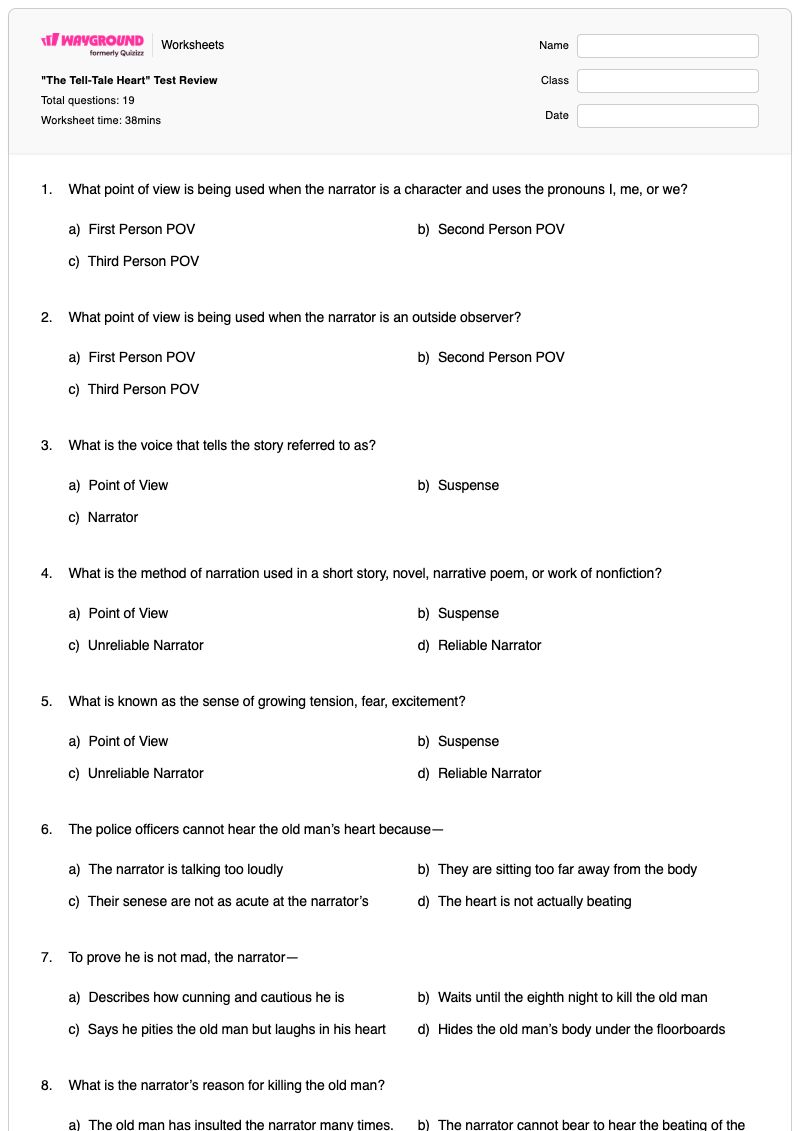
"The Tell-Tale Heart" Test Review

คำถามทั้งหมด: 19

ชื่อ
ระดับ
วันที่
1.

What point of view is being used when the narrator is a character and uses the pronouns I, me, or we?

a)

First Person POV

b)

Second Person POV

c)

Third Person POV

2.

What point of view is being used when the narrator is an outside observer?

a)

First Person POV

b)

Second Person POV

c)

Third Person POV

3.

What is the voice that tells the story referred to as?

a)

Point of View

b)

Suspense

c)

Narrator

4.

What is the method of narration used in a short story, novel, narrative poem, or work of nonfiction?

a)

Point of View

b)

Suspense

c)

Unreliable Narrator

d)

Reliable Narrator

5.

What is known as the sense of growing tension, fear, excitement?

a)

Point of View

b)

Suspense

c)

Unreliable Narrator

d)

Reliable Narrator

6.

The police officers cannot hear the old man’s heart because—

a)

The narrator is talking too loudly

b)

They are sitting too far away from the body

c)

Their senese are not as acute at the narrator’s

d)

The heart is not actually beating

7.

To prove he is not mad, the narrator—

a)

Describes how cunning and cautious he is

b)

Waits until the eighth night to kill the old man

c)

Says he pities the old man but laughs in his heart

d)

Hides the old man’s body under the floorboards

8.

What is the narrator’s reason for killing the old man?

a)

The old man has insulted the narrator many times.

b)

The narrator cannot bear to hear the beating of the old man’s heart.

c)

The old man’s eye remind the narrator of a vulture’s.

d)

The narrator hopes to inherit the old man’s treasures.

9.

The use of a first-person narrator in the story —

a)

allows readers to understand each character’s point of view

b)

helps to explain how the characters are related to each other

c)

gives readers insight into the narrator’s mental instability

d)

illustrates how the old man treats the narrator every day

10.

Which word from paragraph 18 is closest to meaning contempt?

a)

Agony

b)

Derision

c)

Swore

d)

Hypocritical

11.

In paragraphs 14–15, the narrator describes his cleanup and first encounter with the police with a tone of--

a)

Anxiety

b)

Melancholy

c)

Confidence

d)

Indifference

12.

Which choice best expresses the main idea of paragraph 8?

a)

The old man stirs and cries out when he hears the narrator at the door and scares the narrator away.

b)

The narrator can relate to the old man’s fear, but that only makes the narrator feel more powerful.

c)

The narrator chooses to wake the old man so that he can face him directly for the murder.

d)

The narrator slips into the room when the old man wakes, hoping that the old man will not see him.

13.

In paragraph 4, the narrator describes visiting the old man every night at midnight. Why is he unable to commit the murder for the first seven nights?

a)

The old man is a restless sleeper, so the narrator cannot sneak in.

b)

The narrator does not have enough light from the lantern to commit the murder.

c)

He is trying to be kind by giving the old man a few more days to live.

d)

He cannot see the old man’s eye, which is what he feels he needs to kill.

14.

In paragraph 2, the word conceived means to —

a)

become pregnant with a child

b)

have an opinion on an issue

c)

form a plan in the mind

d)

imagine something abstract

15.

How does the narrator’s mention of his acute hearing in paragraph 1 foreshadow the old man’s death?

a)

It foreshadows the point when the old man’s heartbeat drives the narrator to kill him.

b)

It foreshadows his ability to hear the police coming when they respond to the old man’s murder.

c)

It foreshadows his decision to murder the old man because he was tired of listening to him.

d)

It foreshadows the moment when the old man hears the narrator at the door and wakes up.

16.

Which two are examples of irony in the story?

a)

The narrator’s attempts to hide the murder actually result in him giving himself up to the police.

b)

The narrator chooses to commit the murder in the middle of the night, when the old man is asleep.

c)

The more the narrator insists that he is not mad, the more readers can detect evidence of his madness.

d)

The narrator admits that he liked, even loved, the old man, and that he only objected to his pale, filmy eye.

e)

The neighbor hears the old man shriek and summons the police out of concern for his safety.

17.

After the meeting, he (a)   an idea for how to make the process easier for consumers.

18.

When I get home from school in the afternoon, my brother likes to (a)   me by hiding my phone from me.

19.

I could not believe she had the (a)   to yell at her own mother like that.

แป้นคำตอบ

"The Tell-Tale Heart" Test Review

คำถามทั้งหมด: 19

1.
a)

First Person POV

2.
c)

Third Person POV

3.
c)

Narrator

4.
a)

Point of View

5.
b)

Suspense

6.
d)

The heart is not actually beating

7.
a)

Describes how cunning and cautious he is

8.
c)

The old man’s eye remind the narrator of a vulture’s.

9.
c)

gives readers insight into the narrator’s mental instability

10.
b)

Derision

11.
c)

Confidence

12.
b)

The narrator can relate to the old man’s fear, but that only makes the narrator feel more powerful.

13.
d)

He cannot see the old man’s eye, which is what he feels he needs to kill.

14.
c)

form a plan in the mind

15.
a)

It foreshadows the point when the old man’s heartbeat drives the narrator to kill him.

16.
a)

The narrator’s attempts to hide the murder actually result in him giving himself up to the police.

, c)

The more the narrator insists that he is not mad, the more readers can detect evidence of his madness.

17.
conceived
18.
vex
19.
audacity

คำถามที่พบบ่อย

แบบฝึกหัด "The Tell-Tale Heart Test Review" ช่วยให้นักเรียนได้ฝึกฝนอะไรบ้าง?

แบบฝึกหัดภาษาอังกฤษระดับชั้น ม.2 นี้ ประกอบด้วยคำถามแบบเลือกตอบ 15 ข้อ คำถามแบบเลือกคำตอบ 1 ข้อ และคำถามแบบเติมคำในช่องว่าง 3 ข้อ เพื่อประเมินความเข้าใจของนักเรียนเกี่ยวกับมุมมองการเล่าเรื่อง ผู้เล่าเรื่อง ความระทึกใจ และการวิเคราะห์วรรณกรรมในเรื่อง The Tell-Tale Heart นักเรียนจะต้องเชื่อมโยงการเล่าเรื่องในมุมมองบุคคลที่หนึ่งเข้ากับความไม่เสถียรทางจิตใจของผู้เล่าเรื่อง และใช้รายละเอียดเกี่ยวกับชายชรา การฆาตกรรม ตำรวจ น้ำเสียง คำศัพท์ ใจความสำคัญ และการบอกใบ้ล่วงหน้า เพื่อสนับสนุนการตีความของตนเอง

ฉันจะใช้แบบฝึกหัดนี้สอนเรื่องมุมมองและการวิเคราะห์วรรณกรรมในหนังสือเรื่อง "The Tell-Tale Heart" ได้อย่างไร?

เริ่มด้วยการใช้หัวข้อเกี่ยวกับมุมมองการเล่าเรื่องก่อน เพื่อสร้างความแตกต่างระหว่างผู้เล่าเรื่องที่เป็นตัวละครกับผู้สังเกตการณ์ภายนอก จากนั้นให้นักเรียนอธิบายว่าการเล่าเรื่องแบบบุคคลที่หนึ่งของเรื่องนี้เผยให้เห็นความไม่เสถียรทางจิตใจของผู้เล่าเรื่องได้อย่างไร โดยใช้คำถามในแบบฝึกหัดเกี่ยวกับดวงตาของชายชรา การได้ยินที่เฉียบคมของผู้เล่าเรื่อง การทำความสะอาด และการเผชิญหน้ากับตำรวจเป็นหลักฐาน จบด้วยการอภิปรายว่าความระทึกใจ น้ำเสียง และการบอกใบ้ล่วงหน้า มีส่วนช่วยสร้างประสบการณ์การอ่านอย่างไร

ฉันควรระวังข้อผิดพลาดอะไรบ้างเมื่อนักเรียนทำแบบประเมินนี้เสร็จ?

นักเรียนอาจสับสนระหว่างผู้เล่าเรื่องกับมุมมอง หรือเลือกใช้สรรพนามบุรุษที่สามเพียงเพราะผู้เล่าเรื่องกำลังอธิบายตัวละครอื่น ระวังนักเรียนที่ระบุว่าจังหวะการเต้นของหัวใจเป็นเหตุผลในการฆาตกรรมของผู้เล่าเรื่อง แทนที่จะเป็นดวงตาของชายชรา มองข้ามว่าดวงตาต้องปรากฏให้เห็นก่อนที่ผู้เล่าเรื่องจะลงมือได้ หรือตีความความมั่นใจของผู้เล่าเรื่องในระหว่างการทำความสะอาดและการมาเยือนของตำรวจว่าเป็นความวิตกกังวล คำศัพท์บางคำอาจแสดงให้เห็นถึงความสับสนระหว่างคำว่า “การเยาะเย้ย” กับตัวเลือกอื่นๆ ที่แสดงถึงการดูหมิ่น หรือระหว่างคำว่า “คิดขึ้น” ในความหมายของการวางแผน กับความหมายอื่นๆ ที่ไม่เกี่ยวข้องกัน

ฉันจะมอบหมายงานและให้คะแนนการทบทวนบทเรียนเรื่อง "The Tell-Tale Heart Test" ได้อย่างไร?

Wayground จัดเตรียมแบบฝึกหัดนี้ในรูปแบบไฟล์ PDF ที่สามารถพิมพ์ได้ และในรูปแบบแบบทดสอบดิจิทัล โดยมีเฉลยคำตอบครบถ้วนสำหรับทั้ง 19 ข้อ คุณสามารถตรวจงานที่ส่งมาในรูปแบบไฟล์ PDF ได้โดยการสแกนงานของนักเรียนด้วยแอป Wayground for Teachers หรือตรวจสอบคำตอบจากแบบทดสอบดิจิทัลใน Wayground ได้

นอกเหนือจากการระบุจุดยืนแล้ว ทักษะการวิเคราะห์การอ่านใดบ้างที่ได้รับการกล่าวถึง?

แบบฝึกหัดนี้ขอให้นักเรียนตีความว่าย่อหน้าต่างๆ พัฒนาความหมายอย่างไร รวมถึงปฏิกิริยาของผู้เล่าเรื่องต่อความกลัวของชายชราและเหตุผลที่เขารอเจ็ดคืน นอกจากนี้ยังตรวจสอบคำศัพท์ในบริบท น้ำเสียง ใจความสำคัญ แรงจูงใจของตัวละคร และการบอกล่วงหน้า รวมถึงวิธีที่ประสาทการได้ยินที่เฉียบคมของผู้เล่าเรื่องคาดการณ์ถึงความตายของชายชราได้

ฉันจะหาแบบฝึกหัดแบบนี้เพิ่มเติมได้ที่ไหนบน Wayground?

Wayground มีแบบฝึกหัดและโจทย์ฝึกหัดมากมายให้ดาวน์โหลดฟรีในหลากหลายวิชา พร้อมไฟล์ PDF และเฉลยคำตอบ เพื่อช่วยเสริมสร้างทักษะและความเข้าใจในเนื้อหาสำคัญ ดูแหล่งข้อมูลเพิ่มเติมได้ที่ https://wayground.com/en-us/worksheets