

Wayground
electron configurations and orbital notation - Printable ศาสตร์ Worksheets 9th - 12th ระดับชั้น - Wayground

electron configurations and orbital notation

Susan Duderstadt

By Susan Duderstadt

20 คำถาม

9th - 12th ระดับชั้น

ศาสตร์

1.4K เล่น

อัปเดตแล้ว ต.ค. 2569

แบบฝึกหัดเคมีเรื่อง การจัดเรียงอิเล็กตรอนและสัญลักษณ์ออร์บิทัล สำหรับนักเรียนระดับชั้น ม.3-ม.6 สามารถพิมพ์ได้ฟรี ช่วยให้นักเรียนเชื่อมโยงการจัดเรียงอิเล็กตรอนกับธาตุต่างๆ แบบฝึกหัดประกอบด้วยคำถามแบบเลือกตอบ 20 ข้อ ให้นักเรียนระบุธาตุจากรูปแบบการจัดเรียงอิเล็กตรอนและสัญลักษณ์ออร์บิทัล เลือกรูปแบบการจัดเรียงอิเล็กตรอนสำหรับธาตุต่างๆ เช่น ฟลูออรีน นีออน และซิลิคอน และระบุสัญลักษณ์ออร์บิทัลสำหรับออกซิเจน แบบฝึกหัดนี้ยังตรวจสอบความเข้าใจของนักเรียนเกี่ยวกับหลักการเอาฟ์บาว (Aufbau principle) กฎของฮุนด์ (Hund’s rule) และหลักการกีดกันของเปาลี (Pauli exclusion principle) รวมถึงหลักเกณฑ์ใดที่แผนภาพออร์บิทัลละเมิด การผสมผสานนี้ช่วยให้ครูมีวิธีประเมินที่เน้นเฉพาะเจาะจงว่านักเรียนสามารถอ่านภาพแสดงตำแหน่งอิเล็กตรอนและนำกฎที่ควบคุมการเติมออร์บิทัลไปใช้ได้หรือไม่ ใช้สำหรับการฝึกฝนด้วยตนเอง กิจกรรมทบทวน หรือการประเมินผลอย่างรวดเร็ว แบบฝึกหัดนี้มีให้ดาวน์โหลดเป็นไฟล์ PDF ฟรี และมีเฉลยคำตอบครบถ้วนเพื่อการตรวจสอบที่มีประสิทธิภาพ

การตั้งค่าแผ่นงาน

ขนาดตัวอักษร

S
M
L
XL
Waygroundแผ่นงาน

electron configurations and orbital notation

คำถามทั้งหมด: 20

ชื่อ
ระดับ
วันที่
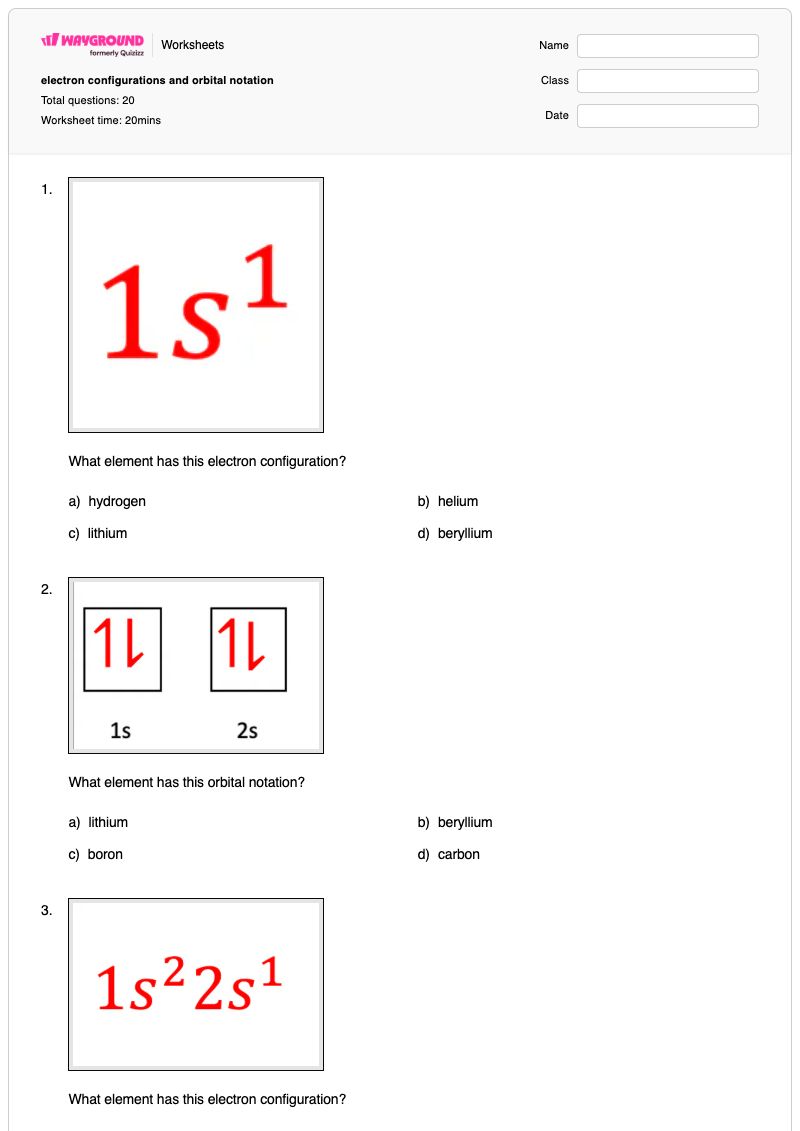
1.
What element has this electron configuration?

What element has this electron configuration?

a)

hydrogen

b)

helium

c)

lithium

d)

beryllium

2.
What element has this orbital notation?

What element has this orbital notation?

a)

lithium

b)

beryllium

c)

boron

d)

carbon

3.
What element has this electron configuration?

What element has this electron configuration?

a)

helium

b)

lithium

c)

beryllium

d)

boron

4.
What element has this electron configuration?

What element has this electron configuration?

a)

boron

b)

carbon

c)

nitrogen

d)

oxygen

5.
Which element is represented by this orbital notation?

Which element is represented by this orbital notation?

a)

carbon

b)

nitrogen

c)

oxygen

d)

fluorine

6.
Which element is represented by this electron configuration?

Which element is represented by this electron configuration?

a)

neon

b)

sodium

c)

magnesium

d)

aluminum

7.
Which element is represented by this orbital notation?

Which element is represented by this orbital notation?

a)

neon

b)

sodium

c)

magnesium

d)

aluminum

8.

Which of the following is the electron configuration for Fluorine

a)
Which of the following is the electron configuration for Fluorine
b)
Which of the following is the electron configuration for Fluorine
c)
Which of the following is the electron configuration for Fluorine
d)
Which of the following is the electron configuration for Fluorine
9.

Which of the following is the electron configuration for neon?

a)
Which of the following is the electron configuration for neon?
b)
Which of the following is the electron configuration for neon?
c)
Which of the following is the electron configuration for neon?
d)
Which of the following is the electron configuration for neon?
10.

Which of the following is the electron configuration for silicon?

a)
Which of the following is the electron configuration for silicon?
b)
Which of the following is the electron configuration for silicon?
c)
Which of the following is the electron configuration for silicon?
d)
Which of the following is the electron configuration for silicon?
11.

Which of the following is the orbital notation for oxygen?

a)
Which of the following is the orbital notation for oxygen?
b)
Which of the following is the orbital notation for oxygen?
c)
Which of the following is the orbital notation for oxygen?
d)
Which of the following is the orbital notation for oxygen?
12.
An electron occupies the lowest energy orbital that can receive it.
a)
Hund’s rule
b)
Pauli exclusion principle
c)
Bohr model of the atom
d)
Aufbau principle
13.
All orbitals of equal energy are occupied by one electron before any single orbital is occupied by a second electron.
a)
Aufbau principle
b)
Pauli exclusion principle
c)
Hund’s rule
d)
Core Notation
14.
No two electrons in the same atom can have the same four quantum numbers.
a)
Aufbau principle
b)
Pauli exclusion principle
c)
Hund’s rule
d)
Noble gas notation
15.
Which guideline, Hund’s rule or the Pauli exclusion principle, is violated in the following orbital diagrams?
Which guideline, Hund’s rule or the Pauli exclusion principle, is violated in the following orbital diagrams?
a)
Hund's
b)
Aufbau's
c)
Pauli's Exclusive
16.
Which guideline, Hund’s rule or the Pauli exclusion principle, is violated in the following orbital diagrams?
Which guideline, Hund’s rule or the Pauli exclusion principle, is violated in the following orbital diagrams?
a)
Aufbau's
b)
Hund's
c)
Pauli exclusive
17.
Electrons are paired based on their spin directions, clockwise and counterclockwise, is what electron configuration rule?
a)
Hund’s Rule
b)
Aufbau Principle
c)
Pauli Exclusion Principle
18.
What is the element?

What is the element?

a)

Neon

b)

Chlorine

c)

Aluminum

d)

Argon

19.
What is the element?

What is the element?

a)

sulfur

b)

chlorine

c)

phosphorus

d)

silicon

20.

Which is the electron configuration for beryllium?

a)
Which is the electron configuration for beryllium?
b)
Which is the electron configuration for beryllium?
c)
Which is the electron configuration for beryllium?
d)
Which is the electron configuration for beryllium?
Waygroundแป้นคำตอบ

electron configurations and orbital notation

คำถามทั้งหมด: 20

1.
a)

hydrogen

2.
b)

beryllium

3.
b)

lithium

4.
b)

carbon

5.
b)

nitrogen

6.
c)

magnesium

7.
b)

sodium

8.
b)
9.
c)
10.
c)
11.
b)
12.
d) Aufbau principle
13.
c) Hund’s rule
14.
b) Pauli exclusion principle
15.
c) Pauli's Exclusive
16.
b) Hund's
17.
c) Pauli Exclusion Principle
18.
d)

Argon

19.
b)

chlorine

20.
b)

คำถามที่พบบ่อย

แบบฝึกหัดเรื่องการจัดเรียงอิเล็กตรอนและสัญลักษณ์ออร์บิทัลครอบคลุมเนื้อหาอะไรบ้าง?

แบบฝึกหัดวิชาเคมีสำหรับนักเรียนระดับชั้น ม.3-ม.6 นี้ ประกอบด้วยคำถามแบบเลือกตอบ 20 ข้อ เกี่ยวกับการระบุธาตุจากโครงสร้างอิเล็กตรอนและสัญลักษณ์ออร์บิทัล นอกจากนี้ยังให้นักเรียนเลือกโครงสร้างอิเล็กตรอนหรือแผนภาพออร์บิทัลสำหรับธาตุที่กำหนด และแยกแยะหลักการเอาฟ์เบา หลักการของฮุนด์ และหลักการกีดกันของเปาลี รวมถึงการระบุหลักการที่ถูกละเมิดด้วย

ฉันจะใช้แบบฝึกหัดนี้ในการสอนเรื่องการจัดเรียงอิเล็กตรอนและสัญลักษณ์ออร์บิทัลได้อย่างไร?

เริ่มแบบฝึกหัดโดยสาธิตวิธีการนับหรือตีความอิเล็กตรอนที่แสดงในแผนภาพการจัดเรียงอิเล็กตรอนหรือแผนภาพวงโคจร และเชื่อมโยงการจัดเรียงนั้นกับธาตุ จากนั้นให้นักเรียนอธิบายว่าเหตุใดแต่ละคำตอบจึงเหมาะสม โดยเฉพาะอย่างยิ่งเมื่อเลือกการจัดเรียงอิเล็กตรอนสำหรับฟลูออรีน นีออน หรือซิลิคอน ใช้คำถามสุดท้ายที่อิงตามกฎเพื่อเชื่อมโยงแผนภาพกับการเติมแบบเอาฟ์เบา กฎของฮุนด์ และการกีดกันของเปาลี

ฉันควรสังเกตข้อผิดพลาดอะไรบ้างเมื่อนักเรียนทำแบบฝึกหัดนี้เสร็จ?

นักเรียนอาจสับสนเกี่ยวกับเอกลักษณ์ของธาตุเมื่ออ่านจำนวนหรือการจัดเรียงอิเล็กตรอนในแผนภาพการจัดเรียงอิเล็กตรอนหรือสัญลักษณ์ออร์บิทัล สังเกตนักเรียนที่สับสนกฎการเติมอิเล็กตรอนทั้งสามข้อ โดยเฉพาะอย่างยิ่งกฎของฮุนด์และหลักการกีดกันของเปาลี หรือที่ระบุผิดกฎเมื่อแผนภาพออร์บิทัลขัดกับหลักเกณฑ์ ขอให้นักเรียนอธิบายรูปแบบการเติมอิเล็กตรอนที่พวกเขาใช้ แทนที่จะเลือกคำตอบโดยอาศัยการจดจำเพียงอย่างเดียว

ฉันจะมอบหมายและให้คะแนนแบบฝึกหัดเรื่องการจัดเรียงอิเล็กตรอนนี้ได้อย่างไร?

บน Wayground คุณสามารถกำหนดแบบฝึกหัดนี้เป็นไฟล์ PDF ที่พิมพ์ได้ หรือเป็นแบบทดสอบดิจิทัล แบบฝึกหัดนี้มีเฉลยคำตอบครบถ้วน และสามารถตรวจงานส่งของนักเรียนได้โดยการสแกนงานของนักเรียนด้วยแอป Wayground for Teachers รูปแบบที่พิมพ์ได้ยังช่วยให้โรงเรียนมีตัวเลือกในการลดเวลาการใช้หน้าจอในขณะที่นักเรียนฝึกอ่านการจัดเรียงและสัญลักษณ์วงโคจร

แบบฝึกหัดนี้ช่วยให้นักเรียนนำกฎการเติมออร์บิทัลไปใช้ได้อย่างไร?

แบบฝึกหัดนี้ไม่ได้จำกัดแค่การระบุธาตุเท่านั้น แต่ยังให้นักเรียนเชื่อมโยงการจัดเรียงอิเล็กตรอนกับหลักการเอาฟ์บาว (Aufbau principle) กฎของฮุนด์ (Hund’s rule) และหลักการกีดกันของเปาลี (Pauli exclusion principle) นักเรียนจะได้ฝึกฝนการจดจำการเติมพลังงานต่ำสุด การบรรจุอิเล็กตรอนเดี่ยวในออร์บิทัลที่มีพลังงานเท่ากันก่อนการจับคู่ และข้อจำกัดเกี่ยวกับเลขควอนตัมของอิเล็กตรอนที่เหมือนกัน นอกจากนี้ พวกเขายังจะนำความรู้นี้ไปใช้ในการพิจารณาว่าแผนภาพออร์บิทัลนั้นละเมิดกฎข้อใด

ฉันจะหาแบบฝึกหัดฟรีแบบนี้เพิ่มเติมได้ที่ไหนบน Wayground?

Wayground มีแบบฝึกหัดและโจทย์ฝึกหัดมากมายให้ดาวน์โหลดฟรีในหลากหลายวิชา พร้อมไฟล์ PDF และเฉลยคำตอบ เพื่อช่วยเสริมสร้างทักษะและความเข้าใจในเนื้อหาสำคัญ ดูแหล่งข้อมูลเพิ่มเติมได้ที่ https://wayground.com/en-us/worksheets