

Wayground
Biogeochemical Cycles - Printable Science, Biology Worksheets - Wayground

Biogeochemical Cycles

20 คำถาม

9th - 9th ระดับชั้น

Science, Biology

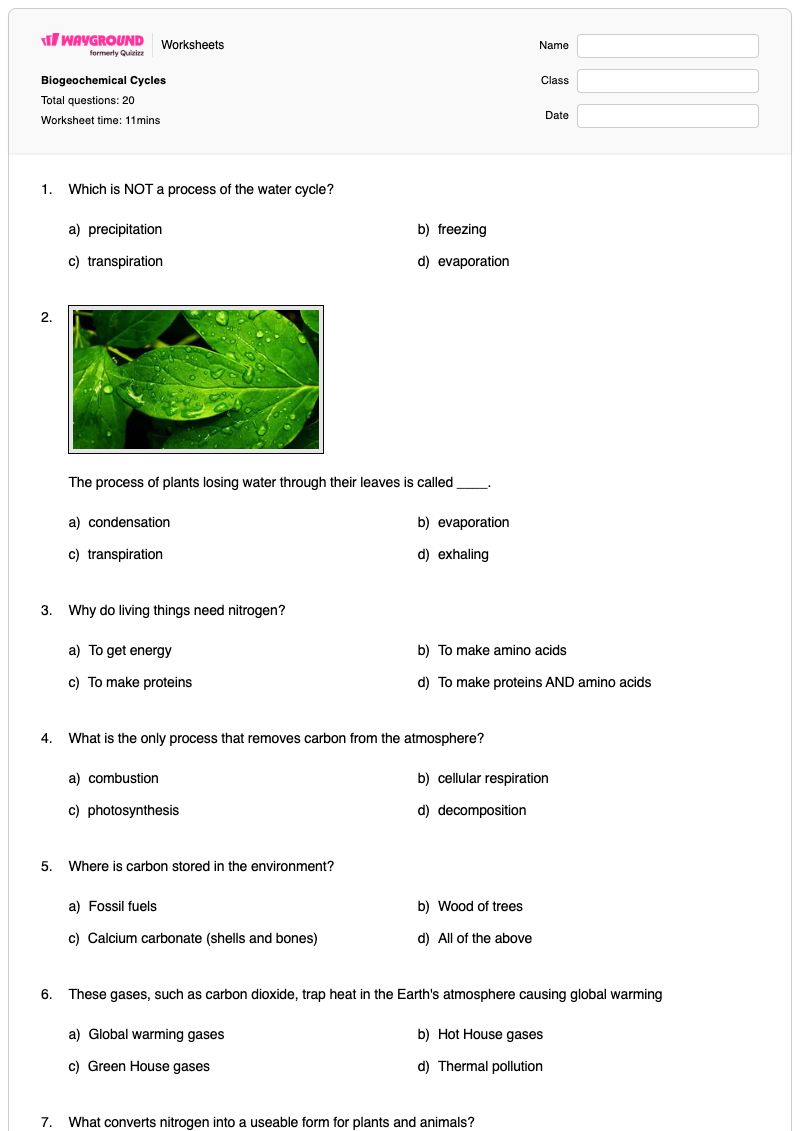
แบบฝึกหัดชีววิทยาสำหรับนักเรียนชั้น ม.3 เรื่อง วัฏจักรทางชีวธรณีเคมี ประกอบด้วยคำถามแบบเลือกตอบ 20 ข้อ ที่ใช้ตรวจสอบความเข้าใจของนักเรียนเกี่ยวกับกระบวนการเคลื่อนที่ของน้ำ คาร์บอน ไนโตรเจน และฟอสฟอรัสในสิ่งแวดล้อม นักเรียนจะได้ระบุถึงกระบวนการในวัฏจักร เช่น การคายน้ำ การสังเคราะห์แสง การผุพัง และการไหลบ่าของน้ำ เชื่อมโยงไนโตรเจนกับโปรตีนและกรดอะมิโน และตระหนักถึงวิธีการที่แบคทีเรียเปลี่ยนไนโตรเจนให้เป็นรูปแบบที่ใช้ประโยชน์ได้ นอกจากนี้ คำถามยังถามให้นักเรียนระบุแหล่งกักเก็บที่สำคัญ ได้แก่ มหาสมุทรสำหรับน้ำ บรรยากาศสำหรับไนโตรเจน และหินและแร่ธาตุสำหรับฟอสฟอรัส นักเรียนจะได้ประยุกต์ใช้ความรู้กับตัวอย่างที่เกี่ยวข้องกับปุ๋ยไนโตรเจนที่เข้าสู่ลำธาร เชื้อเพลิงฟอสซิลและการกักเก็บคาร์บอน และก๊าซเรือนกระจก แบบฝึกหัดที่พิมพ์ได้ฟรีนี้มีเฉลยคำตอบครบถ้วน และให้การฝึกฝนหรือการประเมินผลที่ตรงประเด็นสำหรับการเรียนการสอนวิทยาศาสตร์ชั้น ม.3

การตั้งค่าแผ่นงาน

ขนาดตัวอักษร

S
M
L
XL
แผ่นงาน

Biogeochemical Cycles

คำถามทั้งหมด: 20

ชื่อ
ระดับ
วันที่
1.
Which is NOT a process of the water cycle?
a)
precipitation
b)
freezing
c)
transpiration
d)
evaporation
2.
The process of plants losing water through their leaves is called ____.
a)
condensation
b)
evaporation
c)
transpiration
d)
exhaling
3.

Why do living things need nitrogen?

a)

To get energy

b)

To make amino acids

c)

To make proteins

d)

To make proteins AND amino acids

4.
What is the only process that removes carbon from the atmosphere?
a)
combustion
b)
cellular respiration
c)
photosynthesis
d)
decomposition
5.
Where is carbon stored in the environment?
a)
Fossil fuels
b)
Wood of trees
c)
Calcium carbonate (shells and bones)
d)
All of the above
6.
These gases, such as carbon dioxide, trap heat in the Earth's atmosphere causing global warming
a)
Global warming gases
b)
Hot House gases
c)
Green House gases
d)
Thermal pollution
7.
What converts nitrogen into a useable form for plants and animals?
a)
bacteria
b)
fungi
c)
rain
8.
Which nutrient is not cycled through the atmosphere?
a)
carbon
b)
nitrogen
c)
phosphorous
d)
water
9.
This is released by the weathering of rocks.
a)
Carbon
b)
Oxygen
c)
Phosphorus
d)
Nitrogen
10.

What cycle are fossil fuels part of ?

a)

carbon

b)

oxygen

c)

nitrogen

d)

phosphorus

11.

Where is the largest reservoir for the phosphorus cycle?

a)

rocks and minerals

b)

the ocean

c)

the atmopshere

d)

fossil fuels

12.

What is the largest reservoir for nitrogen?

a)

the ocean

b)

rocks and minerals

c)

the atmosphere

d)

bacteria

13.

What is the largest reservoir for water?

a)

the ocean

b)

rocks and minerals

c)

the atmosphere

d)

glaciers

14.

A particular golf course is using large amounts of nitrogen fertilizer. What process could move this nitrogen into a local stream?

a)

volatilization

b)

nitrogen fixation

c)

runoff and leaching

d)

ammonification

15.

The carbon in coal, oil, and natural gas came from

a)

the combustion of fossil fuels

b)

the remains of dead organisms

c)

carbon-fixing bacteria in swamp soil

d)

carbon dioxide dissolved in ocean water

16.

Nitrogen fixation is the process in which certain bacteria convert nitrogen gas into

a)

liquid nitrogen

b)

nitrates

c)

nitrites

d)

ammonia

17.

Why do living things need nitrogen?

a)

To get energy

b)

To make amino acids

c)

To make proteins

d)

To make proteins AND amino acids

18.

Plant roots directly obtain water from

a)

Water vapor

b)

Groundwater stored below the soil

c)

Precipitation

d)

Water runoff from rivers and streams

19.

According to the diagram, geologic activity, such as volcanoes,

a)

Increases the levels of CO2 in the atmosphere.

b)

Decreases the levels of CO2 in the atmosphere.

20.

Phosphorus is released from rock through ________

a)

decomposition

b)

evaporation

c)

weathering

d)

transpiration

แป้นคำตอบ

Biogeochemical Cycles

คำถามทั้งหมด: 20

1.
b) freezing
2.
c) transpiration
3.
d)

To make proteins AND amino acids

4.
c) photosynthesis
5.
d) All of the above
6.
c) Green House gases
7.
a) bacteria
8.
c) phosphorous
9.
c) Phosphorus
10.
a)

carbon

11.
a)

rocks and minerals

12.
c)

the atmosphere

13.
a)

the ocean

14.
c)

runoff and leaching

15.
b)

the remains of dead organisms

16.
d)

ammonia

17.
d)

To make proteins AND amino acids

18.
b)

Groundwater stored below the soil

19.
a)

Increases the levels of CO2 in the atmosphere.

20.
c)

weathering

คำถามที่พบบ่อย

แบบฝึกหัดเรื่องวัฏจักรทางชีวธรณีเคมีนี้ครอบคลุมหัวข้ออะไรบ้าง?

แบบฝึกหัดชีววิทยาสำหรับนักเรียนชั้น ม.3 นี้ ประกอบด้วยคำถามแบบเลือกตอบ 20 ข้อ เพื่อประเมินกระบวนการ แหล่งกักเก็บ และปฏิสัมพันธ์ภายในวัฏจักรของน้ำ คาร์บอน ไนโตรเจน และฟอสฟอรัส นักเรียนจะได้ระบุคำศัพท์ต่างๆ เช่น การคายน้ำ การสังเคราะห์แสง การไหลบ่าและการชะล้าง และการตรึงไนโตรเจน พร้อมทั้งนำความรู้เกี่ยวกับวัฏจักรไปประยุกต์ใช้กับการใช้ปุ๋ย เชื้อเพลิงฟอสซิล ก๊าซเรือนกระจก และการกักเก็บสารอาหาร

ฉันจะใช้แบบฝึกหัดนี้ในการสอนวัฏจักรทางชีวธรณีเคมีได้อย่างไร?

แนะนำแต่ละวัฏจักรด้วยแผนภาพแสดงกระบวนการอย่างง่าย จากนั้นให้นักเรียนตอบคำถามแบบเลือกตอบโดยระบุชื่อกระบวนการหรือแหล่งกักเก็บที่อธิบายไว้ในแต่ละข้อ ใช้สถานการณ์ปุ๋ยและลำธารเพื่ออธิบายว่ากิจกรรมของมนุษย์เคลื่อนย้ายไนโตรเจนผ่านระบบนิเวศได้อย่างไร และขอให้นักเรียนอธิบายว่าเหตุใดการสังเคราะห์แสง การผุกร่อน หรือแบคทีเรียจึงเกี่ยวข้องกับวัฏจักรเฉพาะเหล่านั้น

ฉันควรสังเกตข้อผิดพลาดอะไรบ้างเมื่อนักเรียนทำแบบฝึกหัดนี้เสร็จ?

นักเรียนอาจสับสนระหว่างการคายน้ำกับการระเหยหรือการควบแน่น และอาจเลือกการตรึงไนโตรเจนเมื่อคำถามอธิบายถึงปุ๋ยที่เคลื่อนตัวลงสู่ลำธารผ่านการไหลบ่าและการชะล้าง นอกจากนี้ โปรดระวังข้อผิดพลาดที่เกี่ยวข้องกับแหล่งกักเก็บ: แบบฝึกหัดระบุว่ามหาสมุทรเป็นแหล่งกักเก็บน้ำที่ใหญ่ที่สุด บรรยากาศเป็นแหล่งกักเก็บไนโตรเจนที่ใหญ่ที่สุด และหินและแร่ธาตุเป็นแหล่งกักเก็บฟอสฟอรัสที่ใหญ่ที่สุด

ฉันจะมอบหมายและให้คะแนนแบบฝึกหัดเรื่องวัฏจักรทางชีวธรณีเคมีนี้ได้อย่างไร?

Wayground จัดทำแบบฝึกหัด 20 ข้อนี้ในรูปแบบไฟล์ PDF ที่สามารถพิมพ์ได้ และในรูปแบบแบบทดสอบดิจิทัล พร้อมเฉลยคำตอบครบถ้วนสำหรับตรวจสอบคำตอบเกี่ยวกับกระบวนการวัฏจักรและอ่างเก็บน้ำ สามารถตรวจให้คะแนนงานที่ส่งในรูปแบบไฟล์พิมพ์ได้โดยการสแกนงานของนักเรียนด้วยแอป Wayground for Teachers

ฉันจะปรับแบบฝึกหัดนี้ให้เหมาะสมกับนักเรียนของฉันได้อย่างไร?

สำหรับคำถามแบบเลือกตอบและตัวเลือกคำตอบในแบบฝึกหัดเรื่องวัฏจักรทางชีวธาตุเคมีนี้ ให้ใช้การตั้งค่าขั้นสูงเพื่อปรับระยะห่างระหว่างตัวอักษร หรือเลือกขนาดตัวอักษรที่ใหญ่ขึ้นเพื่อให้ง่ายต่อการอ่าน นอกจากนี้ คุณยังสามารถเปิดใช้งานแบบอักษรที่เหมาะสำหรับผู้ที่มีภาวะดิสเล็กเซีย หรือแปลแบบฝึกหัดเป็นภาษาอื่นได้ หากตัวเลือกเหล่านั้นช่วยให้เข้าถึงคำศัพท์เกี่ยวกับวัฏจักรได้ดีขึ้น

ฉันจะหาแบบฝึกหัดแบบนี้เพิ่มเติมได้ที่ไหนบน Wayground?

Wayground มีแบบฝึกหัดและโจทย์ฝึกหัดมากมายให้ดาวน์โหลดฟรีในหลากหลายวิชา พร้อมไฟล์ PDF และเฉลยคำตอบ เพื่อช่วยให้นักเรียนพัฒนาทักษะและความเข้าใจในแนวคิดสำคัญๆ ดูแหล่งข้อมูลเพิ่มเติมได้ที่ https://wayground.com/en-us/worksheets