

Wayground
World Cuban Missile Crisis  - Printable สังคมศึกษา Worksheets ระดับ 10 - Wayground

World Cuban Missile Crisis

David Flores

สร้างโดย David Flores

15 คำถาม

10th ระดับชั้น

สังคมศึกษา

อัปเดตแล้ว มิ.ย. 2569

แบบฝึกหัดเรื่องวิกฤตการณ์ขีปนาวุธคิวบาสำหรับนักเรียนชั้นมัธยมศึกษาปีที่ 4 ประกอบด้วยคำถามแบบเลือกตอบ 15 ข้อ เกี่ยวกับการเผชิญหน้าในสงครามเย็นระหว่างสหรัฐอเมริกาและสหภาพโซเวียต นักเรียนจะต้องระบุผู้นำ ประเทศ เหตุการณ์ และคำศัพท์สำคัญต่างๆ เช่น นิกิตา ครุสชอฟ จอห์น เอฟ. เคนเนดี คิวบา อ่าวหมู สงครามตัวแทน คอมมิวนิสต์ และนาโต นอกจากนี้ นักเรียนจะต้องศึกษาว่าภาพถ่ายจากเครื่องบิน U-2 เปิดเผยที่ตั้งขีปนาวุธได้อย่างไร เหตุใดสหรัฐอเมริกาจึงปิดล้อม และเหตุใดเคนเนดีจึงหลีกเลี่ยงการโจมตี คำถามเน้นการตัดสินใจและผลลัพธ์ของวิกฤตการณ์ นักเรียนจะต้องเปรียบเทียบการตอบสนองทางทหารและทางการทูต ระบุข้อตกลงที่เกี่ยวข้องกับขีปนาวุธจูปิเตอร์ของสหรัฐฯ ในตุรกี และตระหนักว่าวิกฤตการณ์นี้เป็นชัยชนะทางการทูตของรัฐบาลเคนเนดี แบบฝึกหัดที่พิมพ์ได้ฟรีนี้ออกแบบมาสำหรับการทบทวนวิชาสังคมศึกษาชั้นมัธยมศึกษาปีที่ 4 การประเมินผลในชั้นเรียน หรือการฝึกฝนด้วยตนเอง และมีเฉลยคำตอบครบถ้วนเพื่อการตรวจสอบที่มีประสิทธิภาพ

การตั้งค่าแผ่นงาน

ขนาดตัวอักษร

S
M
L
XL
Waygroundแผ่นงาน

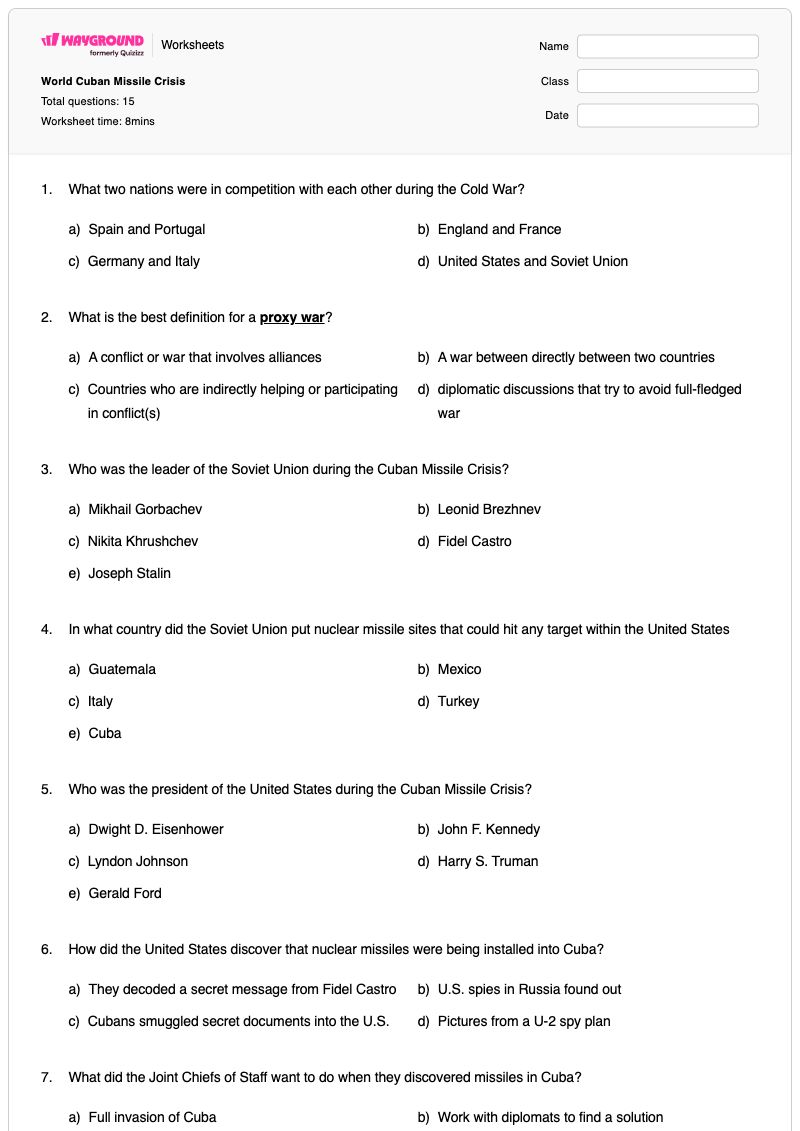
World Cuban Missile Crisis

คำถามทั้งหมด: 15

ชื่อ
ระดับ
วันที่
1.
What two nations were in competition with each other during the Cold War?
a)
Spain and Portugal
b)
England and France
c)
Germany and Italy
d)
United States and Soviet Union
2.

What is the best definition for a proxy war?

a)

A conflict or war that involves alliances

b)

A war between directly between two countries

c)

Countries who are indirectly helping or participating in conflict(s)

d)

diplomatic discussions that try to avoid full-fledged war

3.

Who was the leader of the Soviet Union during the Cuban Missile Crisis?

a)

Mikhail Gorbachev

b)

Leonid Brezhnev

c)

Nikita Khrushchev

d)

Fidel Castro

e)

Joseph Stalin

4.

In what country did the Soviet Union put nuclear missile sites that could hit any target within the United States

a)

Guatemala

b)

Mexico

c)

Italy

d)

Turkey

e)

Cuba

5.

Who was the president of the United States during the Cuban Missile Crisis?

a)

Dwight D. Eisenhower

b)

John F. Kennedy

c)

Lyndon Johnson

d)

Harry S. Truman

e)

Gerald Ford

6.

How did the United States discover that nuclear missiles were being installed into Cuba?

a)

They decoded a secret message from Fidel Castro

b)

U.S. spies in Russia found out

c)

Cubans smuggled secret documents into the U.S.

d)

Pictures from a U-2 spy plan

7.

What did the Joint Chiefs of Staff want to do when they discovered missiles in Cuba?

a)

Full invasion of Cuba

b)

Work with diplomats to find a solution

c)

Attack the Soviet Union with nuclear weapons

d)

Bomb North Korea and invade across the 38th parallel

8.

What event took place prior to the Cuban Missile Crisis that led to Cuba asking for help from the Soviet Union?

a)

Vietnam War

b)

Berlin Wall

c)

Bay of Pigs

d)

Korean War

9.

What did the U.S. do once they discovered the missiles in Cuba?

a)

Attacked Cuba

b)

formed a blockade (quarantine) against new weapons entering Cuba

c)

Asked the United Nations for help

d)

Started negotiations with Fidel Castro

e)

Offered to pay to have the missiles removed

10.

What did the U.S. agree to do in order to get the Soviet Union to remove their missiles from Cuba?

a)

Remove their "Jupiter" missiles from Berlin

b)

Remove their "Jupiter" missiles from Turkey

c)

Remove their "Jupiter" missiles from Iran

d)

None of the these

11.

Which leader was NOT involved in the negotiations for the Cuban Missile Crisis?

a)

Castro

b)

Khrushchev

c)

Kennedy

12.

True or False: The Cuban Missile Crisis was a diplomatic victory for the United States and the Kennedy administration?

a)

True

b)

False

c)

Don't pick this one

13.

Why didn't Kennedy want to attack Cuba once the missiles were discovered?

a)

fear of war

b)

fear of communism in the US

c)

fear of putting European allies in danger

d)

fear of losing re-election

14.

A system where the government owns the factories and other natural resources AND controls the production of goods is known as _____________________.

a)

isolationism

b)

independence

c)

communism

d)

democracy

15.

In 1949 the United States and European countries worked together to form an alliance for protection against Communist aggression called N.A.T.O. What does N.A.T.O stand for?

a)

National Alliance Traffic Organization

b)

North Atlantic Treaty Organization

c)

North American Traffic Organization

d)

National Airlift Traffic Organization

Waygroundแป้นคำตอบ

World Cuban Missile Crisis

คำถามทั้งหมด: 15

1.
d) United States and Soviet Union
2.
c)

Countries who are indirectly helping or participating in conflict(s)

3.
c)

Nikita Khrushchev

4.
e)

Cuba

5.
b)

John F. Kennedy

6.
d)

Pictures from a U-2 spy plan

7.
a)

Full invasion of Cuba

8.
c)

Bay of Pigs

9.
b)

formed a blockade (quarantine) against new weapons entering Cuba

10.
b)

Remove their "Jupiter" missiles from Turkey

11.
a)

Castro

12.
a)

True

13.
a)

fear of war

14.
c)

communism

15.
b)

North Atlantic Treaty Organization

คำถามที่พบบ่อย

แบบฝึกหัดวิกฤตการณ์ขีปนาวุธคิวบาฉบับนี้ครอบคลุมหัวข้ออะไรบ้าง?

แบบฝึกหัดวิชาสังคมศึกษาสำหรับนักเรียนชั้นมัธยมศึกษาปีที่ 4 นี้ ประกอบด้วยคำถามแบบเลือกตอบ 15 ข้อ เพื่อประเมินความเข้าใจของนักเรียนเกี่ยวกับวิกฤตการณ์ขีปนาวุธคิวบาในยุคสงครามเย็น นักเรียนจะต้องระบุผู้นำและเหตุการณ์สำคัญ ตีความคำศัพท์ต่างๆ เช่น สงครามตัวแทนและลัทธิคอมมิวนิสต์ และเชื่อมโยงหลักฐานต่างๆ เช่น ภาพถ่ายจากเครื่องบินรบ U-2 กับการตัดสินใจต่างๆ รวมถึงการปิดล้อมของสหรัฐฯ และการถอนขีปนาวุธจูปิเตอร์ออกจากตุรกี

ฉันจะใช้แบบฝึกหัดนี้ในการสอนเรื่องวิกฤตการณ์ขีปนาวุธคิวบาได้อย่างไร?

เริ่มแบบฝึกหัดโดยทบทวนความขัดแย้งในช่วงสงครามเย็นระหว่างสหรัฐอเมริกาและสหภาพโซเวียต จากนั้นอธิบายบทบาทของเคนเนดีและครุสชอฟ ขณะที่นักเรียนทำแบบฝึกหัดแบบเลือกตอบ ให้หยุดพักเพื่ออภิปรายว่าเหตุการณ์อ่าวหมูส่งผลต่อความสัมพันธ์ระหว่างคิวบากับสหภาพโซเวียตอย่างไร เหตุใดสหรัฐอเมริกาจึงเลือกใช้มาตรการปิดล้อมแทนการโจมตีทันที และข้อตกลงเกี่ยวกับขีปนาวุธช่วยแก้ไขวิกฤตได้อย่างไร

ฉันควรสังเกตข้อผิดพลาดอะไรบ้างเมื่อนักเรียนทำแบบฝึกหัดนี้เสร็จ?

นักเรียนอาจสับสนระหว่างสงครามตัวแทนกับความขัดแย้งโดยตรง หรือเลือกประเทศเพื่อนบ้านแทนที่จะเป็นคิวบาเป็นที่ตั้งของฐานยิงขีปนาวุธของโซเวียต ระวังความสับสนระหว่างเหตุการณ์อ่าวหมูและเหตุการณ์อื่นๆ ในยุคสงครามเย็น ระหว่างการปิดล้อมและการโจมตี และระหว่างขีปนาวุธจูปิเตอร์ในตุรกีกับขีปนาวุธในเบอร์ลิน นักเรียนอาจสับสนระหว่างครุสชอฟและเคนเนดี หรืออ่านภาพถ่ายจากเครื่องบิน U-2 ผิดพลาด โดยคิดว่าเป็นแหล่งข้อมูลทางการทูตแทนที่จะเป็นหลักฐานทางอากาศ

ฉันจะมอบหมายและให้คะแนนแบบฝึกหัดเรื่องวิกฤตการณ์ขีปนาวุธคิวบาอย่างไร?

แบบฝึกหัดนี้มีให้เลือกทั้งในรูปแบบไฟล์ PDF ที่สามารถพิมพ์ได้ และแบบทดสอบดิจิทัลบน Wayground พร้อมเฉลยคำตอบครบถ้วนสำหรับคำถามแบบเลือกตอบทั้ง 15 ข้อ การส่งงานแบบพิมพ์สามารถตรวจได้โดยการสแกนงานของนักเรียนด้วยแอป Wayground for Teachers นอกจากนี้ ตัวเลือกไฟล์ PDF ยังช่วยสนับสนุนโรงเรียนที่ต้องการลดเวลาการใช้หน้าจออีกด้วย

แบบฝึกหัดนี้ประเมินการตัดสินใจและผลลัพธ์ที่สำคัญอะไรบ้าง?

คำถามเหล่านี้จะติดตามวิกฤตการณ์ตั้งแต่การค้นพบฐานยิงขีปนาวุธนิวเคลียร์ของโซเวียตในคิวบา ไปจนถึงการปิดล้อมของสหรัฐฯ และข้อตกลงที่จะถอนขีปนาวุธจูปิเตอร์ออกจากตุรกี นักเรียนจะต้องประเมินด้วยว่าเหตุใดเคนเนดีจึงปฏิเสธการโจมตีทันที ระบุการบุกโจมตีเต็มรูปแบบที่คณะเสนาธิการร่วมต้องการ และตระหนักถึงผลลัพธ์ทางการทูตของวิกฤตการณ์นี้สำหรับรัฐบาลเคนเนดี

ฉันจะหาแบบฝึกหัดฟรีแบบนี้เพิ่มเติมได้ที่ไหนบน Wayground?

Wayground นำเสนอชุดแบบฝึกหัดและโจทย์ฝึกหัดฟรีที่ครอบคลุมหลากหลายวิชา พร้อมไฟล์ PDF และเฉลยคำตอบ เพื่อช่วยเสริมสร้างทักษะและความเข้าใจในแนวคิดสำคัญ ดูแหล่งข้อมูลเพิ่มเติมได้ที่ https://wayground.com/en-us/worksheets