
Wayground
Evolution and Natural Selection - Printable Science Worksheets - Wayground

Evolution and Natural Selection

20 คำถาม

8th - 8th ระดับชั้น

Science

วิวัฒนาการและการคัดเลือกโดยธรรมชาติ เป็นแบบฝึกหัดวิทยาศาสตร์สำหรับนักเรียนชั้น ม.2 (เกรด 2) ประกอบด้วยคำถามแบบเลือกตอบ 20 ข้อ ครอบคลุมหัวข้อเกี่ยวกับการเปลี่ยนแปลงของสิ่งมีชีวิตเมื่อเวลาผ่านไป และวิธีที่นักวิทยาศาสตร์ใช้หลักฐานเพื่ออธิบายวิวัฒนาการ นักเรียนจะได้ระบุบรรพบุรุษร่วมกันจากความคล้ายคลึงกันในนกฟินช์และกระดูกสัตว์ เชื่อมโยงความแปรผันและการปรับตัวกับการเปลี่ยนแปลงของสิ่งแวดล้อมผ่านตัวอย่างผีเสื้อกลางคืนลายจุด และรู้จักการพรางตัว ดีเอ็นเอ และโครงสร้างที่เหลืออยู่ นอกจากนี้ นักเรียนยังจะได้ทบทวนฟอสซิล หินตะกอน การหาอายุด้วยกัมมันตรังสี ครึ่งชีวิต และบันทึกฟอสซิลในฐานะหลักฐานของการเปลี่ยนแปลงทางวิวัฒนาการ แบบฝึกหัดที่พิมพ์ได้ฟรีนี้ช่วยให้นักเรียนแยกแยะแนวคิดวิวัฒนาการที่เกี่ยวข้องในขณะที่นำไปใช้กับตัวอย่างและคำจำกัดความสั้นๆ รูปแบบคำถามแบบเลือกตอบช่วยสนับสนุนการฝึกฝนด้วยตนเอง การทบทวนก่อนการประเมิน หรือการตรวจสอบความเข้าใจอย่างรวดเร็วหลังจากการสอนเกี่ยวกับการคัดเลือกโดยธรรมชาติและหลักฐานทางวิวัฒนาการ แบบฝึกหัดนี้มีเฉลยคำตอบที่สมบูรณ์เพื่อให้ครูสามารถตรวจสอบความเข้าใจผิดได้อย่างมีประสิทธิภาพและให้การติดตามผลที่ตรงเป้าหมาย

การตั้งค่าแผ่นงาน

ขนาดตัวอักษร

S
M
L
XL
แผ่นงาน

Evolution and Natural Selection

คำถามทั้งหมด: 20

ชื่อ
ระดับ
วันที่
1.
Charles Darwin’s observation that finches of different species on the Galápagos Islands have many similar physical characteristics supports the hypothesis that these finches 
 
a)
have the ability to interbreed.
b)
acquired traits through use and disuse.
c)
all eat the same type of food.
d)
descended from a common ancestor.
2.

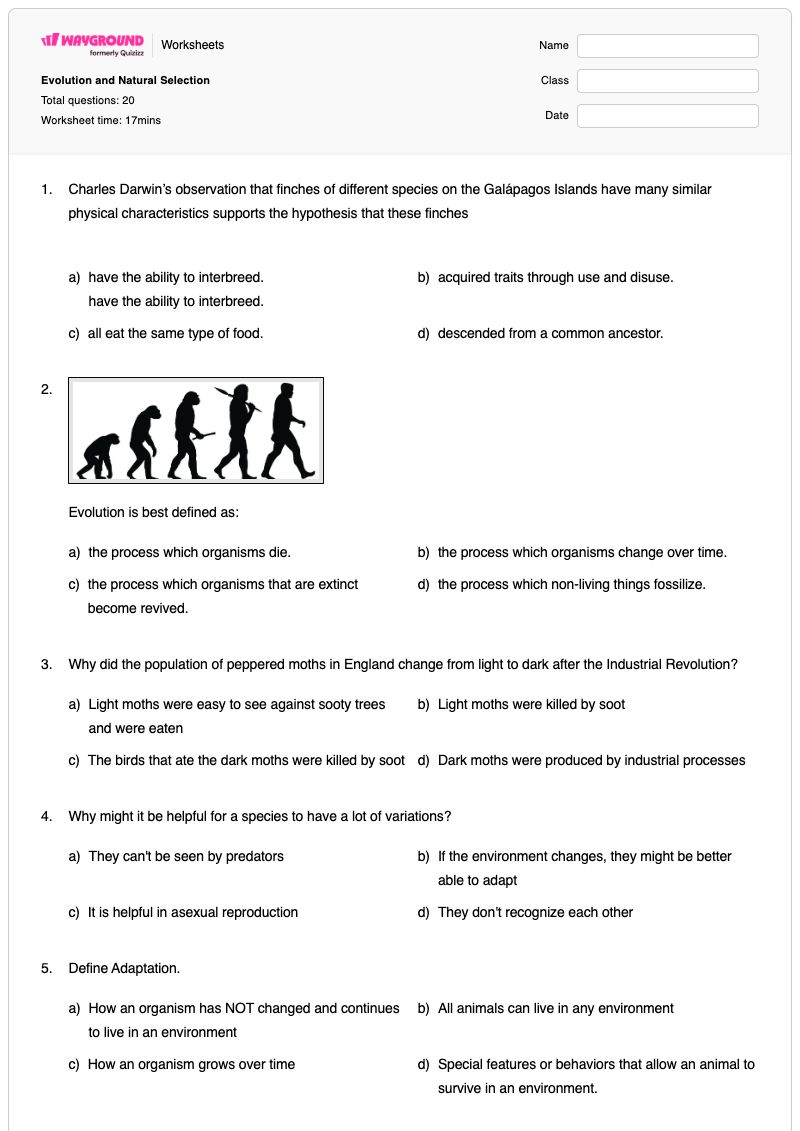
Evolution is best defined as:

a)

the process which organisms die.

b)

the process which organisms change over time.

c)

the process which organisms that are extinct become revived.

d)

the process which non-living things fossilize.

3.
Why did the population of peppered moths in England change from light to dark after the Industrial Revolution?
a)
Light moths were easy to see against sooty trees and were eaten
b)
Light moths were killed by soot
c)
The birds that ate the dark moths were killed by soot
d)
Dark moths were produced by industrial processes
4.

Why might it be helpful for a species to have a lot of variations?

a)

They can't be seen by predators

b)

If the environment changes, they might be better able to adapt

c)

It is helpful in asexual reproduction

d)

They don't recognize each other

5.
Define Adaptation.
a)
How an organism has NOT changed and continues to live in an environment 
b)
All animals can live in any environment 
c)
How an organism grows over time
d)
Special features or behaviors that allow an animal to survive in an environment.
6.
In what type of rock would you typically find fossils?
a)
igneous
b)
metamorphic
c)
sedimentary
d)
rocky
7.
All plants and ANIMALS contain carbon.
a)
True
b)
False
8.
The amount of time it takes for 50% of the remaining radioactive material to decay into stable material is called:
a)
radiocarbon dating
b)
radioactive decay
c)
half-life
d)
successive decay time
9.
Why is DNA important?
a)
it is very small and very complicated
b)
it's in everything
c)
it serves as the blueprint for traits of all living things
d)
because we eat it every day for energy
10.
An animal's color or pattern that helps it blend into its surroundings
a)
Environment 
b)
Mimicry
c)
Camouflage
11.

How do scientists determine the actual age of fossils?

a)

relative dating

b)

sedimentary dating

c)

radioactive dating

d)

mold and cast dating

12.

How does the fossil record help to support the theory of evolution?

a)

the fossil record shows that organisms slowly change over time

b)

The fossil record shows that species evolve very quickly

c)

The fossil record does not support the theory of evolution

13.
Which of these answers BEST describes the tiny leg bones that some whales have, which do not aid in their movement or serve any other function? 
a)
structures that grows and improves in function as they are used
b)
structures that will become adaptations when the environment changes
c)
structures that have lost all or most of their function over evolutionary time
d)
structures that function at certain times of the year or under certain conditions 
14.
What is the genetic material that organisms pass on to their offspring when they reproduce? 
a)
DNA
b)
food
c)
cells
d)
energy
15.
Humans, birds, whales, and lizards all have similar arm bones. What is the reason for this?
a)
The function of these bones is the same in all animals
b)
They live in similar environments
c)
They have a common ancestor
d)
All organisms resemble humans
16.
Individuals with favorable traits survive, reproduce, and pass their traits onto their offspring. This is called
a)
Mutation
b)
Adaptation
c)
Evolution
d)
Natural Selection
17.
An organism's ability to survive and reproduce in its environment refers to its
a)
Fitness
b)
Variation
c)
Selection
d)
Mutation
18.
Which of the following pieces of evolution evidence deals with comparing similar structures in various species?
a)
fossil record
b)
comparing embryology
c)
comparing biochemistry
d)
comparing anatomy
19.
Which of the following pieces of evolution evidence deals with structures common in embryos that form differently or for different purposes in adult form?
a)
fossil record
b)
comparing embryology
c)
comparing biochemistry
d)
comparing anatomy
20.
Which of the following pieces of evolution evidence contain both homologous and vestigial structures?
a)
fossil record
b)
comparing embryology
c)
comparing biochemistry
d)
comparing anatomy
แป้นคำตอบ

Evolution and Natural Selection

คำถามทั้งหมด: 20

1.
d) descended from a common ancestor.
2.
b)

the process which organisms change over time.

3.
a) Light moths were easy to see against sooty trees and were eaten
4.
b)

If the environment changes, they might be better able to adapt

5.
d) Special features or behaviors that allow an animal to survive in an environment.
6.
c) sedimentary
7.
a) True
8.
c) half-life
9.
c) it serves as the blueprint for traits of all living things
10.
c) Camouflage
11.
c)

radioactive dating

12.
a)

the fossil record shows that organisms slowly change over time

13.
c) structures that have lost all or most of their function over evolutionary time
14.
a) DNA
15.
c) They have a common ancestor
16.
d) Natural Selection
17.
a) Fitness
18.
d) comparing anatomy
19.
b) comparing embryology
20.
d) comparing anatomy

คำถามที่พบบ่อย

แบบฝึกหัดเรื่องวิวัฒนาการและการคัดเลือกโดยธรรมชาติครอบคลุมเนื้อหาอะไรบ้าง?

แบบฝึกหัดวิทยาศาสตร์สำหรับนักเรียนชั้น ม.2 นี้ ประกอบด้วยคำถามแบบเลือกตอบ 20 ข้อ เพื่อประเมินว่าหลักฐานสนับสนุนทฤษฎีวิวัฒนาการและการคัดเลือกโดยธรรมชาติอย่างไร นักเรียนจะได้ตีความตัวอย่างต่างๆ เช่น นกฟินช์แห่งหมู่เกาะกาลาปากอส ผีเสื้อกลางคืนลายจุด กระดูกขาของวาฬ กระดูกแขนของสัตว์ที่คล้ายคลึงกัน ฟอสซิล ดีเอ็นเอ ความแปรผัน การปรับตัว และการพรางตัว พร้อมทั้งระบุแนวคิดเกี่ยวกับการหาอายุของฟอสซิล เช่น การหาอายุด้วยกัมมันตรังสีและครึ่งชีวิต

ฉันจะใช้แบบฝึกหัดนี้ในการสอนเรื่องวิวัฒนาการและการคัดเลือกโดยธรรมชาติได้อย่างไร?

แนะนำวิวัฒนาการในฐานะการเปลี่ยนแปลงของสิ่งมีชีวิตเมื่อเวลาผ่านไป จากนั้นใช้ข้อสอบแบบเลือกตอบเพื่ออธิบายว่าแต่ละตัวอย่างทำหน้าที่เป็นหลักฐานหรือแสดงให้เห็นถึงกลไกอย่างไร ให้นักเรียนอธิบายว่าเหตุใดตัวอย่างผีเสื้อกลางคืนลายจุดจึงแสดงให้เห็นถึงการคัดเลือก เหตุใดกระดูกที่คล้ายคลึงกันจึงบ่งชี้ถึงบรรพบุรุษร่วมกัน และความแปรผันสามารถช่วยให้ประชากรตอบสนองต่อการเปลี่ยนแปลงของสิ่งแวดล้อมได้อย่างไร ก่อนที่จะทำแบบฝึกหัดด้วยตนเอง

ฉันควรระวังข้อผิดพลาดอะไรบ้างเมื่อนักเรียนทำแบบฝึกหัดเรื่องวิวัฒนาการนี้?

สังเกตนักเรียนที่เลือกการผสมข้ามสายพันธุ์แทนที่จะเป็นบรรพบุรุษร่วมกันเมื่อตีความนกฟินช์หรือกระดูกสัตว์ที่คล้ายคลึงกัน และสับสนระหว่างการปรับตัวกับการเปลี่ยนแปลงของสิ่งมีชีวิตเนื่องจากความจำเป็น นักเรียนอาจสับสนระหว่างการหาอายุสัมพัทธ์และการหาอายุโดยใช้กัมมันตรังสี ครึ่งชีวิตและการสลายตัวของกัมมันตรังสี หรือการพรางตัวและการเลียนแบบ การทบทวนคำถามในแต่ละตัวเลือกแบบปรนัยสามารถเปิดเผยความเข้าใจผิดได้

ฉันจะมอบหมายและตรวจงานเรื่องวิวัฒนาการและการคัดเลือกโดยธรรมชาติอย่างไร?

Wayground จัดเตรียมแบบฝึกหัดนี้ในรูปแบบไฟล์ PDF ที่สามารถพิมพ์ได้ และในรูปแบบแบบทดสอบดิจิทัล โดยมีเฉลยคำตอบครบถ้วนสำหรับคำถามแบบเลือกตอบทั้ง 20 ข้อ คุณสามารถตรวจงานที่ส่งมาในรูปแบบไฟล์พิมพ์ได้โดยการสแกนงานของนักเรียนด้วยแอป Wayground for Teachers หรือตรวจสอบคำตอบผ่านแบบทดสอบดิจิทัลได้

ฉันจะปรับแบบฝึกหัดเรื่องวิวัฒนาการและการคัดเลือกโดยธรรมชาติให้เหมาะสมกับนักเรียนของฉันได้อย่างไร?

ในการตั้งค่าขั้นสูงของแบบฝึกหัด ให้ปรับระยะห่างระหว่างตัวอักษรหรือขนาดตัวอักษรเพื่อให้คำถามแบบเลือกตอบ 20 ข้ออ่านง่ายขึ้น และเปิดใช้งานแบบอักษรที่เป็นมิตรต่อผู้ที่มีภาวะดิสเล็กเซียเมื่อจำเป็น นอกจากนี้ คุณยังสามารถแปลคำถามและตัวเลือกคำตอบเป็นภาษาอื่นเพื่อให้ผู้เรียนสามารถมุ่งเน้นไปที่แนวคิดต่างๆ เช่น บรรพบุรุษร่วมกัน การปรับตัว ฟอสซิล และการคัดเลือกโดยธรรมชาติ

ฉันจะหาแบบฝึกหัดแบบนี้เพิ่มเติมได้ที่ไหนบน Wayground?

Wayground นำเสนอชุดแบบฝึกหัดและโจทย์ฝึกหัดฟรีที่ครอบคลุมทุกวิชา พร้อมไฟล์ PDF และเฉลยคำตอบ เพื่อสนับสนุนทักษะและแนวคิดที่สำคัญ ดูแหล่งข้อมูลเพิ่มเติมได้ที่ https://wayground.com/en-us/worksheets