

Wayground
7th Grade Milestone Review - Properties of Operations - Printable คณิตศาสตร์ Worksheets 7th ระดับชั้น - Wayground

7th Grade Milestone Review - Properties of Operations

Catherine Jones

สร้างโดย Catherine Jones

20 คำถาม

7th ระดับชั้น

คณิตศาสตร์

อัปเดตแล้ว ก.ย. 2569

แบบฝึกหัดทบทวนบทเรียนระดับชั้นมัธยมศึกษาปีที่ 7 - คุณสมบัติของการดำเนินการ ช่วยให้นักเรียนชั้นมัธยมศึกษาปีที่ 7 ระบุคุณสมบัติที่แสดงโดยสมการ แบบฝึกหัดนี้ประกอบด้วยคำถามแบบเลือกตอบ 20 ข้อ นักเรียนจะได้จำแนกตัวอย่างของคุณสมบัติการจัดกลุ่ม การสลับที่ เอกลักษณ์ ผกผัน และการกระจาย สำหรับการบวกและการคูณ รวมถึงสมการที่มีจำนวนเต็ม เศษส่วน ตัวแปร และวงเล็บ แบบฝึกหัดพีชคณิตเบื้องต้นนี้ช่วยให้นักเรียนตระหนักถึงพฤติกรรมของการดำเนินการเมื่อตัวเลขหรือสัญลักษณ์การจัดกลุ่มเปลี่ยนตำแหน่ง และเมื่อตัวประกอบหรือตัวบวกไม่เปลี่ยนแปลงค่า แบบฝึกหัดนี้มีประโยชน์สำหรับการทบทวน การฝึกฝนด้วยตนเอง หรือการตรวจสอบความเข้าใจก่อนที่นักเรียนจะนำคุณสมบัติเหล่านี้ไปใช้ในการลดรูปนิพจน์ แบบฝึกหัดนี้เป็นแบบฝึกหัดที่พิมพ์ได้ฟรีพร้อมเฉลยคำตอบครบถ้วนเพื่อการตรวจสอบที่มีประสิทธิภาพ

การตั้งค่าแผ่นงาน

ขนาดตัวอักษร

S
M
L
XL
Waygroundแผ่นงาน

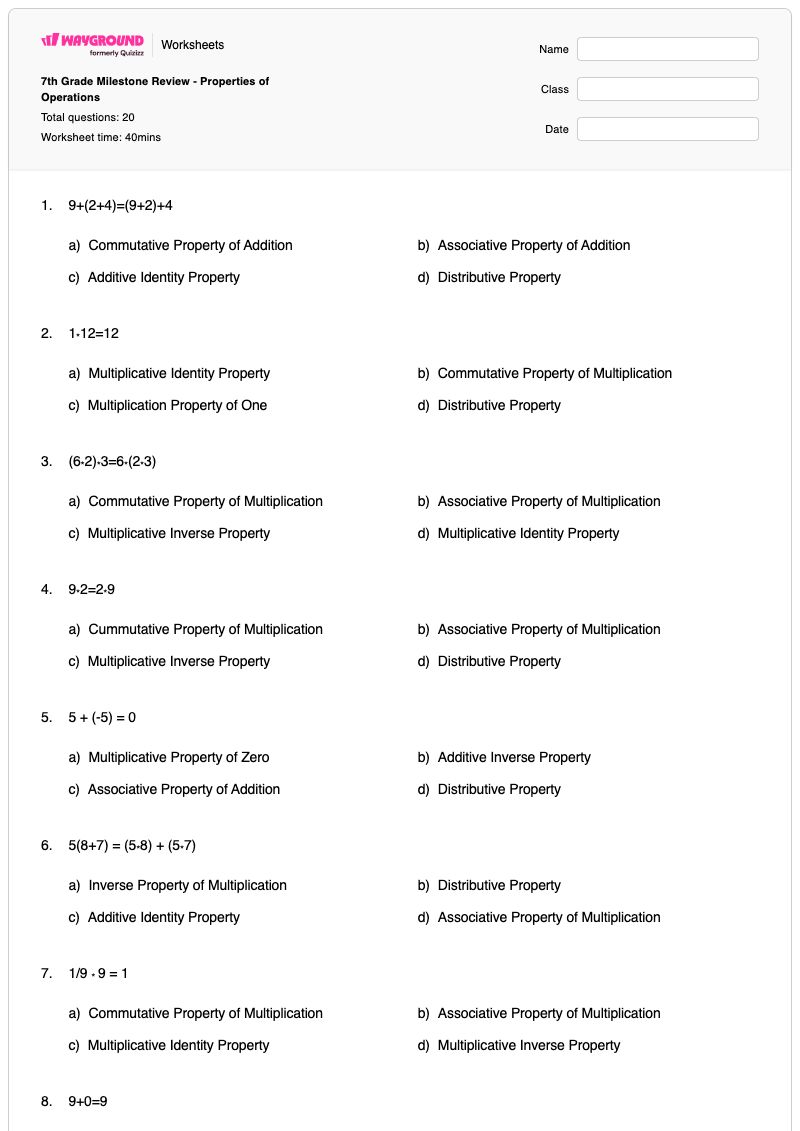
7th Grade Milestone Review - Properties of Operations

คำถามทั้งหมด: 20

ชื่อ
ระดับ
วันที่
1.
9+(2+4)=(9+2)+4
a)
Commutative Property of Addition
b)
Associative Property of Addition
c)
Additive Identity Property
d)
Distributive Property
2.
1*12=12
a)
Multiplicative Identity Property
b)
Commutative Property of Multiplication
c)
Multiplication Property of One
d)
Distributive Property
3.
(6*2)*3=6*(2*3)
a)
Commutative Property of Multiplication
b)
Associative Property of Multiplication
c)
Multiplicative Inverse Property
d)
Multiplicative Identity Property
4.
9*2=2*9
a)
Cummutative Property of Multiplication
b)
Associative Property of Multiplication
c)
Multiplicative Inverse Property
d)
Distributive Property
5.
5 + (-5) = 0
a)
Multiplicative Property of Zero
b)
Additive Inverse Property
c)
Associative Property of Addition
d)
Distributive Property
6.
5(8+7) = (5*8) + (5*7)
a)
Inverse Property of Multiplication
b)
Distributive Property
c)
Additive Identity Property
d)
Associative Property of Multiplication
7.
1/9 * 9 = 1
a)
Commutative Property of Multiplication
b)
Associative Property of Multiplication
c)
Multiplicative Identity Property
d)
Multiplicative Inverse Property
8.
9+0=9
a)
Communtative Property of Addition
b)
Associative Property of Addition
c)
Additive Identity Property
d)
Additive Inverse Property
9.
6*7=7*6
a)
Associative Property of Multiplication
b)
Commutative Property of Multiplication
c)
Inverse Property of Multiplication
d)
Distributive Property
10.
Which property is this example?
5 x 6 = 6 x 5
a)
Commutative property of multiplication
b)
Associative Property of multiplication
c)
Distributive property of multiplication
d)
Identity property of multiplication
11.
Which property is this example?
3(5+y)=15+3y
a)
Commutative property of multiplication
b)
Associative Property of multiplication
c)
Distributive property of multiplication
d)
Identity property of multiplication
12.
Which property is this example?
100 + 0 = 100
a)
Commutative property of addition
b)
Associative Property of addition
c)
Distributive property of multiplication
d)
Identity property of addition
13.
Which property is this example?
(1+2)+3=1+(2+3)
a)
Commutative property of addition
b)
Associative Property of addition
c)
Distributive property of multiplication
d)
Identity property of addition
14.
Which property is this example?
6(5-4)=6(5) - 6(4)
a)
Commutative property of multiplication
b)
Associative Property of multiplication
c)
Distributive property of multiplication
d)
Identity property of multiplication
15.
What property allows this statement to be true? 
(A + B) + C = A + ( B + C)
a)
Associative
b)
Commutative
c)
Distributive
d)
Identity
16.
Changing the location of the grouping symbols does not change the outcome.  Must be the same operation
(5 x 7) x 3 = 5 x (7 x 3)

a)
Identity Property of Multiplication
b)
Commutative Property of Multiplication
c)
Associative Property of Multiplication
d)
Distributive Property
17.
5 + (-5) = 0
a)
Multiplicative Property of Zero
b)
Additive Inverse Property
c)
Associative Property of Addition
d)
Distributive Property
18.
The _______________ property of addition states that any number plus zero equals the other number.
a)
identity
b)
commutative
c)
associative
d)
Inverse
19.
According to the Associative Property of Multiplication, (9 x 6) x 5 = 
a)
270
b)
9 x 30
c)
9 x (6 x 5)
d)
5 x 9 + 5 x 6
20.
Identify the property shown.
m + 0 = m
a)
Multiplicative Identity
b)
Addition Property of Equality
c)
Additive Identity
d)
Symmetric Property
Waygroundแป้นคำตอบ

7th Grade Milestone Review - Properties of Operations

คำถามทั้งหมด: 20

1.
b) Associative Property of Addition
2.
a) Multiplicative Identity Property
3.
b) Associative Property of Multiplication
4.
a) Cummutative Property of Multiplication
5.
b) Additive Inverse Property
6.
b) Distributive Property
7.
d) Multiplicative Inverse Property
8.
c) Additive Identity Property
9.
b) Commutative Property of Multiplication
10.
a) Commutative property of multiplication
11.
c) Distributive property of multiplication
12.
d) Identity property of addition
13.
b) Associative Property of addition
14.
c) Distributive property of multiplication
15.
a) Associative
16.
c) Associative Property of Multiplication
17.
b) Additive Inverse Property
18.
a) identity
19.
c) 9 x (6 x 5)
20.
c) Additive Identity

คำถามที่พบบ่อย

แบบฝึกหัดสำหรับนักเรียนชั้น ม.1 นี้ครอบคลุมเนื้อหาอะไรบ้าง?

แบบฝึกหัดนี้ครอบคลุมการระบุคุณสมบัติการจัดกลุ่ม การสลับที่ เอกลักษณ์ ตัวผกผัน และการกระจาย จากสมการแบบเลือกตอบ 20 ข้อ นักเรียนจะได้เปรียบเทียบตัวอย่างต่างๆ เช่น การเปลี่ยนกลุ่มของตัวบวก การสลับตัวประกอบการคูณ การบวกศูนย์ การคูณด้วยส่วนกลับ และการกระจายตัวประกอบในวงเล็บ เพื่อสร้างความเข้าใจเกี่ยวกับคุณสมบัติที่แสดงโดยแต่ละสมการ

ฉันจะใช้แบบฝึกหัดนี้สอนเรื่องคุณสมบัติของการดำเนินการได้อย่างไร?

แนะนำคุณสมบัติโดยใช้สมการตัวอย่างทีละสมการ จากนั้นให้นักเรียนอธิบายว่าอะไรเปลี่ยนแปลงและอะไรยังคงเหมือนเดิม ก่อนที่จะทำข้อสอบแบบเลือกตอบ ตัวอย่างเช่น เปรียบเทียบ 9 + (2 + 4) = (9 + 2) + 4 กับ 9 × 2 = 2 × 9 เพื่อให้นักเรียนแยกแยะความแตกต่างระหว่างการจัดกลุ่มใหม่กับการเปลี่ยนลำดับ ใช้ตัวเลือกคำตอบเพื่อกระตุ้นให้นักเรียนอธิบายว่าทำไมคุณสมบัติอื่นๆ จึงไม่สามารถอธิบายสมการแต่ละสมการได้

ฉันควรสังเกตข้อผิดพลาดอะไรบ้างเมื่อนักเรียนทำแบบฝึกหัดนี้เสร็จ?

นักเรียนอาจสับสนระหว่างสมบัติการสลับที่และสมบัติการจัดกลุ่ม: ตัวอย่างของสมบัติการจัดกลุ่มจะเปลี่ยนการจัดกลุ่ม ในขณะที่ตัวอย่างของสมบัติการสลับที่จะเปลี่ยนลำดับ พวกเขาอาจเข้าใจผิดว่าการบวกศูนย์หรือการคูณด้วยหนึ่งคือความสัมพันธ์ผกผัน มองข้ามว่า 5 + (−5) = 0 แสดงถึงตัวผกผันการบวก หรือไม่กระจายตัวประกอบไปยังทุกพจน์ในตัวอย่างเช่น 3(5 + y) = 15 + 3y ตรวจสอบให้แน่ใจว่านักเรียนอ่านวงเล็บและระบุการดำเนินการที่ได้รับผลกระทบก่อนที่จะเลือกคำตอบ

ฉันจะมอบหมายและตรวจงานใบงานนี้อย่างไร?

คุณสามารถส่งแบบฝึกหัดนี้เป็นไฟล์ PDF ที่พิมพ์ได้ หรือใช้เป็นแบบทดสอบดิจิทัลบน Wayground ก็ได้ แบบฝึกหัดนี้มีเฉลยคำตอบครบถ้วนสำหรับคำถามแบบเลือกตอบ 20 ข้อ และสามารถตรวจให้คะแนนงานที่ส่งในรูปแบบไฟล์พิมพ์ได้โดยการสแกนงานของนักเรียนด้วยแอป Wayground for Teachers รูปแบบไฟล์พิมพ์ยังช่วยให้โรงเรียนมีตัวเลือกในการฝึกฝนโดยใช้เวลาอยู่หน้าจอน้อยลงด้วย

ฉันจะปรับแบบฝึกหัดเรื่องคุณสมบัติของการดำเนินการนี้ให้เหมาะสมกับนักเรียนของฉันได้อย่างไร?

ใช้การตั้งค่าขั้นสูงของแบบฝึกหัดเพื่อปรับระยะห่างระหว่างตัวอักษร หรือเลือกขนาดตัวอักษรที่ใหญ่ขึ้น เพื่อให้สมการ วงเล็บ และตัวเลือกคำตอบอ่านง่ายขึ้น นอกจากนี้ คุณยังสามารถใช้แบบอักษรที่เหมาะสำหรับผู้ที่มีภาวะดิสเล็กเซีย หรือแปลแบบฝึกหัดแบบเลือกตอบเป็นภาษาอื่นได้ เมื่อตัวเลือกเหล่านั้นรองรับการเข้าถึงชื่อคุณสมบัติและตัวอย่าง

ฉันจะหาแบบฝึกหัดแบบนี้เพิ่มเติมได้ที่ไหนบน Wayground?

Wayground นำเสนอชุดแบบฝึกหัดและโจทย์ฝึกหัดที่สามารถพิมพ์ได้ฟรีอย่างครอบคลุมในทุกวิชา ครูสามารถดาวน์โหลดไฟล์ PDF พร้อมเฉลยคำตอบได้ที่ https://wayground.com/en-us/worksheets เพื่อค้นหาแหล่งข้อมูลเพิ่มเติมสำหรับทักษะและแนวคิดที่สำคัญ