

Wayground
Properties of Matter - Printable Science Worksheets - Wayground

Properties of Matter

20 คำถาม

9th - 9th ระดับชั้น

Science

แบบฝึกหัดวิทยาศาสตร์สำหรับนักเรียนชั้น ม.3 นี้ ช่วยให้นักเรียนจำแนกประเภทของสสารและแยกแยะความแตกต่างระหว่างธาตุ สารประกอบ สารผสมเอกพันธุ์ สารผสมวิวิพันธุ์ สารละลาย คอลลอยด์ และสารแขวนลอย แบบฝึกหัดประกอบด้วยคำถามแบบเลือกตอบ 20 ข้อ นักเรียนจะได้ตีความแผนภาพอนุภาค ระบุประเภทของสารผสม เปรียบเทียบพฤติกรรมของอนุภาคสารแขวนลอยและคอลลอยด์ รู้จักปรากฏการณ์ทินดอลล์ และเลือกวิธีการแยกที่เหมาะสม เช่น การใช้แม่เหล็กเพื่อแยกผงเหล็กออกจากทราย แบบฝึกหัดนี้ยังช่วยเสริมความเข้าใจเกี่ยวกับนิยามของสสารและความแตกต่างระหว่างสมบัติทางกายภาพและทางเคมี นักเรียนจะได้จำแนกตัวอย่างเช่น สถานะของสสาร จุดเดือด ความไวไฟ และความสามารถในการเกิดสนิม โดยนำความแตกต่างเหล่านี้ไปใช้ในรูปแบบคำถามและคำตอบที่เน้นเฉพาะเรื่อง แบบฝึกหัดนี้ออกแบบมาสำหรับใช้ในการสอน ทบทวน หรือประเมินผลวิชาวิทยาศาสตร์ชั้น ม.3 และมีเฉลยคำตอบครบถ้วนเพื่อการตรวจสอบและให้ข้อเสนอแนะอย่างมีประสิทธิภาพ

การตั้งค่าแผ่นงาน

ขนาดตัวอักษร

S
M
L
XL
แผ่นงาน

Properties of Matter

คำถามทั้งหมด: 20

ชื่อ
ระดับ
วันที่
1.
Which one of the following would you use to separate sand from iron filings?
a)
a bar magnet
b)
filter paper
c)
chromatography paper
d)
alum
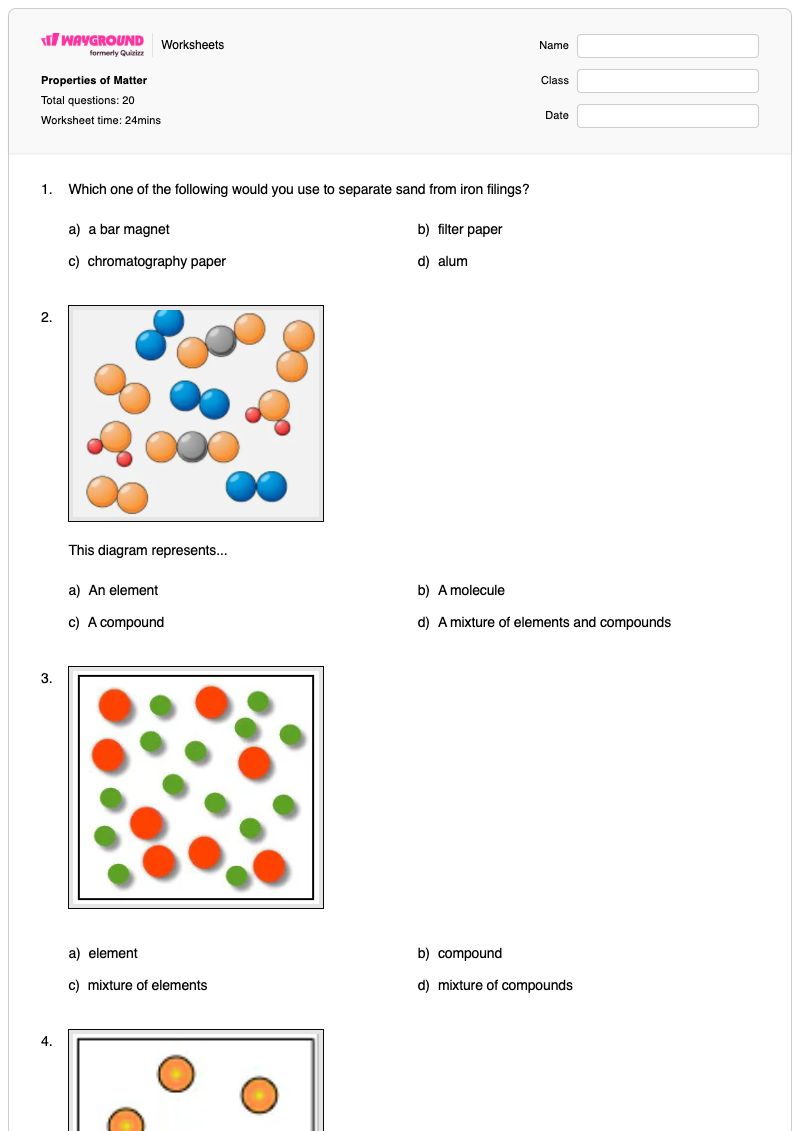
2.

This diagram represents...

a)

An element

b)

A molecule

c)

A compound

d)

A mixture of elements and compounds

3.
a)
element
b)
compound
c)
mixture of elements
d)
mixture of compounds
4.
a)
element
b)
compound
c)
mixture of elements
d)
mixture of compounds
5.
What is a mixture?
a)
elements chemically combined
b)
a combination of different things
c)
it is found on the Periodic Table 
d)
it is made of chemical
6.
What type of mixture is this?
a)
heterogeneous 
b)
homogeneous
7.
Sand floating in water, but most of the sand is settled at the bottom this an example of which type of mixture?
a)
A solution
b)
A colloid
c)
A suspension
d)
A compound
8.

Which statement below does NOT describe a colloid?

a)

A colloid is a type of heterogeneous mixture

b)

A colloid is a type of solution.

c)

The particles in a colloid do not settle like they do in a suspension.

d)

The particles in a colloid do not dissolve – they are just too small to be seen.

9.

How are suspensions and colloids different?

a)

Suspensions settle out and colloids do not settle.

b)

Colloids settle out and suspensions do not settle.

c)

Suspensions dissolve and colloids do not.

d)

Colloids dissolve and suspensions do not.

10.
The scattering of light by colloids is called ____. 
a)
homogeneous
b)
suspension
c)
air pollution
d)
The Tyndall effect
11.
A substance that contains only one type of atom is a(n)
a)
compound
b)
element
c)
heterogeneous mixture
d)
homogeneous mixture
12.

The particles in both a solution and a colloid can

a)

A. scatter light.

b)

B. settle out.

c)

D. pass through a fine filter.

13.
What is matter?
a)
a pure substance
b)
anything that occupies space and possesses mass
c)
an element
d)
a compound
14.
Which of the following is not a chemical property? 
a)
rusting 
b)
boiling 
c)
rotting 
d)
burning 
15.
Which one of these is a chemical property?
a)
melting point
b)
boiling point
c)
color
d)
flammability
16.
Ability to rust is this type of property:
a)
Physical property
b)
Chemical property
17.
Which is an example of a physical property?
a)
ability to react with acid
b)
 state of matter
c)
flammability
d)
ability to react with oxygen
18.
What kind of properties can only be observed when a substance changes into a different substance?
a)
physical properties
b)
chemical properties
c)
liquid properties
d)
real properties
19.
Properties that can be observed without trying to change the identity of the substance.
a)
Physical
b)
Chemical
20.
Which of the following is a chemical change?
a)
human digestion
b)
cutting a tree down
c)
melting a chocolate bar
d)
Has a density of 1 gm/mL
แป้นคำตอบ

Properties of Matter

คำถามทั้งหมด: 20

1.
a) a bar magnet
2.
d)

A mixture of elements and compounds

3.
c) mixture of elements
4.
a) element
5.
b) a combination of different things
6.
a) heterogeneous 
7.
c) A suspension
8.
b)

A colloid is a type of solution.

9.
a)

Suspensions settle out and colloids do not settle.

10.
d) The Tyndall effect
11.
b) element
12.
c)

D. pass through a fine filter.

13.
b) anything that occupies space and possesses mass
14.
b) boiling 
15.
d) flammability
16.
b) Chemical property
17.
b)  state of matter
18.
b) chemical properties
19.
a) Physical
20.
a) human digestion

คำถามที่พบบ่อย

แบบฝึกหัดเรื่องคุณสมบัติของสสารครอบคลุมหัวข้ออะไรบ้าง?

แบบฝึกหัดสำหรับนักเรียนชั้น ม.3 นี้ ประกอบด้วยคำถามแบบเลือกตอบ 20 ข้อ เพื่อประเมินว่านักเรียนจำแนกสสารเป็นธาตุ สารประกอบ หรือสารผสมได้อย่างไร และแยกแยะความแตกต่างระหว่างสารผสมเอกพันธุ์ สารผสมวิวิธพันธุ์ สารละลาย คอลลอยด์ และสารแขวนลอยได้อย่างไร นอกจากนี้ยังให้นักเรียนประยุกต์ใช้วิธีการแยกสาร ระบุปรากฏการณ์ทินดอลล์ และแยกแยะความแตกต่างระหว่างสมบัติทางกายภาพและสมบัติทางเคมี โดยใช้ตัวอย่างเช่น การเดือด การติดไฟ และการเกิดสนิม

ฉันจะใช้แบบฝึกหัดนี้ในการสอนเรื่องคุณสมบัติของสสารได้อย่างไร?

เริ่มด้วยการให้นักเรียนจัดเรียงตัวอย่างเป็นสารบริสุทธิ์และสารผสม จากนั้นสาธิตให้เห็นว่าพฤติกรรมของอนุภาคแตกต่างกันอย่างไรระหว่างสารละลาย คอลลอยด์ และสารแขวนลอย ใช้คำถามเกี่ยวกับวิธีการแยกและแผนภาพเพื่อนำไปสู่การอภิปราย และปิดท้ายด้วยการถามนักเรียนว่าทำไมการเดือดและสถานะของสสารจึงเป็นสมบัติทางกายภาพ ในขณะที่การติดไฟและการเกิดสนิมเป็นสมบัติทางเคมี

ฉันควรสังเกตข้อผิดพลาดอะไรบ้างเมื่อนักเรียนทำแบบฝึกหัดนี้เสร็จ?

นักเรียนอาจสับสนระหว่างสารประกอบกับสารผสม หรือจัดประเภทสารผสมทุกชนิดว่าเป็นสารเนื้อเดียวกันโดยไม่พิจารณาว่าองค์ประกอบของสารผสมนั้นสม่ำเสมอหรือไม่ นอกจากนี้ พวกเขาอาจสับสนความแตกต่างที่สำคัญระหว่างคอลลอยด์และสารแขวนลอย—อนุภาคของสารแขวนลอยจะตกตะกอน ในขณะที่อนุภาคของคอลลอยด์จะไม่ตกตะกอน—และสับสนระหว่างคุณสมบัติทางกายภาพ เช่น จุดเดือด กับคุณสมบัติทางเคมี เช่น ความสามารถในการติดไฟหรือความสามารถในการเกิดสนิม

ฉันจะมอบหมายและตรวจงานเรื่องคุณสมบัติของสสารนี้อย่างไร?

แบบฝึกหัดนี้มีให้ดาวน์โหลดเป็นไฟล์ PDF สำหรับพิมพ์ และเป็นแบบทดสอบดิจิทัลบน Wayground โดยมีเฉลยคำตอบครบถ้วนสำหรับคำถามแบบเลือกตอบทั้ง 20 ข้อ สำหรับการส่งงานแบบพิมพ์ ให้สแกนงานของนักเรียนด้วยแอป Wayground for Teachers เพื่อใช้ในการตรวจและให้คะแนน

ฉันจะปรับแบบฝึกหัดเรื่องคุณสมบัติของสสารนี้ให้เหมาะสมกับนักเรียนของฉันได้อย่างไร?

ใช้การตั้งค่าขั้นสูงของแบบฝึกหัดเพื่อปรับระยะห่างระหว่างตัวอักษรและขนาดตัวอักษร เพื่อให้ข้อสอบแบบเลือกตอบ 20 ข้ออ่านง่ายขึ้น นอกจากนี้ คุณยังสามารถเปิดใช้งานแบบอักษรที่เหมาะสำหรับผู้ที่มีภาวะดิสเล็กเซีย หรือแปลแบบฝึกหัดเป็นภาษาอื่นได้ โดยยังคงคำถามเกี่ยวกับการจำแนกประเภทของสสารและคุณสมบัติทางกายภาพและทางเคมีไว้เหมือนเดิม

ฉันจะหาแบบฝึกหัดแบบนี้เพิ่มเติมได้ที่ไหนบน Wayground?

Wayground มีแบบฝึกหัดและโจทย์ฝึกหัดมากมายให้ดาวน์โหลดฟรีในหลากหลายวิชา พร้อมไฟล์ PDF และเฉลยคำตอบ เพื่อช่วยให้นักเรียนพัฒนาทักษะและความเข้าใจในแนวคิดที่สำคัญ ดูแหล่งข้อมูลเพิ่มเติมได้ที่ https://wayground.com/en-us/worksheets