


Wayground
Limiting Reagents - Printable ศาสตร์ Worksheets 11th ระดับชั้น - Wayground

Limiting Reagents

Joseph  Stevens

สร้างโดย Joseph Stevens

21 คำถาม

11th ระดับชั้น

ศาสตร์

อัปเดตแล้ว มิ.ย. 2569

แบบฝึกหัดวิทยาศาสตร์สำหรับนักเรียนชั้นมัธยมศึกษาปีที่ 4 (เกรด 11) นี้ ให้แบบฝึกหัดที่เน้นเรื่องสารตั้งต้นที่จำกัดและทักษะทางเคมีเชิงปริมาณที่เกี่ยวข้อง ผ่านคำถามแบบเลือกตอบ 21 ข้อ นักเรียนจะได้ระบุสารตั้งต้นที่จำกัดและสารตั้งต้นส่วนเกินจากปริมาณในชีวิตประจำวันและสมการเคมีที่สมดุล กำหนดว่าปฏิกิริยาจะหยุดลงเมื่อใด และเชื่อมโยงสารตั้งต้นที่จำกัดกับปริมาณของผลิตภัณฑ์ที่เกิดขึ้น คำถามยังครอบคลุมถึงผลผลิตทางทฤษฎี ผลผลิตจริง ผลผลิตร้อยละ การแปลงโมล การคำนวณจากอนุภาคเป็นโมล และปัญหาเกี่ยวกับปฏิกิริยาที่อิงตามมวล แบบฝึกหัดนี้มีประโยชน์สำหรับการแนะนำเหตุผลเรื่องสารตั้งต้นที่จำกัด การเสริมบทเรียนเรื่องทางเคมีเชิงปริมาณ หรือการตรวจสอบความเข้าใจของนักเรียนก่อนการคำนวณที่ซับซ้อนมากขึ้น สถานการณ์ที่หลากหลาย ได้แก่ ส่วนผสมของแซนด์วิช อะลูมิเนียมและคลอรีน กรดไฮโดรคลอริกและแมกนีเซียม การผลิตโพแทสเซียมคลอไรด์ ซิลเวอร์ฟอสเฟต และวิตามินซี แบบฝึกหัดที่พิมพ์ได้ฟรีนี้ออกแบบมาสำหรับการสอนวิทยาศาสตร์ชั้นมัธยมศึกษาปีที่ 4 (เกรด 11) และมีเฉลยคำตอบที่สมบูรณ์เพื่อการตรวจสอบและตรวจให้คะแนนอย่างมีประสิทธิภาพ

การตั้งค่าแผ่นงาน

ขนาดตัวอักษร

S
M
L
XL
Waygroundแผ่นงาน

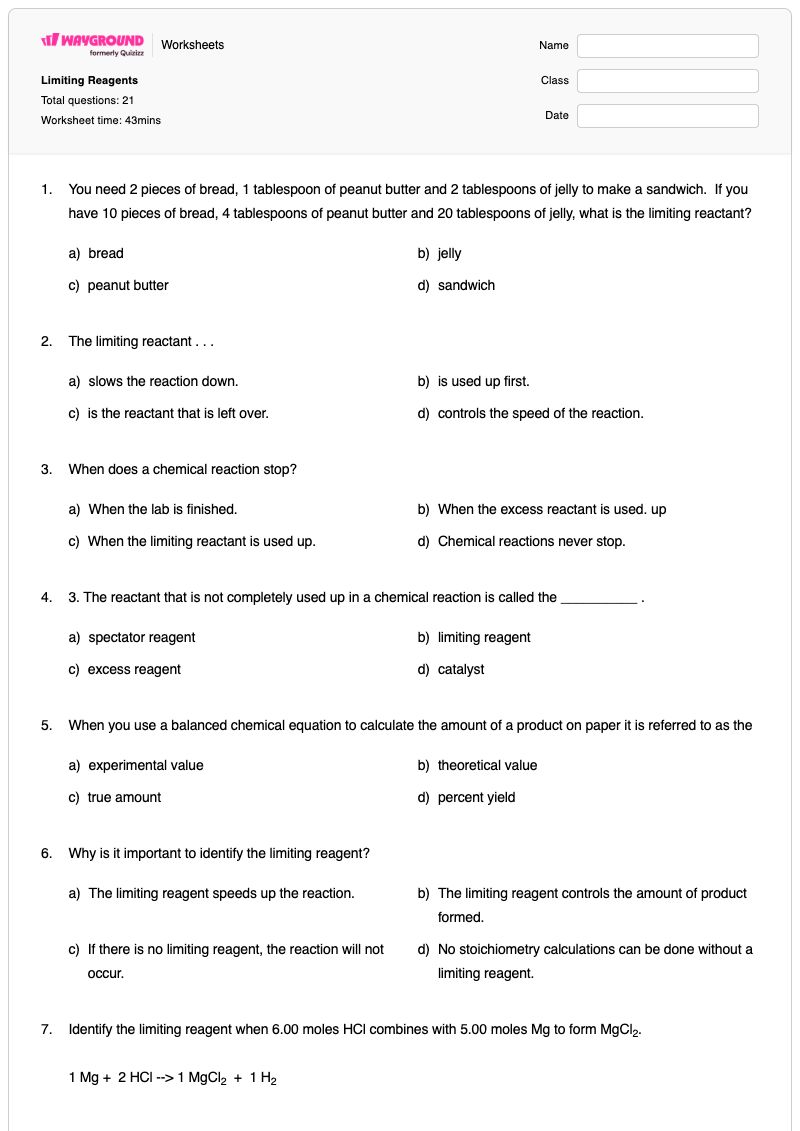
Limiting Reagents

คำถามทั้งหมด: 21

ชื่อ
ระดับ
วันที่
1.
You need 2 pieces of bread, 1 tablespoon of peanut butter and 2 tablespoons of jelly to make a sandwich.  If you have 10 pieces of bread, 4 tablespoons of peanut butter and 20 tablespoons of jelly, what is the limiting reactant?
a)
bread
b)
jelly
c)
peanut butter
d)
sandwich
2.
The limiting reactant . . .
a)
slows the reaction down.
b)
is used up first.
c)
is the reactant that is left over.
d)
controls the speed of the reaction.
3.
When does a chemical reaction stop?
a)
When the lab is finished.
b)
When the excess reactant is used. up
c)
When the limiting reactant is used up.
d)
Chemical reactions never stop.
4.
3. The reactant that is not completely used up in a chemical reaction is called the __________ .
a)
spectator reagent
b)
limiting reagent
c)
excess reagent
d)
catalyst
5.
When you use a balanced chemical equation to calculate the amount of a product on paper it is referred to as the 
a)
experimental value
b)
theoretical value
c)
true amount
d)
percent yield
6.

Why is it important to identify the limiting reagent?

a)

The limiting reagent speeds up the reaction.

b)

The limiting reagent controls the amount of product formed.

c)

If there is no limiting reagent, the reaction will not occur.

d)

No stoichiometry calculations can be done without a limiting reagent.

7.
Identify the limiting reagent when 6.00 moles HCl combines with 5.00 moles Mg to form MgCl2.
 
1 Mg +  2 HCl --> 1 MgCl2  +  1 H2   
 
a)
Mg
b)
H2
c)
MgCl2
d)
HCl
8.
Use the equation 2 Al + 3 Cl2 ---> 2 AlCl3.  If 2 moles of aluminum and 2 moles of chlorine are reacted, identify the limiting reactant.
a)
AlCl3
b)
Cl2
c)
Al
d)
None
9.
When does a chemical reaction stop?
a)
When the lab is finished.
b)
When the excess reactant is used. up
c)
When the limiting reactant is used up.
d)
Chemical reactions never stop.
10.

Theoretical yield = 73g

Actual yield = 62g

Calculate the percent yield.

a)

116%

b)

85%

c)

1.16%

d)

76%

11.
A reaction was predicted to produce 32.4 grams of a compound. When the product was measured, there were only 26.1 grams made. What is the percent yield?
a)
80.6%
b)
6.3%
c)
24.1%
d)
58.5%
12.

Cl2 + 2 KBr → Br2 + 2 KCl

How many grams of potassium chloride can be produced from 356 g of Cl2 and 356 g of potassium bromide?

a)

749 g

b)

223 g

c)

479 g

d)

814 g

13.
Silver nitrate and sodium phosphate are reacted in equal amounts of 200 g each. How many grams of silver phosphate are produced? 
3AgNO3  + Na3(PO4)  --->  Ag3(PO4)  + 3NaNO3
a)
164 g
b)
64 g
c)
146 g
d)
164 moles
14.

A sample of silver contains 5.71 x 10²² atoms. How many moles of silver are present?

a)

3.43 x 1046 moles

b)

0.0529 moles

c)

0.0948 moles

d)

10.5 moles

15.

Vitamin C, also known as ascorbic acid, is water soluble and cannot be produced by the human body. Each day, a person's diet should include a source of Vitamin C, such as orange juice. Ascorbic acid has a molecular formula of C6H8O6 and a molar mass of 176 grams per mole.

Determine the number of moles of vitamin C in an orange that contains 0.171 grams of vitamin C.

a)

30.1 moles

b)

1030 moles

c)

.000971 moles

d)

.0001 mole

16.
What is the molar mass of AuCl3?
a)
96 g
b)
130 g
c)
232.5 g
d)
303.3 g
17.

What is the total mass, in grams, of a 0.75 mole sample of SO2?

a)

16 g

b)

24 g

c)

32 g

d)

48 g

18.
Calculate the mass of iron in a sample of iron ore containing 2.61x10²³ iron atoms.
a)
0.433g
b)
24.2g
c)
44g
d)
6.02g
19.
Balance this equation
_Zn+_HCl-->_ZnCl2 +_H2
a)
1,1,2,1
b)
1,1,1,2
c)
1,2,1,1
d)
2,1,1,1
20.
Balance this equation
_Zn+_HCl-->_ZnCl2 +_H2
a)
1,1,2,1
b)
1,1,1,2
c)
1,2,1,1
d)
2,1,1,1
21.
KNO3 --> KNO2 + O2
What coefficients are needed to balance the reaction?
a)
2, 2, 1
b)
2, 3, 2
c)
1, 2, 2
d)
1, 3, 1
Waygroundแป้นคำตอบ

Limiting Reagents

คำถามทั้งหมด: 21

1.
c) peanut butter
2.
b) is used up first.
3.
c) When the limiting reactant is used up.
4.
c) excess reagent
5.
b) theoretical value
6.
b)

The limiting reagent controls the amount of product formed.

7.
d) HCl
8.
b) Cl2
9.
c) When the limiting reactant is used up.
10.
b)

85%

11.
a) 80.6%
12.
b)

223 g

13.
a) 164 g
14.
c)

0.0948 moles

15.
c)

.000971 moles

16.
d) 303.3 g
17.
d)

48 g

18.
b) 24.2g
19.
c) 1,2,1,1
20.
c) 1,2,1,1
21.
a) 2, 2, 1

คำถามที่พบบ่อย

แบบฝึกหัดเรื่องสารตั้งต้นจำกัดปริมาณครอบคลุมหัวข้ออะไรบ้าง?

แบบฝึกหัดวิทยาศาสตร์ระดับชั้น ม.4 นี้ประกอบด้วยคำถามแบบเลือกตอบ 21 ข้อ เพื่อประเมินว่านักเรียนสามารถระบุสารตั้งต้นที่จำกัดและสารตั้งต้นส่วนเกิน พิจารณาว่าปฏิกิริยาหยุดลงเมื่อใด และใช้สมการเคมีที่สมดุลในการให้เหตุผลเกี่ยวกับปริมาณของผลิตภัณฑ์ได้อย่างไร นอกจากนี้ยังเชื่อมโยงเรื่องสารตั้งต้นที่จำกัดเข้ากับผลผลิตทางทฤษฎี ผลผลิตร้อยละ การแปลงโมล และปัญหาทางเคมีเชิงมวลอีกด้วย

ฉันจะใช้แบบฝึกหัดนี้ในการสอนเรื่องสารตั้งต้นจำกัดได้อย่างไร?

เริ่มต้นด้วยการอธิบายโดยใช้แซนด์วิชเป็นตัวอย่าง ถามนักเรียนว่าส่วนผสมใดหมดก่อนและจำกัดจำนวนแซนด์วิชที่ทำเสร็จ จากนั้นให้นักเรียนเปรียบเทียบปริมาณสารตั้งต้นกับสัมประสิทธิ์ในสมการเคมีที่สมดุล เช่น แมกนีเซียมและกรดไฮโดรคลอริก หรืออะลูมิเนียมและคลอรีน ก่อนที่จะใช้คำถามเกี่ยวกับผลผลิตและการแปลงหน่วยโมลเป็นแบบฝึกหัดหรือแบบทดสอบท้ายบทเรียน

ฉันควรสังเกตข้อผิดพลาดอะไรบ้างเมื่อนักเรียนทำแบบฝึกหัดนี้เสร็จ?

นักเรียนอาจสับสนระหว่างสารตั้งต้นที่จำกัดปริมาณกับสารตั้งต้นส่วนเกิน เลือกสารตั้งต้นที่เหลืออยู่ หรือคิดว่าปฏิกิริยาจะหยุดลงเมื่อสารตั้งต้นส่วนเกินหมดไป ในข้อสอบคำนวณ ให้ระวังอัตราส่วนโมลที่สลับกัน การใช้ผลผลิตทางทฤษฎีเป็นผลผลิตจริง การใช้ความสัมพันธ์ร้อยละของผลผลิตที่ผิด และการไม่แปลงอนุภาคหรือกรัมเป็นโมลก่อนเลือกคำตอบ

ฉันจะมอบหมายและให้คะแนนแบบฝึกหัดเรื่องสารตั้งต้นจำกัดนี้ได้อย่างไร?

แบบฝึกหัดนี้มีให้ดาวน์โหลดในรูปแบบ PDF สำหรับพิมพ์ และเป็นแบบทดสอบดิจิทัลบน Wayground โดยมีเฉลยคำตอบครบถ้วน คุณสามารถตรวจงานที่ส่งมาในรูปแบบ PDF ได้โดยการสแกนงานของนักเรียนด้วยแอป Wayground for Teachers หรือตรวจสอบคำตอบจากแบบทดสอบดิจิทัลก็ได้

ฉันจะปรับแบบฝึกหัดเรื่องสารตั้งต้นที่จำกัดปริมาณนี้ให้เหมาะสมกับนักเรียนของฉันได้อย่างไร?

ใช้การตั้งค่าขั้นสูงของแบบฝึกหัดเพื่อปรับระยะห่างระหว่างตัวอักษรหรือขนาดตัวอักษร เพื่อให้คำถามแบบเลือกตอบ 21 ข้อและสมการเคมีอ่านง่ายขึ้น นอกจากนี้ คุณยังสามารถใช้แบบอักษรที่เหมาะสำหรับผู้ที่มีภาวะดิสเล็กเซีย หรือแปลแบบฝึกหัดเป็นภาษาอื่นได้โดยยังคงแบบฝึกหัดเกี่ยวกับสารตั้งต้นที่จำกัดและสัดส่วนทางเคมีเอาไว้เหมือนเดิม

ฉันจะหาแบบฝึกหัดแบบนี้เพิ่มเติมได้ที่ไหนบน Wayground?

Wayground นำเสนอชุดแบบฝึกหัดและโจทย์ฝึกหัดฟรีที่ครอบคลุมทุกวิชา พร้อมไฟล์ PDF และเฉลยคำตอบ เพื่อสนับสนุนทักษะและแนวคิดที่สำคัญ ดูแหล่งข้อมูลเพิ่มเติมได้ที่ https://wayground.com/en-us/worksheets