

Wayground
Matter Unit Assessment (SOL 5.4) - Printable ศาสตร์ Worksheets 5th ระดับชั้น - Wayground

Matter Unit Assessment (SOL 5.4)

Jessica Toney

สร้างโดย Jessica Toney

25 คำถาม

5th ระดับชั้น

ศาสตร์

แบบประเมินหน่วยเรื่องสสาร (SOL 5.4) เป็นแบบฝึกหัดวิทยาศาสตร์สำหรับนักเรียนชั้นประถมศึกษาปีที่ 5 ที่ใช้ตรวจสอบความเข้าใจของนักเรียนเกี่ยวกับสสาร พฤติกรรมของอนุภาค และการเปลี่ยนแปลงสถานะ แบบฝึกหัดนี้ประกอบด้วย 25 ข้อ—23 ข้อเป็นแบบเลือกตอบ และ 2 ข้อเป็นแบบเลือกคำตอบ—นักเรียนจะได้ระบุค่ามวลและปริมาตรของสสาร อธิบายการเคลื่อนที่ของอนุภาคในของแข็งและของเหลว เชื่อมโยงการเปลี่ยนแปลงอุณหภูมิกับการเคลื่อนที่ของอนุภาค และจำแนกประเภทของกระบวนการต่างๆ เช่น การระเหย แบบประเมินนี้ยังครอบคลุมถึงอะตอม ธาตุ สารประกอบ และสารผสม รวมถึงการตีความองค์ประกอบของคาร์บอนไดออกไซด์และโซเดียมคลอไรด์ และการเลือกตัวอย่างของสารผสม ใช้แบบประเมินนี้หลังจากการสอนหรือเพื่อทบทวนหน่วยเรื่องสสาร เพื่อระบุว่านักเรียนสามารถเข้าใจและนำแนวคิดใดไปใช้ได้อย่างอิสระ ข้อเลือกตอบจะแยกแยะแนวคิดที่เกี่ยวข้องกันอย่างใกล้ชิด เช่น มวล ปริมาตร รูปร่าง การให้ความร้อน การทำให้เย็น ธาตุ และสารประกอบ ในขณะที่ข้อเลือกคำตอบต้องการให้นักเรียนประเมินตัวเลือกที่เกี่ยวข้องทั้งหมด นี่คือแบบฝึกหัดที่พิมพ์ได้ฟรีพร้อมเฉลยคำตอบครบถ้วน เหมาะสำหรับการตรวจสอบความเข้าใจของแต่ละบุคคลหรือเตรียมความพร้อมนักเรียนสำหรับงานประเมิน SOL 5.4

การตั้งค่าแผ่นงาน

ขนาดตัวอักษร

S
M
L
XL
Waygroundแผ่นงาน

Matter Unit Assessment (SOL 5.4)

คำถามทั้งหมด: 25

ชื่อ
ระดับ
วันที่
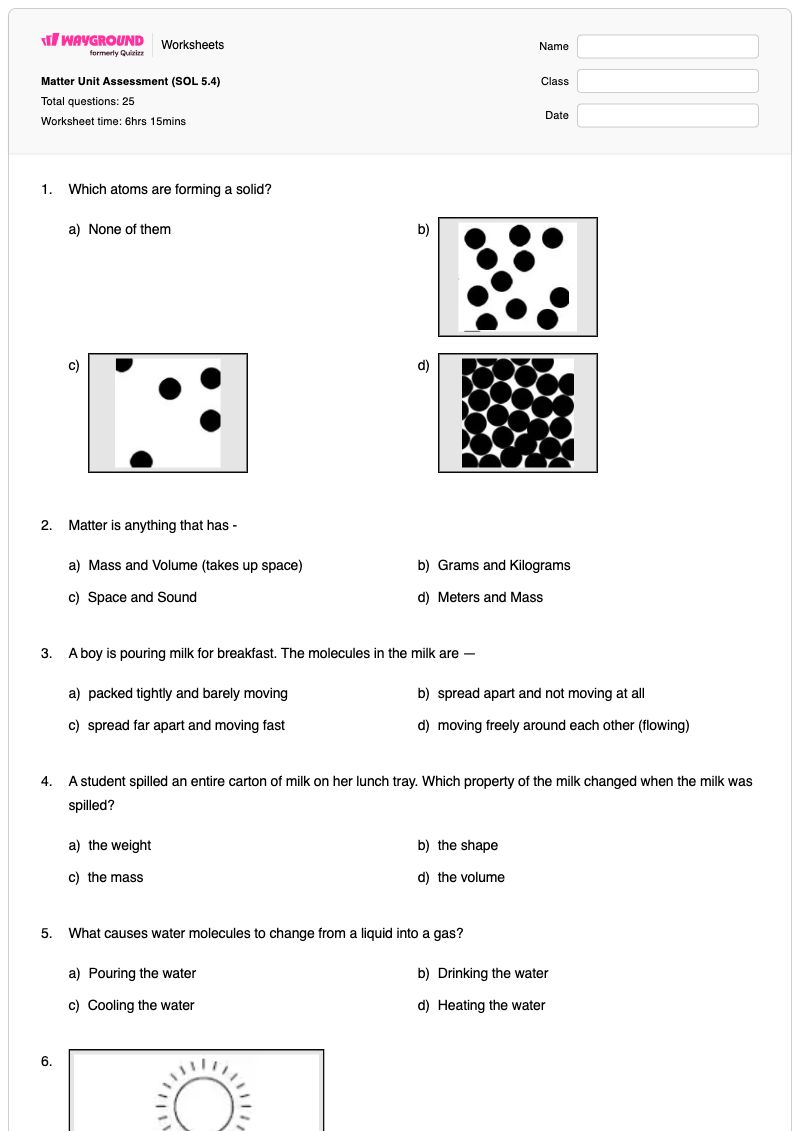
1.

Which atoms are forming a solid?

a)

None of them

b)
Which atoms are forming a solid?
c)
Which atoms are forming a solid?
d)
Which atoms are forming a solid?
2.

Matter is anything that has -

a)

Mass and Volume (takes up space)

b)

Grams and Kilograms

c)

Space and Sound

d)

Meters and Mass

3.

A boy is pouring milk for breakfast. The molecules in the milk are —

a)

packed tightly and barely moving

b)

spread apart and not moving at all

c)

spread far apart and moving fast

d)

moving freely around each other (flowing)

4.

A student spilled an entire carton of milk on her lunch tray. Which property of the milk changed when the milk was spilled?

a)

the weight

b)

the shape

c)

the mass

d)

the volume

5.

What causes water molecules to change from a liquid into a gas?

a)

Pouring the water

b)

Drinking the water

c)

Cooling the water

d)

Heating the water

6.
The process shown would be classified as —

The process shown would be classified as —

a)

evaporation

b)

condensation

c)

transpiration

d)

precipitation

7.

The particles in a liquid move faster when the temperature ________.

a)

increases

b)

decreases

8.

Which of the following will NOT happen when heat is applied?

a)

Liquid water boils and becomes steam or gas

b)

Solid ice melts and becomes a liquid

c)

Liquid water evaporates and becomes a gas

d)

Water freezes and becomes solid ice

9.

Atoms are the smallest part of a(n) —

a)

neutron

b)

electron

c)

proton

d)

element

10.

Hydrogen, oxygen and helium are examples of —

a)

neutrons

b)

electrons

c)

protons

d)

elements

11.

What is the smallest part of matter?

a)

An atom

b)

A voltage

c)

A circuit

d)

A switch

12.
The carbon dioxide compound is made of —

The carbon dioxide compound is made of —

a)

2 oxygens and 1 hydrogen

b)

2 oxygens and 1 carbon

c)

2 hydrogens and 1 oxygen

d)

2 carbons and 1 oxygen

13.

When one molecule of sodium combines with one molecule of chlorine, what is formed?

a)

S2Cl2

b)

NaCl2

c)

NaCl

d)

SC

14.

A ____________ is a combination of two or more substances that do not lose their identifying characteristics when put together. It can be separated by hand.

a)

Solution

b)

Mixture

c)

Compound

d)

Molecule

15.

Choose the mixtures (you must select ALL correct answers).

a)
Choose the mixtures (you must select ALL correct answers).
b)
Choose the mixtures (you must select ALL correct answers).
c)
Choose the mixtures (you must select ALL correct answers).
d)
Choose the mixtures (you must select ALL correct answers).
16.

What is formed when two or more atoms are held together?

a)

A molecule

b)

An electron

c)

An element

d)

A proton

17.

What compound is made of hydrogen and oxygen atoms?

a)

Iron

b)

Water

c)

Gold

d)

Helium

18.

A student combined sand and iron filings in a cup. He separated them using a magnet. Before he separated them, they were an example of —

a)

a molecule

b)

a solution

c)

a mixture

d)

a neutron

19.

Sugar is poured into a glass of water and dissolves. This is an example of a(n) —

a)

solution

b)

ratio

c)

element

d)

compound

20.

Which is a solution?

a)

Lettuce and cucumber salad

b)

Mixed fruit salad

c)

Chocolate milk

d)

Peanuts and fruit

21.

A person served a fruit salad made with bananas, grapes, and apples. The fruit salad is an example of a —

a)

solution

b)

compound

c)

mixture

d)

proton

22.

How are mixtures and solutions the alike?

a)

They are both easy to separate

b)

They dissolve in water

c)

They are both solids

d)

They have two or more ingredients

23.

Identify the solution.

a)
Identify the solution.
b)
Identify the solution.
c)
Identify the solution.
d)
Identify the solution.
24.

Which is an example of a physical change?

a)

A nail rusting

b)

A match burning

c)

A match broken in half

d)

Bread baking

25.

Which is an example of a chemical change?

a)

Tearing paper

b)

A match broken in half

c)

Slicing a loaf of bread

d)

A nail rusting

Waygroundแป้นคำตอบ

Matter Unit Assessment (SOL 5.4)

คำถามทั้งหมด: 25

1.
d)
2.
a)

Mass and Volume (takes up space)

3.
d)

moving freely around each other (flowing)

4.
b)

the shape

5.
d)

Heating the water

6.
a)

evaporation

7.
a)

increases

8.
d)

Water freezes and becomes solid ice

9.
d)

element

10.
d)

elements

11.
a)

An atom

12.
b)

2 oxygens and 1 carbon

13.
c)

NaCl

14.
b)

Mixture

15.
a) , b) , d)
16.
a)

A molecule

17.
b)

Water

18.
c)

a mixture

19.
a)

solution

20.
c)

Chocolate milk

21.
c)

mixture

22.
d)

They have two or more ingredients

23.
c)
24.
c)

A match broken in half

25.
d)

A nail rusting

คำถามที่พบบ่อย

การประเมินหน่วยเรื่องเนื้อหา (SOL 5.4) ครอบคลุมหัวข้ออะไรบ้าง?

แบบประเมินวิชาวิทยาศาสตร์ระดับชั้นประถมศึกษาปีที่ 5 นี้ ประกอบด้วยคำถามแบบเลือกตอบ 23 ข้อ และคำถามแบบเลือกคำตอบ 2 ข้อ เพื่อประเมินความเข้าใจเกี่ยวกับมวลและปริมาตรของสสาร การเคลื่อนที่ของอนุภาค การเปลี่ยนแปลงสถานะ และความสัมพันธ์ระหว่างอะตอม ธาตุ สารประกอบ และสารผสม นักเรียนจะได้ประยุกต์ใช้แนวคิดเหล่านี้โดยการระบุว่าความร้อนส่งผลต่ออนุภาคอย่างไร การจำแนกประเภทการระเหย การตีความสูตรต่างๆ เช่น CO₂ และ NaCl และการเลือกตัวอย่างของสารผสมทั้งหมด

ฉันจะใช้แบบฝึกหัดนี้ในการสอนเรื่องคุณสมบัติและการเปลี่ยนแปลงของสสารได้อย่างไร?

ใช้คำถามเรียงลำดับ: เริ่มต้นด้วยมวลและปริมาตรของสสาร จากนั้นอภิปรายเกี่ยวกับการเคลื่อนที่ของอนุภาคในของแข็งและของเหลว ก่อนที่จะเชื่อมโยงความร้อนกับการระเหย การหลอมเหลว การเดือด และการแข็งตัว หลังจากที่นักเรียนตอบคำถามแล้ว ให้พวกเขาอธิบายว่าทำไมการหกของนมจึงเปลี่ยนรูปร่างแทนที่จะเปลี่ยนมวล และทำไม CO₂ และ NaCl จึงแสดงถึงการรวมกันของธาตุที่แตกต่างกัน ใช้ข้อสอบแบบเลือกตอบหลายข้อเป็นหัวข้อปิดท้ายการอภิปรายเกี่ยวกับวิธีที่สารต่างๆ รักษาคุณลักษณะเฉพาะของตนเองไว้

ฉันควรระวังข้อผิดพลาดอะไรบ้างเมื่อนักเรียนทำแบบประเมินเรื่องนี้?

นักเรียนอาจสับสนระหว่างมวล ปริมาตร น้ำหนัก และรูปร่าง เมื่อพิจารณาสถานการณ์นมที่หก หรือเลือกการแช่แข็งเป็นผลมาจากการให้ความร้อน นอกจากนี้ พวกเขาอาจสับสนระหว่างการระเหยกับการควบแน่น ปฏิบัติต่อธาตุเป็นอนุภาคแทนที่จะเป็นสาร หรืออ่านสูตรเคมีผิดโดยสลับจำนวนและชนิดของอะตอม ในคำถามแบบเลือกตอบหลายข้อ ให้ตรวจสอบว่านักเรียนเลือกส่วนผสมที่ถูกต้องทุกข้อ แทนที่จะหยุดหลังจากเลือกเพียงข้อเดียว

ฉันจะมอบหมายและให้คะแนนการประเมินหน่วยการเรียนรู้เรื่องสสารได้อย่างไร?

แบบประเมินหน่วยการเรียนรู้เรื่องสสาร มีให้เลือกทั้งในรูปแบบไฟล์ PDF ที่สามารถพิมพ์ได้ และแบบทดสอบดิจิทัลบน Wayground โดยมีเฉลยคำตอบครบถ้วน สำหรับการส่งงานในรูปแบบไฟล์พิมพ์ ครูสามารถสแกนงานของนักเรียนด้วยแอป Wayground for Teachers เพื่อตรวจให้คะแนนได้อย่างมีประสิทธิภาพ นอกจากนี้ ตัวเลือกไฟล์ PDF ยังช่วยสนับสนุนโรงเรียนที่ต้องการลดเวลาการใช้หน้าจอในขณะที่ยังคงเข้าถึงการประเมินผลได้ง่าย

ฉันจะปรับวิธีการประเมินเนื้อหาให้เหมาะสมกับนักเรียนของฉันได้อย่างไร?

ในการตั้งค่าขั้นสูงของแบบฝึกหัด ให้ปรับระยะห่างระหว่างตัวอักษรและขนาดตัวอักษรเพื่อให้คำถามเกี่ยวกับสสารทั้ง 25 ข้ออ่านง่ายขึ้น นอกจากนี้ คุณยังสามารถเปิดใช้งานแบบอักษรที่เหมาะสำหรับผู้ที่มีภาวะดิสเล็กเซีย หรือแปลแบบประเมินเป็นภาษาอื่น ซึ่งอาจช่วยให้นักเรียนเข้าถึงคำถามเกี่ยวกับการเคลื่อนที่ของอนุภาค การเปลี่ยนแปลงสถานะ และอะตอมและสารประกอบได้ง่ายขึ้น

ฉันจะหาแบบฝึกหัดแบบนี้เพิ่มเติมได้ที่ไหนบน Wayground?

Wayground นำเสนอชุดแบบฝึกหัดและโจทย์ฝึกหัดฟรีที่ครอบคลุมทุกวิชา พร้อมไฟล์ PDF และเฉลยคำตอบ เพื่อช่วยเสริมสร้างทักษะและความเข้าใจในแนวคิดสำคัญ ดูแหล่งข้อมูลเพิ่มเติมได้ที่ https://wayground.com/en-us/worksheets