

Wayground
T15 Renaissance and Reformation Review Set - Printable สังคมศึกษา Worksheets ระดับ 7 - Wayground

T15 Renaissance and Reformation Review Set

Jon Shaw

สร้างโดย Jon Shaw

21 คำถาม

7th ระดับชั้น

สังคมศึกษา

อัปเดตแล้ว พ.ค. 2568

แบบฝึกหัด T15 ชุดทบทวนยุคฟื้นฟูศิลปวิทยาและการปฏิรูปศาสนา สำหรับนักเรียนชั้น ม.1 (เกรด 7) ทบทวนว่าการเปลี่ยนแปลงทางเศรษฐกิจ ศิลปะ เทคโนโลยี ศาสนา และการเมือง ส่งผลต่อยุโรปอย่างไร นักเรียนจะได้เชื่อมโยงการเติบโตของการค้ากับการเสื่อมถอยของระบบศักดินา ระบุสาเหตุที่ยุคฟื้นฟูศิลปวิทยาเริ่มต้นในอิตาลี รู้จักเทคนิคทางศิลปะของยุคฟื้นฟูศิลปวิทยา เช่น ทัศนวิสัยเชิงเส้น และภาพบุคคลที่เหมือนจริง และอธิบายว่าการพิมพ์ ฆราวาสนิยม และบุคคลสำคัญ เช่น เลโอนาร์โด ดา วินชี ดือเรอร์ ลูเธอร์ ไทน์เดล และโคเปอร์นิคัส มีอิทธิพลต่อการเปลี่ยนแปลงอย่างไร แบบฝึกหัด 21 ข้อนี้ ประกอบด้วยคำถามแบบเลือกตอบ 17 ข้อ และคำถามแบบเลือกคำตอบ 4 ข้อ นักเรียนจะได้ทบทวนเกี่ยวกับแท่นพิมพ์และการรู้หนังสือ 95 ข้อของลูเธอร์ คณะเยสุอิตและสภาเทรนต์ สนธิสัญญาเอาส์บวร์ก การปกครองตนเอง และแบบจำลองระบบสุริยะจักรวาลของโคเปอร์นิคัส แบบฝึกหัดที่พิมพ์ได้ฟรีนี้มีเฉลยคำตอบครบถ้วน ทำให้มีประโยชน์สำหรับการทบทวน การฝึกฝนด้วยตนเอง หรือการตรวจสอบความเข้าใจของนักเรียนเกี่ยวกับพัฒนาการของยุคฟื้นฟูศิลปวิทยาและการปฏิรูปศาสนาในตอนท้ายบทเรียน

การตั้งค่าแผ่นงาน

ขนาดตัวอักษร

S
M
L
XL
Waygroundแผ่นงาน

T15 Renaissance and Reformation Review Set

คำถามทั้งหมด: 21

ชื่อ
ระดับ
วันที่
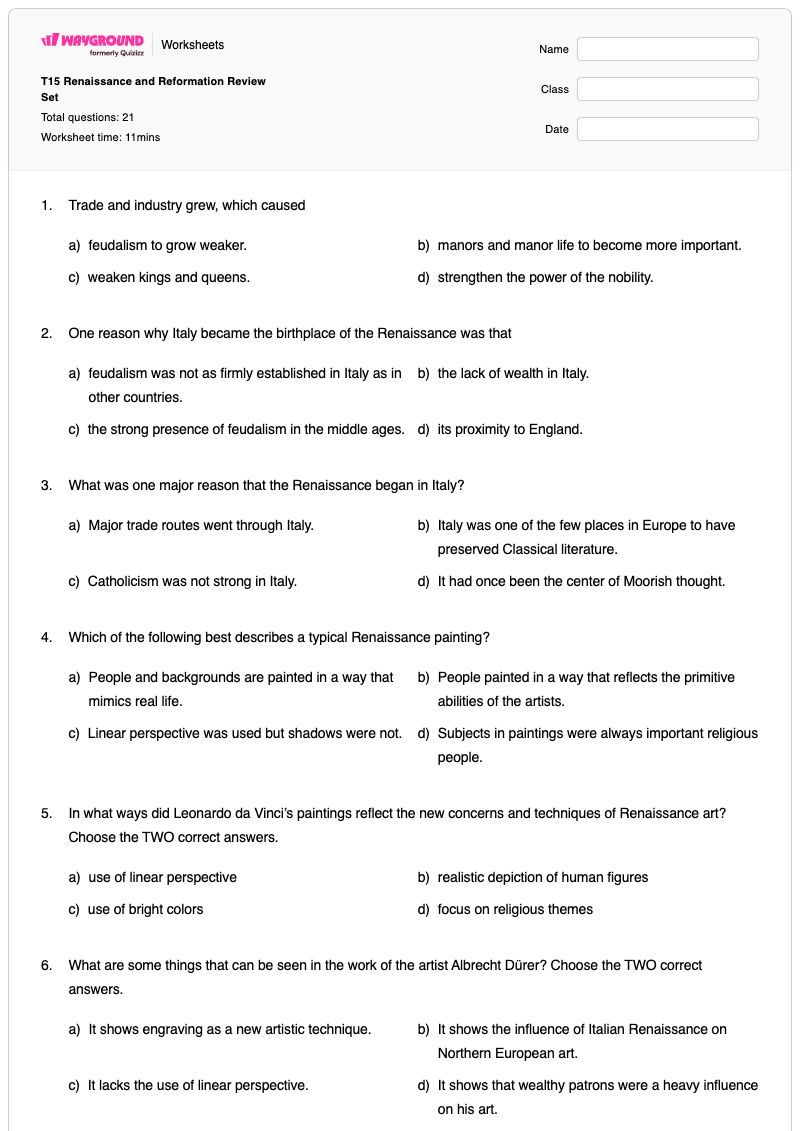
1.
Trade and industry grew, which caused
a)
feudalism to grow weaker.
b)
manors and manor life to become more important.
c)
weaken kings and queens.
d)
strengthen the power of the nobility.
2.
One reason why Italy became the birthplace of the Renaissance was that
a)
feudalism was not as firmly established in Italy as in other countries.
b)
the lack of wealth in Italy.
c)
the strong presence of feudalism in the middle ages.
d)
its proximity to England.
3.
What was one major reason that the Renaissance began in Italy?
a)
Major trade routes went through Italy.
b)
Italy was one of the few places in Europe to have preserved Classical literature.
c)
Catholicism was not strong in Italy.
d)
It had once been the center of Moorish thought.
4.
Which of the following best describes a typical Renaissance painting?
a)
People and backgrounds are painted in a way that mimics real life.
b)
People painted in a way that reflects the primitive abilities of the artists.
c)
Linear perspective was used but shadows were not.
d)
Subjects in paintings were always important religious people.
5.
In what ways did Leonardo da Vinci’s paintings reflect the new concerns and techniques of Renaissance art? Choose the TWO correct answers.
a)
use of linear perspective
b)
realistic depiction of human figures
c)
use of bright colors
d)
focus on religious themes
6.
What are some things that can be seen in the work of the artist Albrecht Dürer? Choose the TWO correct answers.
a)
It shows engraving as a new artistic technique.
b)
It shows the influence of Italian Renaissance on Northern European art.
c)
It lacks the use of linear perspective.
d)
It shows that wealthy patrons were a heavy influence on his art.
7.
How did growing secularism influence European writers during the Renaissance?
a)
They wrote more books about non-religious subjects.
b)
They wrote more religious books than ever before.
c)
The Church supported more secular writers.
d)
Europe became more religiously focused.
8.
What was one of the effects of Gutenberg’s invention of moveable type/the printing press?
a)
Literacy increases among ordinary people.
b)
Literacy is unaffected among ordinary people.
c)
More monks are put to work as scribes.
d)
The spread of Protestantism slows.
9.
Which of the following are ideas from Luther's 95 Theses? Choose the TWO correct answers.
a)
The sale of indulgences leads to corruption.
b)
God alone can grant salvation to sinners.
c)
Church tradition is a source of religious truth.
d)
Only through isolation from the secular world can God be found.
10.
Why is William Tyndale an important figure in Reformation history?
a)
His translation allowed people to read the Bible in English.
b)
He was the first person to highlight the corruption of the Catholic Church.
c)
He personally ended the sale of indulgences.
d)
He first proposed the idea of predestination.
11.
What was the chief goal of the Jesuits during the Counter-Reformation?
a)
reform the Catholic Church
b)
support Protestants
c)
to create an army of God
d)
root out heresy
12.
What meeting of Church authorities did the Catholic Church arrange to try to stop the spread of Protestant ideas?
a)
The Council of Trent
b)
The Peace of Augsburg
c)
The Nicene Creed
d)
The Council of Worms
13.
How did the Peace of Augsburg change Germany?
a)
It turned Germany into a group of states that followed different religions.
b)
It unified Germany in favor of the Catholic Church.
c)
It unified Germany in favor of the Protestant Church.
d)
It put Germany under direct control of John Calvin and Martin Luther.
14.
What idea that emerged as a result of the Protestant Reformation is also reflected in modern democratic governments?
a)
self-government
b)
the Bible as the only source of truth
c)
inductive reasoning
d)
perpetual dialectics
15.
The astronomer Copernicus challenged traditional beliefs by suggesting that
a)
the Earth revolves around the sun.
b)
the sun revolves around the Earth.
c)
science is more important than religion.
d)
humans shouldn't be curious about the natural world.
16.
What theory, which explains the movement of the planets, did Isaac Newton develop?
a)
gravity
b)
optics
c)
trajectory
d)
relativity
17.
Francis Bacon’s contribution to the development of the scientific method was
a)
using specific facts to make general rules.
b)
rediscovering the ideas of the ancient Greeks.
c)
measuring the size and shape of clouds.
d)
connecting science and religion.
18.
What inspired Renaissance thinkers to become interested in humanism?
a)
an increased interest in classical Greek and Roman thought
b)
interest in the traditions of the Catholic Church
c)
the thoughts and ideas of monastic reformer Benedict
d)
the influence of Ignatius Loyola and other Jesuits
19.
What technique did Renaissance architects use to design structures there were balanced and pleasing?
a)
proportion
b)
the golden ratio
c)
linear perspective
d)
chiaroscuro
20.
On what is the architectural technique known as "proportion" based?
a)
Proportion is based on the principles of classical mathematics and relies on simple geometric forms and borrowed elements from classic Greek and Roman architecture.
b)
Proportion is based on the combined use of glass and iron in the eighteenth century and can be seen developing as early as the seventeenth century.
c)
Proportion is the method of creating framed structures of heavy timber jointed together with various joints.
d)
Proportion is a style of wood-house building that uses long, vertical 2" x 4"s for the exterior walls.
21.
What are two ways the Catholic church tried to stop the spread of Protestantism? Choose the TWO correct answers.
a)
Many Protestants were questioned and killed during the Spanish Inquisition.
b)
The Catholic Church banned several books explaining Protestant ideas.
c)
Catholic scholars debated and won against Protestant thinkers in a series of Lincoln-Douglas debates.
d)
Selling Catholic land owned in Protestant countries.
Waygroundแป้นคำตอบ

T15 Renaissance and Reformation Review Set

คำถามทั้งหมด: 21

1.
a) feudalism to grow weaker.
2.
a) feudalism was not as firmly established in Italy as in other countries.
3.
a) Major trade routes went through Italy.
4.
a) People and backgrounds are painted in a way that mimics real life.
5.
a) use of linear perspective, b) realistic depiction of human figures
6.
a) It shows engraving as a new artistic technique., b) It shows the influence of Italian Renaissance on Northern European art.
7.
a) They wrote more books about non-religious subjects.
8.
a) Literacy increases among ordinary people.
9.
a) The sale of indulgences leads to corruption., b) God alone can grant salvation to sinners.
10.
a) His translation allowed people to read the Bible in English.
11.
a) reform the Catholic Church
12.
a) The Council of Trent
13.
a) It turned Germany into a group of states that followed different religions.
14.
a) self-government
15.
a) the Earth revolves around the sun.
16.
a) gravity
17.
a) using specific facts to make general rules.
18.
a) an increased interest in classical Greek and Roman thought
19.
a) proportion
20.
a) Proportion is based on the principles of classical mathematics and relies on simple geometric forms and borrowed elements from classic Greek and Roman architecture.
21.
a) Many Protestants were questioned and killed during the Spanish Inquisition., b) The Catholic Church banned several books explaining Protestant ideas.

คำถามที่พบบ่อย

ชุดหนังสือทบทวน T15 ยุคเรเนสซองส์และการปฏิรูปศาสนา ครอบคลุมเนื้อหาอะไรบ้าง?

แบบฝึกหัดวิชาสังคมศึกษา ชั้น ม.1 นี้ ทบทวนว่าการค้า ศิลปะยุคเรเนสซองส์และมนุษยนิยม แท่นพิมพ์ และแนวคิดการปฏิรูปศาสนา เปลี่ยนแปลงสังคมยุโรปอย่างไร แบบฝึกหัดนี้มีคำถามแบบเลือกตอบ 17 ข้อ และคำถามแบบเลือกตอบหลายข้อ 4 ข้อ โดยให้นักเรียนระบุสาเหตุ จดจำลักษณะต่างๆ เช่น ทัศนียภาพเชิงเส้นและรูปทรงที่เหมือนจริง และเชื่อมโยงบุคคลและเหตุการณ์ต่างๆ—รวมถึงลูเธอร์ ไทน์เดล สภาเทรนต์ สนธิสัญญาออกส์บูร์ก และโคเปอร์นิคัส—เข้ากับผลกระทบทางประวัติศาสตร์

ฉันจะใช้แบบฝึกหัดนี้ในการสอนแนวคิดเกี่ยวกับยุคเรเนสซองส์และการปฏิรูปศาสนาได้อย่างไร?

ใช้คำถามเหล่านี้หลังจากสอนลำดับเหตุการณ์สำคัญในบทเรียน ได้แก่ การค้าที่เติบโตขึ้นทำให้ระบบศักดินาอ่อนแอลง นวัตกรรมในยุคเรเนสซองส์แพร่กระจายผ่านงานศิลปะและการพิมพ์ และการวิพากษ์วิจารณ์ทางศาสนามีส่วนทำให้เกิดการปฏิรูปศาสนา ให้นักเรียนอธิบายว่าเหตุใดคำตอบที่เลือกแต่ละข้อจึงสอดคล้อง จากนั้นใช้คำถามแบบเลือกตอบหลายข้อเกี่ยวกับดาวินชี ดือเรอร์ และข้อเสนอ 95 ข้อของลูเทอร์ เพื่อเปรียบเทียบหลักฐานแทนที่จะทบทวนแบบท่องจำธรรมดา

ฉันควรสังเกตข้อผิดพลาดอะไรบ้างเมื่อนักเรียนทำแบบฝึกหัดนี้เสร็จ?

สังเกตนักเรียนที่เลือกคำตอบเพียงข้อเดียวในข้อสอบแบบเลือกหลายข้อ โดยเฉพาะคำถามที่ต้องการลักษณะเด่นสองประการของผลงานของดาวินชี ลักษณะเด่นสองประการของงานศิลปะของดือเรอร์ หรือแนวคิดสองประการจากข้อเสนอ 95 ข้อของลูเทอร์ นักเรียนอาจสับสนระหว่างเหตุการณ์ที่เกี่ยวข้องกัน เช่น สภาเทรนต์กับสนธิสัญญาเอาส์บวร์ก หรือกลับคำกล่าวอ้างของโคเปอร์นิคัสเกี่ยวกับโลกและดวงอาทิตย์ ขอให้นักเรียนระบุบุคคล เหตุการณ์ หรือผลกระทบที่เฉพาะเจาะจงที่กล่าวถึงในแต่ละคำถาม

ฉันจะมอบหมายและให้คะแนนแบบฝึกหัดเรื่องยุคเรเนสซองส์และการปฏิรูปศาสนานี้อย่างไร?

แบบฝึกหัดนี้มีให้ดาวน์โหลดบน Wayground ในรูปแบบไฟล์ PDF ที่สามารถพิมพ์ได้ และในรูปแบบแบบทดสอบดิจิทัล โดยมีเฉลยคำตอบครบถ้วนสำหรับทั้ง 21 ข้อ สำหรับการส่งงานแบบพิมพ์ คุณสามารถสแกนงานของนักเรียนด้วยแอป Wayground for Teachers เพื่อใช้ในการตรวจและให้คะแนนได้

ฉันจะแยกแยะแบบฝึกหัดทบทวนยุคเรเนสซองส์และการปฏิรูปศาสนานี้ได้อย่างไร?

ในการตั้งค่าขั้นสูงของแบบฝึกหัด ให้ปรับระยะห่างระหว่างตัวอักษรหรือขนาดตัวอักษรเพื่อให้คำถามและตัวเลือกคำตอบทางประวัติศาสตร์อ่านง่ายขึ้น นอกจากนี้ คุณยังสามารถใช้แบบอักษรที่เหมาะสำหรับผู้ที่มีภาวะดิสเล็กเซีย หรือแปลข้อสอบแบบเลือกตอบและเลือกหลายข้อเป็นภาษาอื่นโดยยังคงรูปแบบการทบทวนของแบบฝึกหัดไว้ได้

ฉันจะหาแบบฝึกหัดแบบนี้เพิ่มเติมได้ที่ไหนบน Wayground?

Wayground มีแบบฝึกหัดและโจทย์ฝึกหัดมากมายให้ดาวน์โหลดฟรีในหลากหลายวิชา พร้อมไฟล์ PDF และเฉลยคำตอบ เพื่อช่วยให้นักเรียนพัฒนาทักษะและความเข้าใจในแนวคิดสำคัญๆ ดูแหล่งข้อมูลเพิ่มเติมได้ที่ https://wayground.com/en-us/worksheets