

Wayground
Minerals, Rocks, and Soils - Printable Science Worksheets ระดับ 3 - Wayground

Minerals, Rocks, and Soils

16 คำถาม

3rd - ชั้นประถมศึกษาปีที่ 3

Science

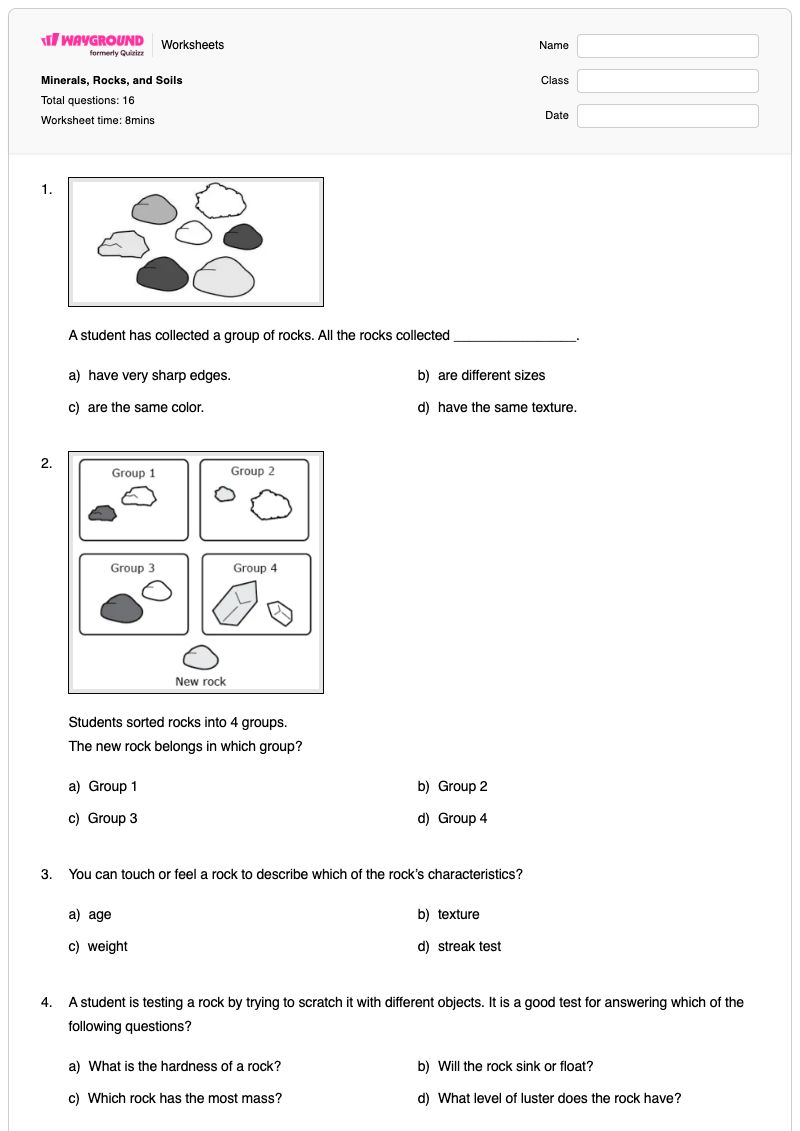
แบบฝึกหัดวิทยาศาสตร์สำหรับชั้นประถมศึกษาปีที่ 3 เรื่อง แร่ธาตุ หิน และดิน ประกอบด้วยคำถามแบบเลือกตอบ 16 ข้อ ที่ช่วยให้นักเรียนระบุและเปรียบเทียบคุณสมบัติที่สังเกตได้ของหินและดิน นักเรียนจะจำแนกหินตามขนาด เนื้อสัมผัส และความมันวาว เชื่อมโยงการทดสอบการขูดกับความแข็ง และแยกแยะประเภทของดิน เช่น ทราย ดินเหนียว ตะกอน และดินร่วน โดยพิจารณาจากความรู้สึกและลักษณะที่รองรับการเจริญเติบโตของพืช แบบฝึกหัดนี้ยังให้นักเรียนนำหลักฐานเกี่ยวกับการผุพังและการกัดเซาะมาประยุกต์ใช้ พวกเขาจะวิเคราะห์ว่าลม คลื่น และน้ำที่เคลื่อนที่เปลี่ยนแปลงหิน ทราย และดินอย่างไร รวมถึงการก่อตัวของซุ้มหิน อนุภาคชายหาด ริ้วคลื่น เนินทราย และการเคลื่อนตัวของดินลงเนิน แบบฝึกหัดนี้สามารถพิมพ์ได้ฟรี พร้อมเฉลยคำตอบครบถ้วน เหมาะสำหรับการฝึกฝน ทบทวน หรือประเมินผลวิชาวิทยาศาสตร์ชั้นประถมศึกษาปีที่ 3

การตั้งค่าแผ่นงาน

ขนาดตัวอักษร

S
M
L
XL
แผ่นงาน

Minerals, Rocks, and Soils

คำถามทั้งหมด: 16

ชื่อ
ระดับ
วันที่
1.

A student has collected a group of rocks. All the rocks collected ________________.

a)

have very sharp edges.

b)

are different sizes

c)

are the same color.

d)

have the same texture.

2.

Students sorted rocks into 4 groups.

The new rock belongs in which group?

a)

Group 1

b)

Group 2

c)

Group 3

d)

Group 4

3.

You can touch or feel a rock to describe which of the rock’s characteristics?

a)

age

b)

texture

c)

weight

d)

streak test

4.

A student is testing a rock by trying to scratch it with different objects. It is a good test for answering which of the following questions?

a)

What is the hardness of a rock?

b)

Will the rock sink or float?

c)

Which rock has the most mass?

d)

What level of luster does the rock have?

5.

The chart shows some properties of four different rocks.


Which of the following rocks can be grouped together using their luster?

a)

1 and 2

b)

2 and 4

c)

1 and 3

d)

3 and 4

6.

A student is investigating the textures of soils. Which soil feels the roughest?

a)

clay

b)

sand

c)

dirt

d)

silt

7.

Sophia is blindfolded. She feels a soil. It feels powdery, soft, and she cannot feel any particles in between her fingers. What soil is she most likely feeling?

a)

sand

b)

loam

c)

clay

d)

rock

8.

Which is the best type of soil for growing vegetables?

a)

sand

b)

clay

c)

loam

d)

silt

9.

Which type of soil feels smooth when you rub it between your fingers?

a)

sand

b)

humus

c)

clay

d)

loam

10.

Use the picture to answer the following question

Which statement explains how the features MOST LIKELY formed?

a)

Workers blasted the rock to create a road

b)

An artist carved the rock to see the beautiful view.

c)

Wind made the arch by weathering rock.

d)

Water formed the river by weathering rock.

11.

Which BEST describes the action of wind and waves on a beach?

a)

They decrease the size of the sand particles.

b)

They have no effect on rocks on the beach.

c)

They increase the hardness of rocks on the beach.

12.

When water runs down a hill of loose soil, it will cause what change to the soil?

a)

Soil from the top of the hill will be moved to the bottom.

b)

The hill will collect more soil and become taller.

c)

The particles of the soil will come together to make rocks.

d)

The solid particles of soil will melt and flow up the hill.

13.

Students observed that in one corner of the playground was a patch of smooth, flat soil. After several days, they noticed that ripples had formed across the sand. What was the most likely cause of this change?

a)

Wind blowing

b)

Ice freezing

c)

Water moving

d)

Snow falling

14.

What happens when strong winds blow sand against large rocks?

a)

The rock grows much bigger.

b)

The rock starts to melt.

c)

Tiny pieces of rock break off.

d)

Plants grow on top of the rock.

15.

Dunes are large piles of sand that move slowly on beaches. What causes the dunes to move from place to place?

a)

Rushing rivers

b)

Blowing winds

c)

Freezing water

d)

Breaking rock

16.

A sharp, jagged rock falls into a fast-moving river. How will the moving water change the rock over time?

a)

The rock will get smoother.

b)

The rock will get heavier.

c)

The rock will melt.

d)

The rock will get bigger.

แป้นคำตอบ

Minerals, Rocks, and Soils

คำถามทั้งหมด: 16

1.
b)

are different sizes

2.
c)

Group 3

3.
b)

texture

4.
a)

What is the hardness of a rock?

5.
b)

2 and 4

6.
b)

sand

7.
c)

clay

8.
c)

loam

9.
c)

clay

10.
c)

Wind made the arch by weathering rock.

11.
a)

They decrease the size of the sand particles.

12.
a)

Soil from the top of the hill will be moved to the bottom.

13.
a)

Wind blowing

14.
c)

Tiny pieces of rock break off.

15.
b)

Blowing winds

16.
a)

The rock will get smoother.

คำถามที่พบบ่อย

แบบฝึกหัดเรื่อง แร่ธาตุ หิน และดิน ครอบคลุมเนื้อหาอะไรบ้าง?

แบบฝึกหัดวิทยาศาสตร์สำหรับชั้นประถมศึกษาปีที่ 3 นี้ ประกอบด้วยคำถามแบบเลือกตอบ 16 ข้อ เพื่อประเมินคุณสมบัติของหิน เนื้อสัมผัสและประเภทของดิน และการผุพังและการกัดเซาะ นักเรียนจะต้องตีความสิ่งที่สังเกตได้ เช่น เนื้อสัมผัส ความแข็ง หรือความมันวาวของหิน ระบุทราย ดินเหนียว และดินร่วนจากคำอธิบาย และอธิบายว่าลมและน้ำเคลื่อนย้ายหรือกัดเซาะวัสดุบนโลกได้อย่างไร

ฉันจะใช้แบบฝึกหัดนี้ในการสอนเรื่องคุณสมบัติของหิน ประเภทของดิน และการผุพังได้อย่างไร?

เริ่มแบบฝึกหัดโดยให้นักเรียนสังเกตหรือสัมผัสตัวอย่างหินและดิน จากนั้นอภิปรายคุณสมบัติต่างๆ เช่น เนื้อสัมผัส ความแข็ง ความมันวาว และขนาดอนุภาค ขณะที่นักเรียนทำแบบฝึกหัดแบบเลือกตอบ ให้พวกเขาอธิบายคำตอบพร้อมหลักฐาน เช่น ทำไมการขูดจึงเป็นการทดสอบความแข็ง ทำไมดินร่วนจึงปลูกพืชได้ หรือลมทำให้เกิดริ้วคลื่น เนินทราย และลักษณะหินผุกร่อนได้อย่างไร

ฉันควรสังเกตข้อผิดพลาดอะไรบ้างเมื่อนักเรียนทำแบบฝึกหัดนี้เสร็จ?

นักเรียนอาจสับสนระหว่างคุณสมบัติของดินกับวิธีการทดสอบที่ใช้สังเกต เช่น เลือกใช้การทดสอบรอยขีดแทนการทดสอบเนื้อสัมผัสเมื่ออธิบายสิ่งที่พวกเขาสัมผัสได้ นอกจากนี้ พวกเขาอาจสับสนระหว่างประเภทของดิน โดยเฉพาะดินเหนียว ดินทราย และดินร่วน หรืออาจกล่าวถึงผลกระทบของลมและน้ำในทางตรงกันข้าม โดยบอกว่าการกัดเซาะทำให้ดินเพิ่มขึ้นบนยอดเขาแทนที่จะเคลื่อนดินลงเนิน

ฉันจะมอบหมายและให้คะแนนแบบฝึกหัดนี้อย่างไร?

แบบฝึกหัดนี้มีให้เลือกทั้งในรูปแบบไฟล์ PDF ที่สามารถพิมพ์ได้ และแบบทดสอบดิจิทัลบน Wayground คุณจึงสามารถเลือกรูปแบบที่เหมาะสมกับบทเรียนวิทยาศาสตร์ชั้นประถมศึกษาปีที่ 3 ของคุณได้ แบบฝึกหัดนี้มีเฉลยคำตอบครบถ้วน และสามารถตรวจงานของนักเรียนได้โดยการสแกนงานของนักเรียนด้วยแอป Wayground for Teachers

ฉันจะปรับแบบฝึกหัดเรื่องหิน ดิน และการผุกร่อนให้เหมาะสมกับนักเรียนแต่ละคนได้อย่างไร?

ใช้การตั้งค่าขั้นสูงของแบบฝึกหัดเพื่อปรับระยะห่างระหว่างตัวอักษรหรือเพิ่มขนาดตัวอักษร เพื่อให้ตัวเลือกแบบปรนัยและสถานการณ์ทางวิทยาศาสตร์อ่านง่ายขึ้น นอกจากนี้ คุณยังสามารถเปิดใช้งานแบบอักษรที่เหมาะสำหรับผู้ที่มีภาวะดิสเล็กเซีย หรือแปลแบบฝึกหัดเป็นภาษาอื่นเพื่อช่วยให้เข้าถึงคำถามเกี่ยวกับคุณสมบัติของหิน ประเภทของดิน และการผุพังได้ง่ายขึ้น

ฉันจะหาแบบฝึกหัดแบบนี้เพิ่มเติมได้ที่ไหนบน Wayground?

Wayground นำเสนอชุดแบบฝึกหัดและโจทย์ฝึกหัดฟรีที่ครอบคลุมหลากหลายวิชา พร้อมไฟล์ PDF และเฉลยคำตอบ เพื่อช่วยให้นักเรียนเชี่ยวชาญทักษะและแนวคิดที่สำคัญ ดูแหล่งข้อมูลเพิ่มเติมได้ที่ https://wayground.com/en-us/worksheets