


Wayground
Osmosis diffusion  - Printable ศาสตร์ Worksheets ระดับ 10 - Wayground

Osmosis diffusion

Michelle McConnell

By Michelle McConnell

20 คำถาม

10th - 10th ระดับชั้น

ศาสตร์

อัปเดตแล้ว ก.ย. 2566

แบบฝึกหัดวิทยาศาสตร์ ม.4 นี้ช่วยเสริมสร้างความเข้าใจเกี่ยวกับออสโมซิส การแพร่ และการขนส่งผ่านเยื่อหุ้มเซลล์ ผ่านคำถาม 20 ข้อ: 1 ข้อเติมคำในช่องว่าง และ 19 ข้อเลือกตอบ นักเรียนจะได้เรียนรู้เกี่ยวกับระดับขององค์ประกอบทางชีวภาพ นิยามการแพร่ว่าเป็นการเคลื่อนที่จากความเข้มข้นสูงไปยังความเข้มข้นต่ำโดยไม่ใช้ ATP แยกแยะความแตกต่างระหว่างการขนส่งแบบพาสซีฟและแบบแอคทีฟ และกำหนดวิธีการที่โมเลกุลเคลื่อนที่ผ่านเยื่อหุ้มเซลล์ที่เลือกผ่านได้ แบบฝึกหัดนี้ยังใช้สถานการณ์ในห้องปฏิบัติการและผลการทดสอบเพื่อเชื่อมโยงแนวคิดกับหลักฐาน นักเรียนจะตีความการทดสอบตัวบ่งชี้แป้งและกลูโคส ระบุสารที่สามารถผ่านเยื่อหุ้มเซลล์ได้ รู้จักสมดุล อธิบายว่าทำไมแป้งจึงมีขนาดใหญ่เกินกว่าจะผ่านเยื่อหุ้มเซลล์ได้ และแยกแยะความแตกต่างระหว่างโมเลกุลอินทรีย์กับน้ำ แบบฝึกหัดนี้สามารถพิมพ์ได้ฟรีพร้อมเฉลย เหมาะสำหรับใช้ในการสอน ทบทวน หรือประเมินผลวิชาวิทยาศาสตร์ ม.4

การตั้งค่าแผ่นงาน

ขนาดตัวอักษร

S
M
L
XL
Waygroundแผ่นงาน

Osmosis diffusion

คำถามทั้งหมด: 20

ชื่อ
ระดับ
วันที่
1.

Organelle, cell, (a)   , organ, organ system, organism

2.

Diffusion is the movement of molecules from an area of

a)

high to low concentration; no energy used.

b)

low to high concentration; no energy used.

c)

low to high concentration; ATP energy used

d)

high to low concentration; ATP energy used

3.
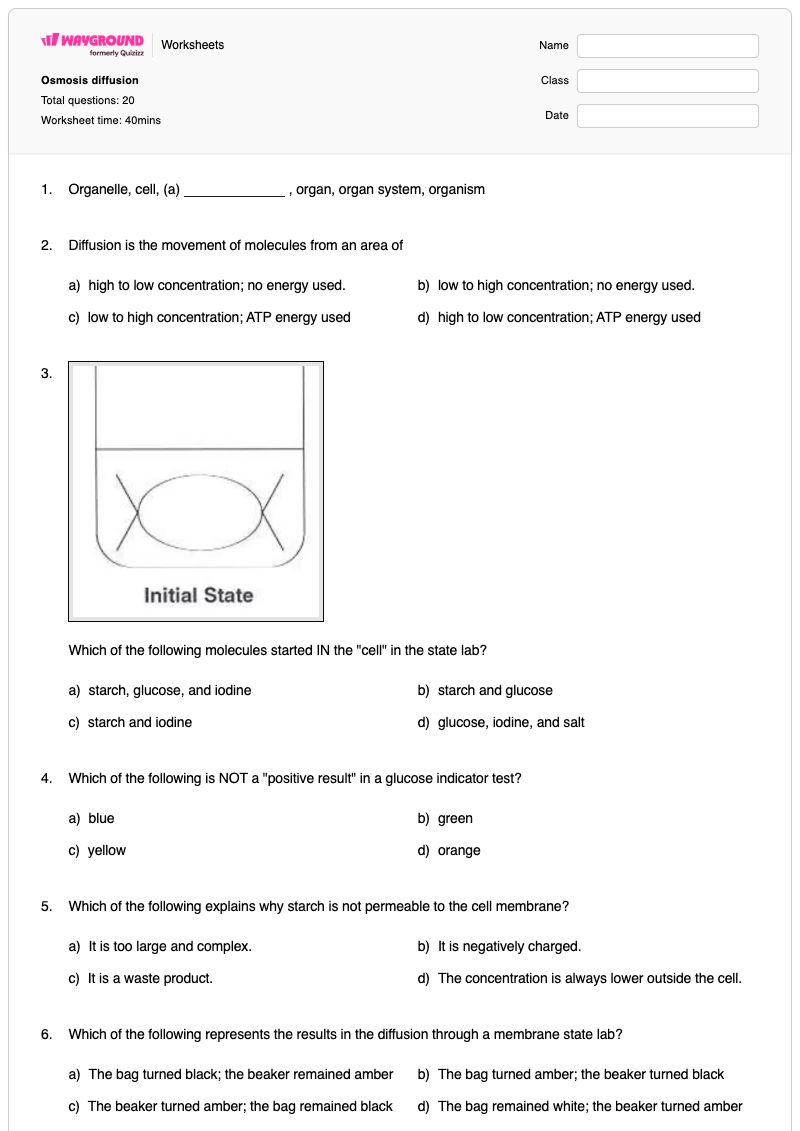
Which of the following molecules started IN the "cell" in the state lab?

Which of the following molecules started IN the "cell" in the state lab?

a)

starch, glucose, and iodine

b)

starch and glucose

c)

starch and iodine

d)

glucose, iodine, and salt

4.

Which of the following is NOT a "positive result" in a glucose indicator test?

a)

blue

b)

green

c)

yellow

d)

orange

5.

Which of the following explains why starch is not permeable to the cell membrane?

a)

It is too large and complex.

b)

It is negatively charged.

c)

It is a waste product.

d)

The concentration is always lower outside the cell.

6.

Which of the following represents the results in the diffusion through a membrane state lab?

a)

The bag turned black; the beaker remained amber

b)

The bag turned amber; the beaker turned black

c)

The beaker turned amber; the bag remained black

d)

The bag remained white; the beaker turned amber

7.
Identify the SUBSTANCE and the PROCESS that caused the change shown

Identify the SUBSTANCE and the PROCESS that caused the change shown

a)

ATP; Active Transport

b)

Salt water; Omsosis

c)

Distilled water; Osmosis

d)

ATP; Passive Transport

8.
Which of the following could be represented by X?

Which of the following could be represented by X?

a)

Transports molecules across the membrane

b)

Requires the use of ATP energy

c)

Movement from high to low concentration

d)

Movement from low to high concentration

9.
Which molecule is in equilibrium (equally concentrated inside and outside of the cell)?

Which molecule is in equilibrium (equally concentrated inside and outside of the cell)?

a)

A

b)

B

c)

C

10.
Where is B most likely to diffuse and why?

Where is B most likely to diffuse and why?

a)

Out of the cell, b/c there is a higher conc. inside.

b)

Into the the cell, b/c there is a higher conc. inside.

c)

Into the the cell, b/c there is a lower conc. outside.

d)

Out of the cell, b/c there is a lower conc. inside.

11.
Active transport would be required to transport molecule B

Active transport would be required to transport molecule B

a)

Into the cell

b)

Out of the cell

12.

When is active transport used by a cell?

a)

When the cell wants to maintain a high or low concentration.

b)

When the cell becomes highly concentrated with water

c)

In a salt water environment

d)

In a distilled water environment

13.

Which of the following does NOT describe the cell membrane?

a)

It is selectively permeable

b)

It is responsible for waste removal

c)

Gases are exchanged here

d)

It contains receptor molecules to receive messages

e)

It is only found in plant cells

14.

In a positive test for starch, iodine reacts and turns

a)

Black

b)

Light blue

c)

Amber

d)

Greene

15.

Which of the following is NOT an organic molecule?

a)

Starch

b)

DNA

c)

Glucose

d)

Water

16.

Which of the following is LEAST likely to be permeable to the cell membrane?

a)

Water

b)

Oxygen

c)

Carbon dioxide

d)

Glucose

e)

Protein

17.

Which of the following molecules is able to diffuse through the cell membrane?

a)

Carbon dioxide

b)

Protein

c)

Starch

d)

Polymers

18.

Which organelle is NOT correctly paired with its function?

a)

Vacuole- storage

b)

Cell membrane- waste removal

c)

Ribosome- protein synthesis

d)

Cytoplasm- Photosynthesis

e)

Mitochondria- energy production

19.

Which of the following explains why plant cells are less likely to burst in distilled water?

a)

Plant contain a cell wall for support and structure

b)

Plant cells are unable to perform osmosis.

c)

Plant cells contain vacuoles and chloroplasts

d)

Plant cells have a rigid cell membrane and a square shape.

20.
Explain why the bag shriveled in the beaker with 80% water and 20% starch.

Explain why the bag shriveled in the beaker with 80% water and 20% starch.

a)

Water moved from high to low concentration.

b)

Water moved from low to high concentration.

c)

Starch moved from high to low concentration.

d)

Starch moved from low to high concentration.

Waygroundแป้นคำตอบ

Osmosis diffusion

คำถามทั้งหมด: 20

1.
tissue
2.
a)

high to low concentration; no energy used.

3.
b)

starch and glucose

4.
a)

blue

5.
a)

It is too large and complex.

6.
a)

The bag turned black; the beaker remained amber

7.
b)

Salt water; Omsosis

8.
a)

Transports molecules across the membrane

9.
a)

A

10.
a)

Out of the cell, b/c there is a higher conc. inside.

11.
a)

Into the cell

12.
a)

When the cell wants to maintain a high or low concentration.

13.
e)

It is only found in plant cells

14.
a)

Black

15.
d)

Water

16.
e)

Protein

17.
a)

Carbon dioxide

18.
d)

Cytoplasm- Photosynthesis

19.
a)

Plant contain a cell wall for support and structure

20.
a)

Water moved from high to low concentration.

คำถามที่พบบ่อย

แบบฝึกหัดเรื่องการแพร่แบบออสโมซิสครอบคลุมหัวข้ออะไรบ้าง?

แบบฝึกหัดสำหรับนักเรียนชั้น ม.4 นี้ครอบคลุมเรื่องการแพร่ การออสโมซิส การขนส่งแบบพาสซีฟ การขนส่งแบบแอคทีฟ สมดุล และการซึมผ่านของเยื่อหุ้มเซลล์แบบเลือกได้ แบบฝึกหัดประกอบด้วยข้อเติมคำในช่องว่าง 1 ข้อ และข้อเลือกตอบ 19 ข้อ ซึ่งจะทดสอบให้นักเรียนประยุกต์ใช้กฎความเข้มข้น-ความชัน ตีความสถานการณ์ของเซลล์และเยื่อหุ้มเซลล์ และใช้ผลการทดสอบตัวบ่งชี้แป้งและกลูโคสจากห้องปฏิบัติการของรัฐ

ฉันจะใช้แบบฝึกหัดนี้สอนเรื่องออสโมซิสและการแพร่ได้อย่างไร?

แนะนำการแพร่กระจายว่าเป็นกระบวนการเคลื่อนที่จากบริเวณที่มีความเข้มข้นสูงไปยังบริเวณที่มีความเข้มข้นต่ำโดยไม่ใช้ ATP จากนั้นเปรียบเทียบกับการขนส่งแบบแอคทีฟ ซึ่งใช้พลังงานในการเคลื่อนย้ายสารต่างๆ ไปในทิศทางตรงกันข้ามกับความเข้มข้น ใช้คำถามในแบบฝึกหัดเพื่อให้นักเรียนคาดเดาว่าสารใดบ้างที่สามารถผ่านเยื่อหุ้มเซลล์ได้ และเปรียบเทียบการคาดเดาเหล่านั้นกับผลการทดสอบจากถุง บีกเกอร์ แป้ง ไอโอดีน และกลูโคส ก่อนที่จะมอบหมายงานทดสอบทั้งหมด

ฉันควรระวังข้อผิดพลาดอะไรบ้างเมื่อนักเรียนทำแบบฝึกหัดเรื่องออสโมซิสและการแพร่?

ระวังนักเรียนที่กลับทิศทางการแพร่ หรือมองว่าการขนส่งผ่านเยื่อหุ้มเซลล์ทั้งหมดเป็นการขนส่งแบบแอคทีฟ นอกจากนี้ พวกเขาอาจสับสนระหว่างสมดุลกับการไม่มีโมเลกุล สันนิษฐานว่าแป้งสามารถผ่านได้เพราะมีอยู่ในห้องปฏิบัติการ หรืออ่านผลการทดสอบด้วยตัวบ่งชี้ผิดพลาด โดยเลือกสีน้ำเงินสำหรับการทดสอบกลูโคสที่เป็นบวก หรือสีเหลืองอำพันสำหรับการทดสอบแป้งที่เป็นบวก แทนที่จะใช้ผลลัพธ์ที่กำหนดไว้ในแบบฝึกหัด

ฉันจะมอบหมายและตรวจงานเรื่องออสโมซิสและการแพร่ได้อย่างไร?

บน Wayground คุณสามารถกำหนดให้เป็นแบบทดสอบดิจิทัล หรือดาวน์โหลดไฟล์ PDF ที่พิมพ์ได้เพื่อให้นักเรียนทำบนกระดาษ แบบฝึกหัดนี้มีเฉลยคำตอบครบถ้วน และสามารถตรวจให้คะแนนงานที่ส่งมาโดยการสแกนงานของนักเรียนด้วยแอป Wayground for Teachers ได้

ฉันจะปรับแบบฝึกหัดเรื่องออสโมซิสและการแพร่ให้เหมาะสมกับนักเรียนของฉันได้อย่างไร?

ใช้การตั้งค่าขั้นสูงของแบบฝึกหัดเพื่อปรับระยะห่างระหว่างตัวอักษรหรือขนาดตัวอักษร เพื่อให้สถานการณ์ความเข้มข้น ตัวเลือกผลการทดลอง และลำดับการเติมคำในช่องว่างอ่านง่ายขึ้น นอกจากนี้ คุณยังสามารถเปิดใช้งานแบบอักษรที่เหมาะสำหรับผู้ที่มีภาวะดิสเล็กเซีย หรือแปลแบบฝึกหัดเป็นภาษาอื่นได้ หากตัวเลือกเหล่านั้นช่วยให้เข้าถึงเนื้อหาเกี่ยวกับการขนส่งผ่านเยื่อหุ้มเซลล์ได้ดีขึ้น

ฉันจะหาแบบฝึกหัดแบบนี้เพิ่มเติมได้ที่ไหนบน Wayground?

Wayground นำเสนอชุดแบบฝึกหัดและโจทย์ฝึกหัดฟรีที่ครอบคลุมหลากหลายวิชา พร้อมไฟล์ PDF และเฉลยคำตอบ เพื่อช่วยให้นักเรียนเชี่ยวชาญทักษะและแนวคิดที่สำคัญ ดูแหล่งข้อมูลเพิ่มเติมได้ที่ https://wayground.com/en-us/worksheets