

Wayground
Civics SOL Review CE.11 - Printable History Worksheets - Wayground

Civics SOL Review CE.11

20 คำถาม

8th - 8th ระดับชั้น

History

แบบฝึกหัดวิชาพลเมืองศึกษา SOL CE.11 สำหรับนักเรียนชั้น ม.2 ทบทวนแนวคิดทางเศรษฐศาสตร์พื้นฐานในวิชาพลเมืองและการปกครอง นักเรียนจะได้ฝึกฝนการแยกแยะความขาดแคลน ทรัพยากร การเลือก ต้นทุนค่าเสียโอกาส การบริโภค และการผลิต ระบุคำถามทางเศรษฐศาสตร์พื้นฐานสามข้อ และเชื่อมโยงความชอบของผู้บริโภคและราคากับการตัดสินใจซื้อ แบบฝึกหัดนี้ยังเปรียบเทียบระบบเศรษฐกิจแบบดั้งเดิม ระบบตลาดเสรี ระบบวางแผน และระบบผสม รวมถึงบทบาทของภาคเอกชนและภาครัฐด้วย แบบฝึกหัดที่พิมพ์ได้ฟรีนี้ประกอบด้วยข้อสอบ 20 ข้อ—7 ข้อเป็นแบบเลือกตอบ และ 13 ข้อเป็นแบบเลือกตอบ—เพื่อตรวจสอบว่านักเรียนสามารถจดจำคำจำกัดความที่ถูกต้อง เลือกคุณลักษณะที่เกี่ยวข้องทั้งหมด และแยกแยะวิธีการตัดสินใจของระบบเศรษฐกิจได้หรือไม่ แบบฝึกหัดนี้สามารถใช้เป็นกิจกรรมทบทวน คู่มือการเรียน หรือการประเมินผลก่อนการสอบวิชาพลเมืองศึกษา SOL ได้ มีเฉลยคำตอบครบถ้วนเพื่อให้ครูสามารถระบุความเข้าใจผิดเกี่ยวกับคำศัพท์ทางเศรษฐศาสตร์ การเป็นเจ้าของทรัพยากร การเลือกของผู้บริโภค และการดำเนินงานของภาครัฐและเอกชนได้อย่างรวดเร็ว

การตั้งค่าแผ่นงาน

ขนาดตัวอักษร

S
M
L
XL
แผ่นงาน

Civics SOL Review CE.11

คำถามทั้งหมด: 20

ชื่อ
ระดับ
วันที่
1.

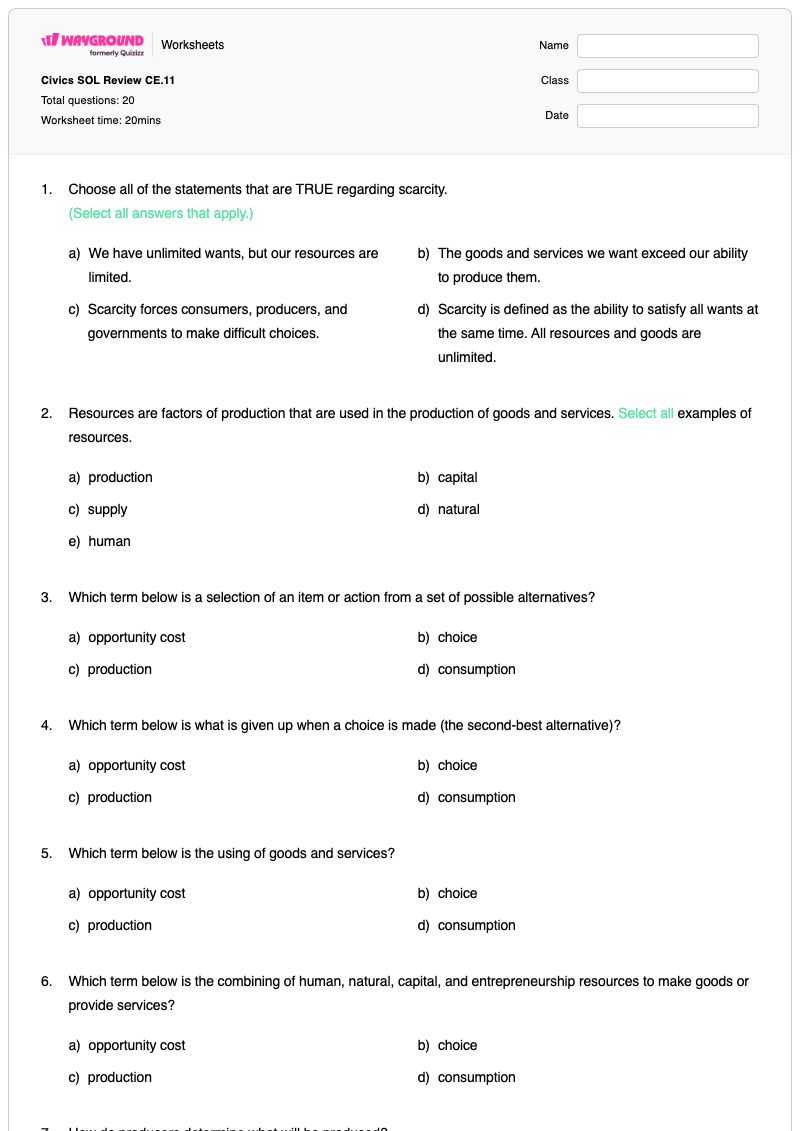
Choose all of the statements that are TRUE regarding scarcity.

(Select all answers that apply.)

a)

We have unlimited wants, but our resources are limited.

b)

The goods and services we want exceed our ability to produce them.

c)

Scarcity forces consumers, producers, and governments to make difficult choices.

d)

Scarcity is defined as the ability to satisfy all wants at the same time. All resources and goods are unlimited.

2.

Resources are factors of production that are used in the production of goods and services. Select all examples of resources.

a)

production

b)

capital

c)

supply

d)

natural

e)

human

3.

Which term below is a selection of an item or action from a set of possible alternatives?

a)

opportunity cost

b)

choice

c)

production

d)

consumption

4.

Which term below is what is given up when a choice is made (the second-best alternative)?

a)

opportunity cost

b)

choice

c)

production

d)

consumption

5.

Which term below is the using of goods and services?

a)

opportunity cost

b)

choice

c)

production

d)

consumption

6.

Which term below is the combining of human, natural, capital, and entrepreneurship resources to make goods or provide services?

a)

opportunity cost

b)

choice

c)

production

d)

consumption

7.

How do producers determine what will be produced?

a)

They pay attention to consumer preferences and available resources.

b)

They produce only what the government suggests they produce.

c)

They roll the dice and hope for the best.

8.

Consumer _____ and ____ determine what is purchased and consumed.

a)

supply and demand

b)

income and services

c)

preference and price

9.

What are the three basic questions of economics? (Select 3.)

a)

How will it be produced?

b)

When will it be produced?

c)

Why will it be produced?

d)

For whom will it be produced?

e)

What will be produced?

10.

Which of the following statements are TRUE regarding a traditional economy?

(Select 2.)

a)

Economic decisions are based on supply and demand.

b)

Economic decisions are based on custom and historical precedent.

c)

People often perform the same type of work as their parents and grandparents, regardless of ability or potential.

d)

People choose their careers based on skills and preferences.

11.

Which of the following are characteristics of a

free market economy?

(Select all answers that apply.)

a)

private ownership of property and resources

b)

profit motive and competition

c)

consumer sovereignty and individual choice

d)

lack of consumer choice

e)

minimal government involvement in the economy

12.

Which of the following are characteristics of a

command economy?

(Select all answers that apply.)

a)

profit motive

b)

consumer choice

c)

central ownership of property and resources

d)

centrally-planned economy with little consumer choice

e)

competition

13.

Which of the following are characteristics of a

mixed economy?

(Select all answers that apply.)

a)

In the private sector, individuals and businesses are the owners and decision makers.

b)

In the public sector, individuals and businesses are the owners and decision makers.

c)

In the public sector, the government is the owner and decision maker.

d)

Most economies today, including the U.S. economy, are mixed economies.

e)

In the private sector, the government is the owner and decision maker.

14.

In a mixed economy, which sector operates like a command economy?

a)

public

b)

private

c)

both public and private

15.

In a mixed economy, which sector operates like a free market economy?

a)

public

b)

private

c)

both public and private

16.

The key factor in determining the type of economy a country has is...

a)

the amount of resources owned by the country.

b)

the supply and demand of the consumers.

c)

the price of goods and services.

d)

the extent of government involvement in the economy.

17.

A consumer is like a king. What consumers want, businesses produce. What is the term for "consumer is king"?

a)

consumer poverty

b)

consumer sovereignty

c)

profit motive

d)

consumption

18.

Bob decides to attend college instead of entering the work force right out of high school. He is hoping to increase his future earning power, and in return, is giving up the immediate income and experience of starting work immediately. What is Bob's opportunity cost in this scenario?

a)

immediate income and experience

b)

future earning power

c)

four years of his life

19.

Which type of resource is the person who has the ideas for new businesses?

a)

natural

b)

human

c)

capital

d)

entrepreneurship

20.

Which type of resource is tools, equipment, and investment money?

a)

natural

b)

human

c)

capital

d)

entrepreneurship

แป้นคำตอบ

Civics SOL Review CE.11

คำถามทั้งหมด: 20

1.
a)

We have unlimited wants, but our resources are limited.

, b)

The goods and services we want exceed our ability to produce them.

, c)

Scarcity forces consumers, producers, and governments to make difficult choices.

2.
b)

capital

, d)

natural

, e)

human

3.
b)

choice

4.
a)

opportunity cost

5.
d)

consumption

6.
c)

production

7.
a)

They pay attention to consumer preferences and available resources.

8.
c)

preference and price

9.
e)

What will be produced?

, d)

For whom will it be produced?

, a)

How will it be produced?

10.
c)

People often perform the same type of work as their parents and grandparents, regardless of ability or potential.

, b)

Economic decisions are based on custom and historical precedent.

11.
a)

private ownership of property and resources

, b)

profit motive and competition

, c)

consumer sovereignty and individual choice

, e)

minimal government involvement in the economy

12.
c)

central ownership of property and resources

, d)

centrally-planned economy with little consumer choice

13.
c)

In the public sector, the government is the owner and decision maker.

, d)

Most economies today, including the U.S. economy, are mixed economies.

, a)

In the private sector, individuals and businesses are the owners and decision makers.

14.
a)

public

15.
b)

private

16.
d)

the extent of government involvement in the economy.

17.
b)

consumer sovereignty

18.
a)

immediate income and experience

19.
d)

entrepreneurship

20.
c)

capital

คำถามที่พบบ่อย

แบบฝึกหัดทบทวนวิชาพลเมืองศึกษา SOL CE.11 ครอบคลุมเนื้อหาอะไรบ้าง?

แบบฝึกหัดสำหรับนักเรียนชั้น ม.2 ชุดนี้ ทบทวนเรื่องความขาดแคลน ปัจจัยการผลิต การเลือก ต้นทุนค่าเสียโอกาส การบริโภค การผลิต ความชอบของผู้บริโภค และคำถามพื้นฐานทางเศรษฐศาสตร์ 3 ข้อ แบบฝึกหัดนี้ประกอบด้วยข้อสอบแบบเลือกตอบ 20 ข้อ และยังต้องการให้นักเรียนแยกแยะความแตกต่างระหว่างระบบเศรษฐกิจแบบดั้งเดิม ระบบเศรษฐกิจแบบตลาดเสรี ระบบเศรษฐกิจแบบวางแผนจากส่วนกลาง และระบบเศรษฐกิจแบบผสม รวมถึงระบุว่าการตัดสินใจเป็นของภาครัฐหรือภาคเอกชน

ฉันจะใช้แบบฝึกหัดนี้ในการสอนแนวคิดและระบบทางเศรษฐศาสตร์ได้อย่างไร?

เริ่มด้วยการแนะนำคำศัพท์โดยให้นักเรียนอธิบายว่าความขาดแคลนนำไปสู่ทางเลือกและต้นทุนค่าเสียโอกาสได้อย่างไร จากนั้นใช้แบบฝึกหัดเพื่อตรวจสอบความสัมพันธ์เหล่านั้น หลังจากนั้น ให้นักเรียนจัดเรียงลักษณะที่เลือกไว้เป็นระบบเศรษฐกิจแบบดั้งเดิม ระบบตลาดเสรี ระบบวางแผน และระบบเศรษฐกิจแบบผสม โดยให้ความสำคัญเป็นพิเศษกับวิธีการทำงานของภาครัฐและภาคเอกชนในระบบเศรษฐกิจแบบผสม

ฉันควรสังเกตข้อผิดพลาดอะไรบ้างเมื่อนักเรียนทำแบบฝึกหัดนี้เสร็จ?

นักเรียนอาจเลือกคำตอบเพียงข้อเดียวในข้อสอบแบบเลือกหลายข้อ มองข้ามไปว่าทรัพยากรนั้นรวมถึงทรัพยากรธรรมชาติ ทรัพยากรมนุษย์ และทรัพยากรทุน หรือสับสนระหว่างทางเลือกกับต้นทุนค่าเสียโอกาส ซึ่งก็คือทางเลือกที่ดีรองลงมาที่ถูกละทิ้งไป นอกจากนี้ พวกเขายังอาจสับสนระหว่างคำถามทางเศรษฐศาสตร์ทั้งสามข้อ สับสนระหว่างลักษณะของตลาดเสรีและระบบวางแผน หรือสลับลำดับของภาคส่วนที่ดำเนินงานเหมือนระบบวางแผนและระบบตลาดเสรีในระบบเศรษฐกิจแบบผสมผสาน

ฉันจะมอบหมายและให้คะแนนแบบฝึกหัดทบทวนวิชาพลเมือง SOL CE.11 ได้อย่างไร?

แบบฝึกหัดนี้มีให้ดาวน์โหลดเป็นไฟล์ PDF สำหรับพิมพ์ และเป็นแบบทดสอบดิจิทัลบน Wayground โดยมีเฉลยคำตอบครบถ้วนสำหรับทั้ง 20 ข้อ สำหรับการส่งงานแบบพิมพ์ คุณสามารถตรวจงานของนักเรียนได้โดยการสแกนด้วยแอป Wayground for Teachers

ฉันจะปรับแบบฝึกหัดระบบเศรษฐกิจนี้ให้เหมาะสมกับนักเรียนของฉันได้อย่างไร?

ในการตั้งค่าขั้นสูงของแบบฝึกหัด ให้ปรับระยะห่างระหว่างตัวอักษรหรือขนาดตัวอักษรเพื่อให้คำศัพท์ทางเศรษฐศาสตร์และตัวเลือกคำตอบอ่านง่ายขึ้น นอกจากนี้ คุณยังสามารถใช้แบบอักษรที่เหมาะสำหรับผู้ที่มีภาวะดิสเล็กเซีย หรือแปลแบบฝึกหัดเป็นภาษาอื่นได้ ขึ้นอยู่กับความต้องการของนักเรียน

ฉันจะหาแบบฝึกหัดแบบนี้เพิ่มเติมได้ที่ไหนบน Wayground?

Wayground มีแบบฝึกหัดและโจทย์ฝึกหัดมากมายให้ดาวน์โหลดฟรีในหลากหลายวิชา พร้อมไฟล์ PDF และเฉลยคำตอบ เพื่อช่วยเสริมสร้างทักษะและความเข้าใจในเนื้อหาสำคัญ ดูแหล่งข้อมูลเพิ่มเติมได้ที่ https://wayground.com/en-us/worksheets