

Wayground
Ancient Greece Culture and Religion - Printable สังคมศึกษา Worksheets ระดับ 3 - Wayground

Ancient Greece Culture and Religion

Ana Acuna

สร้างโดย Ana Acuna

21 คำถาม

ชั้นประถมศึกษาปีที่ 3

สังคมศึกษา

อัปเดตแล้ว ต.ค. 2568

แบบฝึกหัดวิชาสังคมศึกษา ชั้นประถมศึกษาปีที่ 3 เรื่อง วัฒนธรรมและศาสนาของกรีกโบราณ ประกอบด้วยคำถามแบบเลือกตอบ 21 ข้อ เกี่ยวกับวิธีที่ศาสนา ภูมิศาสตร์ และการปกครองมีอิทธิพลต่อชีวิตของชาวกรีกโบราณ นักเรียนจะได้ระบุวัตถุประสงค์ของวิหารพาร์เธนอนและวิหารอื่นๆ อธิบายความสำคัญทางศาสนาของกีฬาโอลิมปิก รู้จักผู้ที่มีสิทธิ์เข้าร่วมการแข่งขัน ตีความตำนานของเฮลิออสและฟาเอธอน และเชื่อมโยงลักษณะทางกายภาพกับการพัฒนานครรัฐ นอกจากนี้ คำถามยังเปรียบเทียบเอเธนส์และสปาร์ตาในด้านรูปแบบการปกครองและผู้นำ พร้อมทั้งเน้นย้ำว่าความเชื่อของชาวกรีกมีอิทธิพลต่อขนบธรรมเนียม กฎหมาย ประเพณี และชีวิตประจำวันอย่างไร แบบฝึกหัดที่พิมพ์ได้ฟรีพร้อมเฉลยนี้ ช่วยให้ครูสามารถตรวจสอบความเข้าใจของนักเรียนเกี่ยวกับวัฒนธรรมและศาสนาของกรีกโบราณได้อย่างมีประสิทธิภาพผ่านแบบฝึกหัดการเลือกตอบ

การตั้งค่าแผ่นงาน

ขนาดตัวอักษร

S
M
L
XL
Waygroundแผ่นงาน

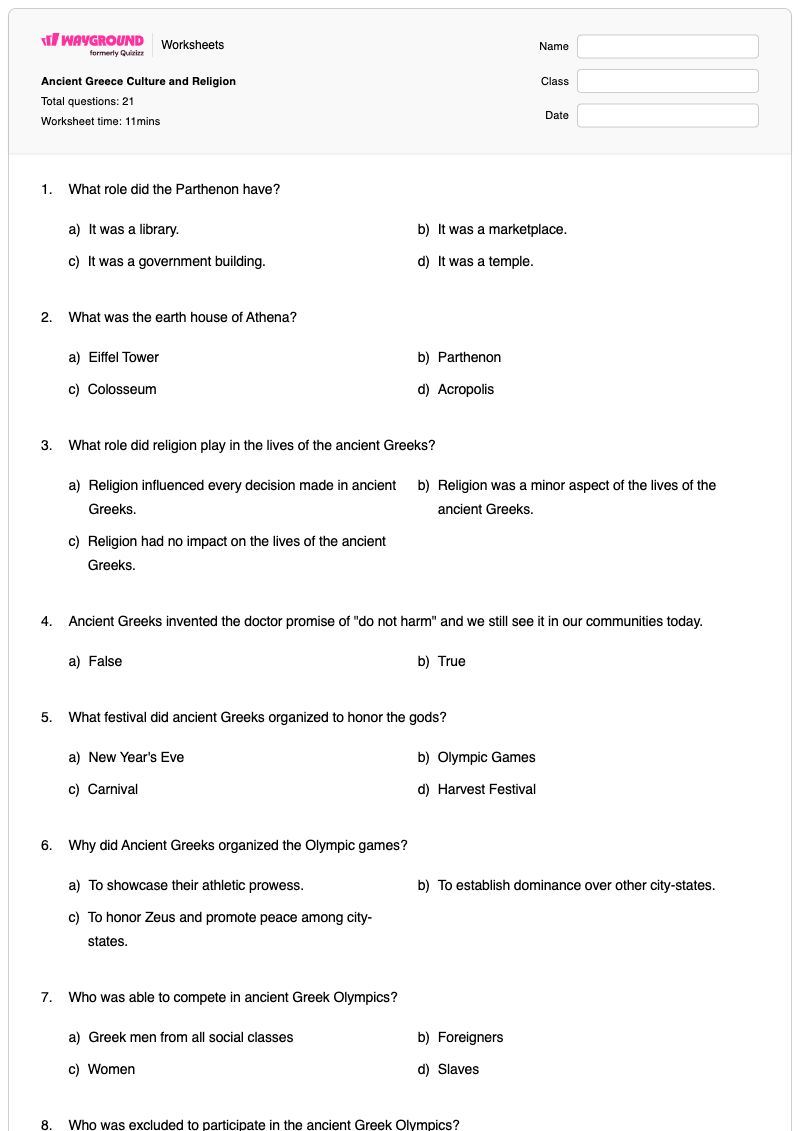
Ancient Greece Culture and Religion

คำถามทั้งหมด: 21

ชื่อ
ระดับ
วันที่
1.

What role did the Parthenon have?

a)
It was a library.
b)
It was a marketplace.
c)
It was a government building.
d)
It was a temple.
2.

What was the earth house of Athena?

a)
Eiffel Tower
b)
Parthenon
c)
Colosseum
d)
Acropolis
3.

What role did religion play in the lives of the ancient Greeks?

a)

Religion influenced every decision made in ancient Greeks.

b)
Religion was a minor aspect of the lives of the ancient Greeks.
c)
Religion had no impact on the lives of the ancient Greeks.
4.

Ancient Greeks invented the doctor promise of "do not harm" and we still see it in our communities today.

a)
False
b)
True
5.

What festival did ancient Greeks organized to honor the gods?

a)
New Year's Eve
b)
Olympic Games
c)
Carnival
d)
Harvest Festival
6.

Why did Ancient Greeks organized the Olympic games?

a)
To showcase their athletic prowess.
b)
To establish dominance over other city-states.
c)
To honor Zeus and promote peace among city-states.
7.

Who was able to compete in ancient Greek Olympics?

a)

Greek men from all social classes

b)
Foreigners
c)
Women
d)
Slaves
8.

Who was excluded to participate in the ancient Greek Olympics?

a)

Women, criminals and enslaved people

b)
Foreigners
c)
Children
9.

Why is important the myth of Helios and Phaethon

a)

It explains the natural event of the sun rising and setting

b)
It teaches the importance of humility and obedience.
c)
It is a love story between Helios and Phaethon.
10.

How did religion influence daily life and culture in ancient Greece?

a)
Religion had no influence on daily life and culture in ancient Greece.
b)
Religion was only practiced by a small group of people in ancient Greece.
c)
Religion played a central role in shaping beliefs, values, rituals, laws, customs, and traditions in ancient Greece.
11.

What physical features surround Greece?

a)

mountains and deserts

b)

seas and islands

c)

deserts and islands

d)

the Great Wall

12.

What natural borders divided ancient Greece civilization creating city-states

a)

religion divided the city-states

b)

language divided

the city-states

c)

physical features divided

the city-states

d)

trading divided the city-states

13.

What was the government in Athens, and why was it important?

a)

Oligarchy, it was run by military leaders in the government.

b)

Democracy, it allowed people to rule the government.

c)

Democracy, it had only one ruler of the government.

14.

Why was Sparta a powerful Greek city-state?

a)

Sparta was powerful because it was run by the people.

b)

Sparta was powerful because it was run by an dictator.

c)

Sparta was powerful because it was governed by military leaders.

15.

What role did temples like the Parthenon have in Ancient Greece?

a)

Temples were used as a way to honor the greek gods.

b)

Temples were used

as a museum for Greek culture.

c)

Temples were used

as a school for greek philosophers.

d)

Temples were used

as a school for greek philosophers.

16.

Why was Sparta a powerful Greek city-state?

a)

Sparta was powerful because it was run by the people.

b)

Sparta was powerful because it was run by an dictator.

c)

Sparta was powerful because it was governed by military leader

17.

How were the city states of Sparta and Athens similar?

a)

both city states focused on the arts

b)

both city states send children to school

c)

both city states treated women unfair

d)

both city states focused on becoming warriors

18.

What did ancient Greeks believe in?

a)

One religion

b)

Many gods and goddesses

c)

One god

d)

Buddhism

19.

What in ancient Greek culture do we see in our communities today?

a)

Common places to shop and workout.

b)

Theaters for entertainment.

c)

Playing sports and games.

d)

All of the above.

20.

How has ancient Greek culture helped our society?

A

B

C

D

a)

creating the doctors oath of "do not harm"

b)

creating a ritual of mummification

c)

creating the idea of happiness

d)

creating the gods

21.

Why did ancient Greeks tell myths about gods and goddesses?

a)

to ask for forgiveness

b)

to make sense of the world around them

c)

to scare away invaders

Waygroundแป้นคำตอบ

Ancient Greece Culture and Religion

คำถามทั้งหมด: 21

1.
d) It was a temple.
2.
b) Parthenon
3.
a)

Religion influenced every decision made in ancient Greeks.

4.
b) True
5.
b) Olympic Games
6.
c) To honor Zeus and promote peace among city-states.
7.
a)

Greek men from all social classes

8.
a)

Women, criminals and enslaved people

9.
a)

It explains the natural event of the sun rising and setting

10.
c) Religion played a central role in shaping beliefs, values, rituals, laws, customs, and traditions in ancient Greece.
11.
b)

seas and islands

12.
c)

physical features divided

the city-states

13.
b)

Democracy, it allowed people to rule the government.

14.
c)

Sparta was powerful because it was governed by military leaders.

15.
a)

Temples were used as a way to honor the greek gods.

16.
c)

Sparta was powerful because it was governed by military leader

17.
c)

both city states treated women unfair

18.
b)

Many gods and goddesses

19.
d)

All of the above.

20.
a)

creating the doctors oath of "do not harm"

21.
b)

to make sense of the world around them

คำถามที่พบบ่อย

แบบฝึกหัดเรื่องวัฒนธรรมและศาสนาของกรีกโบราณครอบคลุมเนื้อหาอะไรบ้าง?

แบบฝึกหัดสำหรับนักเรียนชั้นประถมศึกษาปีที่ 3 นี้ ประกอบด้วยคำถามแบบเลือกตอบ 21 ข้อ เพื่อประเมินความเข้าใจของนักเรียนเกี่ยวกับวิหารกรีก วิหารพาร์เธนอน ความเชื่อทางศาสนา กีฬาโอลิมปิก เทพนิยายกรีก ภูมิศาสตร์ เอเธนส์ และสปาร์ตา นักเรียนจะได้สร้างความรู้ด้านประวัติศาสตร์และวัฒนธรรมโดยเชื่อมโยงศาสนากับชีวิตประจำวัน ลักษณะทางกายภาพกับนครรัฐ และโครงสร้างการปกครองกับวิธีการจัดระเบียบของเอเธนส์และสปาร์ตา

ฉันจะใช้แบบฝึกหัดนี้ในการสอนวัฒนธรรมและศาสนากรีกโบราณได้อย่างไร?

เริ่มแบบฝึกหัดโดยทบทวนเกี่ยวกับวิหารพาร์เธนอน เทพเจ้ากรีก กีฬาโอลิมปิก และลักษณะทางกายภาพของประเทศกรีซ จากนั้นให้นักเรียนใช้คำถามแบบเลือกตอบเพื่ออธิบายว่าศาสนามีอิทธิพลต่อประเพณีอย่างไร และเหตุใดภูเขาและทะเลจึงทำให้เกิดนครรัฐแยกจากกัน ตามด้วยการอภิปรายเปรียบเทียบประชาธิปไตยของเอเธนส์กับความเป็นผู้นำทางทหารของสปาร์ตา

ฉันควรระวังข้อผิดพลาดอะไรบ้างเมื่อนักเรียนทำแบบฝึกหัดเกี่ยวกับกรีกโบราณนี้?

นักเรียนอาจสับสนระหว่างวิหารพาร์เธนอนกับอะโครโพลิส หรือเข้าใจผิดว่ากีฬาโอลิมปิกเป็นการแข่งขันทั่วไป แทนที่จะเป็นงานที่จัดขึ้นเพื่อเป็นเกียรติแก่เทพเจ้าซุสและส่งเสริมสันติภาพ โปรดระวังความสับสนเกี่ยวกับผู้ที่มีสิทธิ์เข้าร่วมการแข่งขันกีฬาโอลิมปิกโบราณ บทบาทของลักษณะทางกายภาพในการแบ่งเขตนครรัฐ และความแตกต่างระหว่างระบอบประชาธิปไตยของเอเธนส์กับระบอบการปกครองโดยผู้นำทางทหารของสปาร์ตา

ฉันจะมอบหมายและให้คะแนนแบบฝึกหัดเกี่ยวกับกรีกโบราณนี้ได้อย่างไร?

คุณสามารถมอบหมายแบบฝึกหัดนี้เป็นไฟล์ PDF ที่พิมพ์ได้ หรือเป็นแบบทดสอบดิจิทัลบน Wayground ก็ได้ และแบบฝึกหัดนี้มีเฉลยคำตอบครบถ้วนสำหรับคำถามแบบเลือกตอบทั้ง 21 ข้อ สำหรับการส่งงานแบบพิมพ์ได้ ให้สแกนงานของนักเรียนด้วยแอป Wayground for Teachers เพื่อช่วยตรวจคำตอบได้อย่างมีประสิทธิภาพ

ฉันจะปรับแบบฝึกหัดเรื่องวัฒนธรรมและศาสนากรีกโบราณนี้ให้เหมาะสมกับนักเรียนของฉันได้อย่างไร?

ใช้การตั้งค่าขั้นสูงของแบบฝึกหัดเพื่อปรับระยะห่างระหว่างตัวอักษรและขนาดตัวอักษร เพื่อให้คำถามแบบเลือกตอบและตัวเลือกคำตอบอ่านง่ายขึ้น นอกจากนี้ คุณยังสามารถเปิดใช้งานแบบอักษรที่เหมาะสำหรับผู้ที่มีภาวะดิสเล็กเซีย หรือแปลแบบฝึกหัดเป็นภาษาอื่นโดยคงเนื้อหาและรูปแบบคำถามเกี่ยวกับกรีกโบราณเอาไว้ได้

ฉันจะหาแบบฝึกหัดแบบนี้เพิ่มเติมได้ที่ไหนบน Wayground?

Wayground นำเสนอชุดแบบฝึกหัดและโจทย์ฝึกหัดฟรีที่ครอบคลุมหลากหลายวิชา พร้อมไฟล์ PDF และเฉลยคำตอบ เพื่อสนับสนุนทักษะและแนวคิดที่สำคัญ ดูแหล่งข้อมูลเพิ่มเติมได้ที่ https://wayground.com/en-us/worksheets