
Wayground
ACADEC ECON Quiz #2 - Printable สังคมศึกษา Worksheets ระดับ 12 - Wayground

ACADEC ECON Quiz #2

Tin Tran

สร้างโดย Tin Tran

20 คำถาม

12th ระดับชั้น

สังคมศึกษา

แบบทดสอบเศรษฐศาสตร์ ACADEC ชุดที่ 2 เป็นแบบฝึกหัดวิชาสังคมศึกษาสำหรับนักเรียนชั้นมัธยมศึกษาปีที่ 6 ที่ทบทวนแนวคิดหลักเกี่ยวกับการตัดสินใจทางเศรษฐศาสตร์ผ่านคำถาม 20 ข้อ: 19 ข้อเป็นแบบเลือกตอบ และ 1 ข้อเป็นแบบเลือกตอบหลายตัวเลือก นักเรียนจะได้เรียนรู้เกี่ยวกับความหมายของความขาดแคลนและต้นทุนค่าเสียโอกาส อธิบายว่าทำไมความขาดแคลนจึงทำให้เกิดความจำเป็นในการแลกเปลี่ยน แยกแยะทรัพยากรธรรมชาติออกจากทุนทางกายภาพ และระบุปัจจัยการผลิต นอกจากนี้ยังได้ประยุกต์ใช้ต้นทุนค่าเสียโอกาสกับการตัดสินใจในการผลิตที่เกี่ยวข้องกับทาโก้ แผนที่ รถบรรทุก และเรือ แบบฝึกหัดนี้ยังพัฒนาการวิเคราะห์เส้นโค้งความเป็นไปได้ในการผลิต (PPC) ต่อไป นักเรียนจะได้เรียนรู้ความหมายของ PPC จำแนกจุดต่างๆ ว่ามีประสิทธิภาพ ไม่มีประสิทธิภาพ หรือเป็นไปไม่ได้ กำหนดต้นทุนค่าเสียโอกาสจากการเปลี่ยนแปลงการผลิต และตระหนักถึงผลกระทบของการเพิ่มขึ้นของแรงงานต่อเส้นโค้ง แบบฝึกหัดที่พิมพ์ได้ฟรีนี้มีเฉลยคำตอบครบถ้วน ทำให้มีประโยชน์สำหรับการทบทวนเศรษฐศาสตร์ การฝึกฝนด้วยตนเอง หรือการเตรียมสอบสำหรับนักเรียนชั้นมัธยมศึกษาปีที่ 6

การตั้งค่าแผ่นงาน

ขนาดตัวอักษร

S
M
L
XL
Waygroundแผ่นงาน

ACADEC ECON Quiz #2

คำถามทั้งหมด: 20

ชื่อ
ระดับ
วันที่
1.
What is scarcity? 
a)
Giving something up to have something else
b)
Extra cost of production
c)
The condition that results form having unlimited wants with limited resources
d)
Rise in general level of prices and workers need more money
2.

What is opportunity cost?

a)

The next best alternative

b)

The best option possible

c)

When something is very good

d)

When someone has no say in a matter

3.

How are scarcity and trade-off related to each other?

a)

Trade-offs create the problem of scarcity

b)

They are not related

c)

Scarcity creates the need for trade-offs

d)

Too many resources creates involves both scarcity and trade-offs

4.
Which of the following is NOT a natural resource?
a)
Oil
b)
Water
c)
Car
d)
Air
5.

Which of the following IS physical capital resource?

a)

Wood

b)

Computer

c)

Labor

d)

Knowledge

6.
My business makes tacos and maps. If I spend all my time making tacos, what is my opportunity cost? 
a)
Tacos
b)
Maps
7.
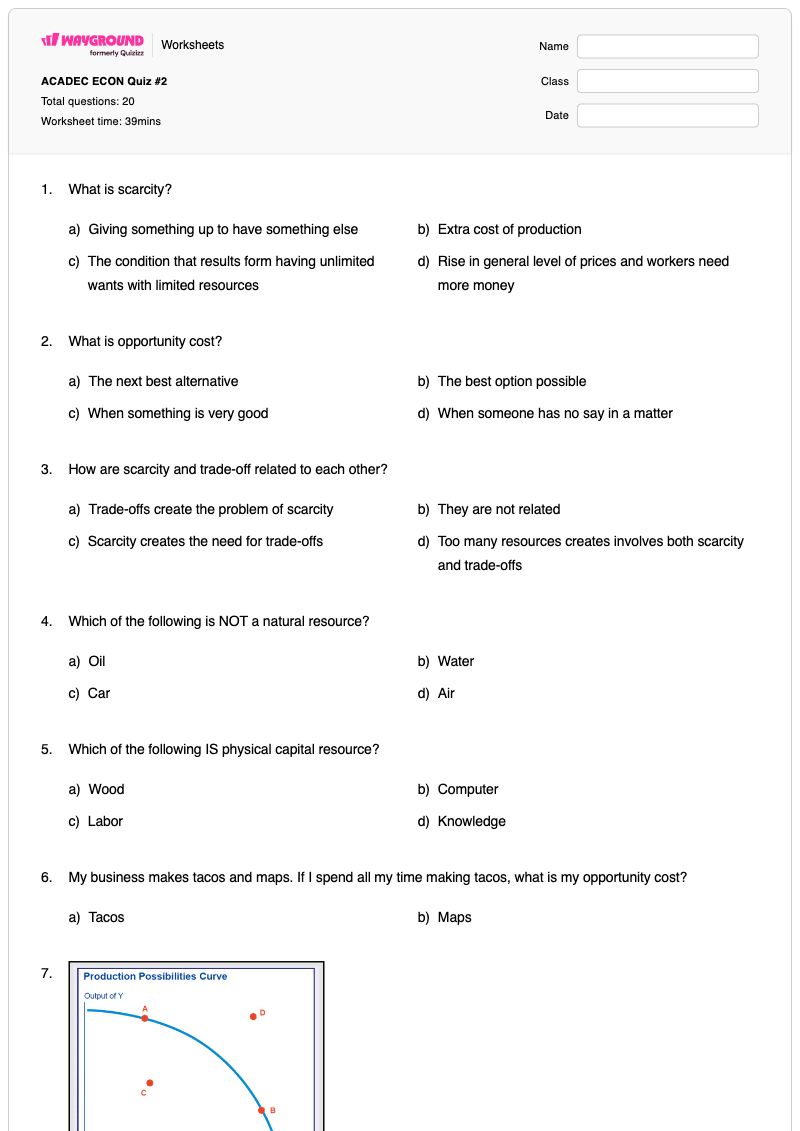
On this PPC, which point is efficient?
On this PPC, which point is efficient? 
a)

A only

b)

C and D

c)

D Only

d)

A and B

8.
On the PPC, which point is inefficient?
a)
A
b)
B
c)
C
d)
D
9.
On the PPC, which point is unattainable?

On the PPC, which point is unattainable?

a)

A

b)

B

c)

C

d)

D

10.
What is the production possibilities curve?
a)
a graph that shows how much an economy can produce between 2 goods
b)
how much money something is
c)
the opportunity one has to give up in order to gain something else
d)
land, labor, capital, entrepreneurs
11.
Land, Labor, Capital, and Entrepreneurship 
a)
Diversification
b)
Deductions
c)
Portfolio
d)
Factors of Production 
12.
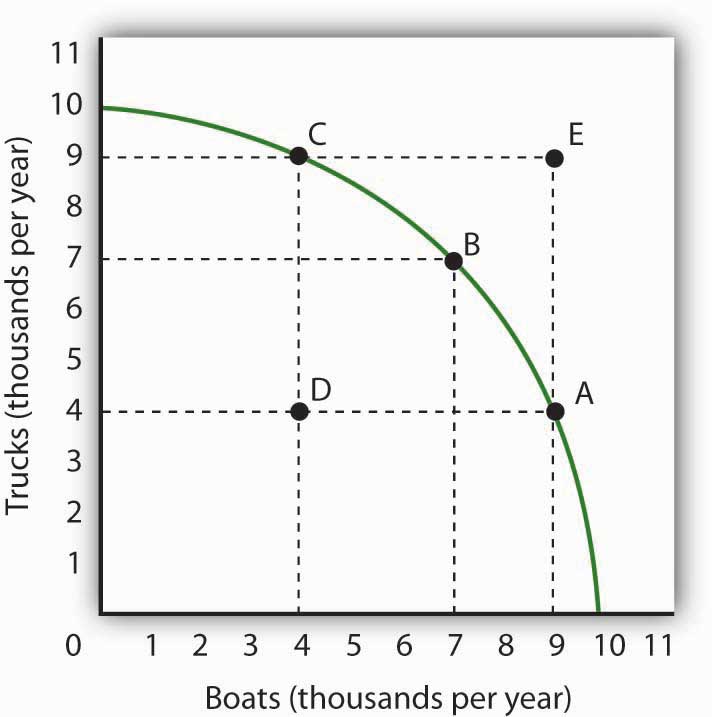
The opportunity cost of increasing production from 7 to 9 trucks is
a)
Scarcity
b)
2 boats
c)
2 trucks
d)
3 boats
13.
The opportunity cost of increasing production from 4 to 7 boats is
a)
1 boat
b)
2 boats
c)
2 trucks
d)
3 trucks
14.

An increase in the labor force would cause the PPC to

a)

Shift inward

b)

Shift outward

c)

Do nothing

d)

Turn into a straight line

15.
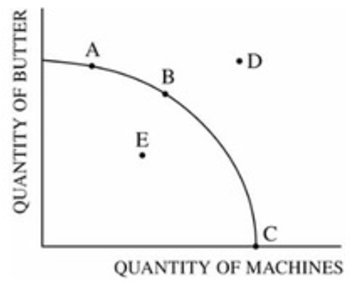
The diagram shows the production possibilities curve for Country Y. Which of the following statements is true?
a)
If Country Y is producing at point C, it is using all its resources efficiently
b)
The opportunity cost of producing more machines is constant
c)
Country Y cannot produce at point E
d)
The most efficient point of production is point D
16.

A college professor is an example of which factors of production? Mark all that apply

a)

Land

b)

Labor

c)

Capital

d)

Entrepreneurship

17.

Points on a production possibility curve are _________________?

a)

Inefficient

b)

unattainable

c)

efficient

d)

trade-offs

18.

An increase in resources will _________________ the economies PPC to the ________________?

a)

shift, left

b)

shift , right

c)

increase, efficiency

d)

decrease, inefficiency

19.

Tools and machinery are which factor of production?

a)

capital

b)

land

c)

labor

d)

entrepreneurship

20.

Monetary value of all final goods, services, and structures produced within a country’s national borders during a one-year period

a)

Capital goods

b)

Productivity

c)

Gross Domestic Product

d)

Specialization

Waygroundแป้นคำตอบ

ACADEC ECON Quiz #2

คำถามทั้งหมด: 20

1.
c) The condition that results form having unlimited wants with limited resources
2.
a)

The next best alternative

3.
c)

Scarcity creates the need for trade-offs

4.
c) Car
5.
b)

Computer

6.
b) Maps
7.
d)

A and B

8.
c) C
9.
d)

D

10.
a) a graph that shows how much an economy can produce between 2 goods
11.
d) Factors of Production 
12.
d) 3 boats
13.
c) 2 trucks
14.
b)

Shift outward

15.
a) If Country Y is producing at point C, it is using all its resources efficiently
16.
c)

Capital

, b)

Labor

17.
c)

efficient

18.
b)

shift , right

19.
a)

capital

20.
c)

Gross Domestic Product

คำถามที่พบบ่อย

แบบทดสอบวิชาเศรษฐศาสตร์ ACADEC ECON Quiz #2 ครอบคลุมเนื้อหาอะไรบ้าง และช่วยให้นักเรียนนำแนวคิดทางเศรษฐศาสตร์ไปประยุกต์ใช้ได้อย่างไร?

แบบฝึกหัดวิชาสังคมศึกษา ชั้นมัธยมศึกษาปีที่ 6 นี้ ประกอบด้วยคำถามแบบเลือกตอบ 19 ข้อ และคำถามแบบเลือกคำตอบ 1 ข้อ เพื่อประเมินเรื่องความขาดแคลน การแลกเปลี่ยน ต้นทุนค่าเสียโอกาส ทรัพยากรธรรมชาติ ทุนทางกายภาพ และปัจจัยการผลิต จากนั้น นักเรียนจะนำแนวคิดเหล่านี้ไปประยุกต์ใช้กับเส้นกราฟความเป็นไปได้ในการผลิต โดยระบุจุดที่มีประสิทธิภาพ จุดที่ไม่มีประสิทธิภาพ และจุดที่ไม่สามารถบรรลุได้ คำนวณต้นทุนค่าเสียโอกาสจากการเปลี่ยนแปลงในการผลิตรถบรรทุกและเรือ และตีความการเปลี่ยนแปลงของเส้นกราฟความเป็นไปได้ในการผลิต

ฉันจะใช้แบบฝึกหัดนี้ในการสอนเรื่องความขาดแคลน ต้นทุนค่าเสียโอกาส และเส้นโค้งความเป็นไปได้ในการผลิตได้อย่างไร?

เริ่มด้วยการแนะนำแนวคิดเรื่องความขาดแคลนและต้นทุนค่าเสียโอกาสก่อน จากนั้นให้นักเรียนอธิบายว่าเหตุใดการเลือกตัวเลือกหนึ่งจึงหมายถึงการละทิ้งตัวเลือกที่ดีที่สุดรองลงมา ใช้สถานการณ์จำลองทาโก้และแผนที่ และคำถามเกี่ยวกับการผลิตรถบรรทุกและเรือ เพื่อจำลองต้นทุนค่าเสียโอกาสก่อนที่นักเรียนจะตีความแผนภาพ PPC และจัดประเภทจุดต่างๆ ขอให้นักเรียนอธิบายเหตุผลว่าทำไมแต่ละจุดจึงมีประสิทธิภาพ ไม่มีประสิทธิภาพ หรือเป็นไปไม่ได้ แทนที่จะเลือกคำตอบโดยไม่Hอธิบายกราฟ

ฉันควรระวังข้อผิดพลาดอะไรบ้างเมื่อนักเรียนทำแบบฝึกหัดเศรษฐศาสตร์นี้?

นักเรียนอาจสับสนระหว่างต้นทุนค่าเสียโอกาสกับทางเลือกที่พวกเขาเลือก เช่น การตั้งชื่อทาโก้แทนแผนที่ ในเมื่อเวลาทั้งหมดหมดไปกับการทำทาโก้ นอกจากนี้ พวกเขายังอาจสับสนระหว่างทรัพยากรธรรมชาติ ทุนทางกายภาพ และแรงงาน หรือเลือกจุดบนเส้นความเป็นไปได้ในการผลิตโดยไม่แยกแยะระหว่างการผลิตที่มีประสิทธิภาพ ไม่มีประสิทธิภาพ และการผลิตที่ไม่สามารถทำได้ ในการคำนวณ ให้ตรวจสอบว่านักเรียนระบุสิ่งที่ต้องเสียไปเมื่อการผลิตเปลี่ยนแปลงไป แทนที่จะเพียงแค่ลบจำนวนสินค้าที่ผลิตได้

ฉันจะมอบหมายและให้คะแนนแบบทดสอบวิชาเศรษฐศาสตร์เชิงวิชาการครั้งที่ 2 ได้อย่างไร?

แบบฝึกหัดนี้มีให้ดาวน์โหลดในรูปแบบ PDF ที่สามารถพิมพ์ได้ และเป็นแบบทดสอบดิจิทัลบน Wayground พร้อมเฉลยคำตอบครบถ้วนสำหรับทั้ง 20 ข้อ คุณสามารถตรวจงานที่ส่งมาในรูปแบบไฟล์พิมพ์ได้โดยการสแกนงานของนักเรียนด้วยแอป Wayground for Teachers รูปแบบไฟล์พิมพ์ยังช่วยให้โรงเรียนสามารถลดเวลาการใช้หน้าจอในขณะที่นักเรียนฝึกฝนการวิเคราะห์ PPC และต้นทุนค่าเสียโอกาสได้อีกด้วย

ฉันจะปรับแบบฝึกหัดนี้ให้เหมาะสมกับนักเรียนของฉันได้อย่างไร?

สำหรับคำถามแบบเลือกตอบและแผนภาพ PPC ในแบบทดสอบ ACADEC ECON Quiz #2 ให้ใช้การตั้งค่าขั้นสูงเพื่อปรับระยะห่างระหว่างตัวอักษรและขนาดตัวอักษรเพื่อให้ง่ายต่อการอ่าน นอกจากนี้ คุณยังสามารถเปิดใช้งานแบบอักษรที่เหมาะสำหรับผู้ที่มีภาวะดิสเล็กเซีย หรือแปลแบบฝึกหัดเป็นภาษาอื่นได้ โดยยังคงโครงสร้างคำถามเกี่ยวกับความขาดแคลน ต้นทุนค่าเสียโอกาส และ PPC ไว้เหมือนเดิม

ฉันจะหาแบบฝึกหัดฟรีแบบนี้เพิ่มเติมได้ที่ไหนบน Wayground?

Wayground นำเสนอชุดแบบฝึกหัดและโจทย์ฝึกหัดฟรีที่ครอบคลุมหลากหลายวิชา พร้อมไฟล์ PDF และเฉลยคำตอบ เพื่อช่วยเสริมสร้างทักษะและความเข้าใจในแนวคิดสำคัญ ดูแหล่งข้อมูลเพิ่มเติมได้ที่ https://wayground.com/en-us/worksheets