

Wayground
Urinary System - Printable ศาสตร์ Worksheets มหาวิทยาลัย - Wayground

Urinary System

Amy Gaines

สร้างโดย Amy Gaines

15 คำถาม

มหาวิทยาลัย

ศาสตร์

อัปเดตแล้ว ก.ค. 2569

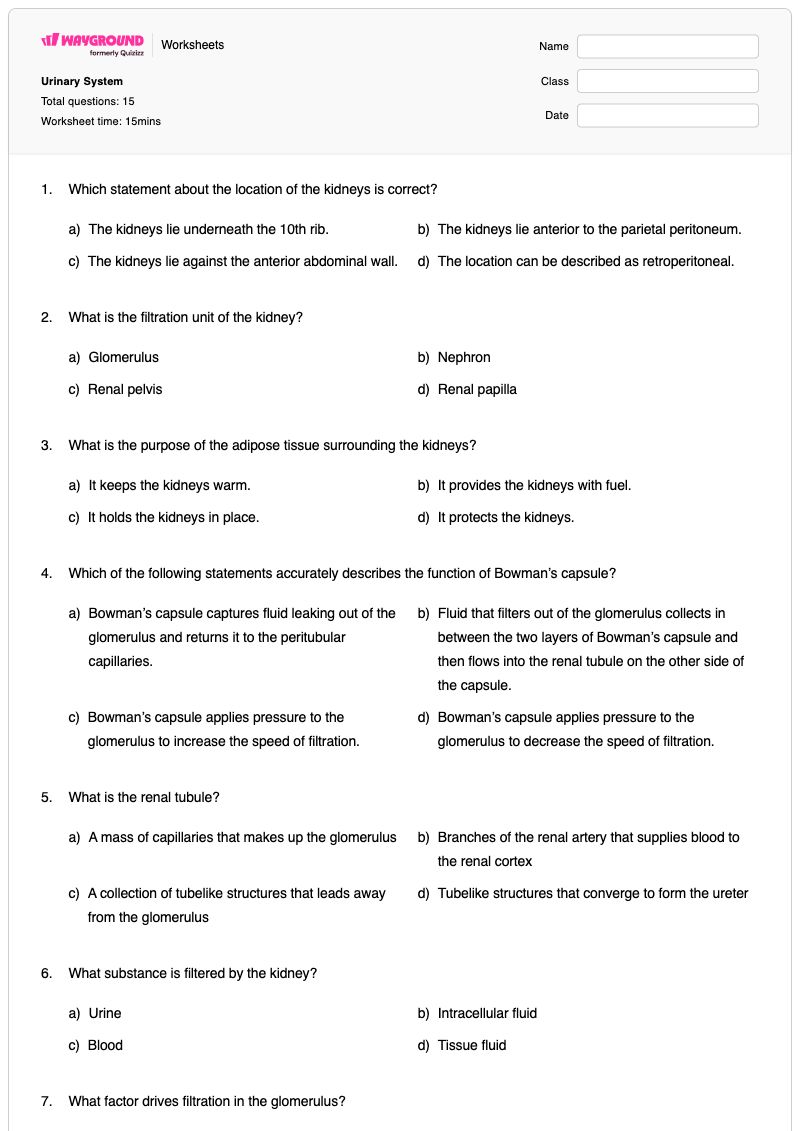
แบบฝึกหัดชีววิทยาสำหรับนักเรียนชั้นมัธยมศึกษาปีที่ 4 (เกรด 13) นี้ ประกอบด้วยคำถามแบบเลือกตอบ 15 ข้อ เพื่อประเมินความรู้พื้นฐานเกี่ยวกับกายวิภาคและสรีรวิทยาของระบบทางเดินปัสสาวะ นักเรียนจะได้ระบุตำแหน่งของไตที่อยู่ด้านหลังเยื่อบุช่องท้อง หน่วยไตและโกลเมอรูลัส บทบาทของเนื้อเยื่อไขมันและแคปซูลโบว์แมน ท่อไต และสารต่างๆ รวมถึงสภาวะความดันที่เกี่ยวข้องกับการกรองของโกลเมอรูลัส นอกจากนี้ คำถามยังเชื่อมโยงโครงสร้างของไตกับหน้าที่และสุขภาพ นักเรียนจะได้ประยุกต์ใช้ความรู้เกี่ยวกับกระบวนการดูดซึมกลับของท่อไต ไมโครวิลลีในท่อขดส่วนต้น โปรตีนในปัสสาวะ ความเสียหายของไตที่เกี่ยวข้องกับความดันโลหิตสูง องค์ประกอบของปัสสาวะปกติ ภาวะปัสสาวะน้อย และบทบาทของระบบเรนิน-แอนジオเทนซิน-อัลโดสเตอโรนในการรักษาระดับความดันโลหิตและการกรองของโกลเมอรูลัส แบบฝึกหัดที่พิมพ์ได้ฟรีนี้มีเฉลยคำตอบครบถ้วนเพื่อการทบทวน การฝึกฝนด้วยตนเอง หรือการประเมินผลอย่างมีประสิทธิภาพ

การตั้งค่าแผ่นงาน

ขนาดตัวอักษร

S
M
L
XL
Waygroundแผ่นงาน

Urinary System

คำถามทั้งหมด: 15

ชื่อ
ระดับ
วันที่
1.
Which statement about the location of the kidneys is correct?
a)
The kidneys lie underneath the 10th rib.
b)
The kidneys lie anterior to the parietal peritoneum.
c)
The kidneys lie against the anterior abdominal wall.
d)

The location can be described as retroperitoneal.

2.
What is the filtration unit of the kidney?
a)
Glomerulus
b)
Nephron
c)
Renal pelvis
d)
Renal papilla
3.
What is the purpose of the adipose tissue surrounding the kidneys?
a)
It keeps the kidneys warm.
b)
It provides the kidneys with fuel.
c)
It holds the kidneys in place.
d)
It protects the kidneys.
4.
Which of the following statements accurately describes the function of Bowman’s capsule?
a)
Bowman’s capsule captures fluid leaking out of the glomerulus and returns it to the peritubular capillaries.
b)
Fluid that filters out of the glomerulus collects in between the two layers of Bowman’s capsule and then flows into the renal tubule on the other side of the capsule.
c)
Bowman’s capsule applies pressure to the glomerulus to increase the speed of filtration.
d)
Bowman’s capsule applies pressure to the glomerulus to decrease the speed of filtration.
5.
What is the renal tubule?
a)
A mass of capillaries that makes up the glomerulus
b)
Branches of the renal artery that supplies blood to the renal cortex
c)
A collection of tubelike structures that leads away from the glomerulus
d)
Tubelike structures that converge to form the ureter
6.
What substance is filtered by the kidney?
a)

Urine

b)

Intracellular fluid

c)

Blood

d)

Tissue fluid

7.
What factor drives filtration in the glomerulus?
a)
Energy from ATP
b)
Energy from glucose
c)
Diffusion
d)
A pressure gradient
8.
What is the most likely cause of protein in urine?
a)
High pressure within the glomerulus
b)
Damaged glomerular capillaries
c)
High-protein diet
d)
Protein is a normal finding in urine
9.
Which structural characteristic of the proximal convoluted tubule enhances its role in tubular reabsorption?
a)
Juxtaglomerular cells
b)
Microvilli
c)
Microscopic pores
d)
Cilia
10.
How much of the fluid filtered by both kidneys is reabsorbed by the body?
a)

5 percent

b)

80 percent

c)

99 percent

d)

30 percent

11.
How does high blood pressure damage kidneys?
a)
High blood pressure drives filtrate formation at an accelerated rate, which wears out the glomerulus.
b)
The kidneys must work against high blood pressures to excrete filtrate, which places a strain on the glomerulus.
c)
High blood pressure damages the endothelium of glomerular capillaries.
d)
High blood pressure increases pressure within the glomerulus, causing glomerular capillaries to burst.
12.
Which of the following is not normally found in urine?
a)
Ammonia
b)
Glucose
c)
Uric acid
d)
Sodium
13.
Each nephron contains a cluster of capillaries called a
a)
Trigone
b)
Glomerulous
c)
Bowman's capsule
d)
Loop of Henle
14.
A urine output of less than 400ml/day is called:
a)
Oliguria
b)
Protienuria
c)
Tachyuria
d)
Bradyuria
15.

The renin-angiotensin-aldosterone system is a key mechanism of what?

a)

Maintaing acid-base balance (pH) in the blood.

b)

Maintaining homeostasis by regulating heart rate in an acceptable range.

c)

Maintaining blood pressure and, therefore, a steady glomerular filtration rate

d)

Maintaing steady rate of peristalsis in the GI tract.

Waygroundแป้นคำตอบ

Urinary System

คำถามทั้งหมด: 15

1.
d)

The location can be described as retroperitoneal.

2.
b) Nephron
3.
d) It protects the kidneys.
4.
b) Fluid that filters out of the glomerulus collects in between the two layers of Bowman’s capsule and then flows into the renal tubule on the other side of the capsule.
5.
c) A collection of tubelike structures that leads away from the glomerulus
6.
c)

Blood

7.
d) A pressure gradient
8.
b) Damaged glomerular capillaries
9.
b) Microvilli
10.
c)

99 percent

11.
d) High blood pressure increases pressure within the glomerulus, causing glomerular capillaries to burst.
12.
b) Glucose
13.
b) Glomerulous
14.
a) Oliguria
15.
c)

Maintaining blood pressure and, therefore, a steady glomerular filtration rate

คำถามที่พบบ่อย

แบบฝึกหัดเกี่ยวกับระบบทางเดินปัสสาวะนี้ครอบคลุมหัวข้ออะไรบ้าง?

แบบฝึกหัดชีววิทยาสำหรับนักเรียนชั้นมัธยมศึกษาปีที่ 4 (เกรด 13) นี้ ครอบคลุมกายวิภาคของระบบทางเดินปัสสาวะและสรีรวิทยาของไต ผ่านคำถามแบบเลือกตอบ 15 ข้อ นักเรียนจะต้องระบุโครงสร้างต่างๆ เช่น หน่วยไต (nephron), โกลเมอรูลัส (glomerulus), แคปซูลโบว์แมน (Bowman’s capsule) และท่อไต (renal tubule) จากนั้นนำแนวคิดเหล่านั้นไปประยุกต์ใช้กับการกรอง การดูดซึมกลับของท่อไต องค์ประกอบของปัสสาวะ ภาวะปัสสาวะน้อย ความเสียหายที่เกี่ยวข้องกับความดันโลหิตสูง และการควบคุมความดันโลหิต

ฉันจะใช้แบบฝึกหัดนี้ในการสอนเรื่องการกรองของไตและการสร้างปัสสาวะได้อย่างไร?

เริ่มแบบฝึกหัดโดยอธิบายการไหลของของเหลวที่กรองจากโกลเมอรูลัสไปยังแคปซูลโบว์แมนและผ่านท่อไต จากนั้นอธิบายว่าแรงดันมีผลต่อการกรองอย่างไร และของเหลวที่กรองแล้วส่วนใหญ่จะถูกดูดซึมกลับอย่างไร ใช้ข้อสอบแบบเลือกตอบเป็นจุดตรวจสอบ โดยขอให้นักเรียนอธิบายว่าทำไมตัวเลือกเช่น ATP การแพร่ หรือปัสสาวะ จึงไม่ใช่คำตอบที่ดีที่สุดสำหรับคำถามเกี่ยวกับการกรอง

ฉันควรระวังข้อผิดพลาดอะไรบ้างเมื่อนักเรียนทำแบบฝึกหัดเกี่ยวกับระบบทางเดินปัสสาวะนี้?

ระวังนักเรียนที่สับสนระหว่างเนฟรอนกับโกลเมอรูลัส แคปซูลโบว์แมนกับท่อไต หรือเลือดกับของเหลวที่ถูกขับออกมาเป็นปัสสาวะ นักเรียนอาจพลาดข้อมูลสำคัญอื่นๆ เช่น ความแตกต่างของความดันเป็นตัวขับเคลื่อนการกรองของโกลเมอรูลัส ไมโครวิลลีช่วยสนับสนุนการดูดซึมกลับของท่อไตส่วนต้น กลูโคสโดยปกติจะไม่พบในปัสสาวะ และปริมาณปัสสาวะที่ต่ำกว่า 400 มิลลิลิตรต่อวันเรียกว่าภาวะปัสสาวะน้อย (oliguria)

ฉันจะมอบหมายและให้คะแนนแบบฝึกหัดเกี่ยวกับระบบทางเดินปัสสาวะนี้ได้อย่างไร?

คุณสามารถใช้แบบฝึกหัดระบบทางเดินปัสสาวะนี้ในรูปแบบไฟล์ PDF ที่พิมพ์ได้ หรือมอบหมายเป็นแบบทดสอบดิจิทัลบน Wayground ก็ได้ แบบฝึกหัดนี้มีเฉลยคำตอบครบถ้วน และสามารถตรวจให้คะแนนงานที่ส่งมาได้โดยการสแกนงานของนักเรียนด้วยแอป Wayground for Teachers รูปแบบที่พิมพ์ได้ยังช่วยให้โรงเรียนมีทางเลือกในการลดเวลาการใช้หน้าจอระหว่างการฝึกฝนวิชาชีววิทยาอีกด้วย

ฉันจะปรับแบบฝึกหัดเกี่ยวกับระบบทางเดินปัสสาวะนี้ให้เหมาะสมกับนักเรียนของฉันได้อย่างไร?

ใช้การตั้งค่าขั้นสูงของแบบฝึกหัดเพื่อปรับระยะห่างระหว่างตัวอักษรและขนาดตัวอักษร เพื่อให้ข้อสอบแบบเลือกตอบ 15 ข้ออ่านง่ายขึ้น นอกจากนี้ คุณยังสามารถเปิดใช้งานแบบอักษรที่เหมาะสำหรับผู้ที่มีภาวะดิสเล็กเซีย หรือแปลแบบฝึกหัดเป็นภาษาอื่น เพื่อช่วยให้นักเรียนเข้าถึงคำถามเกี่ยวกับโครงสร้างต่างๆ เช่น แคปซูลของโบว์แมน โกลเมอรูลัส และท่อไตได้ง่ายขึ้น

ฉันจะหาแบบฝึกหัดแบบนี้เพิ่มเติมได้ที่ไหนบน Wayground?

Wayground นำเสนอชุดแบบฝึกหัดและโจทย์ฝึกหัดฟรีที่ครอบคลุมหลากหลายวิชา พร้อมไฟล์ PDF และเฉลยคำตอบ เพื่อช่วยให้นักเรียนเชี่ยวชาญทักษะและแนวคิดที่สำคัญ ดูแหล่งข้อมูลเพิ่มเติมได้ที่ https://wayground.com/en-us/worksheets