

Wayground
Pro vs Eu vs Viruses - Printable ศาสตร์ Worksheets 9th - 9th ระดับชั้น - Wayground

Pro vs Eu vs Viruses

Laura Ortega

By Laura Ortega

20 คำถาม

9th - 9th ระดับชั้น

ศาสตร์

276 เล่น

อัปเดตแล้ว ก.ย. 2569

แบบฝึกหัดชีววิทยาสำหรับนักเรียนชั้น ม.3 เรื่อง "โปรคาริโอติก ยูคาริโอติก และไวรัส" สามารถพิมพ์ได้ฟรี ช่วยให้นักเรียนแยกแยะความแตกต่างระหว่างเซลล์โปรคาริโอติกและยูคาริโอติกโดยใช้คำถามแบบเลือกตอบ 20 ข้อ นักเรียนจะได้ระบุประเภทของเซลล์จากคำอธิบายและแผนภาพ จำแนกสิ่งมีชีวิต เช่น แบคทีเรียและเห็ด และตระหนักถึงนิวเคลียสว่าเป็นความแตกต่างที่สำคัญระหว่างเซลล์ทั้งสองกลุ่ม คำถามยังทบทวนคุณลักษณะร่วมกันของเซลล์ เช่น ดีเอ็นเอ ไรโบโซม และไซโตพลาซึม รวมถึงออร์แกเนลล์ที่มีเยื่อหุ้ม และโครงสร้างและหน้าที่ที่เลือกไว้ในเซลล์พืชและเซลล์ยูคาริโอติก นักเรียนจะได้นำแนวคิดเหล่านี้ไปใช้กับตัวอย่างที่เกี่ยวข้องกับไซยาโนแบคทีเรีย ยูเกลนา แบคทีเรียบนผิวหนัง ไมโตคอนเดรีย คลอโรพลาสต์ และผนังเซลล์ พร้อมทั้งแก้ไขความเข้าใจผิดทั่วไปเกี่ยวกับดีเอ็นเอของแบคทีเรีย แบบฝึกหัดนี้ออกแบบมาสำหรับการสอนชีววิทยาในชั้น ม.3 การฝึกฝนด้วยตนเอง การทบทวน หรือการประเมินผลระหว่างเรียน และมีเฉลยคำตอบที่สมบูรณ์เพื่อตรวจสอบความเข้าใจของนักเรียน

การตั้งค่าแผ่นงาน

ขนาดตัวอักษร

S
M
L
XL
Waygroundแผ่นงาน

Pro vs Eu vs Viruses

คำถามทั้งหมด: 20

ชื่อ
ระดับ
วันที่
1.
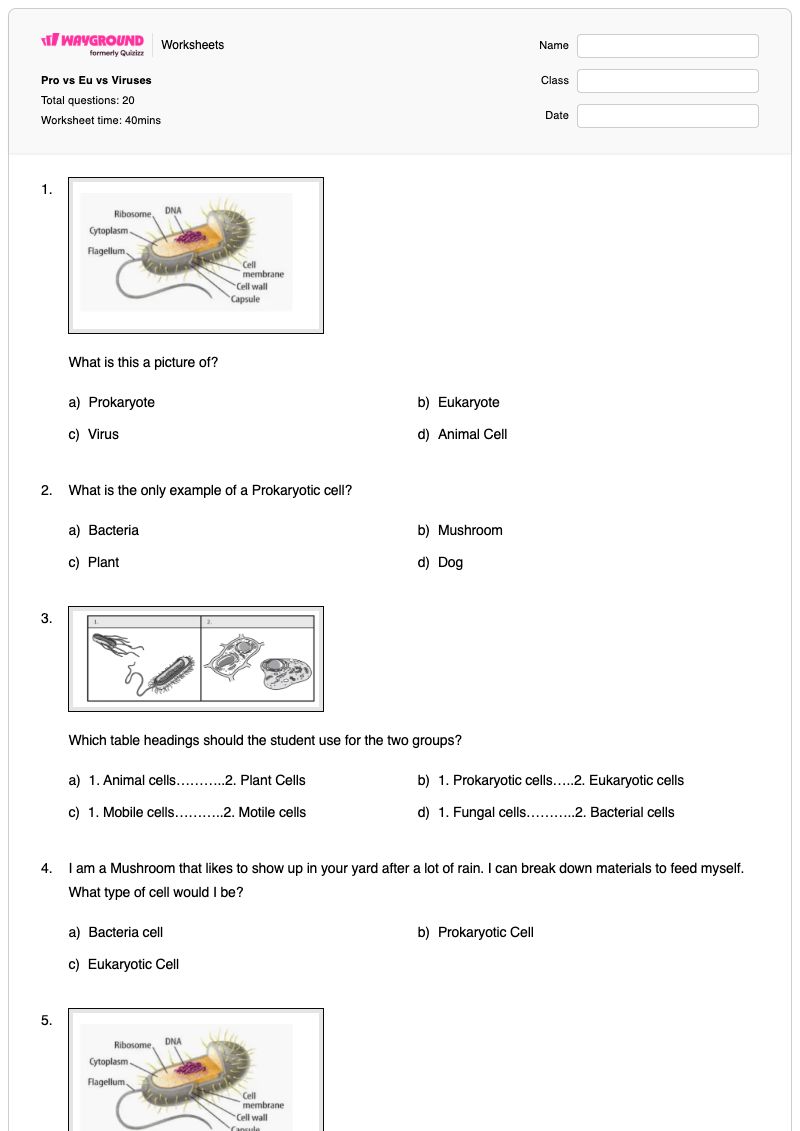
What is this a picture of?

What is this a picture of?

a)

Prokaryote

b)

Eukaryote

c)

Virus

d)

Animal Cell

2.

What is the only example of a Prokaryotic cell?

a)

Bacteria

b)

Mushroom

c)

Plant

d)

Dog

3.
Which table headings should the student use for the two groups?

Which table headings should the student use for the two groups?

a)

1. Animal cells………..2. Plant Cells

b)

1. Prokaryotic cells…..2. Eukaryotic cells

c)

1. Mobile cells………..2. Motile cells

d)

1. Fungal cells………..2. Bacterial cells

4.

I am a Mushroom that likes to show up in your yard after a lot of rain. I can break down materials to feed myself. What type of cell would I be?

a)

Bacteria cell

b)

Prokaryotic Cell

c)

Eukaryotic Cell

5.
A single- celled organism can be classified as a prokaryote based on the absence of…..

A single- celled organism can be classified as a prokaryote based on the absence of…..

a)

a cell membrane.

b)

a nucleus.

c)

cytoplasm.

d)

ribosomes.

6.

What do Eukaryotes and Prokaryotes both share?

a)

Ribosomes

b)

Cytoplasm

c)

DNA

d)

Ribosomes, Cytoplasm and DNA

7.
Some students used information they gathered from lab investigation to prepare a table. They entered the table in their lab…

Some students used information they gathered from lab investigation to prepare a table. They entered the table in their lab notebook.

a)

Cell 1 is eukaryotic, and Cell 2 is Prokaryotic

b)

Cell 1 is prokaryotic, and Cell 2 is Eukaryotic

c)

Both cell 1 and Cell 2 are Eukaryotic

d)

Both Cell 1 and Cell 2 are Prokaryotic

8.

Both euglena and cyanoBACTERIA are photosynthetic unicellular organisms found in pond water. The feature that distinguishes euglena from cyanobacteria is………..

a)

The ability to maintain homeostasis

b)

The presence of ribosomes

c)

The ability to reproduce

d)

The presence of a nucleus

9.

Where are Membrane bound organelles found?

a)

Inside the Eukaryotic cell

b)

Inside our body

c)

Inside the nucleus

d)

Inside the Prokaryotic cell

10.

I am staphylococcus epidermidis and I live on your skin. I am apart of your normal flora in your body, although I am not like your other cells in your body. I am very small and can replicate very quickly. Inside my cell I only have DNA, Ribosomes and Cytoplasm. My DNA is also free floating in my cell and very messy. What type of cell am I?

a)

Skin cell

b)

Eukaryotic cell

c)

Prokaryotic cell

d)

A Virus

11.
Based on the diagram, which organism(s) are eukaryotic and why?

Based on the diagram, which organism(s) are eukaryotic and why?

a)

Organism 2 and 3 only, because both use flagella

b)

Organisms 1, 2, and 3, because they are all single-celled

c)

Organisms 1 and 2 only, because they contain a nucleus

d)

Organisms 1, 2, and 3, because they all have Ribosomes

12.

Which of the following statements is true?

a)

Prokaryotic cells came before Eukaryotic cells

b)

Eukaryotic cells don’t have a nucleus and Prokaryotic cells do

c)

Eukaryotic cells are simple and Prokaryotic cells are complex

d)

Prokaryotic cells are bigger than Eukaryotic cells

13.

Bacteria do not have a nucleus. Since the nucleus contains DNA, it can be concluded that bacteria do not contain DNA.

a)

True, bacteria do not contain DNA.

b)

False, bacteria contain free-floating DNA.

14.

What is the function of mitochondria?

a)

Use chemicals to clean up the cell

b)

Converts sugar into energy for the cell to use

c)

It is the control center of the cell

15.

Unlike animal cells, plant cells have __________ and __________ .

a)

chloroplasts . . . mitochondria.

b)

centrioles . . . cell walls

c)

chloroplasts . . . cell wall

d)

chloroplasts… vacuoles

16.
AIDS is caused by what virus?

AIDS is caused by what virus?

a)

Herpes Simplex Virus Type 1 (HSV Type 1)

b)

Herpes Simplex Virus Type 2 (HSV Type 2)

c)

Human Papilloma Virus (HPV)

d)

Human Immunodeficiency Virus (HIV)

17.

Which of these describes a difference between cells and viruses?

a)

Cells contain protein, and viruses contain only carbohydrates.

b)

Viruses have flagella, and cells have only cilia.

c)

Cells reproduce independently, and viruses require a host to reproduce.

d)

Viruses have membranes made of proteins, and cells have membranes made of nucleic acid.

18.
A photograph of a virus is shown. The projects on the surface of this virus allow the virus to---

A photograph of a virus is shown. The projects on the surface of this virus allow the virus to---

a)

move inside a host cell.

b)

attach to a host cell.

c)

control a host cell's DNA.

d)

signal other viruses to infect a host cell.

19.

Viruses can be transmitted through air, water, food, insect bites, and direct skin contact. Once a virus gains entry to the body, it invades a host cell in order to-

a)

deactivate the host cell's defenses.

b)

synthesize antibodies for defense.

c)

metabolize host proteins and grow.

d)

access cellular processes for replication.

20.

Models of the human immunodeficiency virus (HIV) and an animal cell are shown below. What is the difference in the function of the glycoprotein structures of an HIV vision and the cilia of an animal cell?

a)

The glycoprotein structures are used for ATTACHMENT, and the cilia are used to MOVE fluids surrounding the cell.

b)

The glycoprotein structures are used to obtain NUTRITION, and the cilia are used to secrete proteins.

c)

The glycoproteins structures are used to provide physical SUPPORT for the viral envelope, and the cilia STRENGTHEN the cell membrane.

d)

The glycoprotein structures are used for DEFENSE, and the cilia are used for LOCOMOTION.

Waygroundแป้นคำตอบ

Pro vs Eu vs Viruses

คำถามทั้งหมด: 20

1.
a)

Prokaryote

2.
a)

Bacteria

3.
b)

1. Prokaryotic cells…..2. Eukaryotic cells

4.
c)

Eukaryotic Cell

5.
b)

a nucleus.

6.
d)

Ribosomes, Cytoplasm and DNA

7.
b)

Cell 1 is prokaryotic, and Cell 2 is Eukaryotic

8.
d)

The presence of a nucleus

9.
a)

Inside the Eukaryotic cell

10.
c)

Prokaryotic cell

11.
c)

Organisms 1 and 2 only, because they contain a nucleus

12.
a)

Prokaryotic cells came before Eukaryotic cells

13.
b)

False, bacteria contain free-floating DNA.

14.
b)

Converts sugar into energy for the cell to use

15.
c)

chloroplasts . . . cell wall

16.
d)

Human Immunodeficiency Virus (HIV)

17.
c)

Cells reproduce independently, and viruses require a host to reproduce.

18.
b)

attach to a host cell.

19.
d)

access cellular processes for replication.

20.
a)

The glycoprotein structures are used for ATTACHMENT, and the cilia are used to MOVE fluids surrounding the cell.

คำถามที่พบบ่อย

แบบฝึกหัดเกี่ยวกับเซลล์โปรคาริโอตและยูคาริโอตนี้ครอบคลุมหัวข้ออะไรบ้าง?

แบบฝึกหัดชีววิทยาสำหรับนักเรียนชั้น ม.3 นี้ ประกอบด้วยคำถามแบบเลือกตอบ 20 ข้อ เพื่อช่วยให้นักเรียนจำแนกเซลล์ว่าเป็นเซลล์โปรคาริโอติกหรือยูคาริโอติกจากแผนภาพ คำอธิบายสิ่งมีชีวิต และเบาะแสทางโครงสร้าง นักเรียนจะได้ประยุกต์ใช้บทบาทของนิวเคลียส ออร์แกเนลล์ที่มีเยื่อหุ้ม ดีเอ็นเอ ไรโบโซม และไซโตพลาซึม กับตัวอย่างเช่น แบคทีเรีย เห็ด ยูเกลนา ไซยาโนแบคทีเรีย และเซลล์พืช

ฉันจะใช้แบบฝึกหัดนี้สอนความแตกต่างระหว่างเซลล์โปรคาริโอติกและเซลล์ยูคาริโอติกได้อย่างไร?

เริ่มต้นด้วยการอธิบายความแตกต่างโดยใช้แกนกลางของนิวเคลียสเป็นคุณลักษณะหลัก จากนั้นให้นักเรียนใช้ข้อสอบแบบเลือกตอบเพื่อเปรียบเทียบโครงสร้างของเซลล์และตัวอย่างสิ่งมีชีวิต หยุดพักหลังจากถามคำถามเกี่ยวกับดีเอ็นเอ ไรโบโซม และไซโตพลาซึมที่เหมือนกัน เพื่ออภิปรายว่าเหตุใดคุณลักษณะเหล่านั้นจึงไม่สามารถแยกแยะกลุ่มทั้งสองได้ และใช้กรณีศึกษาของแบคทีเรียและยูเกลนาเป็นตัวอย่างในการเปรียบเทียบที่อิงตามหลักฐาน

ฉันควรระวังข้อผิดพลาดอะไรบ้างเมื่อนักเรียนทำแบบฝึกหัดการจำแนกประเภทเซลล์นี้?

ระวังนักเรียนที่เข้าใจผิดว่าแบคทีเรียไม่มีดีเอ็นเอเพราะไม่มีนิวเคลียส แบบฝึกหัดนี้ทดสอบโดยเฉพาะว่าดีเอ็นเอของแบคทีเรียลอยอยู่ในอากาศ นักเรียนอาจสับสนระหว่างสิ่งมีชีวิตเซลล์เดียวกับโปรคาริโอต มองข้ามนิวเคลียสเมื่อเปรียบเทียบยูเกลนาและไซยาโนแบคทีเรีย หรือเลือกโครงสร้างเช่นไมโทคอนเดรีย คลอโรพลาสต์ หรือผนังเซลล์โดยไม่จับคู่กับชนิดของเซลล์ที่ถูกต้อง

ฉันจะมอบหมายและตรวจให้คะแนนแบบฝึกหัดเรื่องเซลล์โปรคาริโอตและยูคาริโอตนี้ได้อย่างไร?

แบบฝึกหัดนี้มีให้ดาวน์โหลดเป็นไฟล์ PDF สำหรับพิมพ์ และเป็นแบบทดสอบดิจิทัลบน Wayground โดยมีเฉลยคำตอบครบถ้วนสำหรับคำถามแบบเลือกตอบทั้ง 20 ข้อ คุณสามารถตรวจงานที่ส่งมาในรูปแบบไฟล์พิมพ์ได้โดยการสแกนงานของนักเรียนด้วยแอป Wayground for Teachers หรือตรวจสอบคำตอบผ่านแบบทดสอบดิจิทัลก็ได้

ฉันจะอธิบายความแตกต่างระหว่างเซลล์โปรคาริโอติกและเซลล์ยูคาริโอติกในแบบฝึกหัดนี้ให้นักเรียนเข้าใจได้อย่างไร?

ในการตั้งค่าขั้นสูงของแบบฝึกหัด ให้ปรับระยะห่างระหว่างตัวอักษรหรือขนาดตัวอักษรเพื่อให้ข้อสอบแบบเลือกตอบ 20 ข้ออ่านง่ายขึ้น และเปิดใช้งานแบบอักษรที่เป็นมิตรต่อผู้ที่มีภาวะดิสเล็กเซียเมื่อเป็นประโยชน์ นอกจากนี้ คุณยังสามารถแปลคำถามเกี่ยวกับการจำแนกประเภทเซลล์และตัวเลือกคำตอบเป็นภาษาอื่นได้โดยยังคงรักษารูปแบบดั้งเดิมของแบบฝึกหัดไว้

ฉันจะหาแบบฝึกหัดแบบนี้เพิ่มเติมได้ที่ไหนบน Wayground?

Wayground นำเสนอชุดแบบฝึกหัดและโจทย์ฝึกหัดฟรีที่ครอบคลุมทุกวิชา พร้อมไฟล์ PDF และเฉลยคำตอบ เพื่อสนับสนุนทักษะและแนวคิดที่สำคัญ ดูแหล่งข้อมูลเพิ่มเติมได้ที่ https://wayground.com/en-us/worksheets