

Wayground
Momentum: Elastic and Inelastic Collisions - Printable Physics Worksheets - Wayground

Momentum: Elastic and Inelastic Collisions

16 คำถาม

9th - 9th ระดับชั้น

Physics

โมเมนตัม: การชนแบบยืดหยุ่นและไม่ยืดหยุ่น เป็นแบบฝึกหัดฟิสิกส์ระดับชั้น ม.3 ที่สามารถพิมพ์ได้ฟรี ประกอบด้วยคำถามแบบเลือกตอบ 16 ข้อ เกี่ยวกับการอนุรักษ์โมเมนตัมและความแตกต่างระหว่างการชนแบบยืดหยุ่นและไม่ยืดหยุ่น นักเรียนจะได้เรียนรู้สมการโมเมนตัม p = mv² พิจารณาว่าโมเมนตัมและพลังงานจลน์ได้รับการอนุรักษ์หรือไม่ จำแนกประเภทของการชนจากคำอธิบายและตัวอย่างในชีวิตจริง และระบุสิ่งที่เกิดขึ้นในการชนแบบไม่ยืดหยุ่นอย่างสมบูรณ์ แบบฝึกหัดนี้ยังนำแนวคิดเหล่านี้ไปใช้กับสถานการณ์การชนต่างๆ รวมถึงนักว่ายน้ำกระโดดจากแพ และรถยนต์ที่บุบและปล่อยพลังงานความร้อน คำถามเหล่านี้ช่วยให้นักเรียนแยกแยะความแตกต่างระหว่างการอนุรักษ์โมเมนตัมและการอนุรักษ์พลังงานจลน์ และใช้ความสัมพันธ์ของโมเมนตัมอย่างง่ายในการให้เหตุผลเกี่ยวกับการเคลื่อนที่หลังจากแยกจากกัน มีเฉลยคำตอบให้ด้วย ทำให้แบบฝึกหัดนี้มีประโยชน์สำหรับการฝึกฝนแบบมีผู้แนะนำ การทบทวนด้วยตนเอง หรือการตรวจสอบฟิสิกส์ระดับชั้น ม.3 อย่างรวดเร็ว

การตั้งค่าแผ่นงาน

ขนาดตัวอักษร

S
M
L
XL
แผ่นงาน

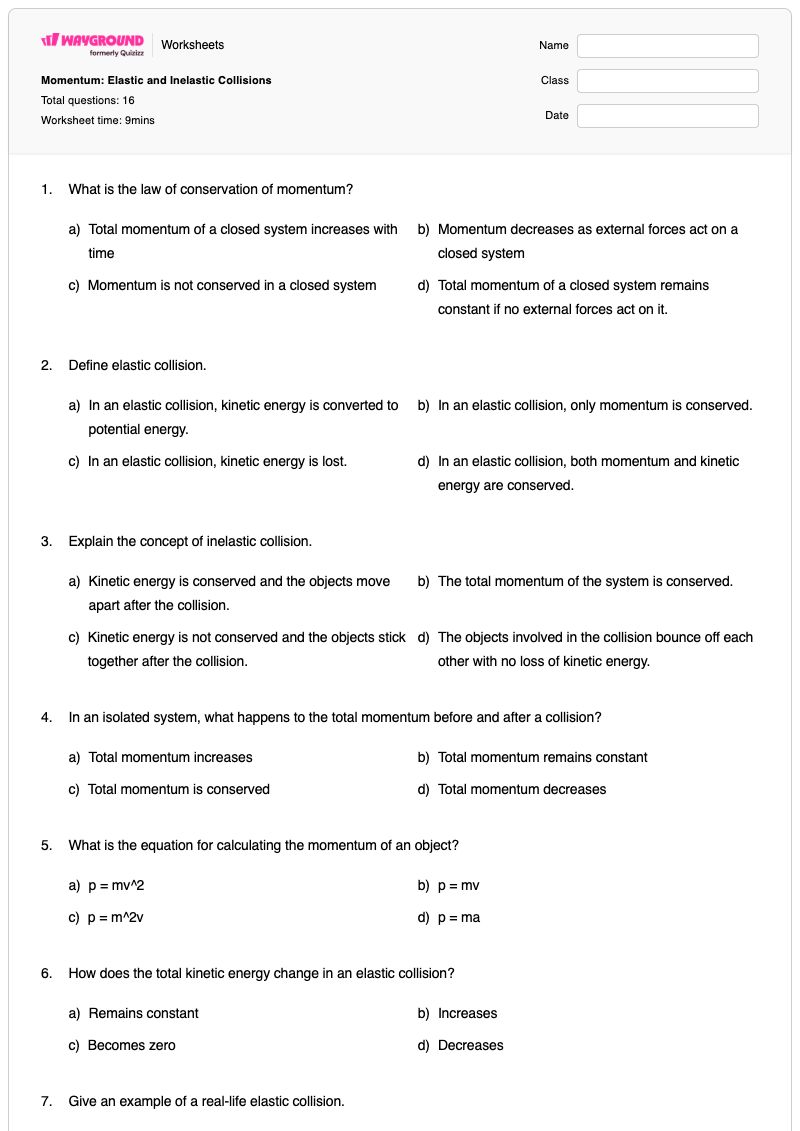
Momentum: Elastic and Inelastic Collisions

คำถามทั้งหมด: 16

ชื่อ
ระดับ
วันที่
1.

What is the law of conservation of momentum?

a)

Total momentum of a closed system increases with time

b)

Momentum decreases as external forces act on a closed system

c)

Momentum is not conserved in a closed system

d)

Total momentum of a closed system remains constant if no external forces act on it.

2.

Define elastic collision.

a)

In an elastic collision, kinetic energy is converted to potential energy.

b)

In an elastic collision, only momentum is conserved.

c)

In an elastic collision, kinetic energy is lost.

d)

In an elastic collision, both momentum and kinetic energy are conserved.

3.

Explain the concept of inelastic collision.

a)

Kinetic energy is conserved and the objects move apart after the collision.

b)

The total momentum of the system is conserved.

c)

Kinetic energy is not conserved and the objects stick together after the collision.

d)

The objects involved in the collision bounce off each other with no loss of kinetic energy.

4.

In an isolated system, what happens to the total momentum before and after a collision?

a)

Total momentum increases

b)

Total momentum remains constant

c)

Total momentum is conserved

d)

Total momentum decreases

5.

What is the equation for calculating the momentum of an object?

a)

p = mv^2

b)

p = mv

c)

p = m^2v

d)

p = ma

6.

How does the total kinetic energy change in an elastic collision?

a)

Remains constant

b)

Increases

c)

Becomes zero

d)

Decreases

7.

Give an example of a real-life elastic collision.

a)

Ping pong

b)

Bowling

c)

Billiards

d)

Soccer

8.

Give an example of a real-life inelastic collision.

a)

Two billiard balls colliding and bouncing off each other

b)

A car crash is an example of a real-life inelastic collision.

c)

A bouncing ball

d)

A rocket launching into space

9.

What are the key differences between elastic and inelastic collisions?

a)

Momentum conservation

b)

Potential energy conservation

c)

Kinetic energy conservation

d)

No difference between the two

10.

A baseball hits a bat and both move in opposite directions after the collision. What type of collision is it?

a)

Elastic

b)

Inelastic

11.

A swimmer with a mass of 75kg dives off a raft with a mass of 500kg. If the swimmer's speed is 4m/s immediately after leaving the raft, what is the speed of the raft? (Hint: The swimmer and the raft are connected ans not moving and then they seperate).

a)

0.06 m/s

b)

6 m/s

c)

0.6m/s

d)

2m/s

12.

How is momentum conserved in a collision?

a)

Momentum is created in a collision

b)

Momentum is lost in a collision

c)

Momentum is only conserved in explosions

d)

Conservation of momentum principle

13.

Two cars collide in a car crash. During the crash the cars bumpers became dented and some thermal energy was given off in the crash. Was momentum conserved in the crash?

a)

No

b)

Yes

14.

Two cars collide in a car crash. During the crash the cars bumpers became dented and some thermal energy was given off in the crash. Was Total Kinetic Energy conserved in the crash?

a)

No

b)

Yes

15.

If there is a perfectly inelastic collision, which of the following must be true?

a)

The total momentum of the system is 0

b)

The total kinetic energy of the system is conserved

c)

The objects stick together after colliding

d)

The total momentum of the system is not conserved

16.

A piece of silly putty is dropped onto a skateboard as it rolls by. The putty sticks to the skateboard and moves the direction the board is moving. What type of collision is this?

a)

Inelastic collision

b)

Elastic Collision

c)

Perfectly Inelastic collision

d)

No collision

แป้นคำตอบ

Momentum: Elastic and Inelastic Collisions

คำถามทั้งหมด: 16

1.
d)

Total momentum of a closed system remains constant if no external forces act on it.

2.
d)

In an elastic collision, both momentum and kinetic energy are conserved.

3.
c)

Kinetic energy is not conserved and the objects stick together after the collision.

4.
c)

Total momentum is conserved

5.
b)

p = mv

6.
a)

Remains constant

7.
c)

Billiards

8.
b)

A car crash is an example of a real-life inelastic collision.

9.
c)

Kinetic energy conservation

10.
a)

Elastic

11.
c)

0.6m/s

12.
d)

Conservation of momentum principle

13.
b)

Yes

14.
a)

No

15.
c)

The objects stick together after colliding

16.
c)

Perfectly Inelastic collision

คำถามที่พบบ่อย

แบบฝึกหัดนี้ครอบคลุมเนื้อหาอะไรบ้างเกี่ยวกับการชนแบบยืดหยุ่นและการชนแบบไม่ยืดหยุ่น?

แบบฝึกหัดฟิสิกส์ระดับชั้น ม.3 นี้ประกอบด้วยคำถามแบบเลือกตอบ 16 ข้อ เพื่อประเมินหลักการอนุรักษ์โมเมนตัม สมการ p = mv และความแตกต่างที่สำคัญระหว่างการชนแบบยืดหยุ่นและการชนแบบไม่ยืดหยุ่น นักเรียนจะต้องจำแนกประเภทของการชน พิจารณาว่าโมเมนตัมหรือพลังงานจลน์ถูกอนุรักษ์ ระบุการชนแบบไม่ยืดหยุ่นอย่างสมบูรณ์ และประยุกต์ใช้เหตุผลเรื่องโมเมนตัมกับสถานการณ์นักว่ายน้ำกับแพ

ฉันจะใช้แบบฝึกหัดนี้สอนเรื่องการชนแบบยืดหยุ่นและแบบไม่ยืดหยุ่นได้อย่างไร?

เริ่มแบบฝึกหัดโดยทบทวนว่าโมเมนตัมรวมยังคงที่ในระบบปิดหรือระบบแยกตัว จากนั้นเปรียบเทียบหลักการนั้นกับพลังงานจลน์ในการชนแบบยืดหยุ่นและไม่ยืดหยุ่น ให้นักเรียนอธิบายว่าเหตุใดการเล่นบิลเลียดและการชนกันของรถยนต์จึงถูกพิจารณาแตกต่างกันในคำถาม และใช้ตัวอย่างนักว่ายน้ำและแพเพื่อจำลองวิธีการแบ่งปันโมเมนตัมเมื่อวัตถุแยกออกจากกัน

ฉันควรระวังข้อผิดพลาดอะไรบ้างในแบบฝึกหัดการชนกันนี้?

นักเรียนอาจเข้าใจผิดว่าพลังงานจลน์จะคงที่เสมอเมื่อโมเมนตัมคงที่ โดยเฉพาะในโจทย์เกี่ยวกับการชนของรถยนต์ที่กันชนบุบและพลังงานความร้อนถูกปล่อยออกมา ระวังความสับสนระหว่างการชนแบบยืดหยุ่นและการชนแบบไม่ยืดหยุ่นอย่างสมบูรณ์ การเลือกสมการโมเมนตัมที่ไม่ถูกต้องแทนที่จะใช้ p = mv และการมองข้ามความสัมพันธ์ของมวลเมื่อคำนวณความเร็วของแพ

ฉันจะมอบหมายและให้คะแนนแบบฝึกหัดเรื่องโมเมนตัมนี้ได้อย่างไร?

แบบฝึกหัดนี้มีให้ดาวน์โหลดในรูปแบบไฟล์ PDF สำหรับพิมพ์ และเป็นแบบทดสอบดิจิทัลบน Wayground โดยมีเฉลยคำตอบครบถ้วนสำหรับคำถามแบบเลือกตอบทั้ง 16 ข้อ การส่งงานแบบพิมพ์สามารถตรวจได้โดยการสแกนงานของนักเรียนด้วยแอป Wayground for Teachers ในขณะที่แบบทดสอบดิจิทัลรองรับการรวบรวมและตรวจงานทางออนไลน์

ฉันจะแยกแยะความแตกต่างระหว่างการชนแบบยืดหยุ่นและการชนแบบไม่ยืดหยุ่นในแบบฝึกหัดนี้ได้อย่างไร?

ในส่วนการตั้งค่าขั้นสูงของแบบฝึกหัด ให้ปรับระยะห่างระหว่างตัวอักษรหรือขนาดตัวอักษรเพื่อให้คำถามแบบเลือกตอบและโจทย์คำนวณอ่านง่ายขึ้น นอกจากนี้ คุณยังสามารถใช้แบบอักษรที่เหมาะสำหรับผู้ที่มีภาวะดิสเล็กเซีย หรือแปลแบบฝึกหัดเมื่อนักเรียนต้องการรูปแบบการอ่านหรือการสนับสนุนด้านภาษาที่แตกต่างกัน

ฉันจะหาแบบฝึกหัดแบบนี้เพิ่มเติมได้ที่ไหนบน Wayground?

Wayground นำเสนอชุดแบบฝึกหัดและโจทย์ฝึกหัดฟรีที่ครอบคลุมทุกวิชา พร้อมไฟล์ PDF และเฉลยคำตอบ เพื่อสนับสนุนทักษะและแนวคิดที่สำคัญ ดูแหล่งข้อมูลเพิ่มเติมได้ที่ https://wayground.com/en-us/worksheets