

Wayground
Quiz Polarity and IMF - Printable ศาสตร์ Worksheets KG - อนุบาล - Wayground

Quiz Polarity and IMF

Orlando Vega

By Orlando Vega

14 คำถาม

KG - อนุบาล

ศาสตร์

19 เล่น

อัปเดตแล้ว ต.ค. 2569

แบบฝึกหัดวิทยาศาสตร์แบบพิมพ์ได้ฟรีนี้ เรื่อง "แบบทดสอบขั้วและแรงระหว่างโมเลกุล" ช่วยให้นักเรียนได้ฝึกฝนการเชื่อมโยงค่าอิเล็กโทรเนกาติวิตีกับขั้วของพันธะและแรงระหว่างโมเลกุล แบบฝึกหัดประกอบด้วย 14 ข้อ ได้แก่ คำถามแบบเลือกตอบ 11 ข้อ กิจกรรมจัดกลุ่ม 2 กิจกรรม และคำถามสำคัญ 1 ข้อ ครอบคลุมหัวข้อต่างๆ เช่น พันธะโคเวเลนต์แบบมีขั้วและไม่มีขั้ว พันธะไอออนิก ไดโพล สัญลักษณ์ประจุในโครงสร้างลูอิส และวิธีการเกิดพันธะโคเวเลนต์ นักเรียนใช้แผนภูมิค่าอิเล็กโทรเนกาติวิตีเพื่อระบุอะตอมที่มีค่าอิเล็กโทรเนกาติวิตีสูงกว่า และคำนวณความแตกต่างระหว่างไฮโดรเจนและฟลูออรีน เรียงลำดับพันธะตามประจุของโมเลกุล และจัดประเภทคำอธิบายของพันธะประเภทต่างๆ นอกจากนี้ พวกเขายังระบุแรงระหว่างโมเลกุล รู้จักพันธะไฮโดรเจนในน้ำ และตีความแบบจำลองภาพของแรงระหว่างโมเลกุลของน้ำและโมเลกุลอื่นๆ แบบฝึกหัดนี้เหมาะสำหรับวิทยาศาสตร์ระดับอนุบาล และมีเฉลยคำตอบครบถ้วนสำหรับการตรวจสอบความเข้าใจหรือทบทวนความเข้าใจผิด

การตั้งค่าแผ่นงาน

ขนาดตัวอักษร

S
M
L
XL
Waygroundแผ่นงาน

Quiz Polarity and IMF

คำถามทั้งหมด: 14

ชื่อ
ระดับ
วันที่
1.
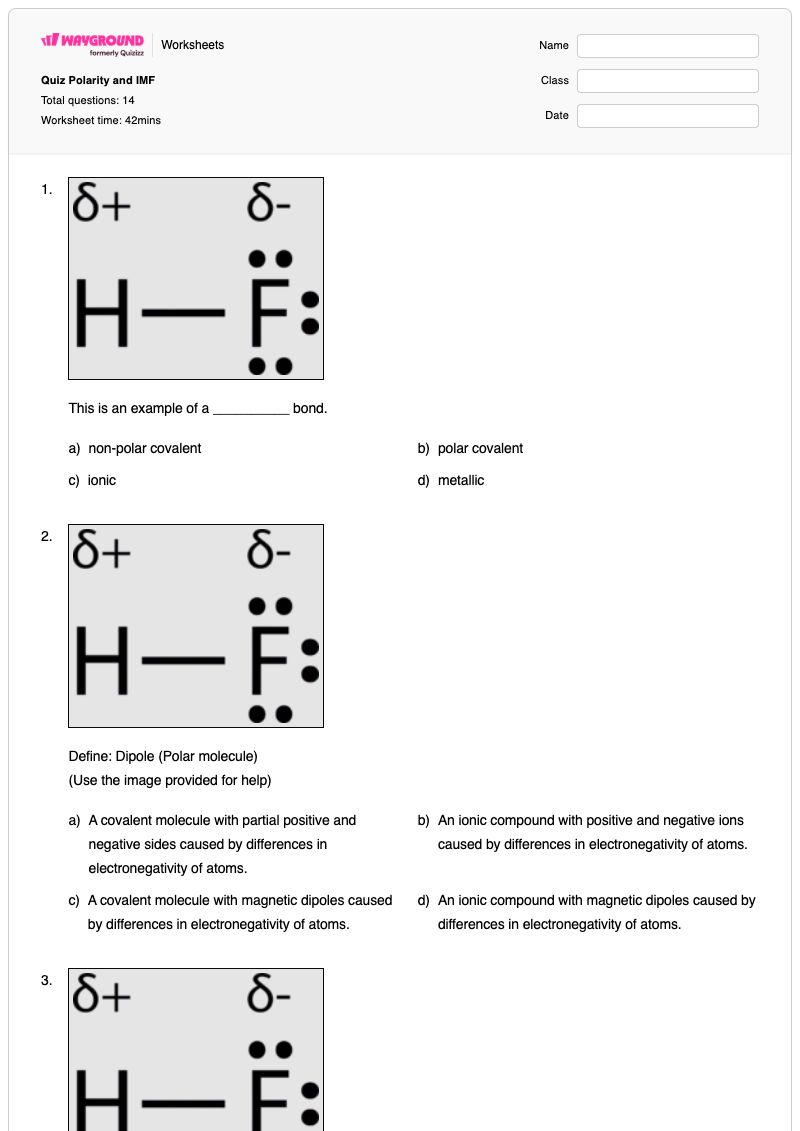
This is an example of a __________ bond.
a)
non-polar covalent
b)
polar covalent
c)
ionic
d)
metallic
2.
Define: Dipole (Polar molecule) (Use the image provided for help)

Define: Dipole (Polar molecule)

(Use the image provided for help)

a)

A covalent molecule with partial positive and negative sides caused by differences in electronegativity of atoms.

b)

An ionic compound with positive and negative ions caused by differences in electronegativity of atoms.

c)

A covalent molecule with magnetic dipoles caused by differences in electronegativity of atoms.

d)

An ionic compound with magnetic dipoles caused by differences in electronegativity of atoms.

3.
Identify the more electronegative atom using the image provided.

Identify the more electronegative atom using the image provided.

a)

Hydrogen (H)

b)

Fluorine (F)

c)

Both have the same electronegativity

4.
Using your electronegativity chart, calculate the difference in electronegativity between the hydrogen and fluorine bond.

Using your electronegativity chart, calculate the difference in electronegativity between the hydrogen and fluorine bond.

a)

1.9

b)

4.0

c)

-1.9

d)

2.1

5.

Order the types of bonds based on the charge of their molecules. (lowest amount of charge to greatest)

a)

Polar Covalent --> Ionic --> Nonpolar Covalent

b)

Ionic --> Nonpolar Covalent --> Polar Covalent

c)

Ionic --> Polar Covalent --> Nonpolar Covalent

d)

Nonpolar Covalent --> Polar Covalent --> Ionic

6.
In this Lewis structure, the symbol (δ-) above Fluorine means...

In this Lewis structure, the symbol (δ-) above Fluorine means...

a)

Fluorine has formed an anion

b)
electrons are less attracted to F than H
c)
electrons are more attracted to F than H
d)
Fluorine has formed a cation
7.

Explain how covalent bonds form.

a)

Complete transfer of valence electrons between atoms to form ions.

b)
Opposite slight charges attract each other between compounds.
c)
Scientists are still not sure how they form.
d)

Sharing of valence electrons between nonmetal atoms.

8.

Organize these options into the right categories

จัดหมวดหมู่ดังต่อไปนี้
Organize these options into the right categories
Polar Molecule
Nonpolar Molecule
9.

Organize these options into the correct categories

จัดหมวดหมู่ดังต่อไปนี้

When electrons are shared unevenly

When one atom takes or gives electrons to another atom

When electrons are shared evenly

Bond formed between a metal and nonmetal atom

Bond between diatomic elements (Br2, Cl2, N2, O2 )

Bond formed between two DIFFERENT nonmetals

Formed by ions held together by electrostatic attraction

Ionic Bond
Polar Covalent Bond
Non-polar Covalent Bond
10.

Click on the more electronegative atom on this water molecule.

11.

Intermolecular forces are the forces...

a)

within molecules that bond atoms together.

b)

between molecules causing them to attract.

12.

Which best explains the very high melting and boiling point of water?

a)

Strong dipole-dipole force between water molecules.

b)

Strong hydrogen bonding force between water molecules.

c)

Weak electron dispersion forces which present in water molecules.

d)

Asymmetrical shape of the polar bonds in water molecules.

13.

Identify the image that correctly show intermolecular forces within ICE (water) molecules.

a)
Identify the image that correctly show intermolecular forces within ICE (water) molecules.

b)
Identify the image that correctly show intermolecular forces within ICE (water) molecules.

c)
Identify the image that correctly show intermolecular forces within ICE (water) molecules.

d)
Identify the image that correctly show intermolecular forces within ICE (water) molecules.

14.

Identify the image showing the strongest intermolecular forces between molecules.

Each circle represents a molecule.

a)
Identify the image showing the strongest intermolecular forces between molecules. Each circle represents a molecule.

b)
Identify the image showing the strongest intermolecular forces between molecules. Each circle represents a molecule.

c)
Identify the image showing the strongest intermolecular forces between molecules. Each circle represents a molecule.

Waygroundแป้นคำตอบ

Quiz Polarity and IMF

คำถามทั้งหมด: 14

1.
b) polar covalent
2.
a)

A covalent molecule with partial positive and negative sides caused by differences in electronegativity of atoms.

3.
b)

Fluorine (F)

4.
a)

1.9

5.
d)

Nonpolar Covalent --> Polar Covalent --> Ionic

6.
c) electrons are more attracted to F than H
7.
d)

Sharing of valence electrons between nonmetal atoms.

8.
Polar Molecule
Organize these options into the right categories
Nonpolar Molecule
Organize these options into the right categories
9.
Ionic Bond

When one atom takes or gives electrons to another atom

Bond formed between a metal and nonmetal atom

Formed by ions held together by electrostatic attraction

Polar Covalent Bond

When electrons are shared unevenly

Bond formed between two DIFFERENT nonmetals

Non-polar Covalent Bond

When electrons are shared evenly

Bond between diatomic elements (Br2, Cl2, N2, O2 )

10.
11.
b)

between molecules causing them to attract.

12.
b)

Strong hydrogen bonding force between water molecules.

13.
b)

14.
a)

คำถามที่พบบ่อย

แบบฝึกหัดเรื่องขั้วแม่เหล็กและแรงระหว่างโมเลกุล (IMF) ครอบคลุมเนื้อหาอะไรบ้าง?

แบบฝึกหัดนี้ใช้คำถามแบบเลือกตอบ การจำแนกประเภท และคำถามแบบระบุจุดสำคัญ เพื่อช่วยให้นักเรียนเชื่อมโยงค่าอิเล็กโทรเนกาติวิตีกับพันธะโคเวเลนต์แบบมีขั้ว พันธะโคเวเลนต์แบบไม่มีขั้ว และพันธะไอออนิก นักเรียนจะได้ระบุอะตอมที่มีค่าอิเล็กโทรเนกาติวิตีสูงกว่า คำนวณความแตกต่างของค่าอิเล็กโทรเนกาติวิตีระหว่างไฮโดรเจนและฟลูออรีน ตีความสัญลักษณ์ δ− ในโครงสร้างลูอิส และจำแนกประเภทของพันธะ คำถามสุดท้ายจะเปลี่ยนไปเน้นที่แรงระหว่างโมเลกุล รวมถึงพันธะไฮโดรเจน และการเปรียบเทียบแรงในน้ำและระหว่างโมเลกุลด้วยภาพ

ฉันจะใช้แบบฝึกหัดนี้ในการสอนเรื่องขั้วของพันธะและแรงระหว่างโมเลกุลได้อย่างไร?

เริ่มแบบฝึกหัดโดยสาธิตวิธีการอ่านแผนภูมิค่าอิเล็กโทรเนกาติวิตีและลบค่าของไฮโดรเจนและฟลูออรีนเพื่อหาผลต่าง 1.9 จากนั้นให้นักเรียนอธิบายว่าเหตุใดการแบ่งปันอิเล็กตรอนที่ไม่เท่ากันจึงสร้างพันธะขั้ว และใช้รายการจำแนกประเภทเพื่อเปรียบเทียบพันธะโคเวเลนต์แบบไม่มีขั้ว พันธะโคเวเลนต์แบบมีขั้ว และพันธะไอออนิก ปิดท้ายด้วยการเปรียบเทียบแรงภายในโมเลกุลกับแรงระหว่างโมเลกุล โดยใช้แผนภาพน้ำและน้ำแข็งเป็นจุดเริ่มต้นในการอภิปราย

ฉันควรระวังข้อผิดพลาดอะไรบ้างเมื่อนักเรียนทำแบบฝึกหัดเรื่องขั้วและ IMF นี้?

นักเรียนอาจสับสนระหว่างพันธะโคเวเลนต์แบบมีขั้วกับพันธะไอออนิก ใช้ δ− เป็นหลักฐานว่าฟลูออรีนกลายเป็นแอนไอออน หรือสลับอะตอมที่ดึงดูดอิเล็กตรอนได้แรงกว่ากัน ในการคำนวณค่าอิเล็กโทรเนกาติวิตี ให้ตรวจสอบว่านักเรียนใช้ค่าผลต่างที่เป็นบวกแทนที่จะเป็นค่าลบ สำหรับการจัดประเภทและภาพประกอบ ให้ระวังนักเรียนที่สับสนระหว่างแรงภายในโมเลกุลกับแรงระหว่างโมเลกุล หรือเลือกใช้แรงไดโพลธรรมดาแทนที่จะใช้พันธะไฮโดรเจนเพื่ออธิบายจุดหลอมเหลวและจุดเดือดสูงของน้ำ

ฉันจะมอบหมายและตรวจให้คะแนนแบบฝึกหัดเรื่องขั้วและ IMF ได้อย่างไร?

Wayground จัดทำแบบฝึกหัดนี้ในรูปแบบไฟล์ PDF ที่สามารถพิมพ์ได้ และในรูปแบบแบบทดสอบดิจิทัล พร้อมเฉลยคำตอบครบถ้วนสำหรับคำถามแบบเลือกตอบ การจำแนกประเภท และคำถามแบบระบุจุดสำคัญ คุณสามารถตรวจสอบคำตอบเกี่ยวกับค่าอิเล็กโทรเนกาติวิตี ประเภทพันธะ และแรงระหว่างโมเลกุลได้โดยตรงในเวอร์ชันดิจิทัล หรือตรวจงานของนักเรียนที่ส่งมาในรูปแบบไฟล์พิมพ์ได้โดยการสแกนงานของนักเรียนด้วยแอป Wayground for Teachers รูปแบบไฟล์พิมพ์ยังช่วยสนับสนุนโรงเรียนที่ต้องการลดเวลาการใช้หน้าจอได้อีกด้วย

ฉันจะปรับแบบฝึกหัดนี้ให้เหมาะสมกับนักเรียนของฉันได้อย่างไร?

ใช้การตั้งค่าขั้นสูงของแบบฝึกหัดเพื่อปรับระยะห่างระหว่างตัวอักษรและขนาดตัวอักษร เพื่อให้การจำแนกประเภทพันธะ ตัวเลือกค่าอิเล็กโทรเนกาติวิตี และแผนภาพโมเลกุลอ่านง่ายขึ้น นอกจากนี้ คุณยังสามารถใช้แบบอักษรที่เหมาะสำหรับผู้ที่มีภาวะดิสเล็กเซีย หรือแปลแบบฝึกหัดเป็นภาษาอื่นได้ผ่านการตั้งค่าเดียวกันนี้ ตัวเลือกเหล่านี้จะช่วยให้คำศัพท์ทางวิทยาศาสตร์ สัญลักษณ์ และแบบฝึกหัดที่ต้องใช้การตอบสนองทางภาพ เข้าถึงได้ง่ายขึ้นโดยไม่ต้องเปลี่ยนแปลงคำถาม

ฉันจะหาแบบฝึกหัดแบบนี้เพิ่มเติมได้ที่ไหนบน Wayground?

Wayground มีแบบฝึกหัดและโจทย์ฝึกหัดมากมายให้ดาวน์โหลดฟรีในหลากหลายวิชา พร้อมไฟล์ PDF และเฉลยคำตอบ เพื่อช่วยเสริมสร้างทักษะและความเข้าใจในเนื้อหาสำคัญ ดูแหล่งข้อมูลเพิ่มเติมได้ที่ https://wayground.com/en-us/worksheets