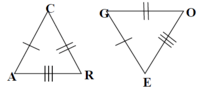
Triangle Congruency

Flashcard
•
Mathematics
•
9th - 12th Grade
•
Practice Problem
•
Hard
+1
Standards-aligned

Wayground Content
FREE Resource
Student preview

15 questions
Show all answers
1.
FLASHCARD QUESTION
Front
What does SSA stand for in triangle congruency, and why is it not a valid shortcut?
Back
SSA stands for Side-Side-Angle. It is not a valid shortcut for proving triangle congruency because it can lead to ambiguous cases where two different triangles can be formed.
Tags
CCSS.HSG.SRT.B.5
2.
FLASHCARD QUESTION
Front
What does SAS stand for in triangle congruency?
Back
SAS stands for Side-Angle-Side, which is a valid postulate for proving that two triangles are congruent if two sides and the included angle of one triangle are equal to the corresponding parts of another triangle.
Tags
CCSS.HSG.SRT.B.5
3.
FLASHCARD QUESTION
Front
What does SSS stand for in triangle congruency?
Back
SSS stands for Side-Side-Side, which is a valid postulate for proving that two triangles are congruent if all three sides of one triangle are equal to the corresponding sides of another triangle.
Tags
CCSS.HSG.SRT.B.5
4.
FLASHCARD QUESTION
Front
What is the Angle-Angle-Side (AAS) theorem in triangle congruency?
Back
The AAS theorem states that if two angles and a non-included side of one triangle are equal to the corresponding parts of another triangle, then the two triangles are congruent.
Tags
CCSS.HSG.SRT.B.5
5.
FLASHCARD QUESTION
Front
What is the Hypotenuse-Leg (HL) theorem in triangle congruency?
Back
The HL theorem states that if the hypotenuse and one leg of a right triangle are equal to the hypotenuse and one leg of another right triangle, then the two triangles are congruent.
Tags
CCSS.HSG.SRT.B.5
6.
FLASHCARD QUESTION
Front
What is the purpose of triangle congruency postulates?
Back
Triangle congruency postulates are used to determine whether two triangles are congruent, meaning they have the same size and shape, which is essential in solving geometric problems.
Tags
CCSS.HSG.SRT.B.5
7.
FLASHCARD QUESTION
Front
What is the difference between congruent triangles and similar triangles?
Back
Congruent triangles have the same size and shape, while similar triangles have the same shape but may differ in size.
Tags
CCSS.8.G.A.2
Access all questions and much more by creating a free account
Create resources
Host any resource
Get auto-graded reports

Continue with Google

Continue with Email

Continue with Classlink

Continue with Clever
or continue with

Microsoft
%20(1).png)
Apple

Others
Already have an account?
Similar Resources on Wayground

10 questions
Secondary storage
Flashcard
•
9th - 11th Grade
8 questions
CHILDREN 2 (1ST CLASS)
Flashcard
•
KG
11 questions
7517 05 Structured Programming
Flashcard
•
10th Grade - University
12 questions
Descriptive adjectives for Home and Furniture
Flashcard
•
10th Grade - University
15 questions
7517 01 Programming Basics
Flashcard
•
10th Grade - University
11 questions
3D Design Vocabulary Flashcard
Flashcard
•
10th Grade
12 questions
WORD FORMATION - NOUN/VERB/ADJECTIVE
Flashcard
•
10th Grade
12 questions
Organic 2 Exam 4 Review
Flashcard
•
KG
Popular Resources on Wayground
15 questions
Fractions on a Number Line

Quiz
•
3rd Grade
20 questions
Equivalent Fractions
Quiz
•
3rd Grade
25 questions
Multiplication Facts
Quiz
•
5th Grade
22 questions
fractions
Quiz
•
3rd Grade
20 questions
Main Idea and Details
Quiz
•
5th Grade
20 questions
Context Clues
Quiz
•
6th Grade
15 questions
Equivalent Fractions
Quiz
•
4th Grade
20 questions
Figurative Language Review
Quiz
•
6th Grade
Discover more resources for Mathematics
20 questions
Graphing Inequalities on a Number Line
Quiz
•
6th - 9th Grade
12 questions
Exponential Growth and Decay
Quiz
•
9th Grade
20 questions
Exponent Rules Review
Quiz
•
8th - 9th Grade
25 questions
Complementary and Supplementary Angles
Quiz
•
7th - 10th Grade
12 questions
Add and Subtract Polynomials
Quiz
•
9th - 12th Grade
13 questions
Model Exponential Growth and Decay Scenarios
Quiz
•
9th - 12th Grade
15 questions
Combine Like Terms and Distributive Property
Quiz
•
8th - 9th Grade
27 questions
7.2.3 Quadrilateral Properties
Quiz
•
9th - 12th Grade